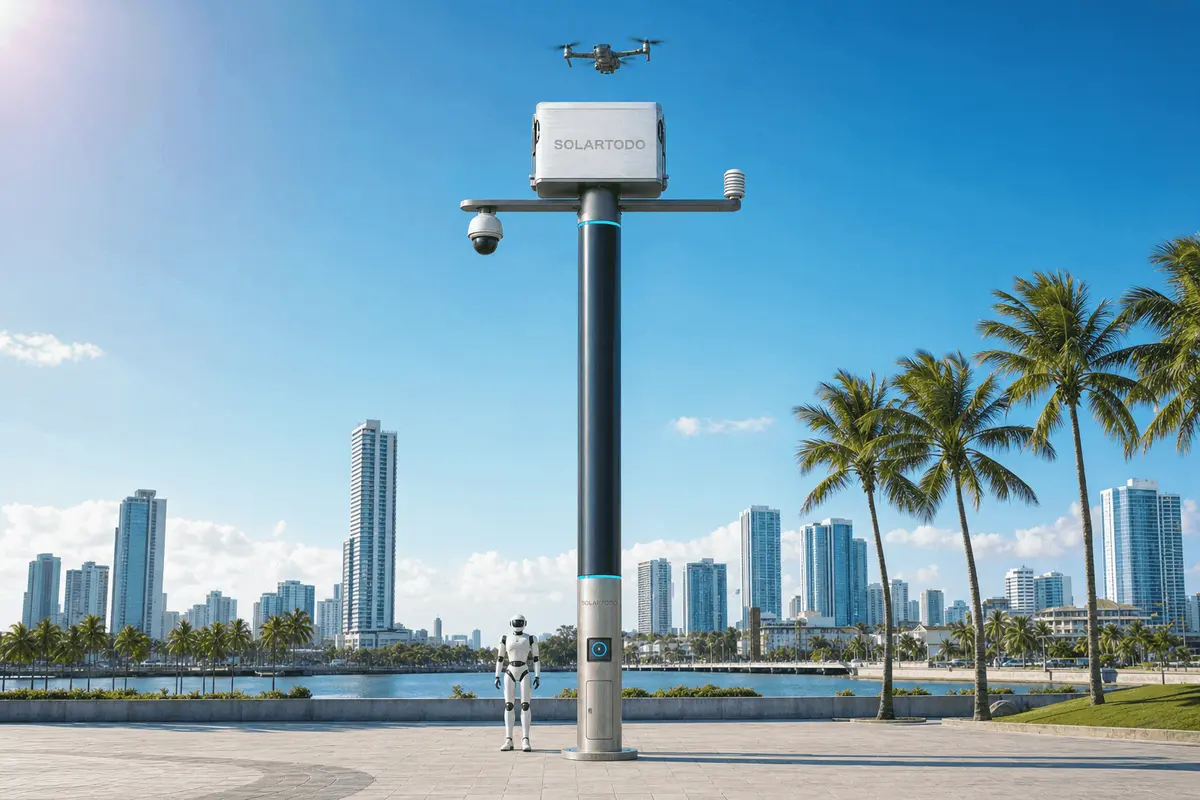
Recife SOLARTODO Sentinel City AI Pole Market Analysis: 108-Node Off-Grid Edge Configuration Guide
Summary
Recife's 1.49 million residents, 218.8 km2 area and 2050 climate plan support about 108 SOLARTODO Sentinel City AI Poles at 40 m spacing. It prioritizes local analytics and off-grid storage for transit and port-adjacent corridors.
Key Takeaways
A 108-node Recife configuration at 40 m spacing would create about 4.3 km of instrumented corridor coverage before site-specific offsets and foundations.
- Approximately 108 SOLARTODO Sentinel City AI Poles would support a 4.3 km corridor when designed around 40 m node spacing.
- Each Sky Hub pole-form node should be specified with 5-20 kWh-class storage and duty-cycle scheduling for drone and robot tasks.
- On-pole CIGS replenishment is a supplemental layer: 2.4-2.7 kWp nameplate, about 0.8-1.1 kW DC clear-sky peak and 6-9 kWh/day in strong irradiance.
- The environmental package should capture 9 variables: wind speed, wind direction, temperature, humidity, pressure, noise, PM10, PM2.5 and illuminance.
- Local analytics should process raw video on the pole, while only de-identified event and status metadata leaves the node.
- Recife's 2022 profile is compact: 1,488,920 residents, 218.843 km2 and about 6,803 residents/km2, according to IBGE.
- A normal project route would use 5 phases: survey, engineering, CKD logistics, foundation/erection and commissioning.
- ROI should be modeled over 5-10 years, with no payback promised before EPC scope, maintenance access and communications backhaul are priced.
Market Context for Recife
Recife's 1.49 million municipal population, 6,803 residents/km2 density and 2050 carbon-neutrality target create a compact market for off-grid edge infrastructure.
According to IBGE (2022), Recife has 1,488,920 residents within 218.843 km2, producing a dense operating environment for sensor placement, public-space awareness and corridor monitoring. The metropolitan region exceeds 3.7 million residents, so a Recife-only pilot should still be designed as part of a larger regional command architecture. Dense waterfront districts, bridges, transit nodes and port-adjacent corridors create short spacing requirements where a 40 m node interval is more credible than sparse highway-style siting.
According to ICLEI and Prefeitura do Recife (2020), Recife's Local Climate Action Plan addresses mobility, sanitation, energy and resilience, with a carbon-neutrality objective for 2050. That context favors infrastructure that can operate during grid interruptions, support environmental monitoring and keep sensitive data close to the point of collection. ITU states, 'uses information and communication technologies (ICTs) and other means to improve quality of life,' which is directly relevant to edge-based urban operations.
Recife's coastal climate also changes the engineering emphasis. The city is humid, marine-exposed and flood-sensitive, so outdoor electronics should be specified around ingress protection, corrosion control, surge protection and maintainable battery compartments. According to ITU (2015), cities account for more than 70% of global greenhouse-gas emissions and 60-80% of energy consumption; local edge infrastructure should therefore be evaluated as a platform for urban efficiency and resilience.
Recommended Technical Configuration
For Recife, approximately 108 SOLARTODO Sentinel City AI Poles at 40 m spacing would suit a 4.3 km multi-zone pilot corridor.
A typical deployment of this scale would use approximately 108 Sky Hub pole-form nodes, grouped into operational clusters of 12-18 poles for installation sequencing, backhaul checks and maintenance routing. Because the SOLARTODO Sentinel City AI Pole is a fully off-grid city edge node, Recife's distribution voltage classes do not determine the configuration in the way they would for a power pole. The controlling factors are coastal exposure, solar access, civil foundation conditions, communications availability and duty-cycle limits for drone or robot operations.
The recommended configuration is a pure smart pole with no illumination function, integrating sensing, edge compute, battery-backed off-grid energy, drone service architecture and optional robot charging workflows. Advanced autonomous drone service, air-ground robotics and non-lethal C-UAS coordination should be treated as simulated or pilot-stage concept capabilities unless separately qualified through local engineering, aviation and public-authority approvals. For commercial planning, SOLARTODO should frame this as a project-based custom configuration available through the city AI pole solutions page and refined through contact us.
The practical technical fit for Recife is a corridor and perimeter-awareness system rather than a generic citywide sensor blanket. Priority zones would include waterfront access points, transit interchanges, municipal facilities, port-adjacent logistics edges and flood-prone operational corridors. A 108-node plan at 40 m spacing should be treated as a basis of design, not a claim of completed deployment.
Technical Specifications
The recommended Recife node uses a fully off-grid pole architecture with 5-20 kWh storage, 2.4-2.7 kWp CIGS nameplate and local AI processing.
- Product line: SOLARTODO Sentinel City AI Pole, Sky Hub pole-form, pure smart pole architecture with no illumination equipment.
- Quantity basis: approximately 108 units at about 40 m spacing, subject to final survey, civil loading and authority review.
- Energy architecture: battery-backed off-grid micro-station with on-pole solar replenishment and workload scheduling.
- Solar replenishment: approximately 15 m2 CIGS surface, 2.4-2.7 kWp nameplate, realistic clear-sky output around 0.8-1.1 kW DC peak and about 6-9 kWh/day in high-irradiance conditions.
- Storage: 5-20 kWh-class battery buffer per node, sized by drone sortie frequency, robot charging demand, camera duty cycle and communications load.
- Edge compute: Jetson-class local inference module for anonymous vehicle count, crowd density, intrusion and perimeter-awareness events.
- Data handling: raw video and sensor streams stay on the pole; only de-identified event metadata, status data and maintenance alerts should leave the node.
- Environmental monitoring: wind speed, wind direction, temperature, humidity, atmospheric pressure, noise, PM10, PM2.5 and illuminance.
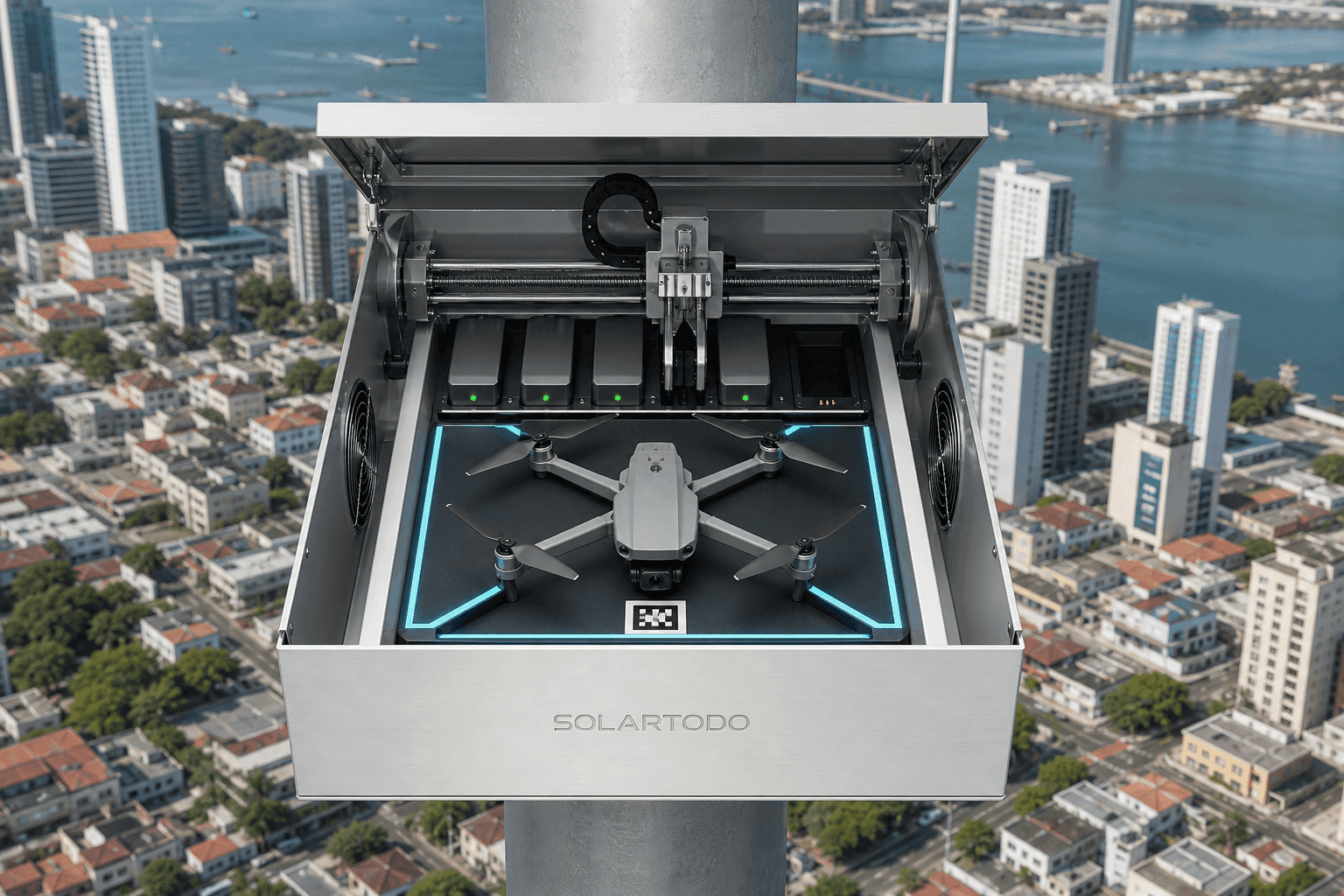
- Drone workflow: launch, patrol, inspection, landing, battery hot-swap, health logging and task redeployment, subject to aviation approvals.
- C-UAS coordination: detection, tracking and human-authorized response coordination; radar, if used, is an optional partner-sensor input rather than pole hardware.
According to IEC (2013), IEC 60529 defines enclosure ingress ratings with solid-particle numerals from 0-6 and liquid-ingress numerals from 0-9. For Recife, the engineering submittal should specify the target IP rating for each electronics compartment, connector bay and service access area instead of using broad weatherproof language. According to ANPD (2025), Brazil's LGPD is available as Law No. 13,709; the Sentinel data workflow should be described as LGPD-oriented by design, not certified compliant.
Implementation Approach
A Recife rollout of 108 off-grid edge nodes would normally follow 5 phases from survey to commissioning over roughly 12-20 weeks.
Phase 1 is a corridor survey covering solar exposure, line-of-sight communications, foundation constraints, flood levels, property boundaries and municipal permitting. The survey should identify where 40 m nominal spacing must be adjusted for bridge approaches, trees, pedestrian circulation, underground utilities or aviation clearances. Output should include a node schedule, civil drawings, communications map and maintenance access plan.
Phase 2 is configuration engineering, including battery sizing, workload duty cycle, sensor field-of-view planning, environmental calibration and edge-compute workload allocation. According to World Bank/ESMAP (2019), the Global Solar Atlas provides solar-resource layers at about 250 m resolution and PVOUT layers around 1 km resolution, useful for screening but not final energy guarantees. The final energy model should use local shading, seasonal cloud cover and task scheduling rather than annual averages alone.
Phase 3 covers CKD logistics, factory acceptance checks and local staging. Phase 4 covers foundations, pole erection, grounding, surge protection, communications commissioning and node identity provisioning. Phase 5 covers acceptance testing: environmental sensor calibration, local analytics thresholds, metadata flow, battery state-of-charge behavior, drone-service interlocks and operator authorization workflows.
Expected Performance & ROI
A 108-node network would prioritize coverage quality, local event latency and reduced utility trenching exposure, with ROI evaluated across a 5-10 year asset model.
Expected performance should be measured in operating indicators rather than claimed citywide outcomes. Recommended KPIs include node uptime, battery reserve hours, event-processing latency, false-alert rate, maintenance truck rolls per month, successful metadata delivery rate and environmental-data completeness. IEA states, 'improve the safety, productivity, accessibility and sustainability of energy systems,' which supports a digital operations model but does not replace local acceptance testing.
The off-grid architecture is especially relevant where trenching, grid access or utility coordination would slow deployment. However, the on-pole solar layer should not be treated as unlimited energy; high-power drone and robot activities must be buffered by storage and scheduled. A credible ROI model for Recife should compare the Sentinel configuration against separate camera poles, weather stations, drone docks, communications cabinets and maintenance contracts.
Payback should not be stated before EPC pricing, site power alternatives, backhaul costs and municipal operating assumptions are known. For early procurement screening, a 5-10 year lifecycle model should include battery replacement assumptions, inspection labor, communications fees, spare battery packs, corrosion maintenance and software support. The decision value is strongest when 1 pole replaces several separate asset classes while keeping raw data local.
Comparison Table
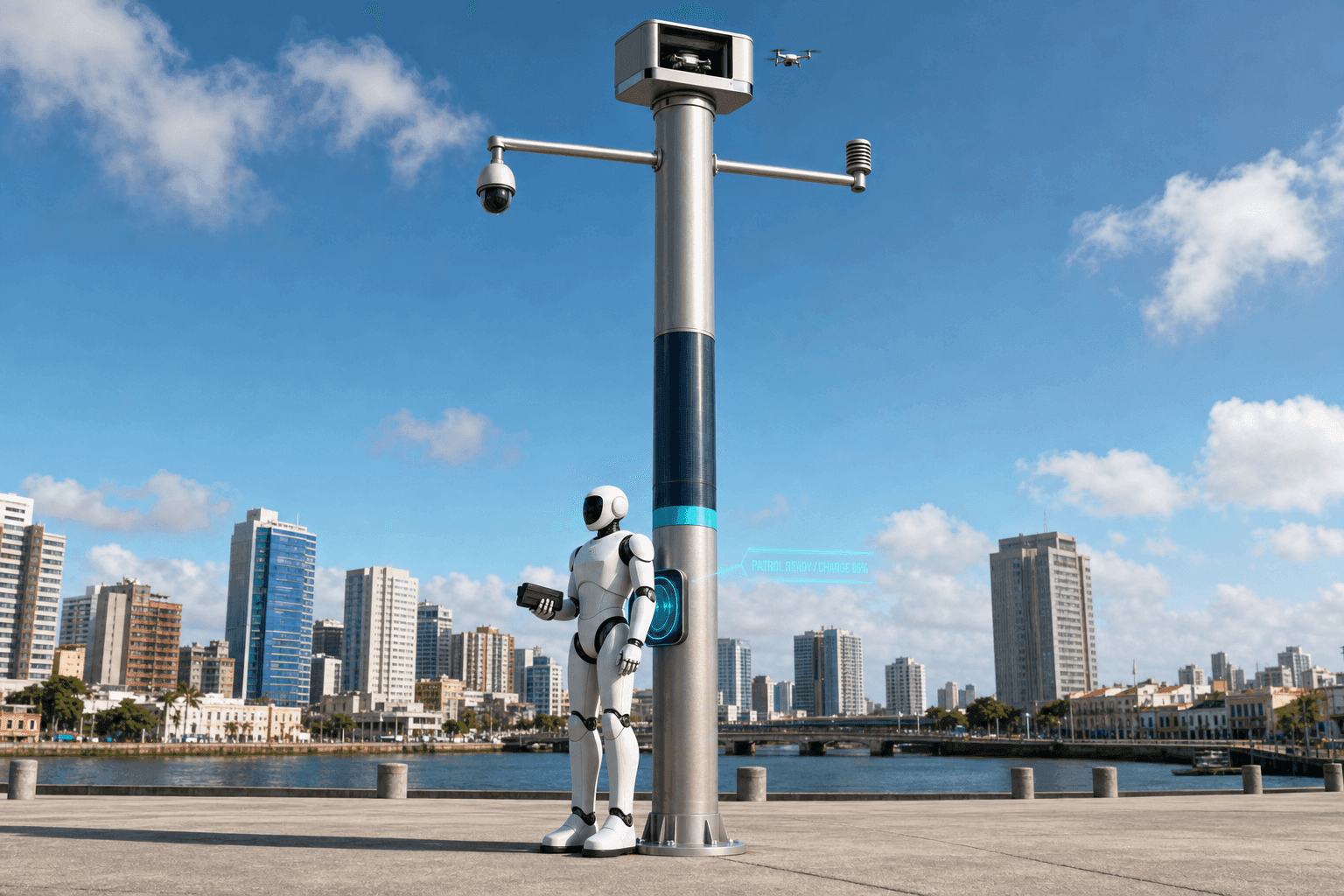
For Recife's 4.3 km corridor profile, the SOLARTODO Sentinel configuration offers 9 sensing categories and 5-20 kWh storage per node.
| Evaluation factor | SOLARTODO Sentinel City AI Pole | Conventional camera pole plus separate systems | Procurement implication |
|---|---|---|---|
| Typical Recife corridor basis | Approximately 108 nodes at 40 m spacing | Multiple poles, cabinets and device mounts | Sentinel reduces asset fragmentation |
| Energy architecture | Fully off-grid, 5-20 kWh storage plus 6-9 kWh/day replenishment | Usually grid-tied or cabinet-powered | Trenching exposure may be lower |
| Local analytics | On-pole inference; raw video stays local | Often recorder- or cloud-centered | Better fit for LGPD-oriented workflows |
| Environmental monitoring | 9-variable package per node | Separate weather or air-quality stations | Denser operational telemetry |
| Drone operations | Pole-integrated service workflow and battery hot-swap architecture | Separate drone base or manual deployment | Higher integration, more approvals |
| C-UAS coordination | Human-authorized, non-lethal coordination with optional partner inputs | Usually separate security platform | Use only after authority review |
| Commercial format | FOB, CIF or EPC Turnkey quotation | Multiple vendor packages | EPC comparison should use full lifecycle scope |
Pricing & Quotation
SOLARTODO offers three pricing tiers for this product line: FOB Supply (equipment ex-works China), CIF Delivered (including ocean freight and insurance), and EPC Turnkey (fully installed, commissioned, with 1-year warranty). Volume discounts are available for large-scale deployments. Configure your system online for an instant estimate, or request a custom quotation from our engineering team at [email protected].
Frequently Asked Questions
These 10 FAQs address Recife-specific deployment, technical limits, EPC quotation routes and operational assumptions for an approximately 108-node city AI pole program.
Q1: What is the recommended Recife configuration for SOLARTODO Sentinel City AI Pole? A typical Recife configuration would use approximately 108 Sky Hub pole-form nodes at about 40 m spacing, covering roughly 4.3 km before field adjustments. Each node should combine local sensing, Jetson-class edge compute, 5-20 kWh storage, on-pole solar replenishment and metadata-only communications. Final quantities require survey confirmation.
Q2: Does the SOLARTODO Sentinel City AI Pole include illumination hardware? No. The SOLARTODO Sentinel City AI Pole is a pure smart pole for sensing, edge compute, energy buffering, drone-service architecture and robot-ready operations. It is not designed with illumination hardware. For Recife, that distinction matters because technical acceptance should focus on data handling, autonomy limits, foundations, battery sizing and communications.
Q3: How long would a 108-node Recife project typically take? A reasonable planning range is about 12-20 weeks after scope freeze, assuming permitting and import documentation proceed normally. The sequence usually includes survey, engineering approval, CKD logistics, civil foundations, pole erection, commissioning and operator training. Flood-prone locations, aviation coordination or complex right-of-way approvals can extend the timeline.
Q4: What ROI or payback should Recife buyers expect? SOLARTODO should not promise payback without EPC pricing and local operating data. A Recife buyer should model 5-10 years of lifecycle cost against alternatives such as separate camera poles, weather stations, drone bases, grid connections and maintenance contracts. The strongest ROI case usually comes from asset consolidation and reduced trenching, not electricity savings alone.
Q5: What maintenance is required in Recife's coastal climate? Maintenance should include quarterly visual checks, connector inspection, battery-health review, environmental sensor calibration, drainage checks and corrosion monitoring. Coastal humidity and salt exposure make enclosure ratings, surge protection and service access important. Drone battery magazines and robot charging interfaces require additional preventive checks because moving service components have higher wear than passive sensors.
Q6: How does this compare with conventional CCTV infrastructure? Conventional CCTV typically depends on separate poles, cabinets, power feeds, recorders and network devices. The Sentinel approach consolidates sensing, compute, battery storage, environmental monitoring and field-operation workflows into one off-grid node. It also processes raw video locally, which better supports LGPD-oriented design when only de-identified event metadata leaves the pole.
Q7: Does SOLARTODO provide EPC pricing for Recife? Yes, quotations can be structured as FOB Supply, CIF Delivered or EPC Turnkey, but this guide intentionally avoids prices. EPC pricing for Recife must account for foundations, logistics, import duties, commissioning, training, communications, maintenance access and warranty scope. Buyers should request a custom quotation after providing coordinates, corridor length and operational priorities.
Q8: What warranty basis is available? The required commercial paragraph specifies EPC Turnkey with a 1-year warranty. For Recife, the warranty matrix should identify coverage for pole structure, electronics, battery system, sensor package, drone-service components and software support. Battery capacity retention, corrosion exclusions and response times should be clarified during quotation rather than assumed from generic equipment terms.
Q9: Can the drone workflow operate automatically in Brazil? The hardware can be configured for launch, patrol, landing, battery exchange and task logging, but Brazilian operation depends on aviation approvals and site rules. Recife planning should include operator authorization, geofencing, safety cases and documented human approval for sensitive actions. Automated field workflows should be validated as project-specific pilot functions.
Q10: What data leaves the pole? The recommended SOLARTODO workflow keeps raw video and sensor streams on the pole for local processing. External systems should receive only de-identified event records, node status, alarms, energy state and maintenance metadata. That architecture supports LGPD-oriented procurement because it limits personal-data exposure, although it should not be described as certified compliance.
References
These 7 references ground Recife demographics, climate planning, smart-city architecture, solar-resource screening, enclosure ratings, data protection, data-governance requirements and procurement decisions.
- [IBGE] (2022): Recife census profile reports 1,488,920 residents and 218.843 km2 municipal area in the official Cidades portal, https://cidades.ibge.gov.br/brasil/pe/recife/panorama.
- [ICLEI and Prefeitura do Recife] (2020): Plano Local de Acao Climatica do Recife covers mobility, sanitation, energy and resilience, with a 2050 carbon-neutrality objective, https://americadosul.iclei.org/material_iclei/plano-local-de-acao-climatica-do-recife-pe/.
- [ITU] (2015): Focus Group on Smart Sustainable Cities defines smart sustainable cities and reports urban shares of more than 70% of GHG emissions and 60-80% of energy use, https://www.itu.int/en/ITU-T/focusgroups/ssc/Pages/default.aspx.
- [IEA] (2017): Digitalisation and Energy describes digital technologies improving safety, productivity, accessibility and sustainability in energy systems, https://www.iea.org/reports/digitalisation-and-energy.
- [World Bank/ESMAP] (2019): Global Solar Atlas 2.0 technical basis provides solar-resource and PV-potential screening layers for early-stage site assessment, https://globalsolaratlas.info/.
- [IEC] (2013): IEC 60529 defines degrees of protection provided by enclosures using IP Code solid and liquid ingress numerals, https://webstore.iec.ch/publication/2452.
- [ANPD/Gov.br] (2025): Brazilian Data Protection Law page publishes the English version of LGPD, Law No. 13,709, https://www.gov.br/anpd/pt-br/centrais-de-conteudo/outros-documentos-e-publicacoes-institucionais/lgpd-en-lei-no-13-709-capa.pdf.
Equipment Deployed
- Approximately 108 SOLARTODO Sentinel City AI Pole Sky Hub pole-form nodes at about 40 m spacing
- 5-20 kWh-class battery storage per off-grid node with duty-cycle scheduling
- Approximately 15 m2 CIGS on-pole solar replenishment, 2.4-2.7 kWp nameplate
- Realistic clear-sky replenishment model of about 0.8-1.1 kW DC peak and 6-9 kWh/day in high-irradiance conditions
- Jetson-class edge compute for local inference and metadata-only external reporting
- Nine-variable environmental monitoring package: wind speed, wind direction, temperature, humidity, pressure, noise, PM10, PM2.5 and illuminance
- Drone service architecture with launch, patrol, landing, battery hot-swap and mission logging, subject to approvals
- Human-authorized C-UAS coordination workflow with optional partner-sensor input