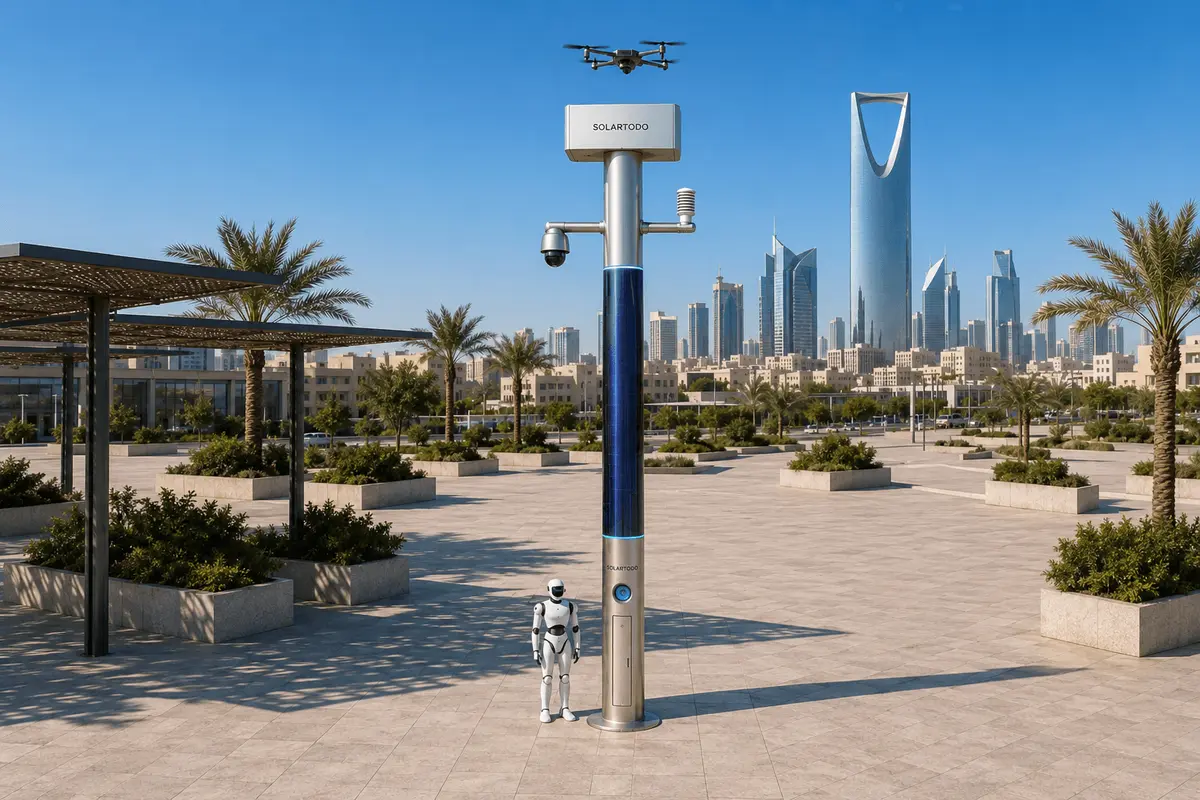
A City AI Pole is a non-lighting physical-AI edge node that combines off-grid energy storage, on-pole compute, sensing, drone operations and robot operations in one urban infrastructure point. In this São Paulo CBD configuration, SOLARTODO Sentinel Sky Hub supports police-led temporary-event fire-response coordination while keeping raw video and sensor data processed locally on the pole.
São Paulo CBD Mission Context
This proposed case study is set in the central business district of São Paulo during a major temporary event period, when police, fire response teams, civil defense, private venue security and traffic managers must share a live operating picture without waiting for a permanent infrastructure program. The seasonal trigger is the severe-storm and typhoon-season planning window used by multinational event operators and insurers, translated locally into São Paulo's heavy-rain, wind, flood and crowd-risk period. The city task is not street lighting. It is public-safety coordination around a dense CBD event perimeter where blocked access roads, temporary stages, delivery restrictions and sudden weather can turn a small incident into a multi-agency response problem. The proposed SOLARTODO Sentinel Sky Hub deployment places robot-ready, drone-ready PURE smart poles at selected event perimeter points, service entrances, temporary command posts and critical pedestrian approaches. Each pole is a fully off-grid edge micro-station with battery storage and 360-degree wrapped flexible CIGS thin-film solar replenishment. For the police stakeholder, the value is operational continuity: a node can be placed where the response problem exists, without waiting for grid tie-in, site power approval or trenching. The KPI frame is availability, measured as whether the common-operating-picture feed, event metadata, mission queue and field node status remain usable during the temporary event window, subject to final engineering confirmation.
Cross-Department Silo Problem
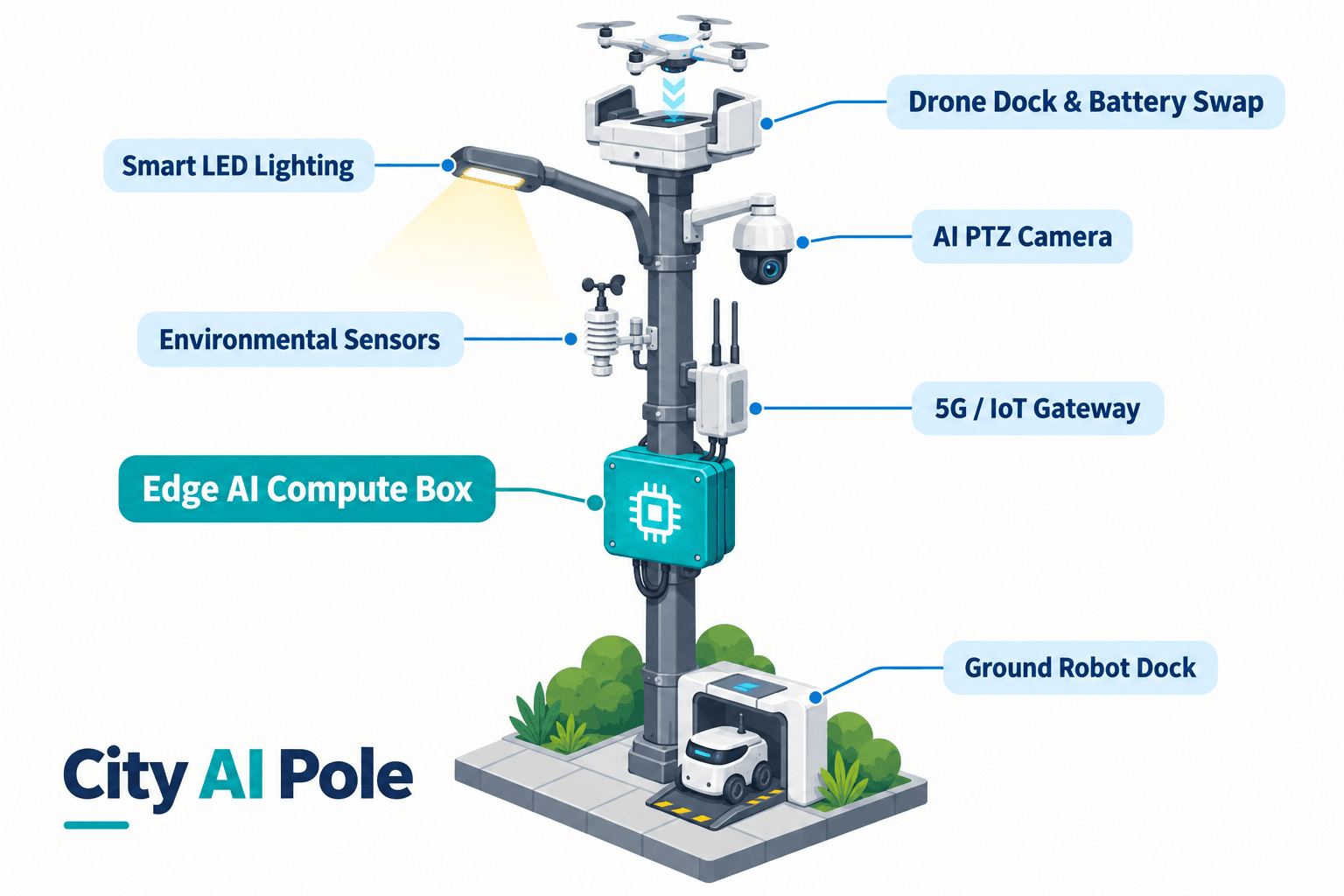
The pain point is not a lack of sensors. São Paulo's CBD event environment already involves radio calls, venue dashboards, private camera rooms, city operations teams and emergency responders. The friction appears when each department sees a different fragment of the incident. Police may receive the first crowd-control report, fire teams may need access-path confirmation, civil defense may watch weather exposure, and event operators may know which temporary structures are occupied. During a fire-response event, the gap between those views can create duplicated dispatch, slow perimeter decisions and unclear handoffs. Sky Hub is proposed as a neutral field node that produces de-identified event and status metadata from the edge and presents it in a shared COP command view. The pole's AI PTZ camera can support anonymous vehicle count, crowd density, intrusion and perimeter awareness. Its environmental package tracks wind speed, wind direction, temperature, humidity, atmospheric pressure, noise, PM10, PM2.5 and illuminance. These signals matter in a fire-response scenario because wind direction can affect smoke movement, crowd density can affect evacuation routing, and perimeter intrusion can affect responder access. Raw video and raw sensor data stay on the pole and are processed locally. Only de-identified event metadata, node health, mission status and authorized alerts are designed to leave the pole. That data posture is PDPL-LGPD-oriented and should be validated by the buyer's legal, cyber and privacy teams before live operations.
Edge Computing For Fire Response
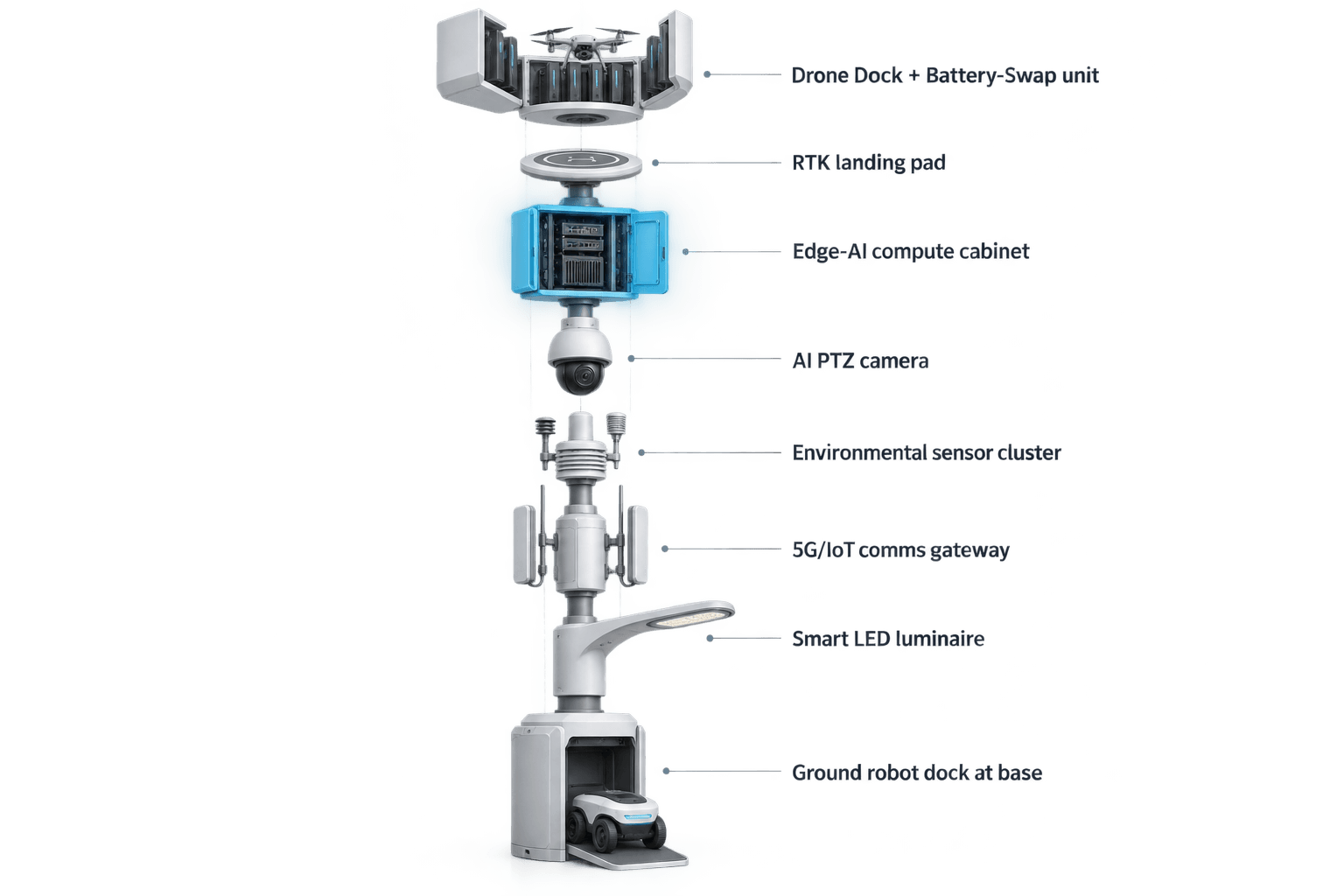
The proposed operational loop follows sensing, authorized assessment and response, edge-compute scheduling, and field operations and maintenance as one practical workflow. When the pole detects an anomaly such as crowd compression near an emergency lane, smoke-like visual change near a service gate or a restricted-area intrusion, the on-pole Jetson-class edge module classifies and scores the event locally. The COP view does not need to stream every raw feed back to a control room. It receives a compact alert with location, confidence band, environmental context, pole power state and recommended response options. Human authorization remains central. Police command can review the event, coordinate with fire response and authorize a field action. That action may include a drone sortie for overhead inspection, a ground robot patrol to a gate or structure edge, or a request to hold the node's compute budget for continuous local inference during the incident window. The Sky Hub's drone operations management layer supports route planning, task queueing, charge or swap state, fleet health and mission logs. A landed drone can receive an automated rear-service battery exchange from a multi-bay battery magazine and relaunch for consecutive sorties, subject to airspace authorization and event safety rules. The ground robot can conduct patrol, alarm response, inspection and air-ground coordination before returning to the pole base for wireless charging. The result is not an autonomous attack system or a generic camera tower. It is a physical-AI edge node that helps police maintain a shared, authorized response cycle while fire teams concentrate on incident control.
Power Availability As The Design Anchor
Because the deployment mode is temporary-event, power is the module focus. A CBD event perimeter often changes late: barriers move, delivery gates shift, command posts relocate, and the safest observation point may not be near a convenient power cabinet. Sky Hub is designed as a fully off-grid pole: battery storage plus on-pole solar replenishment, with no dependency on grid, city or site power. The vertical cylindrical body carries about 15 square meters of 360-degree wrapped flexible CIGS thin-film over an approximately 8 meter tall, 0.6 meter wide form, giving roughly 2.4 to 2.7 kWp nameplate. Real operating assumptions must be more conservative. A vertical cylinder collects direct sun mainly on the sun-facing projection, not the full wrap at once. In a high-irradiance reference region, clear-sky output is roughly 0.8 to 1.1 kW DC peak, typically stronger in the mid-morning and afternoon than at noon, with about 6 to 9 kWh per day. São Paulo engineering should derate this for weather, shading from towers, event banners and seasonal cloud cover. The solar layer is therefore a replenishment layer, not an unlimited pure-solar claim. High-power drone swaps, robot charging and compute bursts are buffered by 5 to 20 kWh-class storage and scheduled by duty cycle. Availability planning should evaluate battery reserve hours, sortie frequency, compute load, sensor duty cycle and safe maintenance windows.
Evaluation Plan And Buyer Fit
For the police buyer, the proposed evaluation should avoid vague smart-city claims and concentrate on availability during the event. Suggested target metrics include COP node uptime, percentage of incident records containing environmental context, drone or robot task completion against authorized requests, battery reserve margin at shift change, and number of cross-department handoffs recorded in the mission log. These are planning and acceptance metrics, not achieved results. A credible São Paulo deployment would begin with a temporary cluster around a defined CBD event perimeter and a written concept of operations shared by police, fire response, civil defense, venue operations and city technology teams. The C-UAS coordination function should also be handled carefully. The pole can detect and track an unauthorized drone and command its own friendly drone for soft aerial net-capture or close-approach deterrence when a human authorizes mitigation. It does not shoot down, jam, deny RF or GNSS, or conduct autonomous attacks. Radar is not built into the pole; radar data, if used, would be an optional partner-sensor input. This keeps the system aligned with the practical city task: giving São Paulo event commanders a deployable, off-grid, local-processing physical-AI node that can reduce cross-department ambiguity and make fire-response coordination more available when weather, crowds and temporary infrastructure raise the operating risk.
System Configuration
| Parameter | Configuration |
|---|---|
| Deployment type | Temporary-event Sky Hub cluster for São Paulo CBD perimeter, command-post approaches and responder access points |
| Power system | Fully off-grid battery-backed micro-station with 360-degree wrapped flexible CIGS solar replenishment and duty-cycle scheduling |
| Edge AI compute | On-pole Jetson-class edge module for local inference, event scoring and workload scheduling |
| Security sensing | AI PTZ camera for anonymous vehicle count, crowd density, intrusion and perimeter awareness |
| Environmental package | Wind speed, wind direction, temperature, humidity, atmospheric pressure, noise, PM10, PM2.5 and illuminance |
| Drone and robot operations | Autonomous sortie tasking, multi-bay battery hot-swap, mission logs, robot patrol and wireless return-to-charge |
| Data handling | Raw video and sensor data stay on the pole; only de-identified event and status metadata may leave the node |
How It Works
- On-pole sensing flags smoke-like change, crowd compression, intrusion or blocked access near the event perimeter.
- Edge AI classifies the event locally and attaches environmental context, power state and confidence band.
- Police command reviews the COP alert and coordinates human-authorized response with fire and venue teams.
- The node schedules a drone sortie, robot patrol or continued local inference according to battery and mission state.
- De-identified event metadata, mission actions and operator decisions are recorded in the shared incident log.
- Operations staff review availability, reserve power and task completion after each event shift.
Planning Assumptions (Indicative)
Illustrative planning inputs a buyer can recompute — target metrics, not achieved results. Subject to final engineering confirmation.
| Metric | Planning assumption | Indicative value |
|---|---|---|
| Node availability | temporary-event acceptance target for COP node status, edge alerts and mission queue availability | ~95-99% target window availability |
| Manual perimeter checks | drone or robot patrol replaces repeated foot checks at selected event access points | ~10-20 patrol loops/week automated |
| Fire-response context | each priority alert should include environmental and perimeter metadata for cross-department review | ~80-90% of priority alerts enriched |
| Battery reserve | operations plan keeps storage above a reserve threshold before night and severe-weather periods | ~25-40% reserve target |
| Department handoffs | police, fire response and venue operations use one incident log for authorized actions | ~1 shared record per priority incident |
Deployed Equipment
- SOLARTODO Sentinel Sky Hub PURE smart pole body
- Battery-backed off-grid power cabinet
- 360-degree wrapped flexible CIGS thin-film solar layer
- On-pole Jetson-class edge compute cabinet
- AI PTZ camera and local perception stack
- Nine-sensor environmental monitoring package
- Autonomous drone bay with multi-bay battery hot-swap magazine
- Ground robot wireless charging base
Frequently Asked Questions
Is Sky Hub a smart streetlight for São Paulo streets?
No. Sky Hub is a PURE smart pole and physical-AI edge node with no lighting system. In this São Paulo CBD event configuration, its role is local sensing, edge compute, drone operations, robot operations, off-grid power and shared command visibility for police-led fire-response coordination.
How can the pole operate without grid or site power during a temporary event?
The proposed node is designed as a fully off-grid micro-station. Battery storage buffers high-power tasks, while the 360-degree wrapped flexible CIGS layer replenishes energy during daylight. The solar layer is supplemental, not unlimited self-sufficiency, so drone sorties, robot charging and inference loads are scheduled by duty cycle.
What data leaves the pole under the proposed São Paulo configuration?
The system is designed for local processing. Raw video and raw sensor data stay on the pole, where edge inference creates de-identified event and status metadata. The COP view may receive alerts, power state, environmental readings, mission status and logs. Final privacy review should confirm PDPL-LGPD-oriented operating rules.
Why is edge computing important for police-led fire response?
Edge computing reduces dependence on constant raw-feed backhaul and helps the node keep classifying local conditions when networks are congested during a CBD event. Police command receives structured alerts with context, while fire response teams can use the same incident record for access, smoke, crowd and perimeter decisions.
Does the proposed deployment claim achieved São Paulo performance results?
No. This case study describes a proposed and illustrative configuration subject to final engineering confirmation. Availability, patrol replacement, reserve power and enriched-alert values are target planning assumptions that a buyer can recompute after site survey, solar shading review, event layout and operating policy approval.
How is Counter-UAS handled without creating a weapons system?
The pole may detect and track an unauthorized drone and coordinate a friendly drone response only after human authorization. Allowed responses are non-kinetic, such as soft aerial net-capture or close-approach deterrence. The system does not shoot down aircraft, jam signals, deny navigation, or conduct autonomous attacks.
Explore Further
- City AI Pole / smart streetlight product line
- More smart-city deployment cases
- Talk to our engineering team
Planning a similar physical-AI deployment for streets, campuses or public spaces? Request an engineering consultation