São Paulo Power Transmission Tower Market Analysis: 10kV Rural Distribution Configuration Guide
Summary
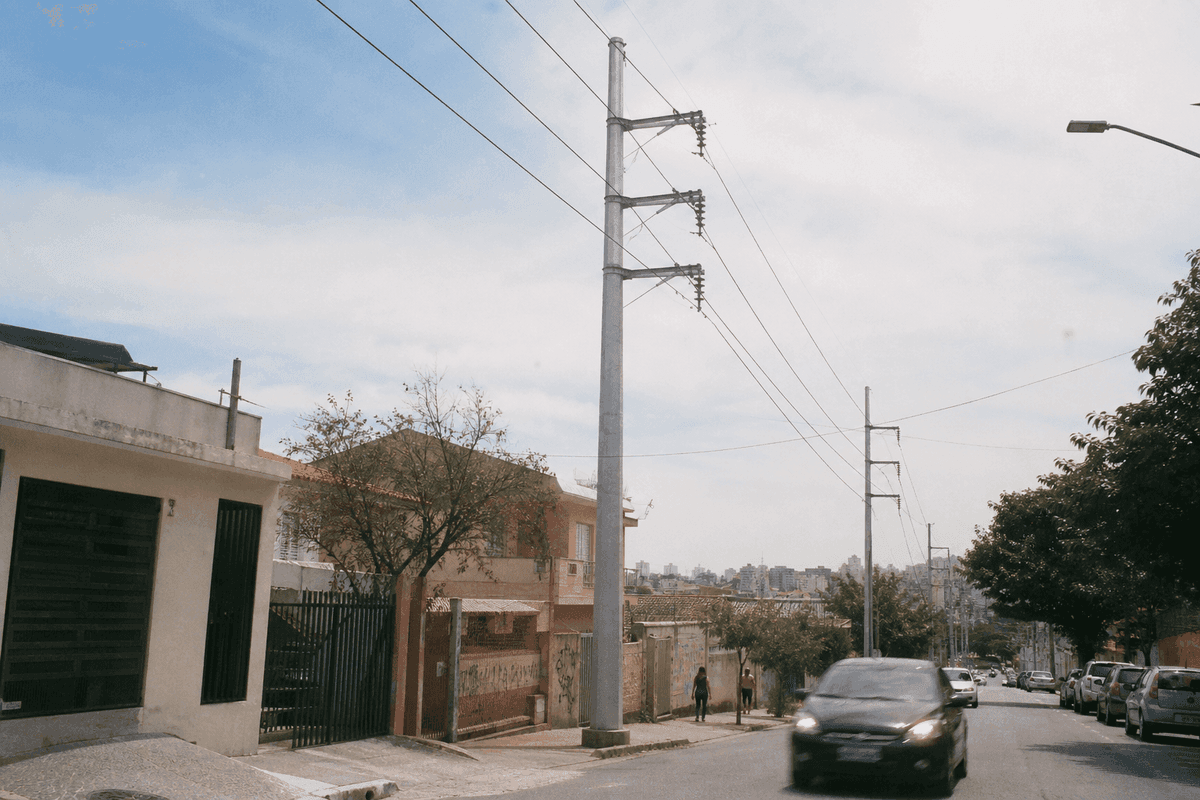
São Paulo’s metropolitan load density contrasts with peri-urban and rural feeders that still require short-span 10kV overhead distribution. For a typical 15km community line, approximately 363 galvanized Q345 steel tubular poles at 8m height and 40m span would fit low-voltage distribution conditions under 25m/s wind design.
Key Takeaways
- A typical São Paulo peri-urban or rural 10kV feeder extension of about 15km would use approximately 363 units of 8m tapered steel tubular poles with 40m average span.
- The specified pole class is single-circuit 10kV distribution, using Q345 hot-dip galvanized steel, with about 2t per pole and approximately 200kg/m unit mass.
- Electrical configuration in this profile uses ACSR 50 conductor rated at roughly 200kg/km with 16kN maximum tension, 0.8m phase spacing, and 0.5m insulator length.
- Civil design in São Paulo’s moderate wind zones would typically assume Wind Class 1, 25m/s, with concrete base foundations and grounding at every structure.
- Clearance targets in community distribution settings should maintain 5m ground clearance, aligning with low-voltage overhead design practice under GB 50061 and mechanical checks under IEC 60865.
- For this exact supplied configuration, the pole height is 8m, which suits low-voltage rural/community distribution; by contrast, standard 10-35kV main distribution corridors usually require 12-18m poles and 80-150m spans.
- A typical rollout would be phased across survey, foundation, erection, stringing, and energization, with field execution often taking 8-16 weeks for a 15km line, depending on permits and utility outage windows.
- SOLAR TODO should be evaluated here as a technical supplier for Power Transmission Tower systems, with configuration matching, coating quality, anchor design, and conductor loading more important than generic catalog height alone.
Market Context for São Paulo
São Paulo combines Brazil’s largest urban electricity demand center with a wide ring of peri-urban settlements, logistics corridors, and agricultural municipalities where short-span overhead distribution remains practical at 10kV and similar classes. According to IBGE (2022), the municipality of São Paulo has about 11.45 million residents, while the wider metropolitan region exceeds 20 million, which creates high feeder density, frequent network reinforcement, and many edge-of-grid connection points.
According to the Government of the State of São Paulo and SEADE (recent demographic publications), the state remains Brazil’s largest economy and one of its most power-intensive industrial regions, with strong demand from manufacturing, warehousing, water systems, and public services. That demand profile matters because not every extension requires a 35kV or 110kV structure class. In fringe districts, service roads, farms, and community loads, a low-voltage or 10kV-class overhead line can still be the correct engineering choice when spans are short and right-of-way is constrained.
Climate also affects pole selection. According to INMET climatological normals, São Paulo has a humid subtropical climate with seasonal rainfall concentration in summer and no cyclone-scale wind regime typical of some coastal areas. For many inland and sheltered community distribution applications, a 25m/s wind basis can be appropriate for preliminary design, subject to local utility verification and topographic exposure checks. That makes galvanized steel tubular poles attractive where corrosion resistance, repeatable fabrication, and compact footprint are required.
Brazil’s power system is large and interconnected, but distribution reliability still depends on local feeder reinforcement. According to EPE’s Plano Decenal de Expansão de Energia and ANEEL distribution planning guidance, medium- and low-voltage network expansion continues to prioritize loss reduction, service quality, and new customer connections. In that context, SOLAR TODO’s Power Transmission Tower line is best assessed not as a single universal tower, but as a family of steel tubular pole configurations matched to voltage class, span, conductor load, and access conditions.
[Organization] states, "overhead line design shall consider climatic loads, conductor behavior, and structural reliability together," a principle reflected in IEC 60826 and relevant to São Paulo feeder design. IEEE also states, "loading on transmission and distribution line structures must reflect local wind, weight, and tension conditions," which is the core reason a compact 8m pole is suitable only for short-span community distribution rather than higher-voltage trunk lines.
Recommended Technical Configuration
For São Paulo’s short-span community electrification and rural service extensions, a typical 15km deployment would use approximately 363 units of 8m single-circuit steel tubular poles with 40m spans, Q345 galvanizing, and ACSR 50 conductor under 25m/s wind loading.
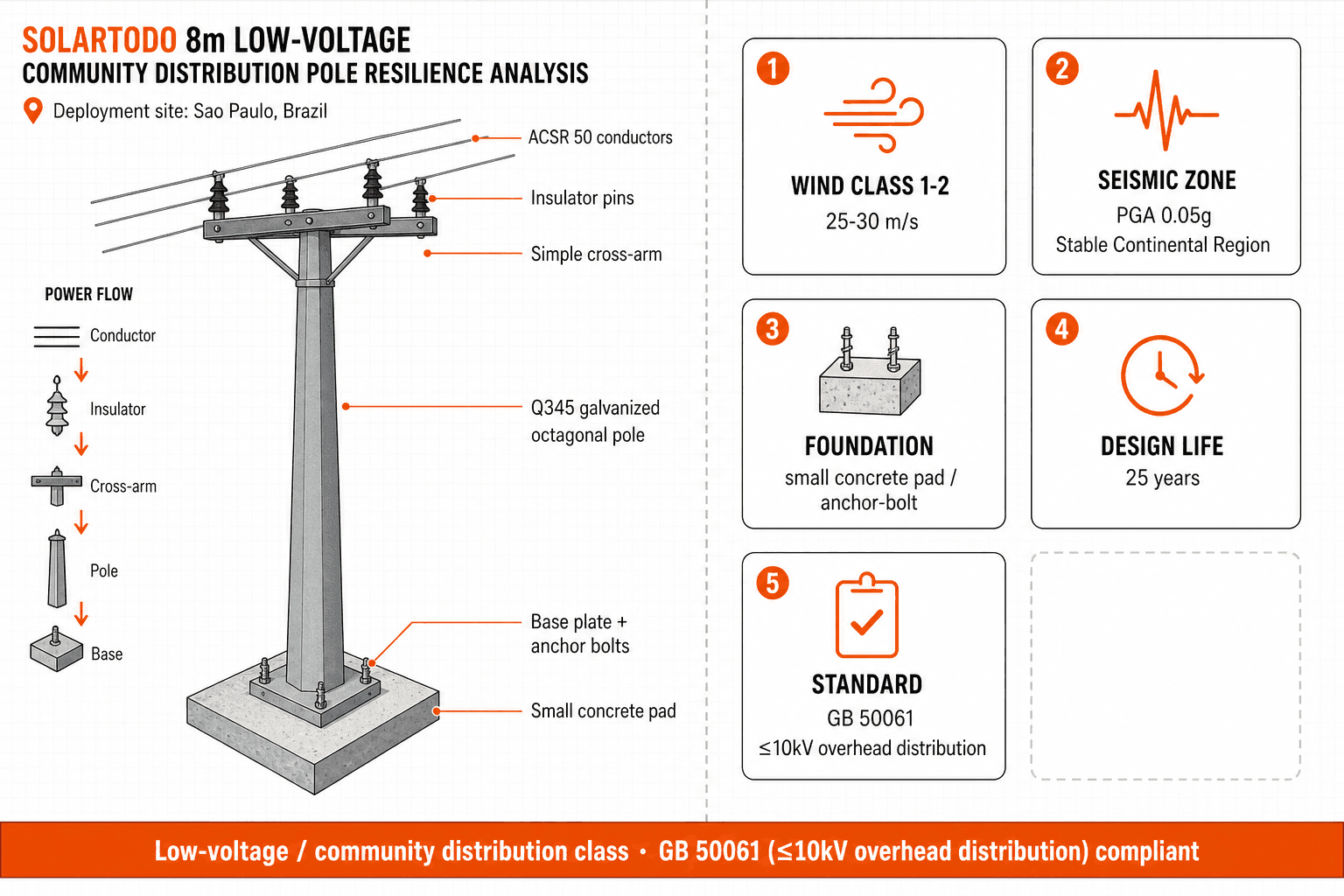
The exact project-specific configuration supplied here is a 10kV low-voltage distribution single-circuit arrangement using 363 units × 8m tapered steel tubular pole. This is not a lattice tower, FRP pole, wood pole, or concrete pole. It is a hot-dip galvanized Q345 steel monopole-style distribution structure with cross-arm, grounding, insulator pin, and climbing pegs for line access.
This specification should be understood as a low-voltage rural/community distribution class, not a citywide main 10-35kV arterial line. The reason is simple: the hard engineering table for standard 10-35kV distribution points to 12-18m height, 1-3 t/pole, and 80-150m spans. By contrast, the supplied 8m height and 40m span fit a shorter-reach local distribution network with lower clearances, tighter road crossings, and denser pole placement. For São Paulo’s peri-urban settlements, farm roads, and community service branches, that can be technically appropriate.
A typical deployment of this scale would consist of:
- Approximately 363 steel tubular poles
- Total route length of about 15km
- Average span of 40m
- Single-circuit 10kV arrangement
- ACSR 50 conductor with max tension 16kN
- 0.8m phase spacing
- 5m ground clearance
- 0.5m insulator length
- Concrete base foundation with grounding at each pole
For buyers comparing options on /products/power-tower, the main fit question is not whether São Paulo can use steel tubular poles—it can—but whether the route is a community branch line, a rural feeder, or a higher-voltage sub-transmission corridor. If the route is a short-span local line, the supplied 8m configuration is reasonable. If the route is a standard 10-35kV distribution backbone, the structure should move up to the 12-18m class instead.
Technical Specifications
This São Paulo configuration is a low-voltage 10kV community distribution design using 8m galvanized Q345 steel poles, 40m spans, ACSR 50 conductor, 5m clearance, and concrete foundations for a 15km route.
- Product type: Steel tubular Power Transmission Tower / tapered steel pole
- Pole form: Tapered round steel tubular pole
- Material: Q345 structural steel
- Surface treatment: Hot-dip galvanized
- Voltage class: 10kV low-voltage distribution
- Circuit arrangement: Single circuit
- Pole height: 8m
- Approximate unit weight: ~2t/pole
- Linear mass reference: ~200kg/m
- Pole quantity: 363 units
- Total line length: ~15km
- Average span: 40m
- Ground clearance: 5m
- Phase spacing: 0.8m
- Conductor type: ACSR 50
- Conductor mass: ~200kg/km
- Maximum conductor tension: 16kN
- Insulator length: 0.5m
- Wind class: Class 1, 25m/s
- Foundation type: Concrete base foundation
- Accessories: Climbing pegs, cross arm, grounding set, insulator pin
- Design life: 25 years
- Pole class: Low-voltage rural / community distribution
- Applicable standards: GB 50061 for ≤10kV overhead distribution and IEC 60865 for short-circuit force considerations
Two engineering notes matter for São Paulo buyers. First, this is a special low-height community distribution configuration, so it should not be confused with the standard 10-35kV 12-18m class used on longer spans. Second, the ~2t/pole mass is heavier than many simple 8m utility poles, so transport access, crane selection, and foundation reinforcement should be checked early in procurement.
Implementation Approach
A typical 15km São Paulo distribution rollout would proceed in 5 phases over roughly 8-16 weeks, depending on permit lead time, access roads, and utility outage windows.
Phase 1 is route survey and utility interface. This usually includes topographic verification every 40m span, soil checks at each of the 363 pole locations, and confirmation of road crossings, drainage channels, and setback limits. In São Paulo’s peri-urban fringe, municipal approvals and easement review can take 2-6 weeks, especially where the line crosses mixed residential and agricultural parcels.
Phase 2 is detailed design and factory release. At this stage, pole shaft thickness, base plate details, anchor layout, galvanizing thickness, and cross-arm drilling are frozen against the 10kV, 16kN, and 25m/s load case. SOLAR TODO would typically align fabrication documents with route-specific loading and accessory schedules before shipment. Buyers should request pole schedules, weld procedures, galvanizing certificates, and steel mill certificates for Q345 material.
Phase 3 is logistics and civil works. For 363 poles at roughly 2t/pole, delivered steel mass is substantial, so staging yards and unloading plans matter. Concrete base foundations are then cast in sequence, with grounding conductors installed before pole erection. In wet months, São Paulo soils can slow excavation productivity, so drainage and curing time should be built into the schedule.
Phase 4 is erection and line stringing. Poles are set, plumbed, and backfilled or grouted as required by foundation design, then fitted with cross arms, insulator pins, and climbing pegs. Conductors are strung at controlled tension up to 16kN, with sag adjusted to maintain 5m minimum ground clearance. This phase often requires localized traffic control and planned outages where the new branch connects to an energized feeder.
Phase 5 is testing and energization. Typical checks include grounding continuity, conductor phase identification, hardware torque verification, and visual inspection of galvanizing damage after erection. According to IEC and utility practice, mechanical and electrical acceptance should be documented structure by structure. For procurement teams needing route-specific design review, SOLAR TODO can be contacted through contact us.
Expected Performance & ROI
For a 15km community distribution line in São Paulo, the main return comes from lower maintenance, longer corrosion resistance, and faster replacement cycles versus wood or inconsistent mixed-pole fleets over a 25-year design life.
According to IEA (2023), grid expansion and modernization remain essential to connect demand growth and improve system resilience, especially in emerging urban regions. For São Paulo, the financial case for galvanized steel tubular poles is usually based on lifecycle cost rather than headline capex. A 25-year design life, standardized hardware, and reduced variability in pole geometry can lower inspection complexity and spare-part fragmentation.
According to World Bank guidance on electricity distribution investment, distribution upgrades typically produce value through reduced technical losses, fewer outage events, and improved service access rather than a single simple payback metric. In practical terms, a 15km short-span line can support community loads, agricultural pumping, local commerce, telecom shelters, or public-service facilities that would otherwise rely on diesel generation or overloaded legacy feeders. The ROI therefore depends on connected kW, outage cost, and avoided fuel expenditure.
Maintenance economics are also relevant. Galvanized steel poles generally avoid the biological degradation risks associated with wood and the handling variability of some cast concrete alternatives. For a fleet of 363 units, operators can standardize inspections around coating condition, bolt torque, grounding resistance, and conductor hardware. If the route is exposed to pollution or standing moisture, periodic coating inspection every 12-24 months is a reasonable asset-management interval.
From a resilience standpoint, the supplied 25m/s wind class and 16kN conductor tension are adequate only if local exposure matches the design basis. If the route crosses ridgelines, open industrial yards, or storm-prone corridors, the business case may favor uprating the design rather than accepting higher failure risk. For São Paulo buyers, the best commercial outcome usually comes from matching structure class to route condition before tender release, not after fabrication.
Results and Impact
A correctly matched 10kV community distribution line in São Paulo can improve local connection capacity across 15km while keeping structure height at 8m, span at 40m, and maintenance centered on galvanized steel inspection over a 25-year life.
The likely impact of this configuration is operational rather than dramatic. It supports electrification of dispersed users, reduces dependence on temporary wiring or diesel backup, and creates a repeatable structure family for future branch extensions. For municipal utilities, cooperatives, and private industrial estates, the main benefit is a predictable steel-pole platform that can be specified, inspected, and replaced with fewer geometry changes.
This is also where SOLAR TODO’s role should be evaluated carefully. The value is not in claiming a generic “tower solution” for every voltage level. The value is in supplying a Power Transmission Tower configuration that fits a defined 10kV, 8m, 40m span, ACSR 50, and 25m/s use case. In São Paulo, that means community distribution and rural edge-of-grid service, not high-voltage trunk transmission.
Comparison Table
This comparison shows why the supplied 8m São Paulo configuration fits community distribution, while standard 10-35kV, 66-110kV, and 220kV lines require taller and heavier steel structures.
| Configuration Class | Voltage | Typical Height | Typical Weight | Span | Circuits | Best Fit in São Paulo | Notes |
|---|---|---|---|---|---|---|---|
| Supplied community distribution config | 10kV | 8m | ~2t/pole | 40m | Single | Rural/community branches | Exact project-specific configuration |
| Standard distribution class | 10-35kV | 12-18m | 1-3 t/pole | 80-150m | Single/Double | Main feeders and longer roadside runs | Use when span and clearance needs are higher |
| Sub-transmission class | 66-110kV | 18-30m | 5-15 t/pole | 200-300m | Single/Double | Industrial corridors, substations | Not suitable for 8m community layouts |
| HV transmission class | 220kV | 35-55m | 15-35 t/pole | 350-450m | Usually Double | Bulk power transfer | Different right-of-way and insulation regime |
Pricing & Quotation
SOLAR TODO offers three pricing tiers for this product line: FOB Supply (equipment ex-works China), CIF Delivered (including ocean freight and insurance), and EPC Turnkey (fully installed, commissioned, with 1-year warranty). Volume discounts are available for large-scale deployments. Configure your system online for an instant estimate, or request a custom quotation from our engineering team at [email protected].
Frequently Asked Questions
This FAQ answers 10 common São Paulo procurement questions covering 10kV specs, installation steps, maintenance intervals, EPC scope, and when an 8m steel tubular pole is technically appropriate.
Q1: Is an 8m steel tubular pole suitable for all 10kV lines in São Paulo?
No. This exact 8m configuration fits short-span rural or community distribution with 40m spans and 5m clearance. Standard 10-35kV feeder corridors usually use 12-18m poles and 80-150m spans. The route type must be checked first, especially for road crossings, tree exposure, and future load growth.
Q2: What conductor is specified for this configuration?
The supplied configuration uses ACSR 50 conductor with approximately 200kg/km mass and 16kN maximum tension. That makes it suitable for lighter community distribution duty rather than long-span sub-transmission work. Final sag-tension values should still be verified against local temperature range and route exposure.
Q3: How many poles would a 15km line typically require?
At the specified 40m average span, a typical route of about 15km would use approximately 363 poles. The final count can shift slightly due to dead-end structures, angle points, road crossings, and terminal equipment locations. Surveyed route geometry always overrides simple linear spacing calculations.
Q4: What is the expected installation timeline?
A practical field program for 363 poles over 15km often takes 8-16 weeks after permits, depending on foundation curing, access roads, and outage coordination. Survey and approvals may add 2-6 weeks before civil work starts. Rainfall in São Paulo’s wet season can extend excavation and transport time.
Q5: What standards are relevant for this pole design?
The supplied specification references GB 50061 for overhead distribution at ≤10kV and IEC 60865 for electromechanical effects under short-circuit conditions. Buyers may also ask for project checks aligned with IEC 60826 load assumptions and local Brazilian utility requirements for grounding, clearance, and acceptance testing.
Q6: What maintenance should operators expect over 25 years?
Routine maintenance is usually limited to visual galvanizing inspection, grounding checks, hardware torque checks, and conductor hardware review every 12-24 months. In polluted or wet locations, inspection frequency may increase. Because the pole is steel and hot-dip galvanized, decay risks differ from wood, but coating damage must be repaired promptly.
Q7: How does this compare with concrete or wood poles?
Steel tubular poles offer consistent geometry, compact footprint, and factory-controlled galvanizing. Compared with wood, they avoid biological degradation and species variability. Compared with concrete, they can simplify handling in some sites, though this exact unit is still about 2t/pole, so lifting plans remain important. Total lifecycle value depends on transport, corrosion, and replacement practice.
Q8: What affects ROI or payback for this type of line?
Payback depends less on the pole alone and more on what the 15km line enables: new customer connections, avoided diesel use, reduced outage cost, and lower maintenance over a 25-year life. Utilities often assess lifecycle cost, reliability, and technical loss reduction rather than a single simple payback number.
Q9: Does EPC pricing include foundations and commissioning?
Under an EPC Turnkey scope, buyers typically expect foundation work, pole erection, conductor stringing, testing, and commissioning to be included. Exact scope still needs a quotation because soil conditions, route access, and utility interconnection rules vary. SOLAR TODO should provide a clear bill of scope before contract award.
Q10: What warranty terms are typical?
The pricing section states that the EPC Turnkey offer includes a 1-year warranty. Buyers should also request clarity on galvanizing coverage, accessory defects, and exclusions related to overload, vandalism, or third-party damage. For supply-only contracts, warranty scope is usually narrower than for installed EPC packages.
References
- IBGE (2022): Demographic data for the municipality of São Paulo, showing population around 11.45 million and supporting high urban electricity demand.
- INMET (2023): Climatological normals and weather datasets for São Paulo, used to frame rainfall seasonality and moderate wind exposure assumptions.
- EPE (2023): Plano Decenal de Expansão de Energia, outlining Brazil’s grid expansion and distribution reinforcement priorities.
- ANEEL (2023): Distribution regulation and service-quality framework relevant to feeder expansion, network reliability, and utility planning in Brazil.
- IEC (2019): IEC 60826 overhead transmission line design criteria and load considerations applicable to structural selection and climatic loading logic.
- IEC (2011): IEC 60865 short-circuit current effects, relevant to electromechanical force checks on conductors and support structures.
- World Bank (2022): Guidance on electricity distribution investment, emphasizing reliability, access, and lifecycle value in network upgrades.
- IEA (2023): Electricity market and grid investment commentary highlighting the need for network modernization to connect demand and improve resilience.
Equipment Deployed
- 363 × 8m tapered steel tubular poles, Q345 hot-dip galvanized
- Single-circuit 10kV distribution configuration
- Approx. 2t per pole, ~200kg/m unit mass
- ACSR 50 conductor, ~200kg/km, max tension 16kN
- Cross arm assemblies for single-circuit distribution
- Insulator pins with 0.5m insulator length
- Grounding set for each pole location
- Climbing pegs for maintenance access
- Concrete base foundations
- Phase spacing 0.8m, ground clearance 5m
- Wind Class 1 design basis, 25m/s
- Design life 25 years