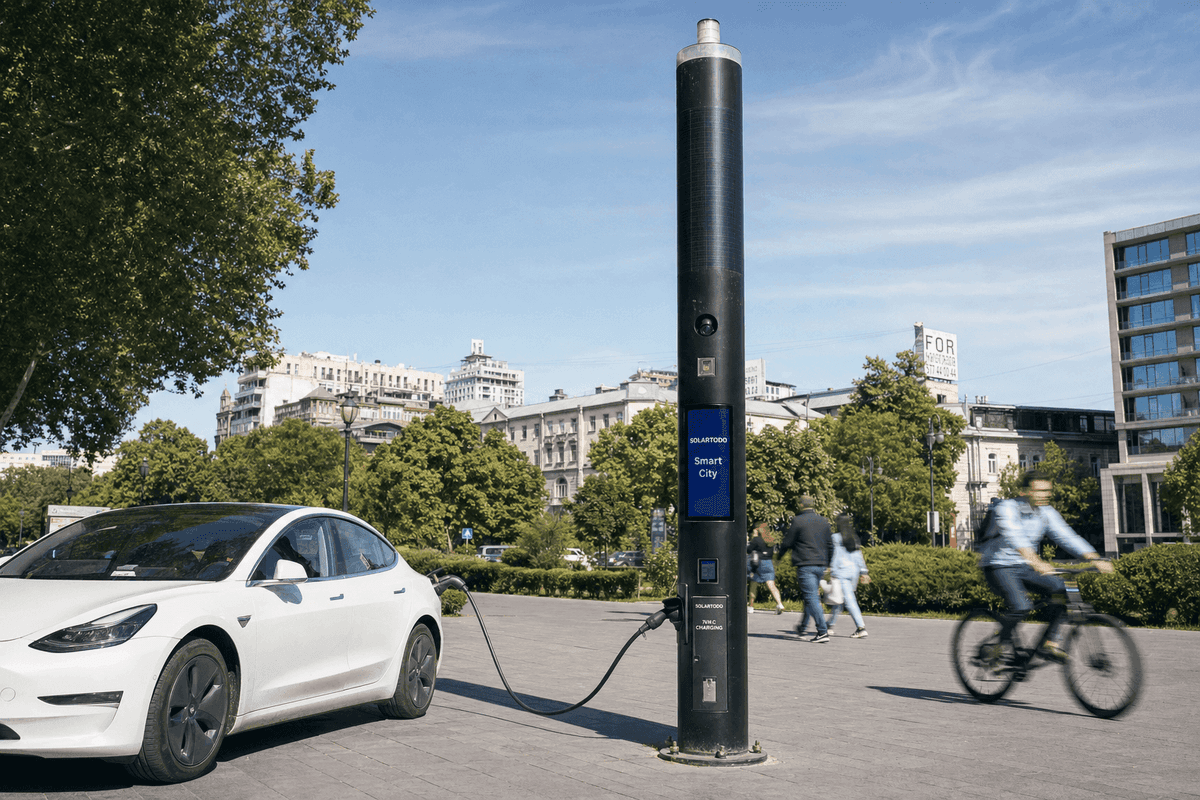
Tbilisi Smart Streetlight Market Analysis: 88-Unit 11m Flush Cylindrical Pole Configuration
Summary
Tbilisi's 1.26M residents, 504.3 km² city area, and 380-770m elevation range support an 88-unit, 11m SOLARTODO Smart Streetlight configuration with 22m spacing and flush Ø200mm cylindrical poles.
Key Takeaways
A Tbilisi Smart Streetlight program should prioritize 11m cylindrical poles, 22m spacing, and fully flush public-realm equipment for dense urban corridors.
- A typical 88-unit deployment would cover approximately 1.94 km at 22m spacing, suitable for boulevard, transit, civic, and mixed-use streets.
- Each pole would use an 11m seamless Ø200mm cylinder with 5mm wall thickness, hot-dip galvanizing, and black RAL9005 powder coating.
- The lighting package specifies 100W LED output at 15,000 lm, 4000K color temperature, and a top Ø200mm PMMA translucent diffuser dome.
- Integrated CIGS thin-film solar provides approximately 201W total output from a 360° wrapped section between 6.5m and 10.3m above grade.
- The embedded EV charging interface uses an 11kW AC Type 2 socket, 5m coiled Type 2 cable, and a flush touchscreen at 1.5m height.
- Digital city functions include 8MP 180° panoramic camera, WiFi 6, 12-parameter environmental sensing, SOS intercom, USB-C PD 30W, and USB-A.
- The recommended battery pack is a 3,000Wh LFP system inside the pole base with MPPT, supporting monitored auxiliary loads and backup operation.
Market Context for Tbilisi
Tbilisi's street infrastructure must serve more than 1.25 million people across a mountainous capital city with dense corridors and strong public-space constraints.
According to the National Statistics Office of Georgia (2024), Tbilisi had approximately 1,258,500 residents in 2024, making it Georgia's largest city and its primary economic center. According to Tbilisi municipal geography data (2026), the city covers about 504.3 km² and sits between roughly 380m and 770m elevation, which creates steep streets, constrained sidewalks, and corridor-specific wind exposure. These conditions favor compact equipment envelopes over poles with side arms, external boxes, or separate EV bollards.
According to the World Bank (2023), Georgia's urban population is above 60% of the national total, and Tbilisi carries much of the country's administrative, commercial, and transport demand. Smart lighting therefore has to do more than illuminate streets: it should host urban sensing, emergency communication, WiFi access, EV charging, and digital wayfinding without adding clutter. World Bank urban guidance states, "Cities are engines of growth," a useful framing for Tbilisi because street assets must support mobility, safety, and digital services simultaneously.
Tbilisi's climate and topography also influence the engineering recommendation. A cylindrical, constant-diameter pole reduces snag points and presents a cleaner wind profile than modular side-arm assemblies. The Global Solar Atlas by the World Bank and Solargis provides solar-resource mapping at approximately 250m to 1km resolution, which is adequate for early feasibility checks but not a substitute for final shading surveys on narrow streets.
Recommended Technical Configuration
A typical Tbilisi configuration would use approximately 88 SOLARTODO Smart Streetlight units in the premium cylindrical form factor for high-visibility urban corridors.
The recommended size class is the SOLARTODO cylindrical smart pole variant rather than a 12m wind-solar hybrid or standard octagonal modular pole. Tbilisi's central corridors, historic streetscapes, and pedestrian-heavy districts benefit from a monolithic Ø200mm form that hides the camera, WiFi, display, SOS intercom, and EV charger inside the cylinder skin. The configuration is not a highway lighting package and is not a park garden-lighting package; it is an urban street-class system.
A typical 88-unit deployment of this scale would use 22m spacing, equal to approximately 45 poles per kilometer. That falls within the stated urban density range of 30-50 poles per kilometer while providing tighter coverage for safety cameras, WiFi service, and environmental sensing. SOLARTODO should be specified as a technical equipment package through the Smart Streetlight product page, with final photometric simulation, foundation design, and utility interface confirmed during engineering review.
Technical Specifications
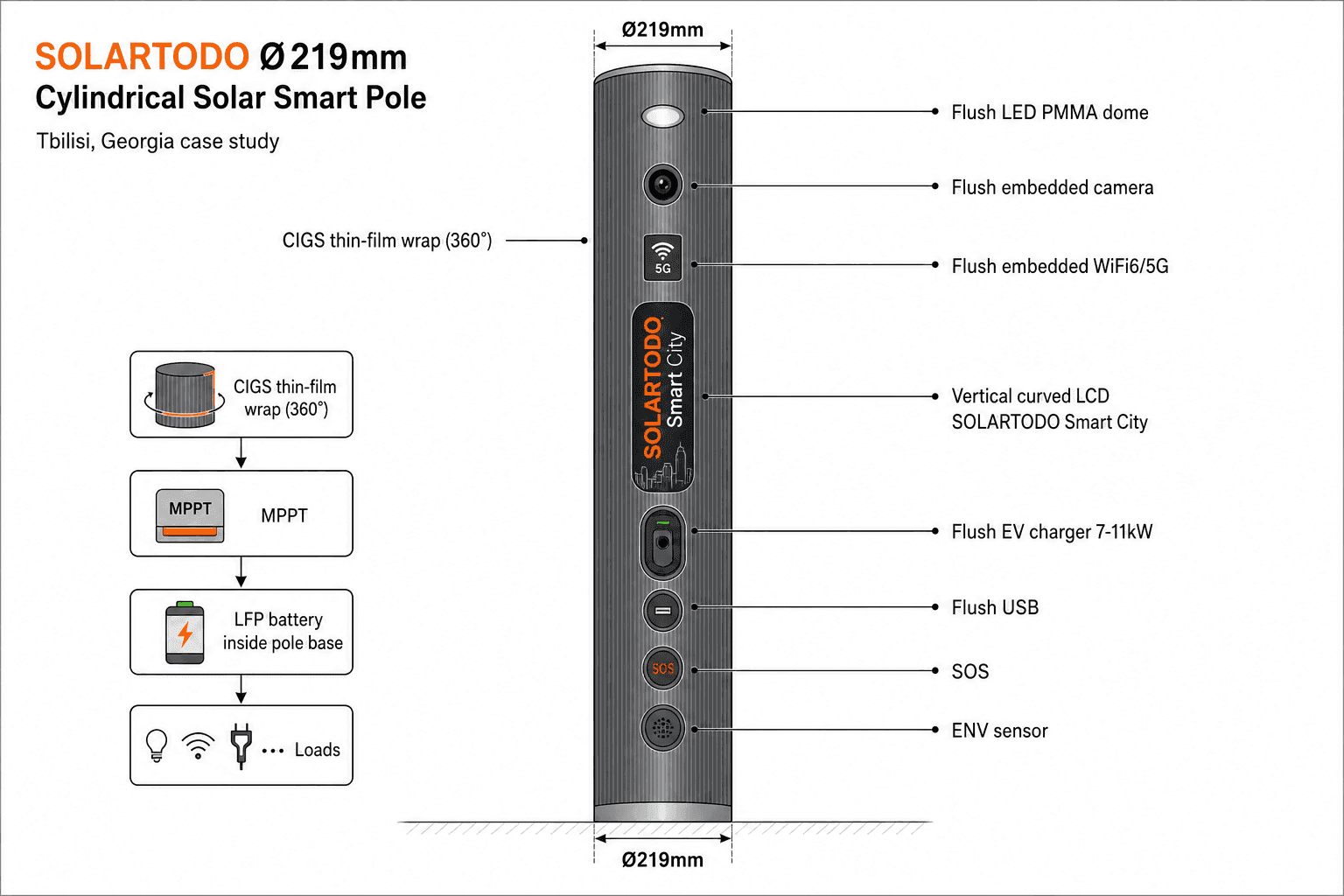
The recommended 11m SOLARTODO Smart Streetlight uses a seamless Ø200mm cylindrical body with all modules flush-integrated and no external side arms.
- Quantity basis: approximately 88 units for a typical corridor package, not a claimed past deployment.
- Pole body: 11m seamless cylindrical Ø200mm pole, constant diameter top-to-bottom, 5mm wall thickness, hot-dip galvanized steel.
- Finish: black RAL9005 powder coat over galvanized substrate.
- Mechanical design rule: one monolithic cylinder; no side arms, luminaire outriggers, IP speaker columns, public-address audio modules, external boxes, widened base, separate bollard, or separate EV pillar.
- Luminaire: Ø200mm PMMA translucent diffuser dome, flush on top, same diameter as the pole, 100W, 15,000 lm, 4000K.
- Solar surface: 360° CIGS flexible thin-film wrap from 6.5m to 10.3m, approximately 201W total, dark blue-black semi-transparent film laminated flush to pole skin.
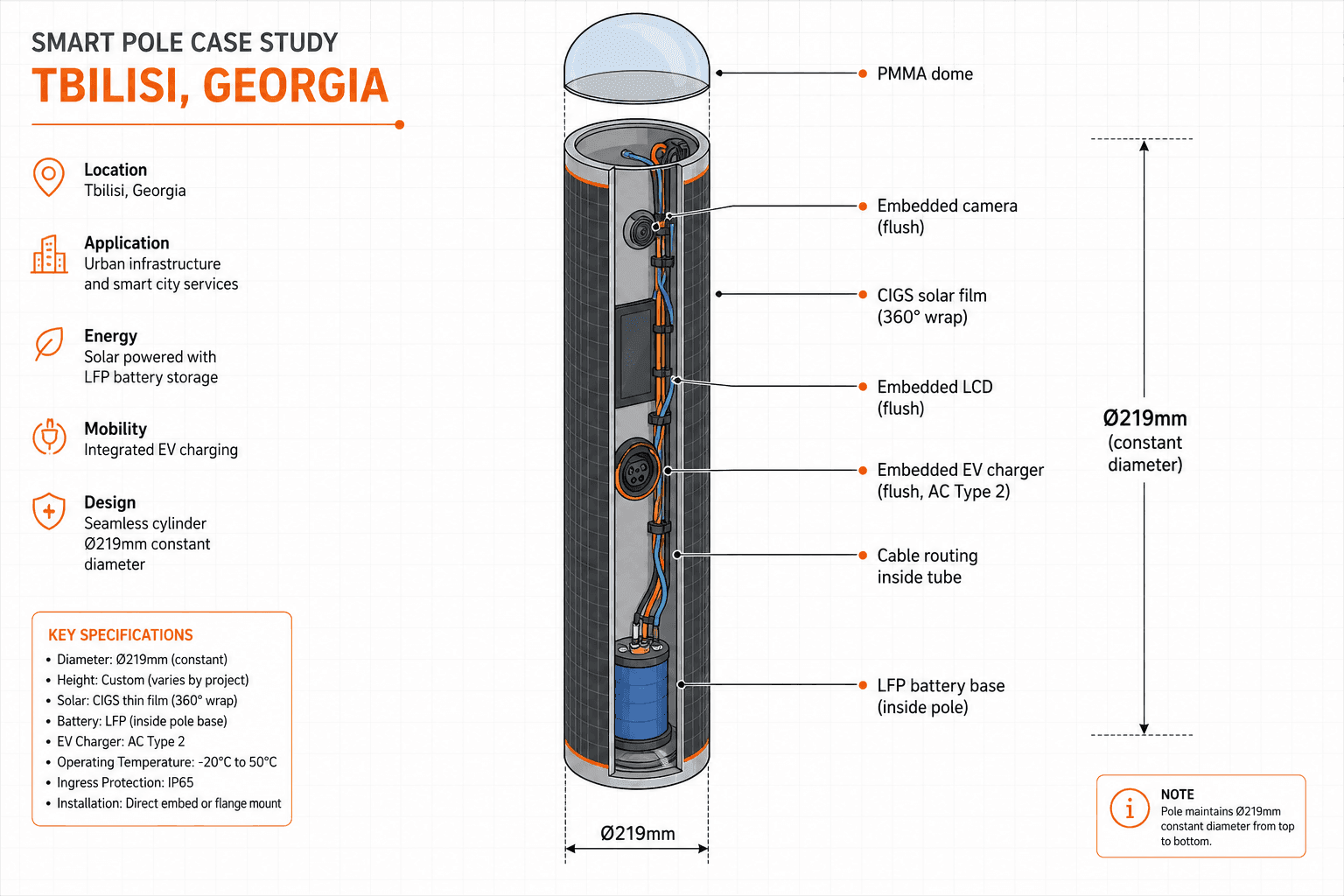
- Battery and controls: 3,000Wh LFP battery inside pole base, MPPT controller, LoRaWAN or 4G smart controller, and cloud platform integration.
- Environmental sensing: flush 12-parameter pod for meteorology, air quality, rain, CO, NO2, and O3 measurement.
- Camera: flush 8MP fisheye 180° panoramic camera behind a dome glass window, with no protruding bracket.
- Communications: embedded WiFi 6 with internal antenna inside the cylinder, no external disc antenna.
- Emergency interface: flush SOS button and two-way audio intercom through pinhole speaker grille only.
- EV charging: fully flush embedded 11kW AC Type 2 charger, flush flip-cap socket, 5m coiled Type 2 cable, and flush touchscreen at 1.5m.
- Display: 1800mm × approximately 170mm vertical curved LCD display, bent to Ø200mm radius, front-face portrait orientation only, showing "SOLARTODO Smart City" text stacked vertically in white on deep blue.
- USB charging: flush USB-C PD 30W and USB-A ports.
- Standards basis: IEC 60598 for luminaires and GB/T 37024 for smart lighting system functions.
According to IEC (2024), IEC 60598 defines general luminaire safety requirements, including construction, marking, and testing expectations for lighting equipment. IEC states, "International Standards support quality infrastructure," which matters because a multi-function pole combines electrical, lighting, communications, and public-access interfaces in one street asset. The SOLARTODO design should therefore be treated as a coordinated electro-mechanical system, not as a decorative pole with accessories added afterward.
Implementation Approach
A Tbilisi Smart Streetlight rollout would normally proceed in 5 engineering stages from corridor survey through commissioning and asset handover.
The first stage is a corridor survey covering lighting class, sidewalk width, utility access, EV demand, camera sightlines, tree canopies, and solar shading. Engineers should validate that 22m spacing meets the intended pedestrian and roadway lighting level before procurement. For the 88-unit basis, survey teams would typically divide the route into installation zones so civil works do not block the full corridor at once.
The second stage is technical submittal and procurement. SOLARTODO would provide pole drawings, module integration layouts, electrical single-line assumptions, charger interface details, display content constraints, and packing lists for CKD or assembled shipping. The display content should remain strictly limited to the specified "SOLARTODO Smart City" vertical text format, with no imagery, video, or advertising.
The third stage is foundation and utility preparation. Because the charger is inside the Ø200mm cylinder and no widened base is allowed, cable routing, earthing, drainage, and service access must be solved below grade and inside the pole envelope. The fourth stage is erection, alignment, electrical termination, charger testing, WiFi commissioning, camera configuration, and sensor calibration. The fifth stage is acceptance testing, cloud onboarding, maintenance training, and documentation for municipal or EPC operators.
Expected Performance & ROI
An 88-unit Tbilisi configuration would combine 8.8kW of LED lighting load, 968kW of embedded AC charging capacity, and 17.7kW of CIGS surface PV.
Expected performance should be modeled as multi-service infrastructure value rather than solar-only payback. The 88-pole lighting load equals 8.8kW at full output, while embedded EV charging capacity equals 88 × 11kW, or 968kW if all charging points are energized at nameplate capacity. The CIGS wrap contributes approximately 17.7kW total rated PV surface, which supports auxiliary loads and battery charging but should not be presented as the main economic driver.
According to IEA (2022), LED lighting is central to building and city energy-efficiency pathways, and IEA describes energy efficiency as "the first fuel." Compared with legacy discharge lighting, a 100W, 15,000 lm LED head can reduce operating power while improving controllability and maintenance planning. The ROI case usually depends on avoided trenching for separate devices, lower visual clutter, consolidated maintenance visits, EV charging utilization, and digital-service value.
For budgeting analysis, payback should be calculated corridor by corridor using local electricity tariffs, charger utilization, maintenance labor, data-service policy, and whether the buyer selects FOB Supply, CIF Delivered, or EPC Turnkey. For technical due diligence, contact SOLARTODO with road geometry, target lux class, power availability, EV connector requirements, and installation photos.
Results and Impact
A typical 88-unit corridor would create a 1.94km smart streetlight backbone with lighting, EV charging, sensing, WiFi, and emergency functions.
The expected impact is a cleaner and more service-dense public realm. Instead of installing a separate lighting pole, charger bollard, CCTV mast, WiFi enclosure, sensor box, and SOS post, the cylindrical SOLARTODO configuration consolidates those functions into one Ø200mm vertical asset. This is especially relevant in Tbilisi streets where sidewalks, shopfronts, curbside parking, and bus movements compete for limited space.
The technical risk profile is also clearer than a fragmented multi-vendor approach. A single cylindrical enclosure simplifies visual design control, but it raises the engineering bar for thermal management, service access, water ingress protection, and cable routing. Final acceptance should include photometric tests, charger electrical safety checks, camera privacy masking, sensor calibration records, display brightness validation, and cloud connectivity tests.
Comparison Table
The 11m cylindrical SOLARTODO configuration offers the most compact integration among 4 Smart Streetlight form factors for Tbilisi's premium corridors.
| Configuration | Best-fit use in Tbilisi | Height / form | Energy system | Integration level | EV charging approach |
|---|---|---|---|---|---|
| cyl_219 recommended | Premium boulevards, transit streets, civic corridors | 11m seamless Ø200mm cylinder | 201W CIGS wrap + 3,000Wh LFP + grid interface | Fully flush, no arms or external boxes | 11kW AC Type 2 inside cylinder |
| standard | Secondary urban roads and lower-cost districts | 6-12m octagonal galvanized pole | Grid or modular options | Modular accessories may be visible | Optional modular EV interface |
| hybrid_12m | Wider streets needing renewable backup visibility | 12m octagonal pole | 100-300W wind + solar + LFP + grid backup | External renewable hardware visible | Integrated cabinet-style EV charging |
| grid_12m | MENA-style grid-powered flagship corridors | 12m octagonal tapered steel | Grid-powered AC | Lower 2.2m integrated charger cabinet | Integrated charger cabinet, not separate pillar |
Pricing & Quotation
SOLARTODO Smart Streetlight quotations are normally structured in 3 tiers: equipment supply, delivered supply, and full EPC turnkey delivery.
SOLARTODO offers three pricing tiers for this product line: FOB Supply (equipment ex-works China), CIF Delivered (including ocean freight and insurance), and EPC Turnkey (fully installed, commissioned, with 1-year warranty). Volume discounts are available for large-scale deployments. Configure your system online for an instant estimate, or request a custom quotation from our engineering team at [email protected].
Frequently Asked Questions
These 10 answers cover the main technical, procurement, ROI, warranty, maintenance, installation, and EPC questions for an 88-unit Tbilisi configuration.
Q1: Why is the cylindrical Ø200mm pole recommended for Tbilisi? The Ø200mm cylindrical format suits Tbilisi corridors where sidewalks, storefronts, trees, and transport stops limit equipment space. It keeps the pole constant-diameter from top to bottom while hiding lighting, camera, WiFi, SOS, display, USB, and 11kW EV charging functions inside the same vertical skin.
Q2: Is this article describing an actual SOLARTODO deployment in Tbilisi? No. This is a market analysis and technical configuration guide, not a fabricated case study. The 88-unit quantity is used as a recommended planning basis for a typical corridor-scale deployment. It should be validated by survey, photometric design, grid availability, utility approvals, and procurement scope.
Q3: What deployment timeline should an EPC buyer expect? A typical 88-unit program would usually require corridor survey, technical submittals, procurement, shipping, foundation works, installation, electrical termination, and commissioning. Depending on permitting and utility readiness, a practical timeline often runs in staged months rather than days, with installation divided into zones to reduce traffic and pedestrian disruption.
Q4: How should ROI be calculated for this Smart Streetlight system? ROI should include avoided separate infrastructure, LED energy savings, consolidated maintenance, EV charging utilization, emergency-service value, WiFi or data-service policy, and lifecycle replacement costs. The 17.7kW total CIGS rating supports auxiliary energy contribution, but the stronger ROI logic is multi-function consolidation across 88 street assets.
Q5: What maintenance model is appropriate for the 11m flush cylindrical pole? Maintenance should use scheduled inspections for the diffuser dome, touchscreen, Type 2 socket, cable, SOS button, pinhole audio grille, sensor calibration, camera window, display brightness, battery health, and cloud connectivity. Because all modules are flush-integrated, technicians need approved access procedures that preserve sealing, coating, and cylinder alignment.
Q6: How does this compare with a standard octagonal smart pole? A standard octagonal pole is typically easier to adapt with modular accessories and may be better for budget-sensitive roads. The Ø200mm cylindrical design is more demanding to manufacture, but it gives Tbilisi premium corridors a cleaner streetscape by removing side arms, visible boxes, separate charger posts, and external antenna discs.
Q7: What EPC pricing information is available without publishing unit prices? SOLARTODO structures quotations as FOB Supply, CIF Delivered, or EPC Turnkey rather than publishing fixed city-level prices. Final EPC pricing depends on foundations, trenching, local labor, utility connection scope, import route, commissioning requirements, and warranty terms. Buyers should request a custom quote using corridor drawings and required service levels.
Q8: What warranty scope should be requested? For EPC Turnkey procurement, the required paragraph specifies a 1-year warranty. Buyers should also request component-level warranty schedules for LED driver, display, charger module, LFP battery, controller, camera, sensors, coating, and CIGS laminate. Warranty review should distinguish manufacturing defects from damage, misuse, vandalism, and utility-side power events.
Q9: What installation constraints matter most in Tbilisi? The main constraints are sidewalk width, underground utilities, slope, drainage, tree shading, curb access, power availability, and charger cable reach. Because the pole cannot use a widened base or separate EV bollard, foundation and cable routing details must be resolved before manufacturing release and installation sequencing.
Q10: Which standards should be referenced in procurement documents? Procurement documents should reference IEC 60598 for luminaire safety and GB/T 37024 for smart lighting system functions, plus local Georgian electrical, civil, permitting, and telecom requirements. For connected infrastructure, ITU IMT-2020 guidance is relevant because smart poles may support dense urban wireless and IoT service planning.
References
These 7 references provide the demographic, urban, energy, lighting, telecom, solar, and product-standard basis for the Tbilisi recommendation.
- National Statistics Office of Georgia (2024): Population by cities and regions; Tbilisi listed at approximately 1,258,500 residents in 2024.
- Tbilisi City Hall / municipal geography data (2026): Tbilisi administrative area about 504.3 km², with elevation range commonly cited around 380-770m.
- World Bank (2023): Georgia urban-development and population indicators; urban population above 60% of national total.
- International Energy Agency (2022): Lighting and energy-efficiency guidance identifying LED deployment as a core efficiency measure.
- IEC (2024): IEC 60598 luminaire safety standard covering general requirements and tests for lighting equipment.
- ITU (2020): IMT-2020 / Recommendation ITU-R M.2150 defining 5G radio-interface capabilities for dense mobile and IoT networks.
- World Bank and Solargis Global Solar Atlas (2024): Solar-resource mapping with approximately 250m to 1km data layers for preliminary PV feasibility analysis.
Equipment Deployed
- 88 units × 11m seamless cylindrical Ø200mm Smart Streetlight pole, constant diameter top-to-bottom, 5mm wall, hot-dip galvanized steel
- Black RAL9005 powder coat finish over galvanized pole body
- Ø200mm PMMA translucent diffuser dome, flush top-mounted, 100W, 15,000 lm, 4000K
- 360° CIGS flexible thin-film solar wrap from 6.5m to 10.3m, approximately 201W per pole
- LFP 3,000Wh battery inside pole base with MPPT controller
- Flush 12-parameter environmental sensor pod with meteorology, air quality, rain, CO, NO2, and O3
- Flush 8MP fisheye 180° panoramic camera behind dome glass window
- Embedded WiFi 6 with internal antenna inside cylinder
- Flush SOS button and two-way audio intercom through pinhole speaker grille
- Fully flush embedded 11kW AC Type 2 EV charger with flip-cap socket, 5m coiled cable, and touchscreen at 1.5m
- 1800mm × approximately 170mm vertical curved LCD display showing SOLARTODO Smart City text only
- Flush USB-C PD 30W and USB-A charging ports