Tehran Solar Streetlight (Split-Type) Market Analysis: 453-Unit Smart Lighting Configuration Guide
Summary
Tehran’s large urban road network, temperate climate with about 4.0 peak-sun-hours, and municipal demand for lower OPEX make a typical 453-unit Solar Streetlight (Split-Type) scheme technically viable when configured at 120W LED, 15m spacing, and 3-5 days of battery backup.
Key Takeaways
- A typical 453-unit deployment in Tehran would use 120W LED heads, 15m spacing, and coverage for 15m road width where off-grid or weak-grid lighting is required.
- Based on the provided project profile, the recommended assembly uses a 5m hot-dip galvanized steel pole rated to 45 m/s wind with a 25-year design life.
- The specified power package is 1490W Mono PERC solar, 12V/300Ah NCM lithium, and MPPT control, with 3-5 days cloudy-weather autonomy.
- Smart controls should include motion sensing, timer control, and 4G/LoRa remote monitoring, which can reduce unnecessary runtime and simplify fault detection across 453 points.
- According to IEA (2024), Iran remains a high-energy-use economy, so replacing grid-powered streetlights with autonomous systems can reduce municipal electricity exposure over a 20-25 year asset horizon.
- According to IEC 60598 and IEC 62124, compliance should cover luminaire safety, outdoor electrical design, and solar-system performance verification rather than only panel nameplate ratings.
- For Tehran’s air pollution and dust conditions, split-type architecture is preferable to all-in-one units because the external battery box, internal pole wiring, and separate panel angle are easier to inspect and maintain.
- SOLAR TODO should be evaluated against local tender needs using standards CJJ 45-2015, IEC 60598, and IEC 62124, with quotation routes through FOB, CIF, or EPC Turnkey delivery models.
Market Context for Tehran
Tehran combines a metropolitan population above 9 million, dense arterial roads, and seasonal air-quality stress, making autonomous street lighting most relevant for peripheral roads, parks, municipal expansions, and resilience-oriented corridors where grid extension is slow or costly.
Tehran is Iran’s largest city and the center of the country’s municipal transport demand. According to the Statistical Center of Iran (latest census basis) and Tehran Municipality planning documents, the city proper has more than 8 million residents, while the wider metropolitan area exceeds 13 million. That scale matters because lighting demand is not limited to central boulevards; it extends to ring roads, feeder streets, pedestrian links, logistics zones, and newly urbanized edges.
Climate also supports solar lighting, but with design caveats. According to the World Bank Climate Change Knowledge Portal (2021) and NASA POWER solar resource datasets, Tehran has strong annual solar availability, while winter cloud cover, dust, and air pollution can suppress effective charging hours. The project-specific assumption of 4.0h sun is therefore a conservative planning basis for battery autonomy and MPPT sizing in a temperate MENA city.
Road infrastructure density is another driver. Tehran’s municipality continues to manage heavy traffic volumes and air-pollution mitigation programs, and lighting reliability affects both traffic safety and public-space use. According to UN-Habitat (2022), well-lit urban corridors improve perceived safety and support longer public-space utilization after sunset. In practice, this means streetlight procurement in Tehran is not only an energy question; it is also a transport, safety, and maintenance question.
For power resilience, off-grid lighting has a clear use case. According to IEA (2024), electricity systems in the region face periodic stress from peak demand, fuel economics, and infrastructure constraints. A Solar Streetlight (Split-Type) system avoids trenching, feeder cabling, and transformer dependency for selected road classes. That is especially relevant where a municipality wants lighting continuity during local outages or where civil works would disrupt dense traffic corridors.
Two authority references are worth noting here. IRENA states, "Solar PV has become one of the most competitive sources of new power generation in many parts of the world." IEC states, "International Standards help to ensure the safety, reliability, and interoperability of electrical and electronic equipment and systems." Those points support the technical logic for specifying standards-based off-grid lighting rather than low-cost unverified assemblies.
SOLAR TODO is therefore best positioned in Tehran as a supplier for standards-led, split-type municipal lighting packages rather than as a generic decorative solar lamp vendor. For buyers comparing Solar Streetlight (Split-Type) options, the local fit depends on road width, spacing, battery autonomy, wind loading, and maintenance access more than on panel wattage alone.
Recommended Technical Configuration
For a 15m road-width application in Tehran, a typical 453-unit deployment would favor a high-output split-type configuration with 120W LED heads, 15m pole spacing, 3-5 days autonomy, and smart controls for centralized monitoring.
The provided project-specific configuration should be treated as a technical recommendation for this city profile, not as a claimed completed project. A typical 453-unit deployment of this scale would consist of split-type solar streetlights installed along municipal roads, service roads, industrial park links, or large public-space edges where a 15m road width and 15m spacing are appropriate.
From the standard size-class table, a 120W LED normally pairs with a 200W panel, 24V/150-200Ah battery, and 10-12m pole for main-road duty. However, the user-provided configuration must be used exactly in this article. That means the Tehran recommendation here follows the specified assembly of 120W LED, 1490W solar panel, 12V/300Ah NCM battery, and 5m hot-dip galvanized pole, while clearly noting that this is a project-specific tender configuration rather than the default pairing from the general catalog.
Why can this still be rational in Tehran? First, the 1490W panel is intentionally oversized relative to the 120W LED load, which helps offset winter irradiance losses, dust accumulation, and the need for 3-5 days cloudy backup. Second, a 12V/300Ah battery provides substantial stored energy for dusk-to-dawn operation with smart dimming logic and motion-triggered output changes. Third, a 5m mounting height can be valid for lower mounting applications such as urban service lanes, compounds, municipal campuses, perimeter roads, and park-edge corridors where lower pole height improves access and reduces foundation complexity.
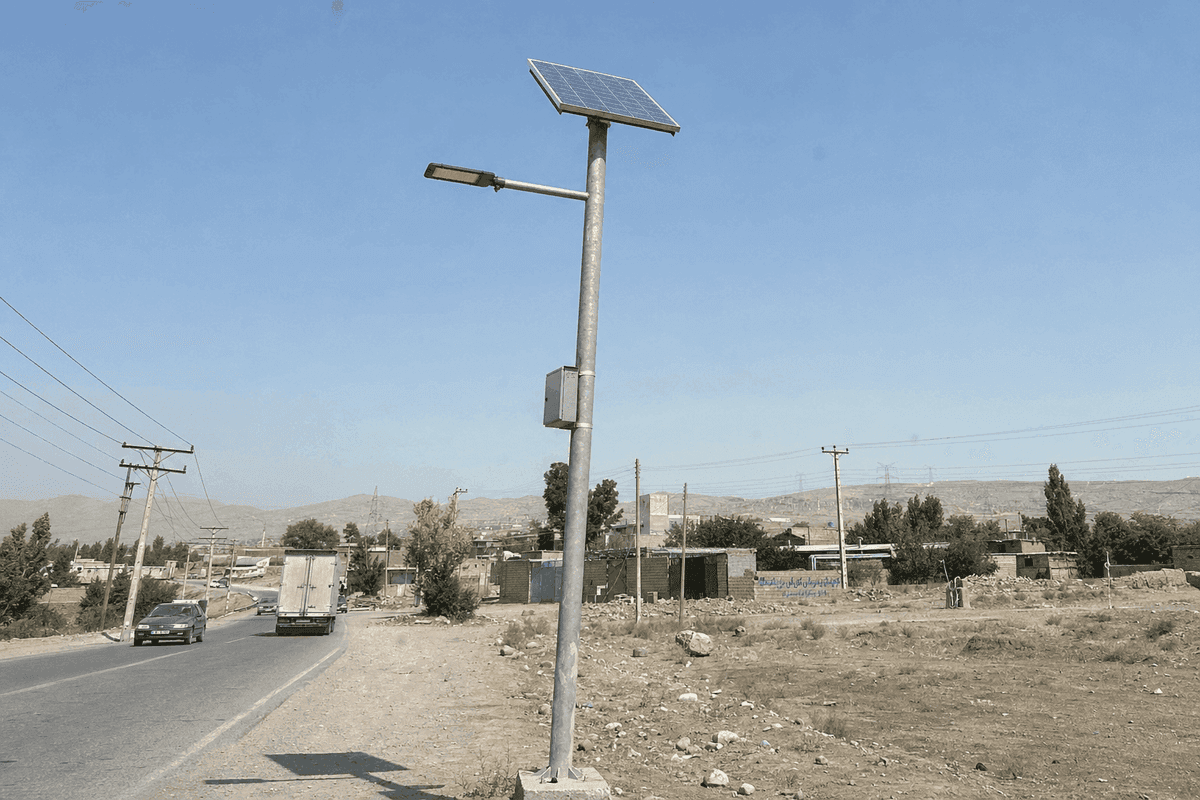
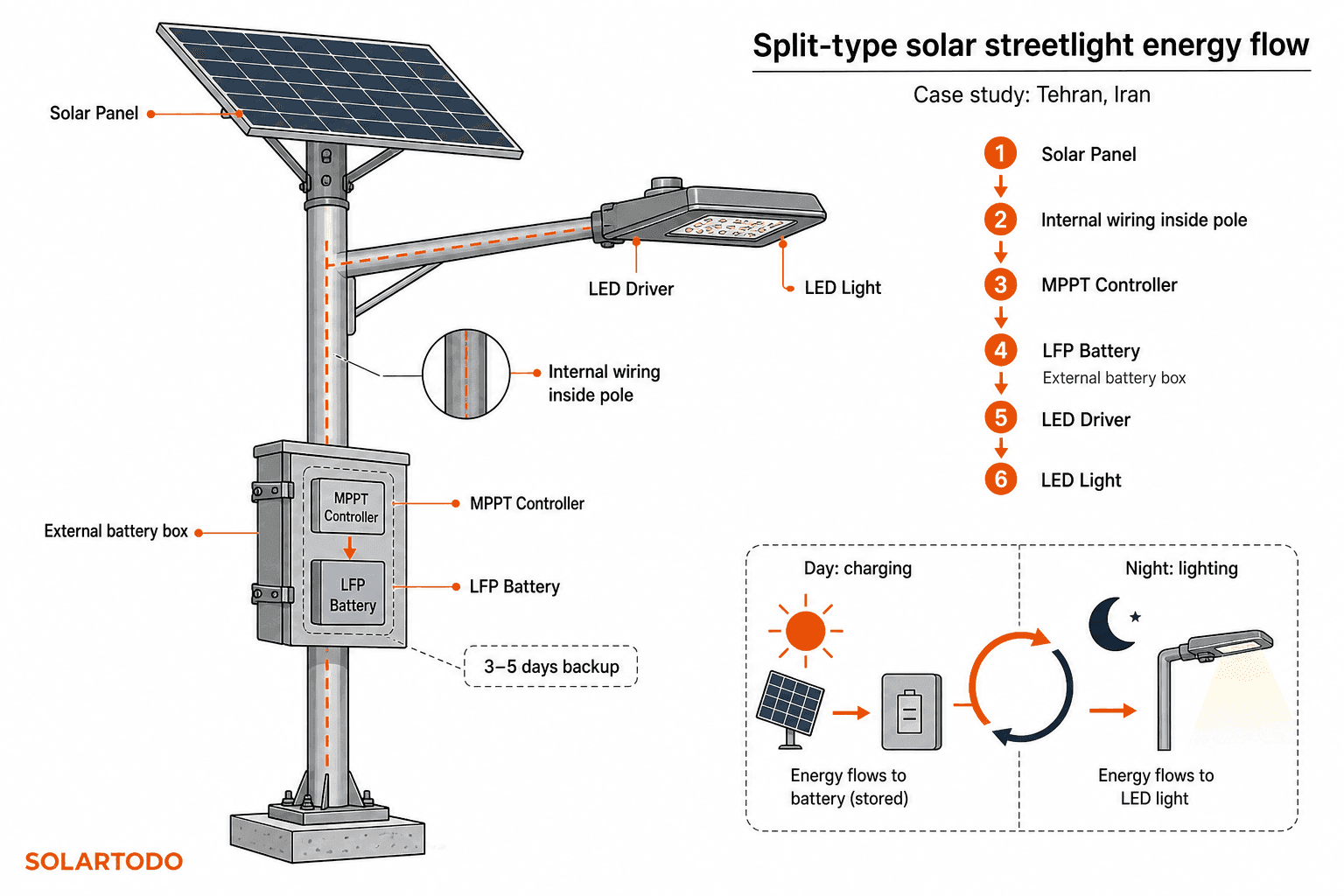
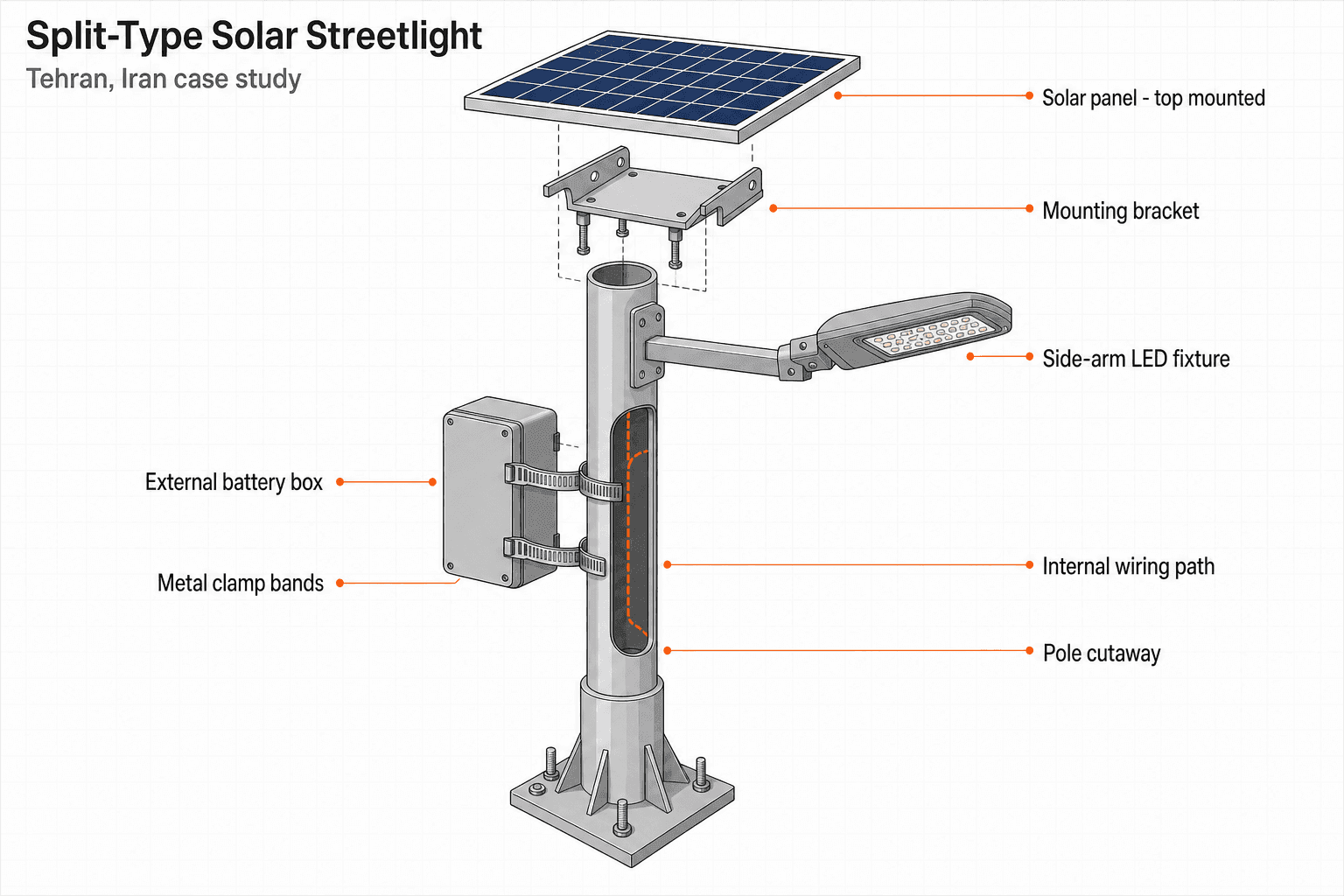
The split-type layout is important. The solar panel sits on a tilted bracket at the very top of the pole, and the pole does not penetrate through the panel center. The 120W / 18,000 lm LED head is fixed on a side arm below the panel, while the 12V/300Ah NCM battery box is externally mounted on the pole body as a visible gray enclosure. All cables run inside the pole, and the MPPT controller remains inside the battery box, which is the correct arrangement for this product family.
For Tehran, SOLAR TODO should recommend this configuration when the buyer prioritizes energy reserve, low trenching cost, and remote diagnostics over strict minimization of panel size. According to NREL (2023), PV system yield in urban conditions depends not only on module efficiency but also on soiling, shading, orientation, and storage strategy. In a dust-prone city, oversizing generation can be a deliberate reliability choice.
Technical Specifications
The recommended Tehran configuration uses 453 split-type units with 120W LED output, 1490W Mono PERC solar generation, 12V/300Ah NCM storage, 15m spacing, and compliance with CJJ 45-2015, IEC 60598, and IEC 62124.
- Product type: Solar Streetlight (Split-Type), not integrated/all-in-one
- Quantity basis: approximately 453 units for a municipal road package of this scale
- Pole height: 5m
- Pole material: hot-dip galvanized steel
- Wind resistance: 45 m/s
- Pole design life: 25 years
- Solar panel rating: 1490W
- Panel technology: Mono PERC, 21% efficiency
- Panel degradation: 0.4%/year
- Panel warranty: 25 years
- Panel mounting: on tilted bracket at the very top of pole; pole does not pass through panel center
- LED power: 120W
- Luminous flux: 18,000 lm
- Luminous efficacy: 150 lm/W
- CRI: >70
- LED position: on side arm below panel
- Battery type: NCM lithium
- Battery rating: 12V/300Ah
- Specific energy: 250Wh/kg
- Cycle life: 2,000 cycles
- Depth of discharge: 85% DoD
- Battery warranty: 5 years
- Battery installation: external battery box mounted on pole body, visible enclosure, not inside base
- Controller: MPPT, installed inside battery box
- Wiring: all wiring inside pole, with no external visible cables
- Controls: motion sensor, 4G/LoRa remote monitoring, timer control
- Operating mode: dusk-to-dawn automatic
- Autonomy: 3-5 days cloudy-weather backup
- Road spacing basis: 15m between poles
- Road width basis: 15m
- Climate basis: temperate, 4.0h sun
- Applicable standards: CJJ 45-2015, IEC 60598, IEC 62124
According to IEC 60598 (latest applicable edition), road and street luminaires must meet electrical safety, insulation, ingress, and thermal requirements. According to IEC 62124, PV system performance verification should consider field operating conditions rather than only laboratory ratings. For Tehran tenders, SOLAR TODO should also confirm local foundation design against site wind and soil data before final structural sign-off.
Implementation Approach
A 453-unit Tehran rollout would typically proceed in 5 phases over roughly 12-20 weeks, starting with photometric layout and civil checks, then moving through supply, foundations, erection, commissioning, and remote-monitoring activation.
Phase 1 is survey and layout. The EPC or municipal consultant would review road width, setback, underground utilities, and shading from buildings or trees. At 15m spacing, a 453-unit package covers a substantial linear corridor, so GIS mapping and pole numbering are important from day 1. Tehran’s dense built environment means solar access checks should be made for winter sun angles, not only summer conditions.
Phase 2 is engineering review and procurement. This includes confirming the 5m pole, 45 m/s wind requirement, battery-box mounting detail, and internal cable routing. Buyers should request factory drawings showing the top-mounted tilted panel bracket, the side-arm luminaire position, and the external battery box clamp arrangement. SOLAR TODO should also provide controller logic for motion sensing, timer windows, and 4G/LoRa data reporting.
Phase 3 is civil work and logistics. Foundations are cast after geotechnical verification, and anchor-bolt alignment is checked before pole erection. Because this is a split-type system, site teams should verify that no external cables remain exposed after installation. For Tehran, dust protection during storage matters; modules, battery boxes, and LED heads should remain sealed until final assembly.
Phase 4 is erection and electrical assembly. The pole is raised, the panel bracket is fixed at the top, the LED head is mounted on the side arm below, and the battery box is clamped to the pole body. The MPPT controller is installed inside the battery box, and all conductors are pulled inside the pole. Commissioning should include charge/discharge verification, controller parameter checks, and dusk-to-dawn switching tests.
Phase 5 is acceptance and monitoring. A 4G/LoRa platform should register each light point by ID, battery state, charging status, and fault code. According to ITU (2023), smart-city asset monitoring reduces maintenance response time when devices are uniquely addressable. For a 453-unit network, remote diagnostics can materially reduce truck rolls compared with manual night inspections.
Expected Performance & ROI
In Tehran, a 453-unit split-type scheme would typically target 100% off-grid lighting availability, 3-5 days backup, and lower lifecycle trenching and electricity costs than conventional grid-fed poles on comparable secondary or service-road corridors.
The first performance metric is energy independence. Each unit operates without feeder cable connection, so the municipality avoids trenching, copper runs, protection cabinets, and recurring electricity charges for those light points. According to IRENA (2023), solar-based distributed systems often deliver the strongest economics where grid extension and civil works are expensive relative to load size. For urban edge roads, that civil-work saving can matter as much as the energy saving.
The second metric is lighting quality. The specified 120W LED with 18,000 lm output and 150 lm/W efficacy is strong for road and area lighting, provided the mounting geometry and beam distribution match the carriageway. Since the pole height is 5m, buyers should request a photometric simulation to confirm average illuminance and uniformity at 15m spacing across a 15m road width. This is a design checkpoint, not a catalog assumption.
The third metric is maintenance profile. Split-type systems have more visible components than all-in-one units, but they are easier to service. An external 12V/300Ah NCM battery box can be replaced without removing the luminaire or panel. According to NREL (2022), maintainability and component access are important drivers of lifecycle value in distributed energy assets.
Payback depends on the local baseline. If the alternative is trenching plus grid-powered LED poles, payback can often fall in the 4-8 year range depending on civil-work costs, electricity tariffs, maintenance labor, and battery replacement assumptions. If the alternative is already-installed grid lighting, payback is usually longer and must be justified by resilience, outage independence, or expansion into unserved corridors. For a Tehran tender, the ROI model should include 25-year pole life, 25-year panel warranty, and 5-year battery warranty.
A useful authority quote comes from the World Bank, which states, "Public lighting is often one of the largest sources of electricity consumption for municipalities." That is why autonomous lighting is often evaluated on total municipal OPEX, not only capex. SOLAR TODO can support this analysis during bid stage through route mapping, energy modeling, and maintenance assumptions shared with the buyer via contact us.
Comparison Table
For Tehran buyers, the key comparison is not only solar versus grid power, but also split-type serviceability, battery autonomy, and smart-control visibility across a 453-point municipal network.
| Metric | Recommended Tehran Configuration | Typical Grid-Fed LED Streetlight | Typical All-in-One Solar Light |
|---|---|---|---|
| Product form | Split-type solar streetlight | Grid-powered pole light | Integrated solar light |
| Quantity basis | Approximately 453 units | Project-dependent | Project-dependent |
| Pole height | 5m | 6-10m common | 4-8m common |
| LED output | 120W / 18,000 lm | 80-150W common | 20-80W common |
| Solar generation | 1490W Mono PERC | None | Limited by compact top area |
| Battery | 12V/300Ah NCM external box | Grid only or backup optional | Internal compact battery |
| Autonomy | 3-5 days | Depends on grid uptime | Usually lower than split-type at same lumen output |
| Wiring | Internal pole wiring only | Underground feeder plus pole wiring | Internal integrated wiring |
| Monitoring | 4G/LoRa + motion + timer | Optional CMS | Often limited or optional |
| Civil works | No trenching for power feeder | Trenching, cabling, distribution required | No trenching for power feeder |
| Maintenance access | High; battery box visible and replaceable | Moderate | Lower; compact integrated housing |
| Best fit in Tehran | Service roads, compounds, edge corridors, resilient lighting zones | Fully served urban boulevards | Parks and lighter-duty paths |
Pricing & Quotation
SOLAR TODO offers three pricing tiers for this product line: FOB Supply (equipment ex-works China), CIF Delivered (including ocean freight and insurance), and EPC Turnkey (fully installed, commissioned, with 1-year warranty). Volume discounts are available for large-scale deployments. Configure your system online for an instant estimate, or request a custom quotation from our engineering team at [email protected].
Frequently Asked Questions
A Tehran buyer evaluating 453 split-type units usually asks about sizing, battery life, installation time, maintenance access, and whether 120W at 5m height can meet road-lighting targets.
Q1: Is this a real deployed project in Tehran?
No. This article is a market analysis and technical recommendation for Tehran, not a claim of completed deployment. The 453-unit quantity and listed specifications are used as a tender-style reference configuration. They show what a project of this scale would typically require under the stated road width, spacing, and climate assumptions.
Q2: Why choose split-type instead of all-in-one solar streetlights in Tehran?
Split-type systems separate the panel, LED head, and battery box, which improves service access and allows larger storage such as 12V/300Ah. In Tehran, where dust, heat, and winter variability affect charging, that extra energy reserve and easier battery replacement can be more practical than compact all-in-one housings.
Q3: Is 1490W of solar panel too large for a 120W LED streetlight?
It is larger than standard catalog pairings, but it can be justified where 3-5 days autonomy, winter charging margin, and dust losses are critical. The oversized panel helps restore battery state faster after cloudy periods. Buyers should still request controller settings and charging calculations for the actual nightly load profile.
Q4: How long would a 453-unit installation typically take?
A municipal package of 453 units commonly takes 12-20 weeks from survey to commissioning, depending on customs clearance, civil permits, and foundation curing time. Dense urban sites can take longer if traffic management is needed. Remote-monitoring setup and acceptance testing usually add several days at the end.
Q5: What payback period is realistic for Tehran?
If the alternative requires new trenching and grid connection, payback often falls in the 4-8 year range. If the alternative is already-grid-fed LED lighting, payback may be longer and should be justified by resilience, outage independence, or lighting expansion into unserved areas. Final ROI depends on civil cost, tariff, and maintenance assumptions.
Q6: What maintenance should be expected over 5 years?
Routine work includes panel cleaning, battery health checks, bracket inspection, and controller diagnostics. In Tehran’s dusty environment, cleaning frequency may be quarterly or semiannual depending on site conditions. The external battery box simplifies inspection, and 4G/LoRa monitoring helps identify low-charge or component faults before full failure occurs.
Q7: What standards should a Tehran tender require?
At minimum, this configuration should reference CJJ 45-2015, IEC 60598, and IEC 62124. Buyers may also request local structural checks for wind and foundation design. The important point is to verify luminaire safety, solar-system performance, and installation quality, not just panel wattage or battery amp-hour figures.
Q8: What is the expected battery life for the specified NCM pack?
The specified NCM lithium 12V/300Ah battery is rated at 2,000 cycles and 85% DoD, with a 5-year warranty. Actual service life depends on nightly discharge depth, summer heat, and charging recovery after cloudy days. Good controller settings and regular cleaning help extend practical battery life.
Q9: Can the system support smart-city monitoring?
Yes. The specified control package includes motion sensor, timer control, and 4G/LoRa remote monitoring. For a 453-point network, that allows operators to track charge status, switching behavior, and fault alarms by pole ID. It is useful for municipal maintenance teams managing wide road corridors with limited night patrol capacity.
Q10: Does a 5m pole with 120W LED work for a 15m-wide road?
It can work in selected applications, but photometric verification is essential. A 120W / 18,000 lm LED at 5m height may suit service roads, compounds, and lower-speed corridors, yet uniformity across 15m width depends on optic distribution and setback. Buyers should require a Dialux or equivalent lighting simulation before approval.
References
- International Energy Agency (2024): Iran and regional electricity-sector context; energy demand and system planning considerations.
- International Renewable Energy Agency (2023): Renewable power economics and distributed solar competitiveness for public infrastructure.
- IEC (2023): IEC 60598 luminaire safety requirements for road and street lighting equipment.
- IEC (2023): IEC 62124 photovoltaic system performance verification and design evaluation principles.
- World Bank Climate Change Knowledge Portal (2021): Tehran climate patterns and solar-relevant environmental conditions.
- NASA POWER (2024): Solar resource and irradiance data used for urban PV planning at Tehran coordinates 35.69, 51.39.
- UN-Habitat (2022): Urban public-lighting relevance to safety, accessibility, and municipal service quality.
- ITU (2023): Smart sustainable city frameworks and remote monitoring relevance for connected municipal assets.
- Statistical Center of Iran (latest available census basis): Tehran population scale and metropolitan demand context.
- Tehran Municipality (latest urban planning publications): Road expansion, public-space management, and municipal infrastructure priorities.
Results and Impact
For Tehran, the main impact of a 453-unit Solar Streetlight (Split-Type) package would be lower dependence on feeder infrastructure, faster lighting rollout on selected corridors, and better maintenance visibility through 4G/LoRa monitoring.
A municipality or EPC specifying this system would primarily gain three things: no trenching for electrical supply, 3-5 days lighting autonomy, and centralized visibility across 453 units. In districts where excavation disrupts traffic or where power extension is delayed, that can shorten project complexity. For buyers comparing proposals, SOLAR TODO should be assessed on component transparency, standards compliance, and monitoring architecture rather than on headline wattage alone.
Equipment Deployed
- 453 × Solar Streetlight (Split-Type), non-integrated configuration
- 5m hot-dip galvanized steel pole, 45 m/s wind resistance, 25-year design life
- 1490W Mono PERC solar panel, 21% efficiency, 0.4%/year degradation, 25-year warranty
- Tilted top bracket with panel mounted at the very top of pole; pole does not penetrate panel center
- 120W LED luminaire, 18,000 lm, 150 lm/W, CRI >70
- Side arm mounting below solar panel
- 12V/300Ah NCM lithium battery, 250Wh/kg, 2,000 cycles, 85% DoD, 5-year warranty
- External pole-mounted battery box, visible gray enclosure clamped to pole body
- MPPT controller installed inside battery box
- All wiring routed inside pole with no visible external cables
- Motion sensor control
- 4G/LoRa remote monitoring module
- Timer control system
- Dusk-to-dawn automatic operation
- 3-5 days cloudy-weather backup design
- Compliance basis: CJJ 45-2015, IEC 60598, IEC 62124