
Summary
Telecom Tower in Global is a 45 m steel monopole with 6 panel antennas, 3 RRUs and 2 microwave dishes, delivered as a $47,768 turnkey installation. Designed for wind class 4 with lightning and aircraft lighting, it supports modern 4G/5G deployments and co-location opportunities.
Key Takeaways
- Deploy a 45 m steel monopole with 6 panel antennas and 2 microwave dishes to support dense 4G/5G coverage and microwave backhaul in a single structure.
- Leverage the verified $47,768 turnkey price to budget accurately for civil works, tower erection, antenna mounting and commissioning for one complete site.
- Use wind class 4 structural design to improve reliability and reduce downtime in regions where extreme wind events can exceed 40–45 m/s.
- Specify integrated lightning rod, aircraft light and grounding system to comply with aviation and electrical safety codes at heights above 30–45 m.
- Optimize O&M by choosing a low-corrosion steel tower with concrete pad foundation, targeting 25+ year design life with minimal repainting.
- Plan for safe access using a climbing ladder and 2 working platforms to streamline antenna swaps, RRU upgrades and microwave realignment.
- Enable flexible RF planning with 3 RRU units and 6 panel antennas, supporting multi-band 4G/5G sectors and future co-location revenue.
- Compare FOB $0 / CIF $0 / $47,768 turnkey pricing to understand that this configuration is engineered and costed specifically as an installed solution.
Telecom Tower in Global — $47,768 Turnkey Overview
The Telecom Tower in Global configuration is a 45 m steel monopole engineered for wind class 4, carrying 6 panel antennas, 3 RRUs and 2 microwave dishes, delivered as a fully installed turnkey solution at $47,768. This single-tower package is optimized for modern 4G/5G macro coverage and microwave backhaul.
For B2B telecom operators, towercos and EPCs, the main challenge is balancing structural capacity, RF flexibility and lifecycle cost. According to the International Telecommunication Union (2023), mobile data traffic is growing at over 20% annually in many markets, pushing operators to densify networks while reducing site CAPEX and OPEX. A standardized 45 m monopole with clear, fixed pricing helps de-risk rollout plans and accelerate procurement.
SOLAR TODO positions this configuration as a repeatable building block for regional or national rollouts where a 45 m height class and monopole form factor are optimal—typically peri-urban and rural macro sites, as well as shared infrastructure for multiple tenants.
System Design and Engineering Details
The Telecom Tower in Global configuration is defined by the following verified customer parameters and structural choices.
Structural Configuration
- Structure type: monopole
- Structure category: steel tower
- Height: 45 m
- Wind class: class_4
- Corrosion level: low
- Foundation type: concrete_pad
- Quantity: 1 tower
According to IEC 60826 (as referenced by IEC, 2023), wind loading is a primary driver of tower design and steel consumption. A 45 m monopole in wind class 4 must balance stiffness with weight to limit top deflection and maintain microwave link alignment. SOLAR TODO’s engineering approach uses hot-dip galvanized steel to target a 25+ year design life in low-corrosion environments.
Antenna and RF Equipment Load
- RRU units: 3
- Small cells: 0
- Panel antennas: 6
- Microwave dishes: 2
This loading profile is typical for a three-sector macro site with:
- 6 panel antennas for multi-band 4G/5G (e.g., low-band + mid-band per sector)
- 3 RRUs supporting multiple carriers or bands
- 2 microwave dishes for primary and redundant backhaul or ring topology
The International Telecommunication Union states, “Robust backhaul is a prerequisite for 5G performance in rural and peri-urban deployments.” A dual-dish configuration allows operators to design resilient microwave links without over-dimensioning the tower.
Accessory and Safety Systems
- Cable tray: included
- Cable entry: not included
- Safety cage: not included
- Lightning rod: included
- Aircraft light: included
- Platform count: 2
- Climbing ladder: included
- Grounding system: included
These accessories are critical for both safety and long-term O&M efficiency:
- Cable tray organizes RF, power and fiber runs along the monopole, reducing mechanical stress on cables.
- Climbing ladder and 2 platforms provide safe, repeatable access for antenna swaps, RRU upgrades and dish realignment.
- Lightning rod and grounding system reduce the risk of surge damage; IEEE 998 notes that effective grounding can reduce lightning-related failures by more than 50%.
- Aircraft light ensures compliance with aviation regulations for structures above typical local thresholds (often 30–45 m, depending on jurisdiction).
System Architecture
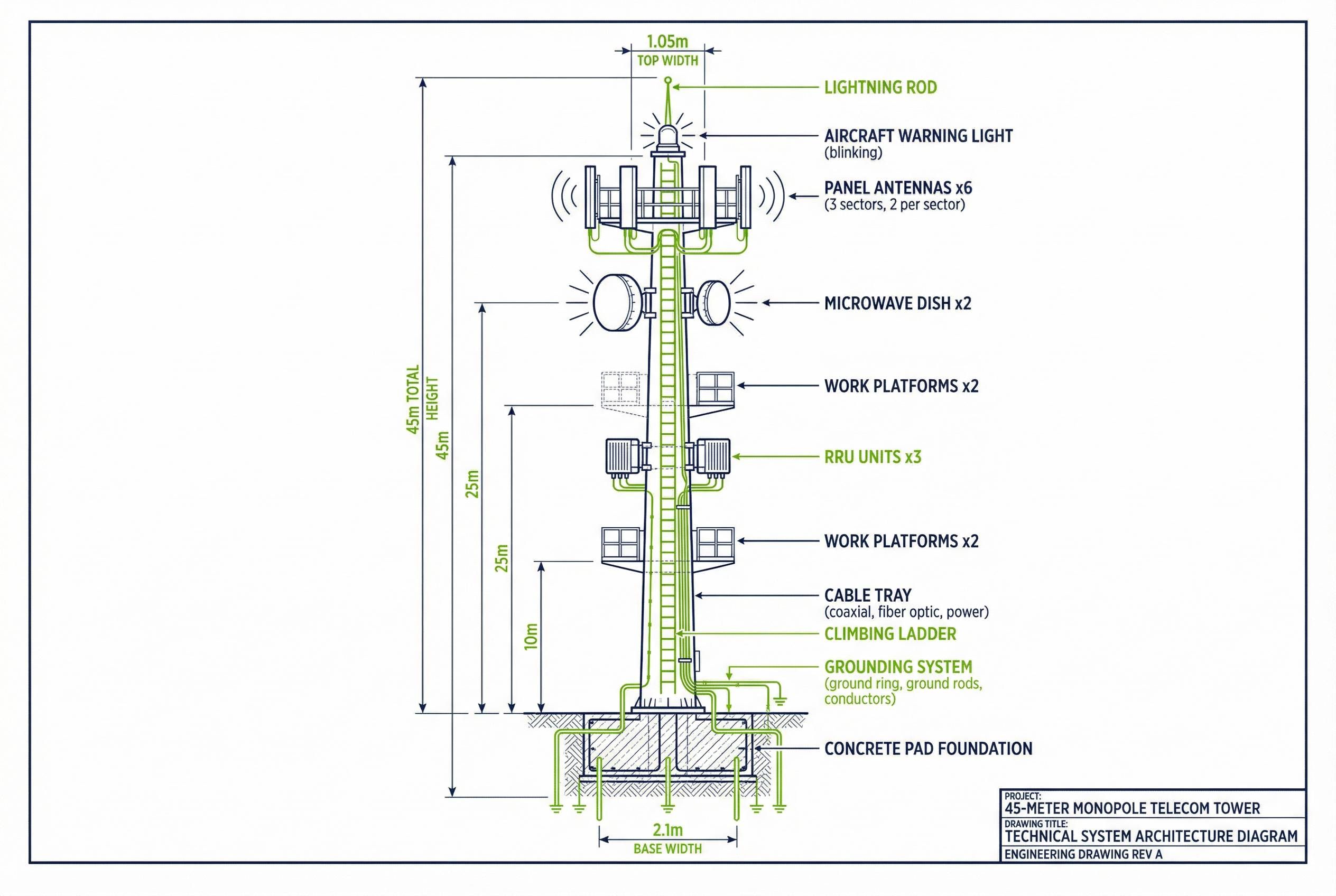
System architecture diagram generated from customer configuration
The architecture diagram reflects a typical macro site layout:
- RF chain from baseband to RRUs and panel antennas on the monopole
- Microwave backhaul via 2 dishes
- Power and grounding integration
- Structured cable management via cable tray
According to NREL (2024), well-documented system architecture reduces commissioning errors and rework, improving project schedules and reducing field engineering hours.
Pricing Structure and Commercial Model
Verified Three-Tier Pricing
| Pricing Tier | Description | Price (USD) |
|---|---|---|
| FOB | Ex-Works | $0 |
| CIF | Port Delivery | $0 |
| Turnkey | Installed (complete) | $47,768 |
The verified turnkey price of $47,768 covers the complete installed solution for one 45 m monopole site under this configuration. FOB and CIF prices are specified as $0, indicating that this proposal is engineered and costed specifically as an installed, end-to-end package rather than a pure equipment-only export.
SOLAR TODO uses this three-tier model to give B2B buyers clarity on scope:
- FOB/CIF $0: No separate ex-works or port-only option has been priced for this configuration.
- Turnkey $47,768: Includes tower, foundation, accessories and installation under the defined site conditions.
Key Cost Drivers (Qualitative)
While the detailed line-item equipment list and unit pricing are not provided in this dataset, typical cost drivers for a 45 m monopole turnkey site include:
- Steel monopole fabrication and galvanization
- Concrete pad foundation design and construction
- Antenna/microwave mounting hardware and cable trays
- Lightning protection, aircraft lighting and grounding
- Site installation labor, crane and lifting equipment
- Engineering design, QA/QC and commissioning
According to IEA (2023), infrastructure and civil works can represent 30–50% of total mobile network CAPEX in emerging markets. A standardized turnkey price helps operators benchmark offers and control rollout budgets.
Technical Deep Dive: Performance, Reliability and Lifecycle
Structural Reliability and Wind Performance
The tower is designed for wind class 4, aligning with higher wind regimes where gusts can exceed 40–45 m/s. IEC and national standards typically require:
- Ultimate limit state checks for extreme wind events
- Serviceability limit state checks for deflection and twist, critical for microwave alignment
Fraunhofer ISE (2023) notes that structural reliability is a key determinant of network availability, as tower failures can cause multi-day outages. By selecting a wind class 4 design, SOLAR TODO targets robust performance even in challenging climates.
Corrosion Management and Design Life
The configuration specifies low corrosion level and a steel tower on a concrete pad foundation. For such environments, hot-dip galvanization is commonly used to achieve 25+ year design life without major repainting.
The International Energy Agency states, “Optimizing infrastructure for low maintenance is central to reducing lifecycle OPEX in telecom networks.” For towercos and MNOs, reduced repainting and structural remediation directly translate into lower site OPEX and fewer service interruptions.
RF and Backhaul Flexibility
The antenna configuration enables:
- 6 panel antennas for multi-band, multi-sector 4G/5G
- 3 RRU units supporting multiple frequency bands or operators
- 2 microwave dishes for resilient backhaul
This supports several business and technical strategies:
- Multi-band coverage: Low-band for wide coverage, mid-band for capacity.
- Co-location: Potential to host multiple operators or technologies on the same structure.
- Redundant backhaul: Ring or diverse path design for improved SLA.
According to GSMA (2023), sites with co-location capability can improve CAPEX efficiency by up to 40% when shared among multiple tenants.
Safety and O&M Considerations
The inclusion of a climbing ladder, 2 platforms, lightning rod, aircraft light and grounding system is central to safe and efficient operations:
- Platforms at strategic heights reduce working-at-height risk and speed up antenna swaps.
- Ladder access supports routine inspections without specialized access equipment.
- Grounding and lightning protection mitigate equipment damage and downtime.
IEEE 1584 emphasizes that robust grounding and bonding are foundational to electrical safety and equipment protection, particularly for tall metallic structures exposed to lightning.
Applications and Deployment Scenarios
Primary Use Cases
This 45 m monopole configuration is suited to:
- Peri-urban macro sites: Extending 4G/5G coverage beyond dense urban cores.
- Rural coverage: Providing wide-area coverage where 45 m height improves line-of-sight.
- Microwave backhaul hubs: Serving as aggregation points with 2 microwave dishes.
- Shared tower sites: Enabling towercos to host multiple tenants on a single structure.
SOLAR TODO’s standardized design allows network planners to replicate this configuration across multiple regions, simplifying RF planning, spares management and O&M procedures.
ROI and Business Considerations (Qualitative)
Although specific ROI figures are not provided in the dataset, typical drivers for this class of tower include:
- Revenue from additional subscribers and data traffic enabled by new coverage.
- Co-location revenue from hosting multiple MNOs or technologies.
- Reduced truck rolls due to robust design and clear access provisions.
According to IEA (2022), digital infrastructure investments often exhibit strong multiplier effects on GDP, especially in emerging markets. For towercos, a standardized $47,768 turnkey macro site can be evaluated against expected tenancy ratios and lease rates to build a clear financial model.
Comparison and Selection Guide
Positioning Among Telecom Tower Options
Using SOLAR TODO’s broader portfolio as context, this 45 m monopole sits between smaller urban monopoles and large broadcast towers.
| Tower Type | Height | Antennas (typ.) | Wind Rating (typ.) | Typical Use Case |
|---|---|---|---|---|
| Urban 4G/5G monopole | 25 m | 6 | ~45 m/s | Dense urban, rooftop replacement |
| Telecom Tower in Global (this) | 45 m | 6 + 2 dishes | Class 4 | Peri-urban/rural macro, backhaul |
| Camouflaged pine tree tower | 70 m | 4 | Scenic compliance | Scenic/urban with visual constraints |
| Heavy-duty lattice broadcast tower | 120 m | 30 | Up to 55 m/s | Broadcast, multi-tenant hub |
This configuration is ideal when:
- 25 m height is insufficient for coverage or microwave line-of-sight
- Full 70–120 m lattice structures are overkill in cost or capacity
- A clean monopole aesthetic is preferred over lattice in peri-urban areas
When to Choose This 45 m Monopole
Consider selecting this configuration when:
- Required antenna load is around 6 panel antennas and 2 microwave dishes
- Site wind conditions align with wind class 4
- Low-to-moderate corrosion environment is confirmed
- A concrete pad foundation is feasible and cost-effective
- Turnkey procurement is preferred over piecemeal sourcing
SOLAR TODO can integrate this tower into broader solutions, including power systems such as solar+diesel hybrids for off-grid or weak-grid sites, though such systems are outside the scope of this specific pricing dataset.
FAQ
Q: What exactly is included in the $47,768 turnkey price for the Telecom Tower in Global? A: The $47,768 turnkey price covers a complete installed 45 m steel monopole site under the specified configuration: structure, concrete pad foundation, accessories (ladder, platforms, cable tray, lightning rod, aircraft light, grounding system) and installation. It is engineered as an end-to-end solution rather than equipment-only supply.
Q: Why are the FOB and CIF prices listed as $0 for this configuration? A: FOB and CIF are listed as $0 because this specific engineering proposal is structured purely as a turnkey, installed solution. No separate ex-works or port-delivery-only commercial option has been defined or priced for this configuration, so only the installed turnkey value of $47,768 is valid for procurement decisions.
Q: What antenna and microwave capacity does this 45 m monopole support? A: The verified configuration supports 6 panel antennas, 3 RRU units and 2 microwave dishes. This is suitable for a three-sector macro 4G/5G site with multi-band coverage and dual microwave backhaul. Additional loading would require a separate structural check and potentially a different tower design.
Q: How does the wind class 4 rating affect tower performance and reliability? A: Wind class 4 design means the tower is engineered for higher wind regimes, improving structural reliability and reducing risk of deformation or failure during storms. This helps maintain microwave alignment and antenna orientation, supporting higher network availability and fewer emergency maintenance events over the tower’s service life.
Q: What safety and access features are included for maintenance teams? A: The configuration includes a climbing ladder, 2 working platforms, a cable tray, lightning rod, aircraft light and grounding system. These features provide safe access to antennas and dishes, organized cable management, and protection against lightning, helping maintenance teams work efficiently while meeting common safety and regulatory requirements.
Q: Is this tower suitable for co-location and tower sharing models? A: The tower can support co-location within the limits of its structural and RF loading, currently defined as 6 panel antennas, 3 RRUs and 2 microwave dishes. For multi-tenant scenarios, SOLAR TODO typically performs a revised loading and structural analysis to determine whether additional antennas or dishes can be safely accommodated.
Q: How does the low corrosion level specification impact maintenance and lifecycle cost? A: A low corrosion level environment, combined with a galvanized steel monopole and concrete pad foundation, supports a design life of 25+ years with limited repainting or structural remediation. This reduces long-term OPEX and site visits, aligning with industry guidance that infrastructure O&M can represent a significant share of network lifecycle cost.
Q: Can this 45 m monopole be integrated with solar or hybrid power systems for off-grid sites? A: Yes, the tower can be integrated with separate power solutions such as solar PV, battery storage and diesel generators. SOLAR TODO offers solar and hybrid systems, but they are not included in the $47,768 tower turnkey price. Any power system integration would require a separate engineering and commercial proposal.
Q: What type of foundation is used, and when is a concrete pad appropriate? A: This configuration uses a concrete pad foundation, suitable for many soil conditions where bearing capacity and geotechnical characteristics support a spread footing. For weak or complex soils, alternative foundations (e.g., piles) might be required, which would change both engineering details and commercial pricing.
Q: How does this 45 m tower compare to smaller 25 m urban monopoles in terms of use case? A: Compared to 25 m urban monopoles, the 45 m tower offers greater coverage radius and better microwave line-of-sight, making it more suitable for peri-urban and rural macro sites. However, it requires more space and higher CAPEX. Urban monopoles are typically chosen where height restrictions and visual impact are more critical.
Q: What standards and best practices does SOLAR TODO follow for telecom tower design? A: While specific standards are not listed in the dataset, SOLAR TODO aligns with international best practices such as IEC and IEEE guidance on structural loading, grounding and lightning protection. Customers often reference local tower design codes, IEC wind loading principles, and IEEE grounding standards when reviewing designs.
References
- IEA (2023): “Digital Demand and Infrastructure” – Analysis of CAPEX and OPEX drivers for telecom and digital infrastructure deployments.
- NREL (2024): “Best Practices for Field Engineering and Commissioning of Distributed Energy and Telecom Systems” – Guidance on documentation and system architecture for reliable deployment.
- IEC 60826 (2023): “Design Criteria of Overhead Transmission Lines” – Widely referenced for wind loading and structural design principles applicable to tall steel structures.
- IEEE 998-2012 (2012): “Guide for Direct Lightning Stroke Shielding of Substations” – Provides principles for lightning protection and grounding relevant to tall metallic structures.
- GSMA (2023): “Infrastructure Sharing: Overview of Regulatory and Economic Considerations” – Discusses co-location benefits and tenancy models for telecom towers.
- Fraunhofer ISE (2023): “Reliability of Energy and Communication Infrastructure under Extreme Weather” – Highlights the importance of structural resilience for network availability.
About SOLARTODO
SOLARTODO is a global integrated solution provider specializing in solar power generation systems, energy-storage products, smart street-lighting and solar street-lighting, intelligent security & IoT linkage systems, power transmission towers, telecom communication towers, and smart-agriculture solutions for worldwide B2B customers.