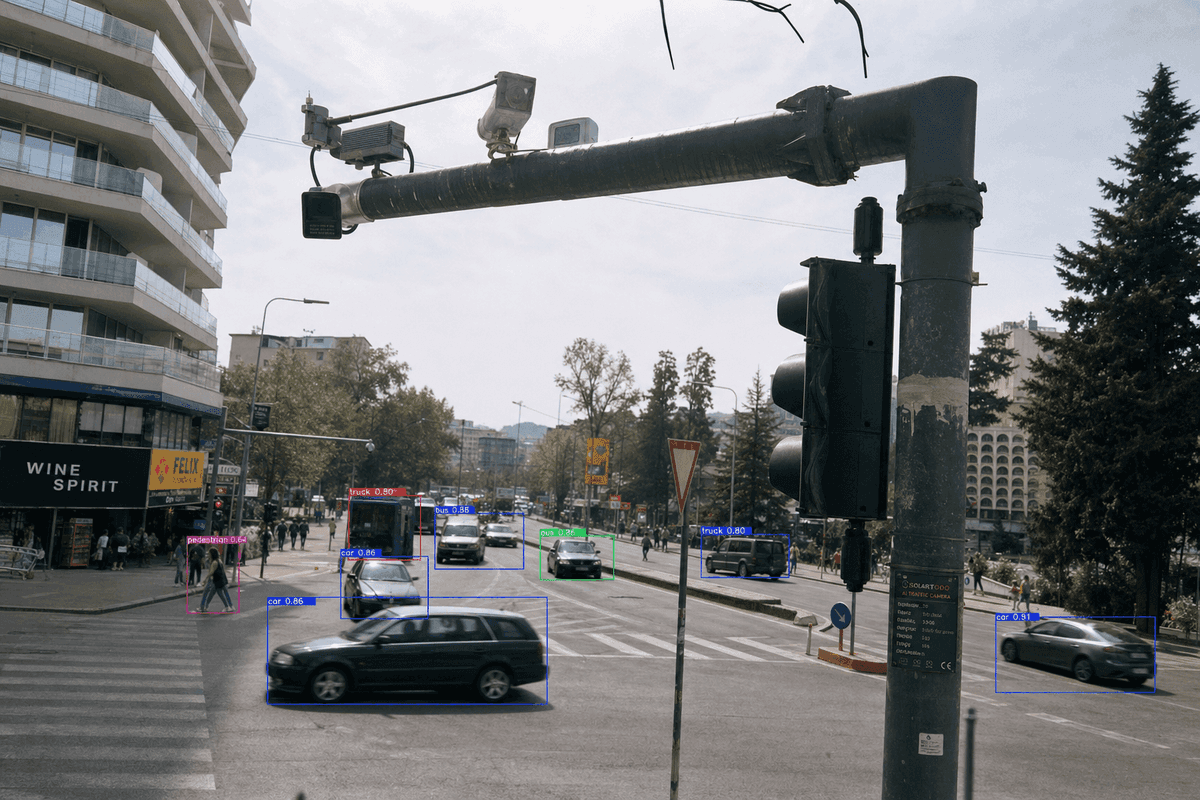
Tirana Smart Traffic System Market Analysis: 18-Intersection 6m Configuration Guide for AI Traffic Control
Summary
Tirana’s urban traffic profile supports a typical 18-intersection Smart Traffic System using 6m hot-dip galvanized L-arm poles, 4K AI vision, and 77GHz radar. Based on Albania’s urban concentration, rising motorization, and city digitalization goals, a Joint Venture model with 5G/fiber backhaul is a technically suitable configuration.
Key Takeaways
- A typical deployment profile for Tirana would cover approximately 18 intersections using 6m L-arm steel poles in dark grey, matching dense urban junction geometry rather than 8m or 10m highway-class layouts.
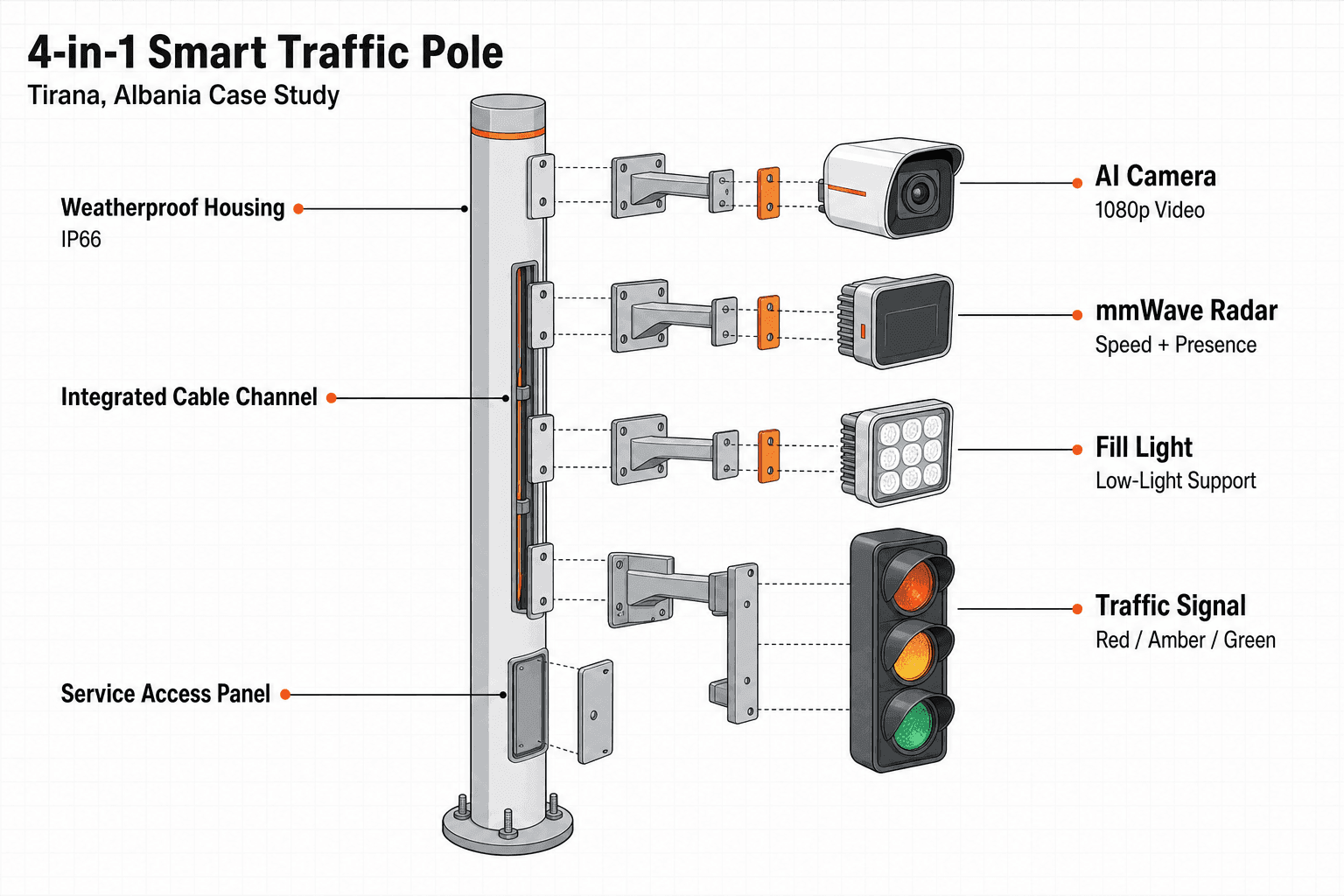
- Each pole would combine 4 functions in 1 structure: 4K AI camera, 77GHz mmWave radar, LED fill light, and LED signal head, reducing separate roadside hardware counts by roughly 3-4 devices per approach.
- The specified edge stack uses NVIDIA Jetson with <50ms response and 98% detection accuracy, supporting 45 detection types for mixed traffic conditions common in central Tirana.
- A typical 18-intersection package would support adaptive signal control, emergency vehicle priority, and wrong-way alert, with data sent over 5G/fiber to a TrafficGPT central platform for natural-language traffic queries.
- According to the World Bank (2023), Albania’s urban population exceeds 60%, which increases pressure on signalized corridors and strengthens the case for AI-based junction management in the capital region.
- According to the European Commission (2023), Albania remains aligned with EU-oriented transport and digital modernization priorities, making NTCIP and GB 25280 interoperability planning relevant for municipal procurement.
- For Tirana’s compact city intersections, a Joint Venture model can fit phased rollout better than full upfront capex, especially when the initial scope is around 18 nodes instead of a citywide 50+ intersection program.
- Compared with conventional loop-detector and camera-only systems, a camera-plus-radar stack typically improves all-weather detection resilience, especially in rain, glare, and partial occlusion conditions at 4-approach urban crossings.
Market Context for Tirana
Tirana’s transport modernization need is shaped by a capital-city population above 500,000 residents in the municipality and a much larger functional urban area, making junction efficiency more important than isolated corridor upgrades. According to INSTAT (2023), Tirana County remains Albania’s largest population and economic center. According to the World Bank (2023), Albania’s urban population is above 60% of the national total, concentrating vehicle trips, bus operations, and pedestrian demand into a limited number of city intersections.
The city profile supports smart junction control rather than highway gantry infrastructure. Tirana’s road environment is defined by compact blocks, frequent pedestrian crossings, bus movements, motorcycles, and mixed turning behavior, so a 6m urban pole class is more suitable than 10-12m highway variants. According to the Municipality of Tirana’s strategic planning documents, the city continues to prioritize sustainable mobility, public transport, and digital municipal services. That combination favors intersection-level sensing, adaptive timing, and incident alerts over static signal plans.
Telecom availability also matters because this product depends on low-latency backhaul. According to ITU (2023), mobile broadband and fiber expansion in Europe and neighboring markets continue to improve urban connectivity, which supports 5G/fiber architecture for traffic edge devices. In practical terms, Tirana’s central corridors are more likely to support a hybrid communications design with fiber at major intersections and 5G fallback at harder civil-work locations.
Climate and visibility conditions also support a multimodal sensor stack. Tirana has a Mediterranean climate with winter rain, summer glare, and seasonal visibility variation, so camera-only sensing can lose performance in certain hours and weather windows. A 77GHz mmWave radar layer adds speed, presence, and trajectory data when image contrast drops. According to NHTSA (traffic safety guidance widely used for signal analytics references) and global ITS practice, multimodal detection improves reliability where occlusion and weather affect optical sensing.
Two authority statements are relevant here. The International Telecommunication Union states, "Digital technologies can improve the safety, efficiency and sustainability of transport systems." The International Energy Agency states, "Data and digitalisation are becoming increasingly important enablers of more efficient transport systems." Those points align with Tirana’s need for measurable traffic control improvements rather than only adding signal heads.
For SOLAR TODO, the local fit is not about claiming an existing project in Tirana; it is about matching the city’s junction geometry and operational needs to the correct hardware class. Based on the city profile, a typical 18-intersection scope is large enough to justify a central platform, but still compact enough for phased commissioning and operator training. Buyers evaluating Smart Traffic System solutions should focus on sensor fusion, standards compliance, and communications design before comparing only unit price.
Recommended Technical Configuration
A typical Tirana deployment of this scale would use approximately 18 intersections with 6m L-arm hot-dip galvanized steel poles, each carrying 4 integrated traffic functions and connected by 5G/fiber to a central TrafficGPT platform.
The correct size class for this city profile is the 6m urban intersection pole, not the general 8m base example and not the 10-12m highway gantry class. The reason is simple: Tirana’s target use case is dense, signalized urban junctions with standard signal mounting heights, short-to-medium mast-arm reach, and close roadside utility clearances. A 6m L-arm steel pole provides enough elevation for camera field of view and signal visibility while limiting foundation loads and visual intrusion in compact streets.
The project-specific configuration should remain exact. A typical 18-intersection package in Tirana would consist of 6m L-arm steel poles in dark grey, fabricated in hot-dip galvanized steel, each configured as a 4-in-1 smart traffic pole. Every unit would include a 4K AI camera with 98% accuracy and <50ms response, a 77GHz mmWave radar, an LED fill light, and an LED signal head. Edge computing would run on NVIDIA Jetson hardware.
Functionally, the recommended software stack should include the full 45-type detection library plus adaptive signal control, emergency vehicle priority, and wrong-way alert. That mix fits Tirana’s mixed traffic pattern better than a basic red-light or queue-length package. Emergency priority is especially relevant for urban ambulance routing where seconds matter at constrained intersections. Wrong-way alert is useful at channelized turns, one-way downtown segments, and slip-lane conflict points.
The communications layer should support both 5G and fiber backhaul into the TrafficGPT central platform. Fiber is preferable at high-volume corridors because it provides stable bandwidth for 4K video analytics and lower recurring telecom cost over time. 5G remains useful for pilot phases, temporary rerouting during civil works, and intersections where trenching is delayed. According to ITU (2023), broadband infrastructure remains a core requirement for smart mobility systems, which directly applies here.
The recommended commercial structure is Joint Venture, as specified. For Tirana, that model can fit municipal modernization programs where the buyer wants local participation, phased capex, and shared implementation governance. SOLAR TODO can therefore be positioned as a technical and manufacturing partner within a broader city program rather than as a simple hardware vendor. For commercial discussions on phasing and interfaces, buyers can contact us.
Technical Specifications
The recommended Tirana configuration is a 6m, 18-intersection, 4-in-1 Smart Traffic System using AI vision, 77GHz radar, and central TrafficGPT control under NTCIP and GB 25280 interoperability requirements.
- Deployment scale: approximately 18 intersections
- Pole type: L-arm steel pole
- Pole height: 6m
- Pole finish: dark grey
- Material protection: hot-dip galvanized steel
- Integrated modules: 4K AI camera + 77GHz mmWave radar + LED fill light + LED signal head
- AI detection accuracy: 98%
- AI response time: <50ms
- Detection library: 45+ object/event types, specified here as full 45-type detection
- Edge AI hardware: NVIDIA Jetson
- Traffic functions: adaptive signal control, emergency vehicle priority, wrong-way alert
- Communications: 5G/fiber backhaul
- Central software layer: TrafficGPT with natural language queries
- Cooperation model: Joint Venture
- Applicable standards: NTCIP, GB 25280
- Typical intersection density: 4-12 poles per intersection in the broader product family, though this Tirana guide is framed around the specified 18-intersection / 6m pole class
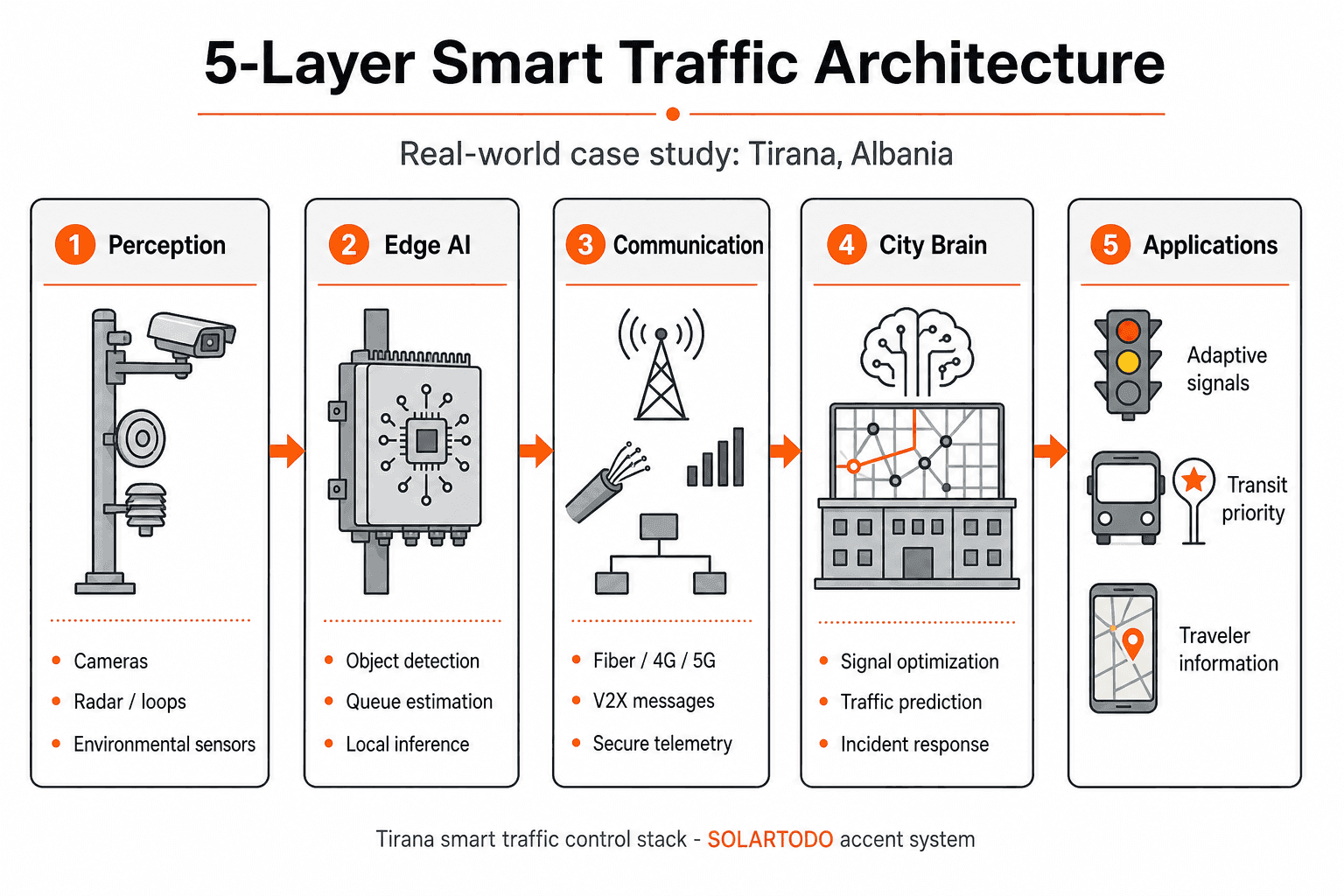
- System architecture: Perception → Edge AI → Communication → City Brain → Applications
Implementation Approach
A phased Tirana rollout would typically start with 18 intersections divided into 3 phases of 6 intersections, which reduces commissioning risk and allows signal timing validation before citywide expansion.
Phase 1 would cover site survey, utility mapping, lane geometry capture, and communications audit. At each of the 18 nodes, engineers would verify mast placement, camera sight lines, radar coverage angles, power availability, and fiber or 5G access. This phase should also map emergency routes, bus corridors, and pedestrian-heavy crossings so that adaptive logic reflects real operating priorities rather than generic timing plans.
Phase 2 would cover civil and pole works. For 6m hot-dip galvanized L-arm poles, the municipality or EPC partner would typically prepare foundations, conduit paths, earthing, and control cabinet interfaces before pole erection. Because Tirana has constrained urban rights-of-way in older districts, phased night works may be preferable at high-volume intersections. Installation sequencing should avoid simultaneous disruption across parallel corridors.
Phase 3 would cover device integration and software commissioning. Each pole’s 4K AI camera, 77GHz radar, LED fill light, and LED signal head would be calibrated at the edge using NVIDIA Jetson processing. The central team would then connect the nodes to TrafficGPT over 5G/fiber, confirm event taxonomy for the 45 detection types, and test adaptive timing, emergency priority, and wrong-way alerts.
Phase 4 would cover acceptance testing and operator training. For a system of 18 intersections, the city should require a structured test plan with latency, detection, failover, and central-query validation. NTCIP compliance matters here because it reduces integration risk with existing or future signal controllers. SOLAR TODO should be evaluated on interface documentation, spare parts planning, and traffic-engineering support, not only on hardware lead time.
Expected Performance & ROI
For a city like Tirana, an 18-intersection AI traffic package would typically target measurable gains in delay reduction, incident response, and maintenance efficiency within 12-36 months, depending on baseline congestion and telecom readiness.
Expected performance should be framed with benchmarks rather than invented local outcomes. According to the International Energy Agency (2023), digitalization improves transport system efficiency through better data use and operational control. According to the World Bank (2023), urban mobility bottlenecks in growing cities create direct economic costs through travel delay, fuel waste, and unreliable public transport. For Tirana, the practical implication is that even modest signal optimization at 18 intersections can matter if those nodes sit on bus, emergency, or commuter corridors.
A reasonable performance expectation for adaptive signal control in a dense capital-city environment is a 10-25% reduction in average intersection delay where fixed-time plans are outdated, though actual results depend on lane discipline, enforcement, and corridor coordination. Camera-plus-radar fusion can also improve detection continuity during rain, glare, and partial occlusion. That matters because false calls and missed detections can degrade signal timing more than controller hardware limitations do.
Maintenance economics also improve when 4 functions sit on one pole instead of multiple roadside devices with separate brackets and power points. Fewer structures can reduce civil complexity, spare-part variety, and inspection time. The hot-dip galvanized steel body also supports long service life in outdoor urban conditions, while NVIDIA Jetson edge processing reduces dependence on constant upstream cloud processing for every event.
From an ROI perspective, buyers should evaluate 4 cost buckets: civil works, communications, hardware, and software operations. In many cities, civil works and trenching can account for a large share of capex, which is why 5G/fiber hybrid design matters. A Joint Venture structure can spread early-stage cost while allowing local operation and maintenance participation. For Tirana, payback would generally depend on whether the city monetizes benefits through reduced congestion, lower manual traffic management cost, fewer incident delays, and better public transport reliability.
Results and Impact
For Tirana, the strongest expected impact comes from improving 18 priority intersections where mixed traffic, pedestrians, and bus flows create recurring delay and safety conflicts.
The most relevant operational outcomes would be better queue detection, faster incident awareness, and more responsive signal timing during peak periods. Emergency vehicle priority can reduce intersection clearance time on ambulance routes. Wrong-way alerts can support enforcement and safety teams at high-risk approaches. TrafficGPT also gives operators a simpler way to query conditions using natural language rather than manual database extraction.
For municipal buyers, the broader impact is organizational as much as technical. A system that merges 4K AI, 77GHz radar, and central analytics into one standards-based platform can reduce fragmented procurement across cameras, signal hardware, and standalone detectors. SOLAR TODO therefore fits best where the city wants one integrated traffic asset model under NTCIP and GB 25280, with room to scale beyond the initial 18 intersections.
Comparison Table
The table below compares a recommended 18-intersection SOLAR TODO Smart Traffic System profile for Tirana against conventional urban signal monitoring options.
| Metric | SOLAR TODO Smart Traffic System | Camera-Only Smart Junction | Conventional Loop + Signal Head |
|---|---|---|---|
| Recommended Tirana scope | 18 intersections | 18 intersections | 18 intersections |
| Pole class | 6m L-arm hot-dip galvanized steel | 6m-8m pole, often separate devices | Separate poles and roadside cabinets |
| Sensors per node | 4K AI camera + 77GHz radar | 4K/HD camera only | Inductive loop only |
| Detection accuracy | 98% specified | Lower in glare/rain/occlusion | Good presence detection, weak classification |
| Response time | <50ms specified | Depends on processor/network | Controller dependent |
| Detection types | 45 types | Usually fewer event classes | Limited to presence/count |
| Adaptive signal control | Yes | Sometimes | Limited / external add-on |
| Emergency vehicle priority | Yes | Optional | Usually external subsystem |
| Wrong-way alert | Yes | Limited reliability | No |
| Backhaul | 5G/fiber | Fiber/4G/5G | Usually local cabinet only |
| Central platform | TrafficGPT natural-language queries | VMS/analytics dashboard | Basic controller interface |
| Standards | NTCIP, GB 25280 | Varies | NTCIP possible |
| Structure count | 4-in-1 integrated | 2-4 roadside devices | Multiple field devices |
| Commercial model | Joint Venture | EPC or equipment only | EPC or controller upgrade |
Pricing & Quotation
SOLAR TODO offers three pricing tiers for this product line: FOB Supply (equipment ex-works China), CIF Delivered (including ocean freight and insurance), and EPC Turnkey (fully installed, commissioned, with 1-year warranty). Volume discounts are available for large-scale deployments. Configure your system online for an instant estimate, or request a custom quotation from our engineering team at [email protected].
Frequently Asked Questions
This FAQ answers 10 common procurement and engineering questions for a Tirana Smart Traffic System, covering specifications, timeline, ROI, maintenance, EPC scope, warranty, and installation constraints.
Q1: Why is a 6m pole recommended for Tirana instead of 8m or 10m?
A 6m L-arm pole fits compact urban intersections where signal visibility, camera angle, and roadside clearance must be balanced. Tirana’s target use case is not a highway gantry or wide arterial flyover. For dense city junctions, 6m usually provides adequate mounting height with lower foundation load, easier permitting, and less visual impact than 8-12m structures.
Q2: What is included in the 4-in-1 Smart Traffic System configuration?
Each specified unit combines 4 modules on one pole: a 4K AI camera, 77GHz mmWave radar, LED fill light, and LED signal head. The edge processor is NVIDIA Jetson. The software stack supports 45 detection types, adaptive signal control, emergency vehicle priority, and wrong-way alert, with data sent to TrafficGPT over 5G/fiber.
Q3: How many intersections can this recommended Tirana package cover?
This guide is based on a typical scope of 18 intersections. That is large enough to justify central software, operator workflows, and corridor-level signal optimization. It is also small enough for phased commissioning in 3 stages of 6 intersections if the municipality wants to validate detection logic, telecom performance, and signal timing before expanding further.
Q4: What deployment timeline is realistic for 18 intersections?
A realistic program often runs 3-6 months depending on civil permits, telecom access, and controller integration. Survey and design may take 2-4 weeks, civil works 4-8 weeks, device installation 2-4 weeks, and testing another 2-3 weeks. Timelines shorten if existing foundations, conduits, and fiber are already available at several intersections.
Q5: How does radar improve performance compared with camera-only systems?
A 77GHz mmWave radar adds stable speed, presence, and trajectory detection when cameras face glare, rain, shadows, or partial blockage by buses and trucks. Camera-only systems can perform well in clear daylight, but multimodal sensing is usually more dependable across 24-hour urban traffic conditions. That is important for adaptive timing and wrong-way alerts.
Q6: What kind of ROI or payback should a city expect?
Payback commonly depends on congestion cost, manual traffic management cost, and public transport delay. For urban adaptive signal systems, municipalities often look for benefits within 12-36 months through lower delay, better incident response, and reduced field maintenance complexity. The strongest business case appears where 18 intersections sit on high-volume commuter, bus, or emergency corridors.
Q7: What maintenance model is typical for this system?
A practical maintenance model includes quarterly inspection, annual calibration review, firmware updates, and spare parts for cameras, radar units, and signal components. Because 4 functions are consolidated on one structure, field maintenance can be simpler than managing separate devices on multiple brackets. Buyers should still require SLA terms for uptime, replacement lead times, and remote diagnostics.
Q8: Does EPC pricing usually include civil works and commissioning?
Under an EPC Turnkey structure, pricing usually includes equipment, shipment, installation, commissioning, and a defined warranty period. Civil scope can vary by tender and may or may not include trenching, utility relocation, and traffic management during roadworks. Buyers should request a line-by-line bill of quantities for foundations, conduits, cabinets, backhaul, and controller integration.
Q9: What standards matter most for interoperability?
For this configuration, NTCIP and GB 25280 are the key listed standards. NTCIP is important for traffic controller and ITS interoperability, especially where the city may integrate mixed-vendor infrastructure over time. Buyers should also review local electrical, road-safety, grounding, and telecom requirements in Albania before final design approval and municipal acceptance testing.
Q10: What warranty terms should buyers request?
The pricing section specifies 1-year warranty for EPC Turnkey. For municipal procurement, it is sensible to ask for warranty detail by subsystem: pole structure, camera, radar, edge computer, LED signal, and communications equipment. Buyers should also request spare-part availability, RMA process, firmware support period, and whether remote diagnostics are included during the first 12 months.
References
- INSTAT (2023): Population and regional statistics showing Tirana County as Albania’s largest population and economic center.
- World Bank (2023): Albania urban population data and urban development indicators relevant to traffic concentration in capital-city corridors.
- Municipality of Tirana (2022): Strategic planning and sustainable urban mobility priorities supporting digital transport management and public-service modernization.
- ITU (2023): Digital infrastructure and transport digitalization guidance; supports broadband and smart mobility system requirements.
- International Energy Agency (2023): Transport digitalisation analysis stating that data and digitalisation improve transport system efficiency.
- NTCIP (latest applicable edition): Communications standards framework for interoperable traffic control and ITS field devices.
- GB 25280 (applicable edition): Road traffic signal controller and related traffic signal system compliance framework referenced for product interoperability.
Equipment Deployed
- 6m L-arm steel pole, dark grey, hot-dip galvanized
- 4-in-1 Smart Traffic System pole assembly
- 4K AI camera with 98% accuracy and <50ms response
- 77GHz mmWave radar sensor
- LED fill light module
- LED traffic signal head
- NVIDIA Jetson edge AI computing unit
- 5G/fiber backhaul communications interface
- TrafficGPT central platform with natural language query support
- NTCIP and GB 25280 compliant control and integration package
- Adaptive signal control software
- Emergency vehicle priority module
- Wrong-way alert module
- Full 45-type traffic detection software library