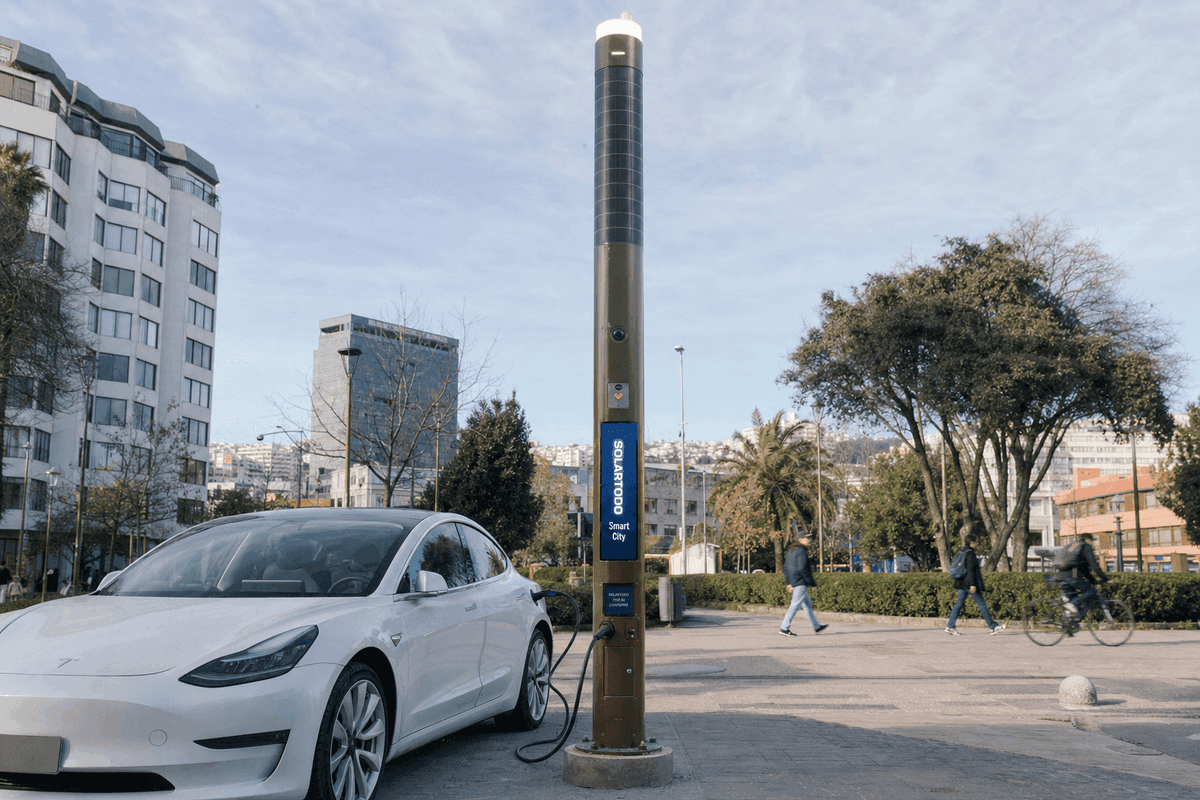
Valparaíso Smart Streetlight Market Analysis: 11m Ø315mm Flush-Integrated Pole Configuration
Summary
Valparaíso’s 296,655-resident coastal commune and 28m streetscape spacing support an approximately 85-unit Smart Streetlight configuration using 11m Ø315mm flush cylindrical poles with 316W CIGS wrap and 7kW AC charging.
Key Takeaways
This Valparaíso Smart Streetlight guide recommends 85 flush-integrated 11m poles at 28m spacing for premium coastal streets, mobility nodes, and civic corridors.
- A typical 85-unit deployment would cover about 2.38km of corridor at 28m spacing, within the 25-50m smart streetlight planning range.
- Each recommended pole is an 11m seamless Ø315mm cylinder with 5mm wall thickness, hot-dip galvanizing, and antique bronze RAL8011 finish.
- The lighting package uses a Ø315mm multi-ring glow column, 60W output, 9,000lm luminous flux, and 4000K neutral-white color temperature.
- The solar assist layer is approximately 316W of 360-degree CIGS film wrapped from 6.5m to 10.3m, with no rigid panels or brackets.
- Embedded mobility hardware includes a 7kW AC Type 2 Mennekes charger, 5m coiled cable, flush touchscreen at 1.5m, and socket at 1.2m.
- Communications are designed around internal dual-mode WiFi 6 and 5G-ready antennas, avoiding external boxes, side arms, or speaker columns.
- The base energy buffer is an internal 1,800Wh LFP battery with MPPT, suitable for sensors, communications, control, and resilience support.
- Core compliance should reference IEC 60598 for luminaires and GB/T 37024 for smart lighting system requirements.
Market Context for Valparaíso
Valparaíso’s coastal urban form, UNESCO-listed historic areas, and 296,655-person commune profile make compact 11m smart poles more appropriate than highway-scale masts.
Valparaíso is a dense port city with steep terrain, narrow streets, tourism pressure, and a visually sensitive historic center. According to Chile’s National Statistics Institute, the 2017 census recorded 296,655 residents in the Valparaíso commune, while the wider metropolitan region carries significantly larger commuter and visitor flows. For a SOLARTODO Smart Streetlight strategy, the key issue is not only lighting, but how to consolidate lighting, sensing, public WiFi, EV charging, and civic information into one low-clutter streetscape asset.
According to UNESCO (2003), the Historic Quarter of the Seaport City of Valparaíso was inscribed as a World Heritage property because of its exceptional testimony to late-19th-century port-city development. That context favors a monolithic cylindrical pole with flush modules over protruding cameras, speaker boxes, advertising cabinets, or separate charger bollards. A premium Ø315mm constant-diameter cylinder also reduces visual noise in streets where architectural character and pedestrian sightlines matter.
According to the World Bank (2024), Chile’s urban population is above 87%, which reinforces the need for dense, networked public infrastructure rather than isolated lighting upgrades. According to IEA (2024), electric car sales continued to rise globally, with public charging availability becoming a limiting factor for urban adoption. For Valparaíso, embedded 7kW AC charging is better framed as destination charging for curbside dwell time, not as a highway fast-charging substitute.
Climate and corrosion are also design drivers. Valparaíso’s marine exposure means coatings, gaskets, display seals, charger doors, and grounding hardware should be specified for coastal maintenance regimes. The recommended SOLARTODO configuration uses hot-dip galvanized steel, flush module integration, and no side arms, reducing exposed attachment points where salt air and vibration can accelerate wear.
Recommended Technical Configuration
A typical 85-unit Valparaíso Smart Streetlight configuration should use the cyl_219 premium cylindrical variant, not a highway pole or garden-light class product.
The recommended size class is SOLARTODO’s cylindrical smart pole family, configured here as an 11m seamless Ø315mm pole. This is the correct fit because Valparaíso’s target use case is urban street, plaza-edge, waterfront, and mobility-node infrastructure. The product is not intended for highways, where 12m-plus traffic poles are more appropriate, and it is not a park garden light, where 6-8m lower-output fixtures would normally be selected.
A typical 85-unit deployment of this scale would use 28m spacing, equivalent to approximately 35.7 poles per km. That falls inside the 30-50 poles per km density range specified for city and urban street applications. For procurement planning, approximately 85 units should be treated as a corridor-scale package rather than proof of a completed SOLARTODO installation.
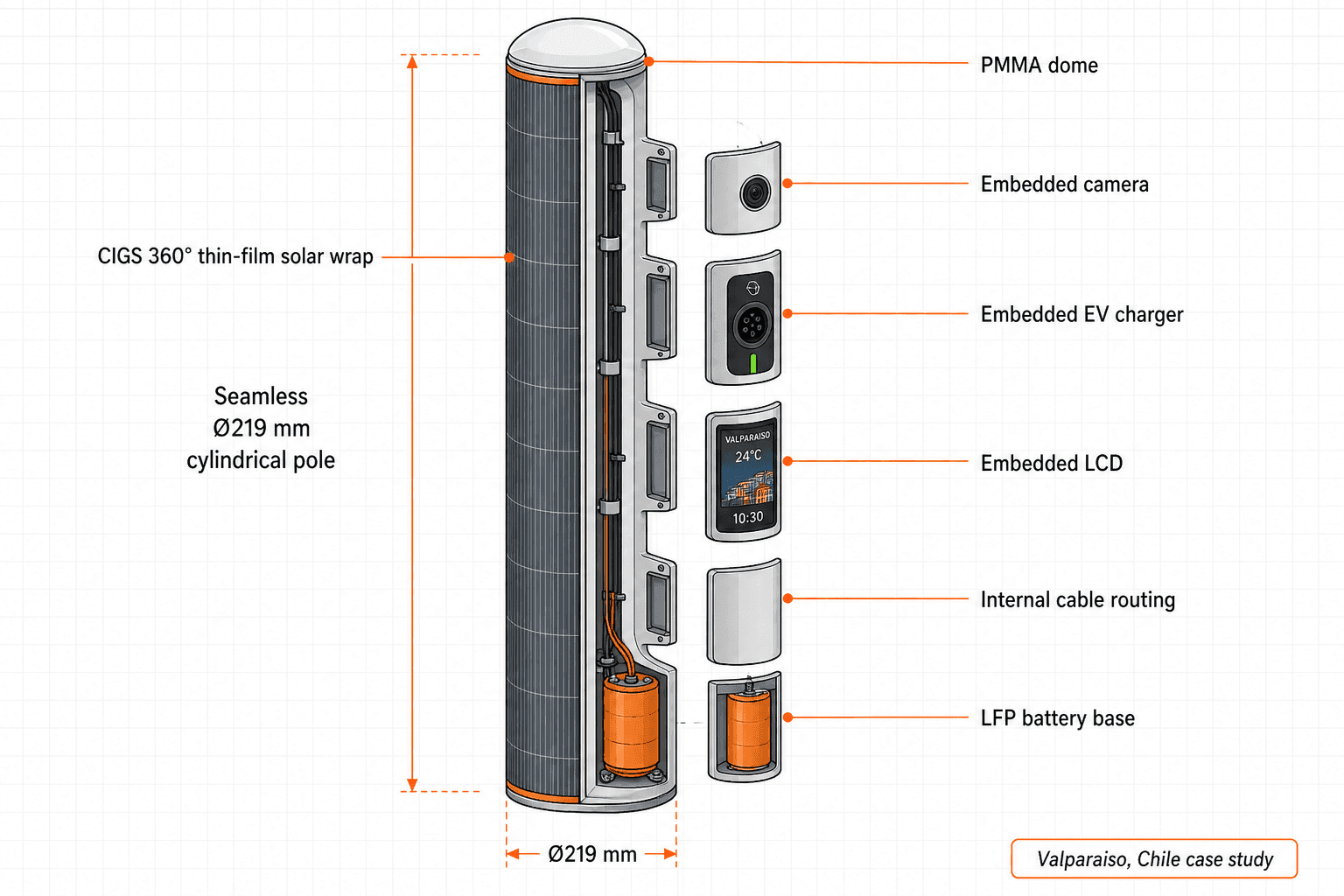
The recommended configuration is the provided cyl219 specification: 85 units of 11m seamless cylindrical Ø315mm poles, constant diameter from top to bottom, 5mm wall thickness, hot-dip galvanized finish, and antique bronze RAL8011 coating. All modules are flush-integrated into the cylinder skin. There are no side arms, no luminaire outriggers, no IP speaker columns, no public-address audio modules, no external boxes, no widened base, and no separate charger bollard.
Technical Specifications
The Valparaíso configuration uses 85 units of 11m Ø315mm seamless poles with 60W lighting, 316W CIGS solar wrap, 1,800Wh LFP storage, and 7kW AC charging.
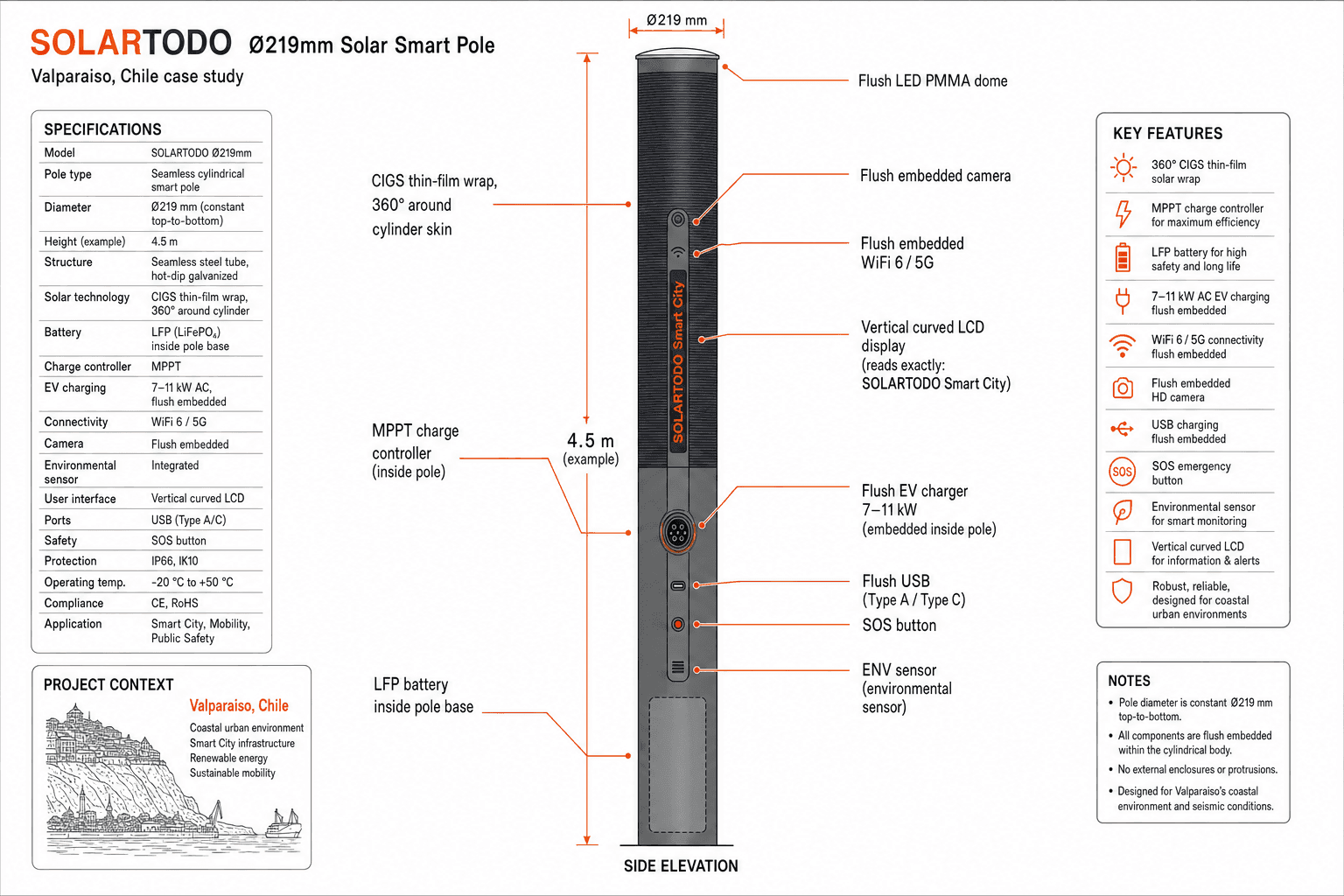
- Product line: SOLARTODO Smart Streetlight, cyl_219 cylindrical premium variant.
- Quantity basis: approximately 85 units for a typical corridor-scale deployment.
- Pole body: 11m seamless cylindrical Ø315mm pole, constant diameter top-to-bottom, 5mm wall, hot-dip galvanized steel.
- Finish: antique bronze RAL8011, selected for premium streetscape and heritage-sensitive urban settings.
- Luminaire: Ø315mm top multi-ring glow column, 3-5 graduated rings over the top 1.5m.
- Lighting output: 60W, 9,000lm, 4000K, integrated with the pole body and no arm bracket.
- Solar layer: 360-degree CIGS flexible thin-film wrap from 6.5m to 10.3m, approximately 316W total.
- Energy storage: internal LFP 1,800Wh battery inside pole base with MPPT controller.
- Camera: flush 8MP fisheye 180-degree panoramic camera behind dome glass, with no protrusion.
- Environmental sensing: top flush 8-parameter pod for temperature, humidity, wind, pressure, noise, PM2.5, PM10, and illuminance.
- Communications: embedded dual-mode WiFi 6 and 5G-ready internal antennas.
- Emergency interface: 12cm x 12cm flush SOS button panel with integrated micro-camera, microphone, and speakerphone grille.
- EV charging: embedded 7kW AC Type 2 Mennekes charger, flush flip-cap socket at 1.2m, 5m coiled Type 2 cable, and flush touchscreen at 1.5m.
- Display: 1,800mm tall by approximately 170mm wide vertical curved LCD, bent to Ø315mm radius, front-face only, portrait orientation.
- Display content: strictly “SOLARTODO Smart City,” with SOLARTODO uppercase and Smart City title case, white sans-serif on deep blue, with no imagery, video, or advertising.
- Extra power: flush USB-C PD 30W and USB-A ports.
- Spacing: 28m, equivalent to about 35.7 units per km.
- Standards: IEC 60598 and GB/T 37024.
According to IEC (2024), IEC 60598-1 covers general requirements and tests for luminaires, making it the appropriate baseline for integrated lighting safety. IEC states, “This part 1 specifies general requirements for luminaires,” a concise standard anchor for electrical, thermal, mechanical, and marking review. According to China’s GB/T 37024 smart lighting standard, networked road lighting should be evaluated as a system, not only as a single luminaire.
Implementation Approach
A Valparaíso rollout of 85 smart poles would normally proceed through survey, utility coordination, CKD logistics, civil works, installation, commissioning, and acceptance testing.
The first phase should map the 28m spacing plan against pedestrian flows, curbside EV charging demand, transformer availability, 5G coverage targets, camera privacy constraints, and protected-view corridors. Foundation design should account for the 11m pole height, coastal wind exposure, cable routing, charger protection, and maintenance access. Because all modules are flush-integrated, dimensional tolerances and factory QA are more important than field retrofits.
The second phase would finalize shop drawings, display content, charging interface details, controller configuration, and IEC 60598 documentation. CKD or semi-knockdown shipping can reduce logistics risk, but curved LCDs, CIGS laminates, dome glass, and charger doors should be protected as finished architectural surfaces. For Chilean import and installation planning, buyers should confirm customs codes, electrical certification requirements, and local installer qualifications before fabrication release.
The third phase would cover foundations, grounding, feeder cabling, pole erection, charger commissioning, communications activation, and cloud platform integration. Acceptance tests should include lux verification, 7kW charger load testing, WiFi 6 coverage checks, camera field-of-view review, SOS audio verification, display brightness validation, and battery/MPPT telemetry. For procurement support, buyers can contact us before freezing electrical and civil assumptions.
Expected Performance & ROI
A properly configured 85-unit Valparaíso system can consolidate lighting, sensing, WiFi, 5G readiness, SOS, display, USB, and 7kW charging into one 11m asset class.
Expected performance should be modeled across multiple value streams rather than treated as a single lighting retrofit. The 60W LED system produces 9,000lm, while the 316W CIGS wrap and 1,800Wh LFP battery support auxiliary loads, resilience, and controller uptime. The 7kW AC charger is suitable for curbside destination charging, where vehicles may remain parked for 1-3 hours rather than requiring rapid highway turnover.
According to IEA (2024), public charging infrastructure must scale with EV adoption, especially in cities where private home charging is unevenly available. According to IRENA (2023), renewable power and electrification are central to urban decarbonization pathways, but infrastructure must be planned around local load, operations, and finance. IRENA states, “Renewable energy is at the heart of the energy transition,” which supports pairing efficient public assets with local renewable generation where technically practical.
Payback depends on electricity tariffs, charger utilization, maintenance costs, civil works, network subscriptions, and whether telecom lease revenue is available. For an advisory model, municipal buyers should test three cases: conservative lighting-only savings, moderate civic-services value, and higher-utilization mobility-plus-connectivity value. SOLARTODO should be evaluated as a streetscape infrastructure platform, not just a luminaire supplier.
Comparison Table
The recommended cyl_219 pole outperforms a standard arm-mounted pole on visual integration, while a standard pole may remain cheaper for less sensitive corridors.
| Metric | Recommended Valparaíso cyl_219 configuration | Standard modular smart pole | Fit for Valparaíso |
|---|---|---|---|
| Height | 11m | 6-12m | 11m suits urban street corridors |
| Pole form | Ø315mm seamless cylinder | Octagonal galvanized pole | Cylinder is better for premium streetscapes |
| Module integration | 100% flush embedded | Modular side-mounted options | Flush design reduces visual clutter |
| Lighting | 60W / 9,000lm / 4000K | 80-150W typical LED | Lower-profile architectural output |
| Solar | 316W CIGS wrap, 360 degrees | Optional rigid panels | CIGS avoids brackets and tilt frames |
| Battery | 1,800Wh LFP internal | Varies by configuration | Supports sensors and resilience |
| EV charging | 7kW AC embedded Type 2 | Optional external or modular | Embedded charger avoids bollard clutter |
| Spacing | 28m, about 35.7 poles/km | 25-50m typical | Within urban street density range |
| Display | 1,800mm x 170mm curved LCD | Optional LED display | Restricted civic branding, no ads |
| Best use | Heritage-sensitive civic corridors | Cost-driven streets | cyl_219 is preferred for Valparaíso center/waterfront |
Pricing & Quotation
SOLARTODO offers three pricing tiers for this product line: FOB Supply (equipment ex-works China), CIF Delivered (including ocean freight and insurance), and EPC Turnkey (fully installed, commissioned, with 1-year warranty). Volume discounts are available for large-scale deployments. Configure your system online for an instant estimate, or request a custom quotation from our engineering team at [email protected].
Frequently Asked Questions
These 10 FAQs address Valparaíso-specific specifications, installation sequence, ROI assumptions, EPC pricing, maintenance, warranty, and alternatives for an 85-unit smart streetlight plan.
Q1: Is this article describing a completed SOLARTODO project in Valparaíso? No. This is a market analysis and technical configuration guide for Valparaíso, Chile, not a fabricated case study or deployment claim. The 85-unit figure is a recommended planning quantity for a typical corridor-scale configuration at 28m spacing. It should be treated as an engineering and procurement basis until a real site survey, utility review, and contract are completed.
Q2: Why is the 11m Ø315mm cylindrical pole recommended for Valparaíso? Valparaíso combines dense pedestrian streets, coastal exposure, and heritage-sensitive views, so a monolithic cylindrical pole reduces visual clutter compared with arm-mounted equipment. The 11m height supports urban street lighting, sensing, WiFi, 5G readiness, SOS, and EV charging. The Ø315mm constant body also keeps the charger and display integrated without a widened base or separate bollard.
Q3: How long would an 85-unit implementation typically take? A typical 85-unit rollout would usually require separate periods for survey, permitting, engineering drawings, fabrication, shipping, civil works, installation, commissioning, and acceptance testing. The practical schedule depends on municipal approvals, utility interconnection, charger certification, port logistics, and foundation complexity. For planning, buyers should treat procurement and civil coordination as the critical-path items, not pole erection alone.
Q4: What maintenance cadence is realistic for coastal Chile? A coastal Valparaíso installation should be inspected every 6 months for gaskets, CIGS laminate edges, charger doors, grounding, and corrosion staining. Firmware, camera health, WiFi 6 radios, and 5G antenna telemetry should be checked quarterly through the cloud controller. The Ø315mm monolithic body reduces exposed brackets, but salt-air washdowns remain important.
Q5: How is the 7kW EV charger installed without a bollard? The Type 2 Mennekes socket, 5m coiled cable, touchscreen, metering, protection devices, and communication module are embedded inside the Ø315mm cylinder. The pole keeps a constant diameter from top to bottom, with a flush flip-cap at 1.2m and touchscreen at 1.5m. Electrical design should include RCD, overcurrent protection, grounding, and utility-approved connection.
Q6: How does this compare with a standard arm-mounted smart pole? A standard octagonal smart pole is usually simpler to procure and can carry side-arm luminaires, speakers, cameras, and displays. The recommended cyl_219 configuration is more architectural: no side arms, no boxes, 360-degree CIGS wrap, flush 180-degree camera, and integrated 7kW charging. It fits heritage-sensitive boulevards better, while standard poles fit cost-driven corridors.
Q7: What ROI drivers should be included in a business case? ROI should combine LED energy reduction, avoided trenching where solar-battery support offsets auxiliary loads, EV charging revenue, advertising-free civic display value, reduced maintenance visits, and shared communications backhaul. Payback depends on tariff, utilization, freight, civil works, and permitting. For Valparaíso, corrosion-resistant design and compact streetscape footprint are material lifecycle-cost factors.
Q8: Does the system meet lighting and smart-city standards? The recommended specification references IEC 60598 for luminaire safety and GB/T 37024 for smart lighting system requirements. Final compliance should be validated against Chilean electrical rules, municipal street-lighting criteria, EV charging requirements, and telecom permits. Standards should be included in the purchase specification, factory acceptance test, and site acceptance checklist.
Q9: What warranty structure is typical for EPC procurement? An EPC quotation typically separates the 1-year turnkey installation warranty from component warranties for LED drivers, controllers, batteries, chargers, displays, and pole coating. Buyers should request serial-number traceability, corrosion-coating documentation, IP/IK ratings, and spare-part availability. Coastal Chile specifications should also define acceptable inspection intervals and warranty exclusions for vandalism or unauthorized electrical work.
Q10: Can SOLARTODO customize the display content? For this Valparaíso configuration, the vertical curved LCD content is intentionally restricted to “SOLARTODO Smart City” text, stacked vertically with white sans-serif letters on deep blue. It is not designed for video, advertising, or imagery. This keeps the premium cylinder visually calm and reduces content-management, permitting, and distraction issues in pedestrian streets.
References
These 7 references ground the Valparaíso recommendation in population data, heritage context, urban electrification trends, lighting standards, and smart-city infrastructure principles.
- INE Chile (2017): The national census reports Valparaíso commune population at 296,655 residents, supporting dense urban infrastructure planning.
- UNESCO (2003): The Historic Quarter of the Seaport City of Valparaíso was inscribed as a World Heritage property, making low-clutter streetscape integration important.
- World Bank (2024): Chile’s urban population is above 87%, reinforcing the importance of city-scale public infrastructure modernization.
- IEA (2024): Global EV Outlook 2024 identifies public charging infrastructure as a key enabler for electric mobility adoption.
- IRENA (2023): World Energy Transitions Outlook links renewable power, electrification, and urban infrastructure to decarbonization pathways.
- IEC (2024): IEC 60598-1 specifies general requirements and tests for luminaires, relevant to integrated LED streetlighting products.
- GB/T 37024 (2018): Smart lighting system requirements provide a reference framework for networked road lighting control, monitoring, and integration.
Equipment Deployed
- 85 units × 11m seamless cylindrical Ø315mm smart pole, constant diameter, 5mm wall, hot-dip galvanized steel, RAL8011 antique bronze
- Ø315mm integrated multi-ring glow column, 3-5 rings over top 1.5m, 60W, 9,000lm, 4000K
- 360-degree CIGS flexible thin-film solar wrap from 6.5m to 10.3m, approximately 316W total
- LFP 1,800Wh internal pole-base battery with MPPT controller
- Flush 8MP fisheye 180-degree panoramic camera behind dome glass
- Flush 8-parameter environmental sensor pod for temperature, humidity, wind, pressure, noise, PM2.5, PM10, and illuminance
- Embedded dual-mode WiFi 6 and 5G-ready internal antenna system
- Embedded 7kW AC Type 2 Mennekes charger with flush flip-cap socket, 5m coiled cable, and touchscreen
- Vertical curved LCD display, 1,800mm × approximately 170mm, flush inset into Ø315mm cylinder
- Flush SOS panel 12cm × 12cm with micro-camera, microphone, and speakerphone grille
- Flush USB-C PD 30W and USB-A charging interfaces