رؤية 2030 ومشاريع lithium iron phosphate في المملكة…

Cinn Song
Founder & Chief Solutions Architect
Watch the video
TL;DR
Saudi Arabia's Vision 2030 makes LFP battery storage a strategic infrastructure category. The Kingdom targets 48 GWh of storage and 50% renewable electricity by 2030, with 20 GWh already announced in SPPC Group 1 and Group 2 BESS projects. Buyers should prioritize 4-hour design, IEC/UL/IEEE compliance, thermal management, EPC clarity, and ROI modeling.
Saudi Vision 2030 is accelerating LFP battery storage through a 48 GWh 2030 target, 20 GWh of announced BESS groups, and 50% renewable electricity ambition, creating demand for bankable, desert-ready EPC systems.
Summary
Saudi Vision 2030 is accelerating LFP battery storage through a 48 GWh 2030 target, 20 GWh of announced BESS groups, and 50% renewable electricity ambition, creating demand for bankable, desert-ready EPC systems.
Key Takeaways
- Qualify LFP BESS projects against Saudi Arabia's 48 GWh storage target and 50% renewable electricity ambition by 2030.
- Specify 4-hour storage blocks, because SPPC Group 1 and Group 2 total 5,000 MW and 20,000 MWh.
- Select IEC 62619:2022 and UL 9540-certified battery systems to reduce approval, insurance, and grid-connection risk.
- Model C&I peak shaving with 100 kW/200 kWh LFP systems where 1 daily cycle can support 6,000+ cycle service life.
- Compare FOB, CIF, and EPC turnkey pricing before procurement, with 5%, 10%, and 15% volume discounts at 50+, 100+, and 250+ units.
- Require liquid cooling for high-duty 200 kWh industrial cabinets operating near 15-35°C internal battery temperature.
- Integrate solar PV, PCS, BMS, EMS, fire detection, and SCADA into 1 bankable package for Saudi industrial and infrastructure projects.
- Validate ROI using 5-7 year payback assumptions, demand-charge savings, and site-specific tariffs before final investment approval.
Vision 2030 and the Saudi LFP Storage Opportunity
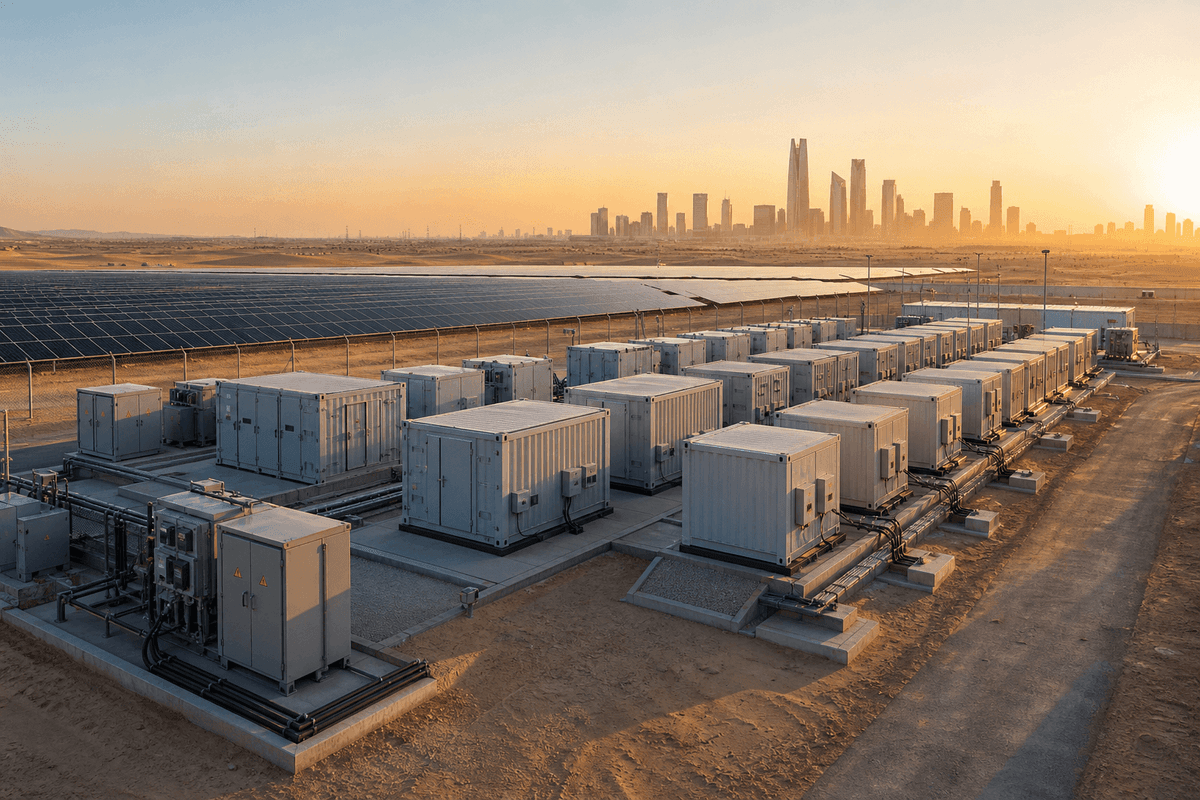
Saudi Arabia's LFP storage opportunity is defined by 48 GWh of targeted storage by 2030, 50% renewable electricity ambition, and fast-growing 4-hour BESS tenders.
Vision 2030 is turning battery storage from a backup accessory into core national energy infrastructure. The Saudi Power Procurement Company and Ministry of Energy have moved from pilot-scale storage to gigawatt-hour procurement, creating a bankable pipeline for developers, EPC contractors, battery suppliers, and industrial buyers. For B2B decision-makers, the key point is practical: LFP battery energy storage systems can help stabilize solar-heavy power systems, reduce diesel or liquid-fuel dependence, and improve reliability for grid, industrial, telecom, water, and smart-city assets.
According to the Saudi Press Agency (2025), Saudi Arabia aims to reach up to 48 GWh of storage capacity by 2030, with 26 GWh already tendered or under development at that time. The same release stated that the Kingdom targets 50% of electricity production from renewables by 2030. These figures align LFP projects directly with Vision 2030's energy diversification, localization, and infrastructure-resilience goals.
The first large procurement wave established the market template. According to SPA (2024), Group 1 includes four battery energy storage projects totaling 2,000 MW and 8,000 MWh, each designed for 4 hours of storage under a build-own-operate structure. In April 2026, SPA reported Group 2 at 3,000 MW and 12,000 MWh across six projects. Together, these two groups represent 20 GWh of grid-scale storage capacity.
LFP is especially relevant because Saudi projects need long cycle life, high thermal stability, predictable maintenance, and favorable lifecycle economics. LFP chemistry has lower energy density than some nickel-based batteries, but grid and C&I projects usually prioritize safety, cycle life, and cost per delivered kilowatt-hour over compact packaging. For desert infrastructure, that tradeoff is often rational.
Technical Deep Dive: Why LFP Fits Saudi Grid and C&I Projects
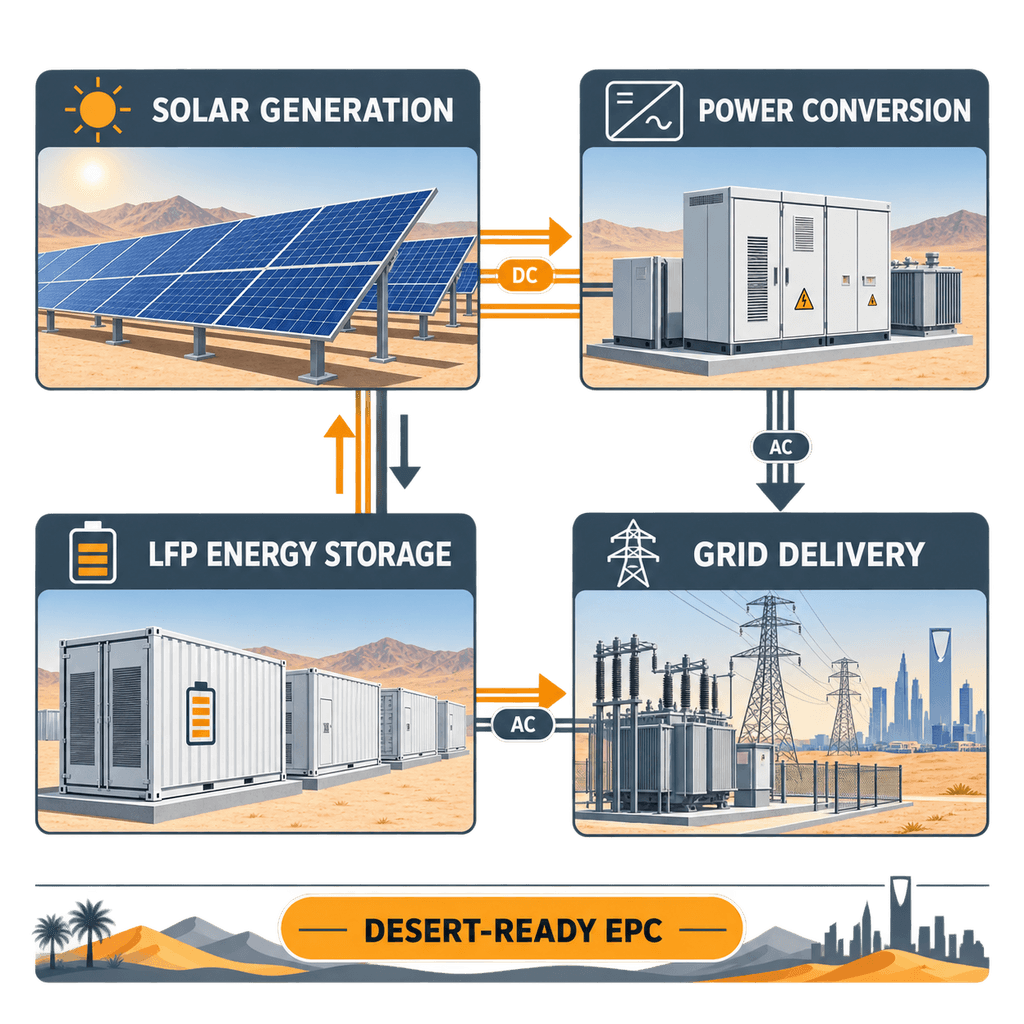
LFP batteries fit Saudi grid and C&I projects because 6,000+ cycles, 4-hour discharge, and strong thermal stability match solar-shifting and peak-shaving duty cycles.
A lithium iron phosphate battery uses a phosphate-based cathode and graphite anode. Compared with nickel manganese cobalt chemistries, LFP usually offers higher thermal stability, lower cobalt and nickel exposure, and a long cycle-life profile. In stationary storage, this helps developers design assets for daily cycling, peak clipping, frequency support, solar ramp management, and backup power without forcing aggressive battery replacement assumptions.
For grid-scale Saudi projects, the reference architecture is a 4-hour BESS block. A 500 MW / 2,000 MWh site stores solar generation during high-output periods and discharges into evening demand or grid-balancing windows. For commercial and industrial facilities, the same principle scales down: a 100 kW / 200 kWh LFP system can reduce peak demand, absorb excess rooftop solar, and provide controlled backup for critical loads.
SOLARTODO's 200 kWh Industrial Self-Consumption LFP Battery Energy Storage System is positioned for these C&I applications. It combines 200 kWh nominal capacity, 100 kW continuous output, LFP chemistry, a bidirectional PCS, a BMS, and thermal management for industrial self-consumption. For factories, warehouses, data rooms, farms, and telecom facilities, this size can support peak shaving and solar integration without the permitting complexity of a utility-scale yard.
According to IEC (2022), IEC 62619 covers safety requirements for secondary lithium cells and batteries used in industrial applications, including stationary energy storage. UL Solutions states, 'UL 9540 covers electrical, electrochemical, mechanical and other types of energy storage technologies.' For procurement teams, these standards should be written into technical specifications rather than treated as optional documentation.
According to IRENA (2025), battery storage costs fell 93% from 2010 to 2024, reaching about USD 192/kWh. IRENA also states, 'renewables remained the most cost-competitive option' for new electricity generation in 2024. That cost trend explains why Saudi solar-plus-storage procurement is moving quickly: storage is becoming an economic enabler of renewable penetration, not only a reliability premium.
Core Components for Saudi BESS Specifications
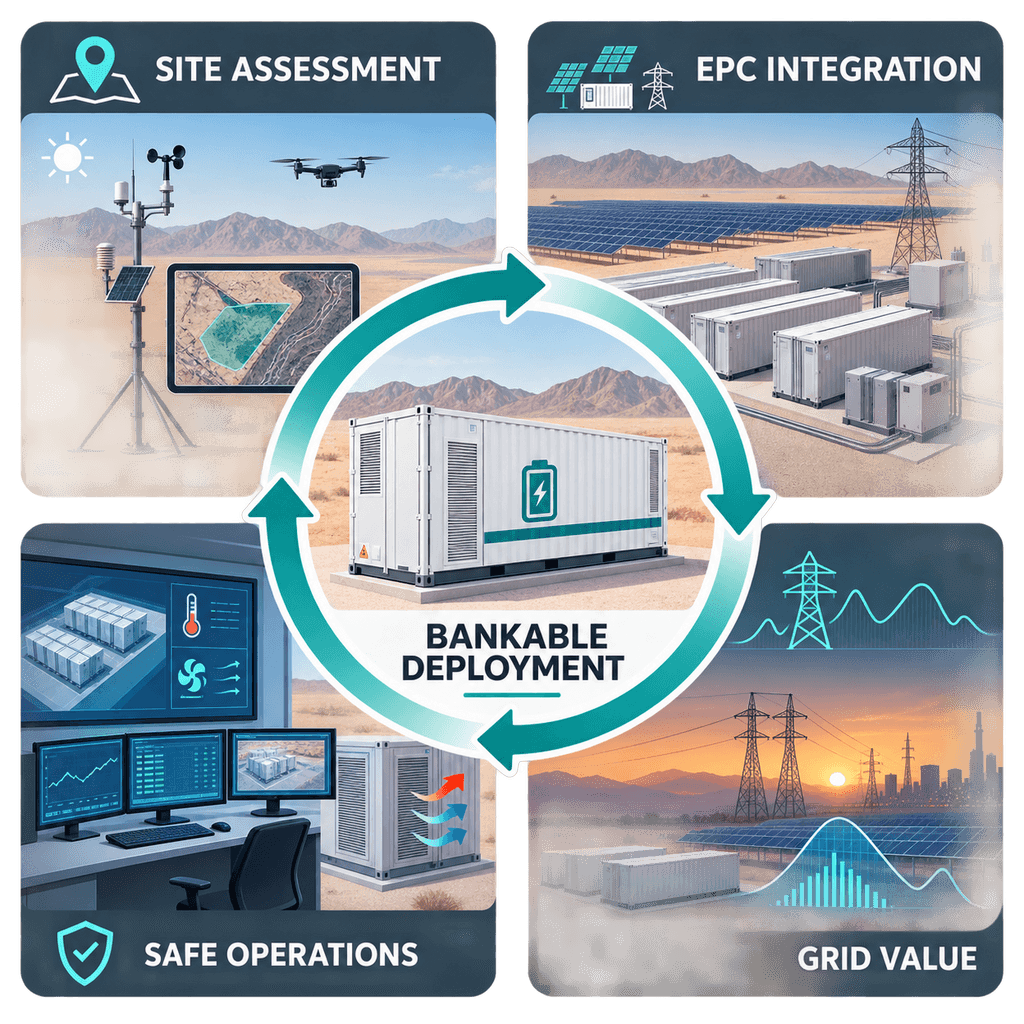
A bankable LFP BESS should include battery racks, BMS, PCS, EMS, HVAC or liquid cooling, fire detection, isolation protection, metering, and grid communications.
The BMS monitors cell voltage, current, state of charge, state of health, and temperature. The PCS converts DC battery power into AC power and manages charge/discharge commands. The EMS optimizes dispatch according to solar generation, tariff windows, demand peaks, grid instructions, and backup reserve. For Saudi projects, the EMS should support remote monitoring, Arabic/English documentation, and utility-grade data logging.
Thermal design is not a minor detail. Saudi ambient conditions can stress cabinets, inverters, and cell packs, especially when storage is cycled daily. For 200 kWh industrial cabinets and larger containerized systems, procurement specifications should define operating temperature limits, derating curves, HVAC redundancy, cooling medium, filter access, alarm thresholds, and emergency shutdown logic.
Applications for Saudi Infrastructure, Industry, and Smart Cities
LFP storage supports at least 5 Saudi project types: grid-scale solar shifting, C&I peak shaving, telecom backup, water infrastructure, and smart-city microgrids.
Grid-scale storage is the most visible opportunity because SPPC tenders are measured in gigawatt-hours. These assets help absorb solar output, reduce curtailment, and provide dispatchable capacity during evening demand. According to IEA (2024), solar PV and wind are forecast to account for 95% of renewable capacity additions through 2030, which means system flexibility will become increasingly valuable.
Industrial self-consumption is the second major use case. A manufacturer with rooftop or carport solar often has midday surplus and evening demand. A 200 kWh LFP BESS can store excess PV, discharge during peak tariff periods, and maintain power for selected critical loads. In markets with demand charges or diesel backup, the value stack can include bill savings, fuel savings, uptime protection, and lower generator runtime.
Telecom towers and remote infrastructure are also strong candidates. LFP systems can reduce diesel generator starts, stabilize DC power, and support hybrid solar telecom sites. SOLARTODO supplies telecom towers, power towers, solar streetlights, security systems, and smart infrastructure, so battery sizing can be integrated with poles, cameras, sensors, lighting, and communications equipment rather than purchased as a separate box.
Water and agriculture infrastructure matter because Saudi projects often combine energy, water, and digital monitoring. Solar-powered desalination, pumping, cold storage, and irrigation controls need dependable energy after sunset. LFP storage can support 4-10 hour autonomy windows for selected loads, while smart monitoring tracks battery health, PV yield, pump operation, and fault alarms.
Smart-city and tourism projects require a different procurement mindset. For Red Sea, NEOM-style, logistics, port, and industrial-city environments, storage should be evaluated as part of a resilient power architecture. That includes fire code compliance, visual integration, communications redundancy, cybersecurity, maintenance access, and lifecycle replacement planning.
EPC Investment Analysis and Pricing Structure
EPC buyers should compare FOB, CIF, and turnkey delivery because logistics, civil works, commissioning, and warranties can shift total cost by 10-30%.
EPC means Engineering, Procurement, and Construction. For LFP battery projects, turnkey EPC delivery typically includes site survey, electrical design, battery and inverter selection, container or cabinet layout, protection studies, civil pad design, installation, cabling, testing, commissioning, documentation, and operator training. For larger projects, it may also include SCADA integration, grid-code studies, spare parts, performance guarantees, and O&M support.
Pricing should be evaluated in three tiers. FOB Supply covers factory supply only and is best for experienced buyers with their own freight, customs, installation, and commissioning teams. CIF Delivered includes international freight and insurance to the destination port, reducing logistics risk for importers. EPC Turnkey includes delivery, installation, commissioning, and project coordination, making it the most complete option for industrial owners and infrastructure developers.
| Pricing tier | Scope included | Best for | Buyer risk |
|---|---|---|---|
| FOB Supply | Battery cabinet/container, PCS, BMS, EMS, factory test documents | Experienced importers and EPC firms | Highest logistics and site-interface risk |
| CIF Delivered | FOB scope plus freight and insurance to destination port | Distributors and project developers | Medium customs and installation risk |
| EPC Turnkey | Equipment, engineering, installation, testing, commissioning, training | Industrial owners and infrastructure clients | Lowest execution risk |
Volume guidance should be requested before final quotation. For standardized SOLARTODO systems, buyers can use planning assumptions of 5% discount for 50+ units, 10% for 100+ units, and 15% for 250+ units, subject to configuration, destination, certifications, and delivery schedule. Project financing is available for large projects above USD 1,000K, depending on buyer qualification, country risk, collateral structure, and project economics.
Standard payment terms are 30% T/T deposit plus 70% against bill of lading, or 100% L/C at sight. Procurement teams should align payment terms with inspection checkpoints: design approval, factory acceptance test, shipment documents, site acceptance test, and final commissioning. For EPC Turnkey contracts, retainage and performance milestones may be negotiated separately.
ROI depends on tariff structure and use case. A C&I system can target 5-7 year payback where demand charges, time-of-use spreads, diesel displacement, or outage costs are material. For a 200 kWh system cycling once daily, the buyer should model usable capacity, round-trip efficiency, degradation, O&M, inverter replacement, warranty terms, and residual capacity after 10 years. Contact SOLARTODO at [email protected] for EPC quotation, technical sizing, and financing review.
Comparison and Selection Guide for LFP Projects
Saudi LFP buyers should score systems across 8 criteria: capacity, C-rate, cooling, certifications, fire safety, PCS efficiency, EMS capability, and warranty.
| Selection factor | Grid-scale BESS | C&I LFP BESS | Procurement implication |
|---|---|---|---|
| Typical duration | 4 hours | 1-4 hours | Match dispatch to tariff or grid requirement |
| Example size | 500 MW / 2,000 MWh | 100 kW / 200 kWh | Scale design from load profile, not budget alone |
| Chemistry priority | LFP or equivalent safe chemistry | LFP preferred | Favor cycle life and thermal stability |
| Cycle-life target | 6,000+ cycles | 6,000+ cycles | Supports daily cycling assumptions |
| Cooling approach | HVAC or liquid cooling | Air or liquid cooling by duty | Specify derating at Saudi ambient temperatures |
| Key standards | IEC 62619, UL 9540, IEEE 1547 | IEC 62619, UL 9540, UL 1973 | Require certificates in bid package |
| Contract model | BOO, ISP, PPA-style storage service | FOB, CIF, or EPC Turnkey | Align risk allocation with buyer capability |
| Monitoring | SCADA and utility interface | EMS portal and alarms | Require data export and remote diagnostics |
According to IEEE (2018), IEEE 1547 defines interconnection and interoperability requirements for distributed energy resources connected to electric power systems. This matters because a battery is not only a container of cells; it is a grid-interactive asset. Poor inverter settings, weak protection coordination, or incomplete commissioning can delay energization and create avoidable utility objections.
Buyers should also compare warranties carefully. A 10-year warranty may reference different conditions, including depth of discharge, annual throughput, average temperature, maintenance compliance, and remaining capacity. For high-temperature sites, warranty validity should be tied to realistic ambient conditions and cooling design rather than laboratory assumptions.
SOLARTODO can support Saudi-facing projects with LFP storage, solar PV integration, smart streetlights, telecom power, towers, security systems, and smart agriculture monitoring. The recommended workflow is inquiry, technical sizing, offline quotation, financing review if applicable, factory acceptance, shipment, installation, and commissioning. SOLARTODO is a B2B manufacturer and exporter, not an online marketplace.
FAQ
LFP storage decisions in Saudi Arabia usually depend on 6 issues: Vision 2030 alignment, safety, cost, EPC scope, warranty, and grid compliance.
Q: What does Vision 2030 mean for lithium iron phosphate battery projects in Saudi Arabia? A: Vision 2030 creates a national demand signal for LFP battery projects by linking renewable energy, grid reliability, and industrial diversification. Saudi Arabia targets 50% renewable electricity by 2030 and up to 48 GWh of storage capacity, making bankable 4-hour BESS projects highly relevant for utilities, EPC firms, and industrial owners.
Q: Why is LFP chemistry suitable for Saudi energy storage projects? A: LFP is suitable because it offers strong thermal stability, long cycle life, and lower exposure to nickel and cobalt supply risks. For Saudi solar-plus-storage and C&I peak-shaving systems, 6,000+ cycle capability and predictable safety behavior are more valuable than maximum energy density, especially in high-temperature infrastructure environments.
Q: Are Saudi Arabia's announced BESS projects specifically LFP projects? A: Public tender releases describe BESS capacity, locations, duration, and delivery models, but they may not always name the final cell chemistry. However, LFP is widely favored for 4-hour stationary storage because it balances safety, cost, cycle life, and bankability. Buyers should verify chemistry, cell supplier, and certifications in each bid.
Q: What does a 500 MW / 2,000 MWh BESS project mean? A: A 500 MW / 2,000 MWh BESS can discharge 500 MW for 4 hours at rated output. This configuration is useful for shifting solar generation into evening demand, reducing curtailment, and supporting grid reliability. Saudi Group 1 and Group 2 projects use this 4-hour structure across multiple regions.
Q: How should an industrial buyer size a 200 kWh LFP battery system? A: Start with 12 months of interval load data, solar PV output, tariff periods, and backup requirements. A 100 kW / 200 kWh system fits facilities needing 1-2 hours of peak shaving or critical-load backup. Final sizing should model usable capacity, round-trip efficiency, degradation, and required reserve margin.
Q: What certifications should procurement teams require for LFP BESS? A: Procurement teams should require IEC 62619:2022 for industrial lithium battery safety, UL 9540 for complete energy storage systems, and IEEE 1547-2018 where grid interconnection applies. Additional documents should include factory test reports, fire-safety documentation, inverter certificates, warranty terms, and commissioning procedures.
Q: How much does EPC turnkey delivery include compared with FOB supply? A: FOB supply usually covers equipment at the factory, while EPC turnkey includes engineering, delivery coordination, installation, testing, commissioning, and training. CIF sits between them by adding freight and insurance to port. EPC costs more upfront but can reduce schedule, interface, and performance risk for first-time storage buyers.
Q: What payment terms are typical for SOLARTODO LFP storage projects? A: Standard terms are 30% T/T deposit and 70% against bill of lading, or 100% L/C at sight. Large projects above USD 1,000K may qualify for financing review. Buyers should link payments to design approval, factory acceptance testing, shipment documents, and site commissioning milestones.
Q: What ROI can Saudi C&I buyers expect from LFP storage? A: ROI depends on electricity tariffs, demand charges, diesel displacement, solar surplus, and outage costs. A well-sized C&I LFP system can target 5-7 year payback where daily cycling and peak shaving are available. Financial models should include degradation, usable capacity, maintenance, inverter replacement, and warranty limits.
Q: What maintenance does an LFP BESS require in desert environments? A: Desert maintenance should include filter cleaning, thermal-system inspection, torque checks, insulation testing, firmware review, alarm testing, and visual inspection of enclosures and cable entries. For high-duty systems, quarterly checks are prudent, with annual professional service. Temperature logs are critical for warranty and degradation management.
Q: How does SOLARTODO support Saudi LFP storage and infrastructure projects? A: SOLARTODO supports B2B buyers with LFP BESS, solar integration, telecom power, smart streetlights, towers, security systems, and smart agriculture monitoring. The process is inquiry, technical sizing, offline quotation, optional financing, manufacturing, shipment, and commissioning support. For project review, contact [email protected].
Conclusion
Saudi Vision 2030 makes LFP storage a strategic procurement category because 20 GWh of announced BESS groups already supports a broader 48 GWh 2030 target.
The bottom line: Saudi LFP projects should be specified as bankable energy infrastructure, not commodity batteries. For grid, industrial, telecom, water, and smart-city applications, buyers should prioritize 4-hour design logic, 6,000+ cycle LFP cells, IEC/UL/IEEE compliance, verified cooling, and EPC structures that match project risk.
References
- IRENA (2025): Renewable Power Generation Costs in 2024; reports solar PV LCOE of USD 0.043/kWh and battery storage cost decline of 93% from 2010 to 2024. https://www.irena.org/Publications/2025/Jun/Renewable-Power-Generation-Costs-in-2024 — https://www.irena.org/Data/View-data-by-topic/Capacity-and-Generation
- IEA (2024): Renewables 2024; forecasts solar PV and wind to account for 95% of renewable capacity additions through 2030 and highlights need for system flexibility. https://www.iea.org/reports/renewables-2024/electricity — https://www.iea.org/reports/world-energy-outlook-2024
- IEC 62619:2022 (2022): Safety requirements for secondary lithium cells and batteries used in industrial applications, including stationary energy storage systems. https://webstore.iec.ch/en/publication/64073 — https://webstore.iec.ch/
- IEEE 1547-2018 (2018): Standard for interconnection and interoperability of distributed energy resources with electric power systems interfaces. https://standards.ieee.org/ieee/1547/5915/ — https://standards.ieee.org/ieee/1547/7382/
- UL Solutions (2025): UL 9540 energy storage system testing and certification guidance covering ESS safety, controls, protection, communications, and grid interaction. https://www.ul.com/services/energy-storage-system-testing-and-certification — https://www.ul.com/ Authoritative references for Saudi LFP storage include 8 sources covering national targets, BESS tenders, battery safety, grid interconnection, and renewable cost data.
- Saudi Press Agency (2025): Saudi Arabia among world's top 10 global markets in energy storage; cites 48 GWh storage target, 26 GWh tendered, 50% renewable electricity target, and 2,000 MWh Bisha project. https://www.spa.gov.sa/en/N2261911
- Saudi Press Agency (2024): SPPC Group 1 BESS qualification process; four projects totaling 2,000 MW / 8,000 MWh under BOO model with 15-year storage services agreements. https://www.spa.gov.sa/en/N2200582
- Saudi Press Agency (2026): Principal Buyer Group 2 BESS qualification process; six projects totaling 3,000 MW / 12,000 MWh across Qassim, Makkah, Madinah, and Eastern Region. https://www.spa.gov.sa/en/N2568317
- IRENA (2025): Renewable Power Generation Costs in 2024; reports solar PV LCOE of USD 0.043/kWh and battery storage cost decline of 93% from 2010 to 2024. https://www.irena.org/Publications/2025/Jun/Renewable-Power-Generation-Costs-in-2024
- IEA (2024): Renewables 2024; forecasts solar PV and wind to account for 95% of renewable capacity additions through 2030 and highlights need for system flexibility. https://www.iea.org/reports/renewables-2024/electricity
- IEC 62619:2022 (2022): Safety requirements for secondary lithium cells and batteries used in industrial applications, including stationary energy storage systems. https://webstore.iec.ch/en/publication/64073
- IEEE 1547-2018 (2018): Standard for interconnection and interoperability of distributed energy resources with electric power systems interfaces. https://standards.ieee.org/ieee/1547/5915/
- UL Solutions (2025): UL 9540 energy storage system testing and certification guidance covering ESS safety, controls, protection, communications, and grid interaction. https://www.ul.com/services/energy-storage-system-testing-and-certification
About SOLARTODO
SOLARTODO is a global integrated solution provider specializing in solar power generation systems, energy-storage products, smart street-lighting and solar street-lighting, intelligent security & IoT linkage systems, power transmission towers, telecom communication towers, and smart-agriculture solutions for worldwide B2B customers.
About the Author

Cinn Song
Founder & Chief Solutions Architect
Cinn Song founded SOLARTODO LIMITED and leads its smart-city infrastructure engineering — from solar, storage and integrated smart poles to the company's push into physical-AI city edge nodes: pole-mounted edge computing, vertical LLMs for smart cities, drone-based O&M with autonomous battery swapping, robotic maintenance, and high-speed counter-UAS interception. Since 2010, he has directed turnkey EPC + BOT delivery across 50+ countries, including telecom monopole supply for national grid operators, off-grid solar street-lighting for African municipalities, and integrated smart-pole programs for Gulf smart cities.
Cite This Article
Cinn Song. (2026). رؤية 2030 ومشاريع lithium iron phosphate في المملكة…. SOLARTODO. Retrieved from https://solartodo.com/knowledge/2030-lithium-iron-phosphate
@article{solartodo_2030_lithium_iron_phosphate,
  title = {رؤية 2030 ومشاريع lithium iron phosphate في المملكة…},
  author = {Cinn Song},
  journal = {SOLARTODO Knowledge Base},
  year = {2026},
  url = {https://solartodo.com/knowledge/2030-lithium-iron-phosphate},
  note = {Accessed: 2026-10-13}
}
Published: August 23, 2026 | Available at: https://solartodo.com/knowledge/2030-lithium-iron-phosphate
Subscribe to Our Newsletter
Get the latest solar energy news and insights delivered to your inbox.
View All Articles