3120 Turnkey Power Transmission Tower in Gothenburg,…

Cinn Song
Founder & Chief Solutions Architect
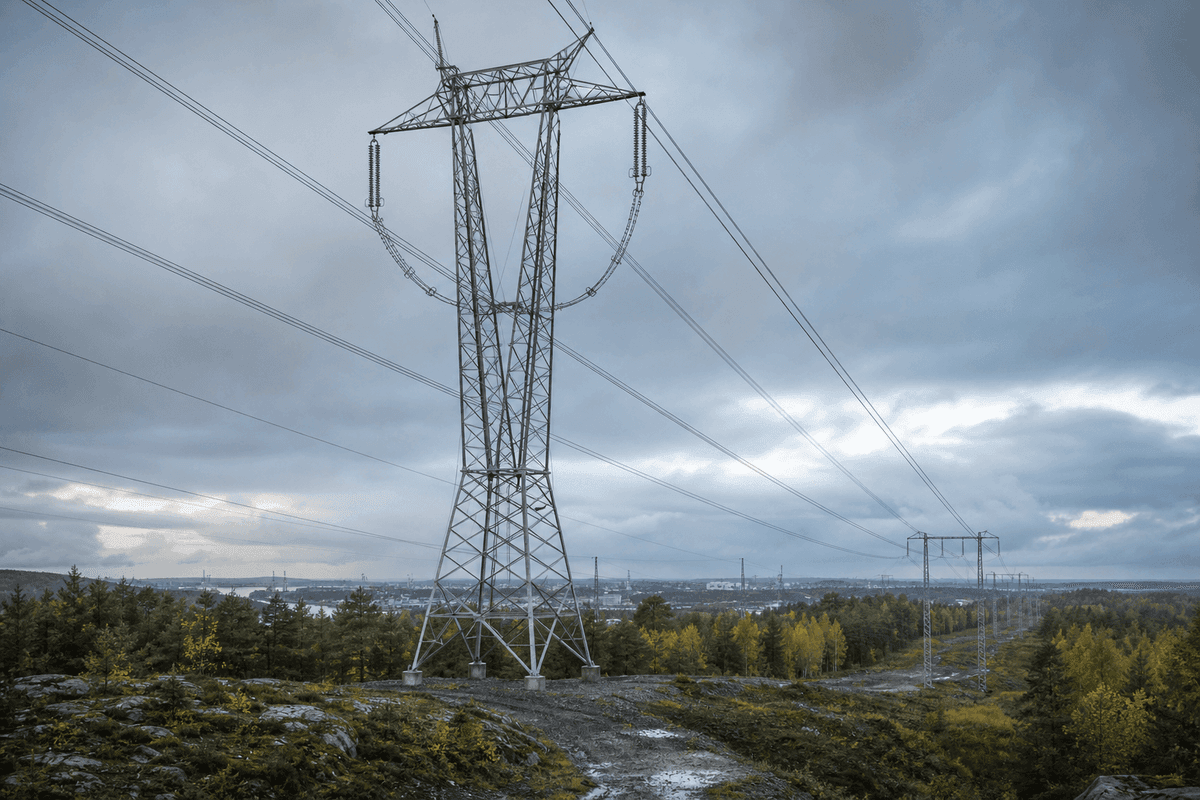
Watch the video
TL;DR
A 3120 turnkey power transmission tower package for Gothenburg should be specified as a 35-220 kV engineered EPC scope, not a simple catalogue purchase. Use 25-45 m galvanized steel structures, IEC 60826 and IEEE 738 design checks, 50-year life planning, FOB/CIF/EPC price separation, and financing review for projects above USD 1,000K.
A 3120 turnkey power transmission tower package in Gothenburg should specify 25-45 m galvanized steel structures, 35-220 kV line duty, 50-year design life, and EPC pricing from FOB supply to full installation.
Summary
A 3120 turnkey power transmission tower package in Gothenburg should specify 25-45 m galvanized steel structures, 35-220 kV line duty, 50-year design life, and EPC pricing from FOB supply to full installation.
Key Takeaways
- Define the 3120 scope as a 35-220 kV turnkey transmission tower package with 25-45 m structures, route survey, foundations, erection, and commissioning.
- Match Gothenburg grid demand by planning for Västra Götaland load growth, where regional electricity use exceeds 22 TWh/year and may nearly double by 2045.
- Select hot-dip galvanized Q355-Q420 steel with ISO 1461 coating control and a 50-year design life for Sweden's coastal and industrial environment.
- Use IEC 60826:2017 for reliability-based overhead line loading and IEEE 738-2023 for conductor temperature and ampacity calculations.
- Compare FOB, CIF, and EPC pricing because a 25 m 35 kV pole may cost USD 10,000-15,000 installed, while a 45 m 220 kV angle tower can reach USD 48,000-65,000 supply value.
- Reduce site labor risk by using flanged dodecagonal poles for 35 kV feeders, typically cutting erection time by 30-50% versus comparable lattice assembly.
- Apply volume discounts of 5% for 50+ towers, 10% for 100+ towers, and 15% for 250+ towers when procurement lots are technically standardized.
- Validate ROI against alternatives by quantifying avoided rework, fewer crane days, lower corrosion maintenance, and 20-35 year life-cycle cost savings.
3120 Turnkey Power Transmission Tower in Gothenburg, Sweden
A 3120 turnkey transmission tower package for Gothenburg combines 35-220 kV steel structures, 25-45 m heights, EPC delivery, and 50-year service planning for industrial electrification.
For B2B buyers, the term 3120 should be treated as a procurement package code rather than a single universal tower geometry. In practice, a Gothenburg package can include 25 m 35 kV dodecagonal tangent poles for sub-transmission feeders, 45 m 220 kV lattice angle towers for route deviations, terminal structures, conductor hardware, grounding, foundations, site erection, and commissioning documentation. SOLARTODO should therefore position the offer as a project-engineered tower system, not as a catalogue item sold without grid studies.
Gothenburg is a relevant location for this category because Västra Götaland is one of Sweden's most electricity-intensive industrial regions. According to Svenska kraftnät (2025), Västra Götaland consumes more than 22 TWh of electricity per year, produces about 30% of what it uses, and imports about 70% from other regions or countries. That creates strong demand for transmission reinforcement, renewable integration, and distribution capacity around ports, industrial parks, EV charging corridors, and new manufacturing loads.
According to Svenska kraftnät (2025), Vattenfall Eldistribution has requested about 1,200 MW of increased withdrawal capacity for 2026-2035 in the Gothenburg and south-west Sweden area, with another 1,500 MW available after 2035. This does not mean SOLARTODO is contracted on those public projects; it means B2B buyers in the region should treat line capacity, permitting, lead time, and structure standardization as board-level procurement risks.
The International Energy Agency states, 'Invest in grids today or face gridlock tomorrow.' That statement is directly relevant to transmission tower procurement because steel structures, foundations, conductors, and right-of-way delivery are often on the critical path before new solar, storage, port electrification, or industrial load can connect.
Technical Configuration and Engineering Basis
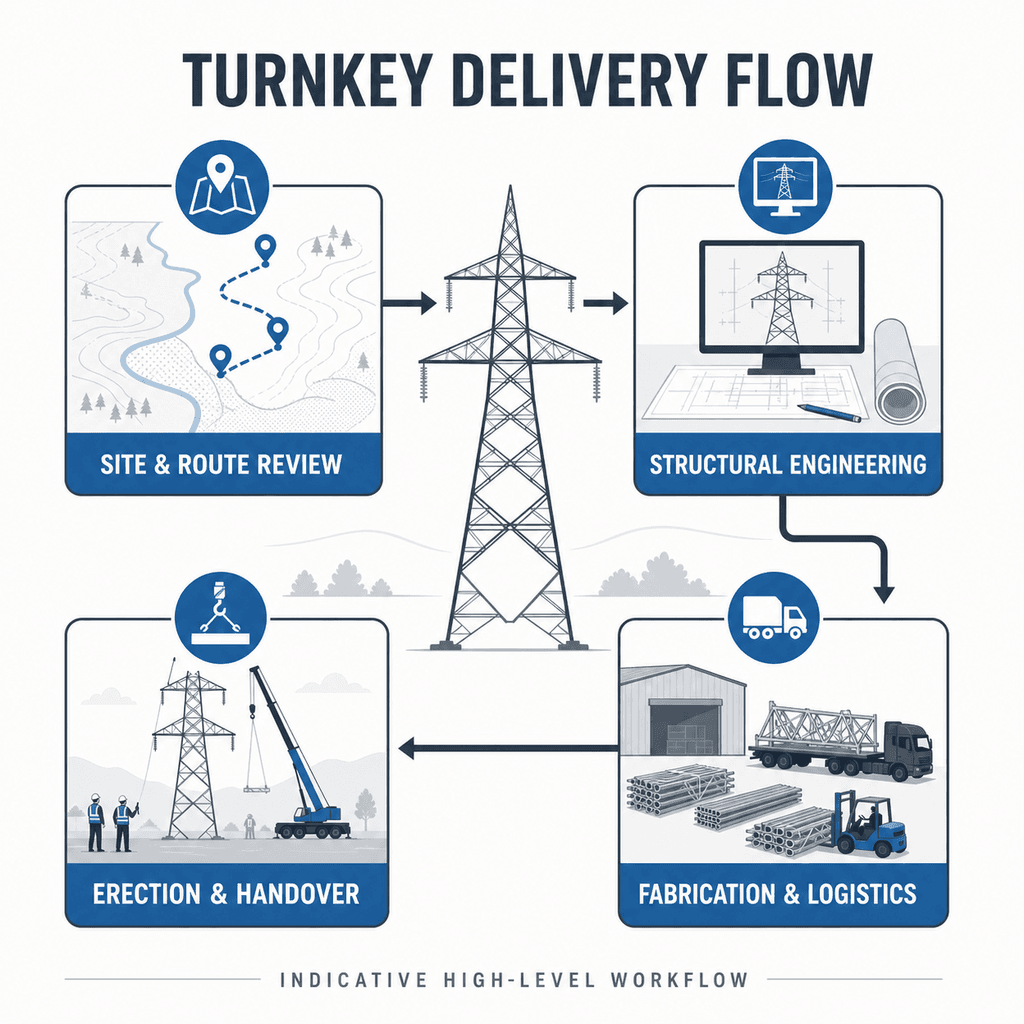
A Gothenburg-ready 3120 tower configuration should combine 35 kV feeder poles and 220 kV lattice towers with IEC, IEEE, ISO, and local Swedish approval requirements.
The baseline SOLARTODO configuration uses two proven structure families. The first is a 25m 35kV Dodecagonal Tangent Tower Flanged, a galvanized steel distribution pole for 1 circuit, 1 conductor per phase, and a typical 150 m straight-line span. The second is a 45m 220kV Transmission Angle Tower, a Q420 steel lattice structure for double-circuit high-voltage line sections requiring a 30-degree deviation and stronger lateral load capacity.
| Parameter | 35 kV Tangent Pole | 220 kV Angle Tower | Procurement Impact |
|---|---|---|---|
| Typical height | 25 m | 45 m | Determines clearance, crane class, and transport plan |
| Voltage duty | 35 kV | 220 kV | Sets insulation, conductor spacing, and safety clearance |
| Structure type | Dodecagonal flanged steel pole | Galvanized lattice angle tower | Affects erection time and steel tonnage |
| Circuit basis | 1 circuit | 2 circuits | Impacts capacity and outage planning |
| Typical span | 150 m | 350-450 m | Drives tower count per route kilometer |
| Wind/ice basis | Class B / 15 mm ice | Class B / 15 mm ice | Must be localized for Swedish climate data |
| Design life | 50 years | 50 years | Supports life-cycle cost comparison |
| Indicative installed/supply value | USD 10,000-15,000 EPC | USD 48,000-65,000 supply | Use for early budgeting only |
According to IEC (2017), IEC 60826 defines loading and strength requirements for overhead lines using reliability-based design principles, normally for lines of 45 kV and above. For a Gothenburg project, this standard should be combined with Swedish grid owner requirements, geotechnical investigation, route-specific wind exposure, ice loading, environmental permitting, and earthing design.
According to IEEE (2023), IEEE 738 describes a numerical method linking conductor temperature with electrical current and weather conditions. This matters when a 35 kV export feeder connects solar-plus-storage assets or when a 220 kV route must preserve N-1 operating margins during low-wind, high-load winter conditions.
The dodecagonal pole option is especially practical where urban or peri-urban corridors restrict installation space. Factory-welded shaft sections, flange joints, and pre-drilled bolt patterns can reduce site assembly time by 30-50% compared with equivalent lattice erection. For procurement managers, that can reduce crane rental exposure, traffic management cost, and weather delay risk.
The 220 kV lattice angle tower serves a different purpose. It is heavier because angle towers resist longitudinal conductor tension in addition to vertical and transverse loads. For deviations around substations, protected areas, rail corridors, port zones, or industrial estates, the extra 12-18% steel weight versus a tangent structure can be economically justified by route feasibility and grid reliability.
Gothenburg Applications and Grid Integration
In Gothenburg, a 3120 tower package is most useful for 10-50 MW solar interconnections, industrial feeders, port electrification, and 220 kV grid reinforcement interfaces.
Västra Götaland is not a generic renewable market. It combines automotive manufacturing, petrochemical operations, ports, shipping, heavy transport, wind resources, emerging solar production, and cross-border power flows. Svenska kraftnät states that Sweden's national grid is mainly AC, with about three fourths at 400 kV and one fourth at 220 kV. That makes 220 kV structures relevant for reinvestment, transition interfaces, and sub-regional transmission upgrades even when new national-grid lines increasingly favor 400 kV.
A practical 3120 deployment could include a 35 kV collector line from a solar or storage project to an industrial substation, plus a limited number of 220 kV angle or terminal structures near a higher-voltage interface. For a 12 km 35 kV route using 150 m spans, the line may need about 80 tangent structures before adding angle and terminal towers. Standardizing the tangent pole drawing early can reduce procurement variation across the route.
According to IEA (2025), global investment in power transmission grew by 10% in 2023 to reach USD 140 billion, but spending may need to exceed USD 200 billion per year by the mid-2030s under current policy settings. For Gothenburg buyers, this global pressure affects lead times for steel, galvanizing capacity, conductors, insulators, and specialist erection contractors.
According to IRENA (2025), renewables added 582 GW globally in 2024, including 452.1 GW of solar PV, equal to 77.8% of renewable additions. The transmission implication is clear: low-cost generation does not become bankable delivered energy until substations, conductors, protection systems, and tower corridors are ready.
The International Renewable Energy Agency states, 'renewables remained the most cost-competitive option for new electricity generation in 2024.' For a procurement manager, that quote supports renewable generation investment, but the tower package still needs a conventional engineering discipline: route design, load trees, foundation design, galvanizing QA, FAT inspection, installation method statements, and final as-built documentation.
EPC Investment Analysis and Pricing Structure
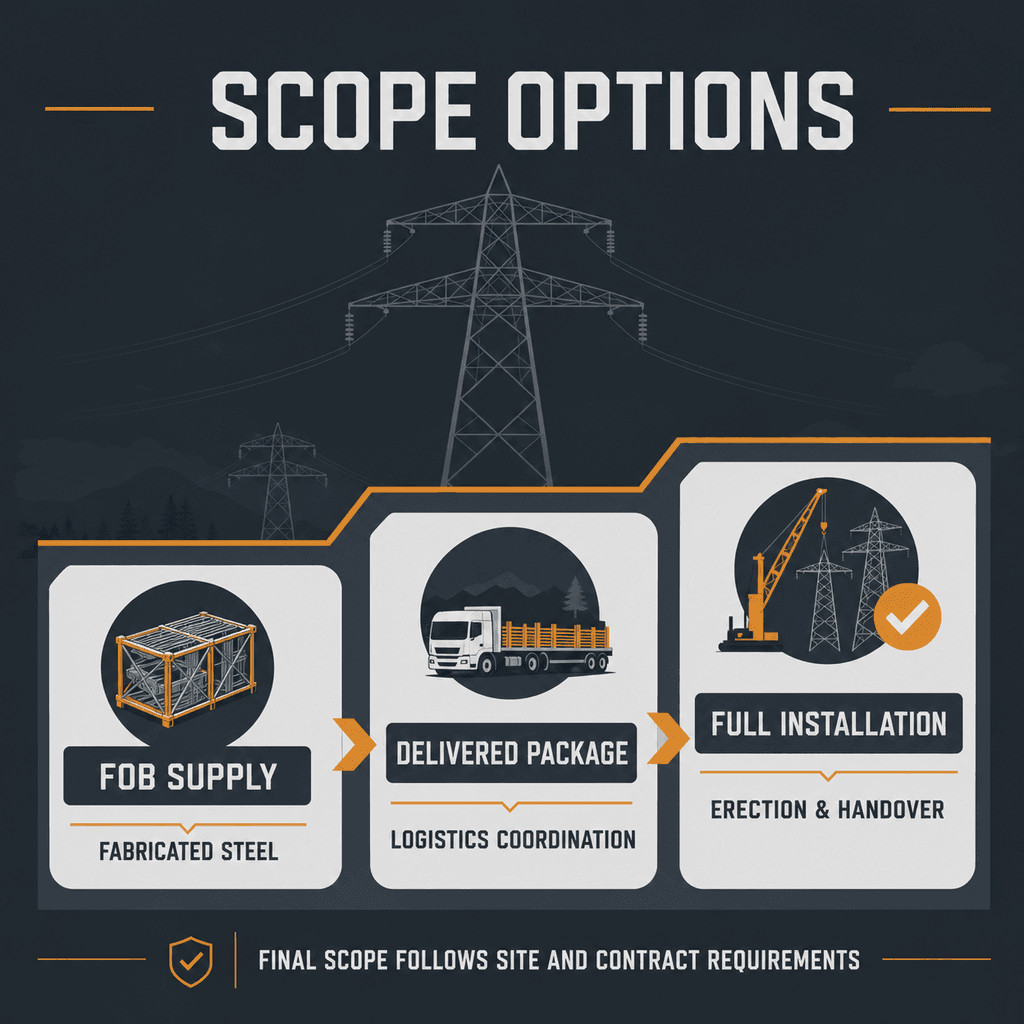
A 3120 EPC tower package should price FOB, CIF, and turnkey delivery separately, with 5-15% volume discounts and financing for projects above USD 1,000K.
EPC means Engineering, Procurement, and Construction. For a turnkey SOLARTODO tower package, engineering includes tower loading review, drawings, bill of materials, foundation coordination, conductor interface checks, galvanizing specification, and quality documentation. Procurement includes steel, fasteners, crossarms, insulators, grounding materials, packing, export documentation, and logistics. Construction includes foundation works, tower erection, conductor stringing support where contracted, inspection, commissioning assistance, and handover files.
| Pricing Tier | Typical Scope | Best For | Commercial Notes |
|---|---|---|---|
| FOB Supply | Tower steel, bolts, galvanizing, packing, factory QA | Buyers with their own freight and local EPC team | Lowest invoice value, buyer controls shipping and site risk |
| CIF Delivered | FOB scope plus international freight and insurance to agreed port | Importers needing landed-cost clarity | Useful for Gothenburg-area port planning and customs budgeting |
| EPC Turnkey | Engineering, supply, shipping, civil works, erection, and handover | Utilities, IPPs, industrial owners, and project developers | Highest value, but lowest interface risk for schedule control |
Indicative budgeting should be separated by structure class. The 25 m 35 kV flanged dodecagonal tangent pole has an EPC turnkey reference range of USD 10,000-15,000 per installed tower under standard conditions. The 45 m 220 kV angle tower has a supply reference range of USD 48,000-65,000 before site-specific foundation, installation, conductor hardware, and Swedish compliance costs. Final pricing depends on steel weight, zinc coating, route access, labor rates, soil conditions, outage constraints, and inspection requirements.
SOLARTODO should quote volume pricing transparently. A technically standardized order can use 50+ towers for a 5% discount, 100+ towers for a 10% discount, and 250+ towers for a 15% discount, provided drawings, coating class, hardware sets, and packing specifications remain stable. Splitting one corridor into many unique tower drawings can erase these savings through engineering hours and fabrication changeovers.
ROI should be calculated against the buyer's real alternative, not against a theoretical lowest price. Compared with reinforced concrete poles or field-assembled lattice structures, galvanized flanged steel poles may reduce construction windows, road closures, maintenance repainting, and replacement risk. A 30-50% erection-time reduction across 80 tangent poles can remove several crane days and shorten energized-ready dates, which matters when industrial loads or renewable assets are waiting to connect.
Payment terms are typically 30% T/T advance plus 70% against bill of lading, or 100% L/C at sight for approved banking channels. Project financing is available for large projects above USD 1,000K, subject to buyer credit review, country risk, project documentation, and insurance requirements. For budgetary discussion and technical clarification, contact [email protected] or +6585559114.
Selection Guide and Procurement Risk Control
Buyers should select 3120 tower structures by voltage class, span, angle load, corrosion exposure, logistics, and 50-year ownership cost rather than unit price alone.
A procurement team in Sweden should start with route classification. Straight 35 kV feeder sections normally use tangent or suspension structures because they carry vertical conductor weight and transverse wind load. Corners, terminals, crossings, and substation approaches need angle, strain, or dead-end structures. The fastest way to lose schedule is to procure tangent poles for locations that later require longitudinal load resistance.
| Decision Factor | Low-Risk Choice | Red Flag | Mitigation |
|---|---|---|---|
| Voltage class | 35 kV for feeders, 220 kV for transmission interfaces | Mixed voltage scope without interface drawings | Freeze single-line diagram before tower release |
| Route angle | Tangent below about 2 degrees | 10-30 degree deviation assigned to tangent pole | Use angle tower load cases and stronger foundations |
| Coastal corrosion | Hot-dip galvanizing to ISO 1461 | Thin coating or poor drainage holes | Require coating report and visual QA photos |
| Foundation | Soil-specific reinforced concrete | Standard foundation used without geotechnical data | Run boreholes and uplift checks before casting |
| Delivery model | CIF or EPC for interface-heavy imports | FOB chosen without Swedish installer capacity | Assign logistics and installation responsibility in contract |
| Documentation | Drawings, MTCs, galvanizing certificates, packing list | Missing bolt grade or steel certificates | Hold shipment until QA dossier is complete |
According to IEA (2023), the world must add or replace 80 million km of grids by 2040 and annual grid investment needs to double to more than USD 600 billion by 2030. This makes supplier qualification more important because grid hardware bottlenecks can delay energy projects even when generation assets are ready.
According to IRENA (2025), utility-scale solar PV reached a global weighted average LCOE of USD 0.043/kWh in 2024, while battery storage costs declined 93% from 2010 to 2024. Those figures support solar and storage development, but transmission towers remain the physical bridge between lower-cost generation and usable industrial electricity.
SOLARTODO can support B2B procurement by packaging drawings, preliminary load assumptions, QA records, export documentation, and project financing into one inquiry-to-quotation workflow. SOLARTODO is not an online marketplace; engineering review, local code alignment, logistics, and payment terms should be confirmed offline before contract award. For Gothenburg projects, SOLARTODO should also coordinate with the buyer's local designer to ensure Swedish approvals remain under the responsible grid owner or licensed engineering party.
FAQ
A 3120 turnkey tower package is best understood through 10 procurement questions covering voltage, cost, installation, standards, maintenance, warranty, and Sweden-specific grid risk.
Q: What is a 3120 turnkey power transmission tower package? A: A 3120 turnkey package is a project-defined transmission tower scope covering engineering, steel supply, logistics, foundations, erection, and handover. For Gothenburg, it can combine 25 m 35 kV tangent poles with 45 m 220 kV angle towers, depending on route voltage, span, and substation interface requirements.
Q: Is 3120 a single tower model or a project code? A: 3120 should be treated as a project or procurement code unless the buyer provides a certified drawing number. Transmission towers are engineered by voltage, span, wind, ice, angle, conductor, and foundation conditions, so SOLARTODO should confirm the final geometry before pricing or manufacturing.
Q: Which voltage classes fit Gothenburg industrial and renewable projects? A: Most industrial feeders and solar collector lines use medium or sub-transmission voltages such as 35 kV, while grid reinforcement interfaces may involve 220 kV or 400 kV systems. A 35 kV pole is suitable for shorter feeder corridors; a 220 kV tower suits higher-capacity transmission routes.
Q: How much does a turnkey tower package cost? A: Early budgeting can use USD 10,000-15,000 per installed 25 m 35 kV pole and USD 48,000-65,000 supply value for a 45 m 220 kV angle tower. Final EPC cost depends on foundations, access roads, Swedish labor, inspection, freight, conductor hardware, and outage constraints.
Q: What does EPC turnkey delivery include? A: EPC delivery includes engineering review, procurement, fabrication, galvanizing, export packing, freight coordination, foundation work, erection, inspection, and handover documents. It reduces interface risk because one commercial scope covers drawings, materials, logistics, and site delivery instead of leaving the buyer to coordinate multiple vendors.
Q: What standards should the tower design follow? A: The design basis should reference IEC 60826:2017 for overhead line loading, IEEE 738-2023 for conductor current-temperature calculations, ISO 1461 for hot-dip galvanizing, and applicable Swedish grid owner requirements. Local climatic data, soil investigation, right-of-way rules, and permitting requirements must still be verified by the project engineer.
Q: How long does installation take per tower? A: A 25 m flanged steel pole can often be erected faster than a lattice tower because major sections arrive factory-welded and bolt together on site. A 45 m 220 kV angle lattice tower may require 7-10 days for assembly and erection after foundation curing, depending on access and weather.
Q: Why use galvanized steel instead of concrete poles? A: Galvanized steel offers predictable fabrication, lighter transport per strength class, easier bolted connections, and a compact structure profile. In coastal or industrial environments, hot-dip galvanizing to ISO 1461 supports long corrosion life, while damaged components can often be replaced more easily than cracked concrete structures.
Q: What maintenance is required over 50 years? A: Maintenance usually includes visual inspections every 3-5 years and detailed checks every 8-10 years for bolts, corrosion, grounding, insulators, and conductor hardware. Coastal exposure near Gothenburg may justify closer coating inspections, especially around drainage points, base plates, fasteners, and areas exposed to road salt or industrial pollutants.
Q: Can SOLARTODO customize towers for Swedish wind and ice loads? A: Yes, SOLARTODO can adapt tower geometry, steel grade, galvanizing, conductor arrangement, and foundation interfaces to project-specific wind, ice, span, and soil requirements. The buyer should provide route data, conductor type, line angle schedule, geotechnical reports, and applicable grid owner standards before final manufacturing release.
Q: What payment and financing terms are available? A: Standard terms are 30% T/T advance plus 70% against bill of lading, or 100% L/C at sight. For large projects above USD 1,000K, financing may be available after credit review, project documentation, delivery schedule confirmation, and country-risk assessment.
Q: How should a procurement team reduce delivery risk? A: Freeze route drawings, classify every tower by tangent, angle, terminal, or dead-end duty, and separate FOB, CIF, and EPC responsibilities in the contract. Require material certificates, galvanizing reports, bolt lists, packing marks, inspection hold points, and a realistic installation schedule before releasing mass production.
Conclusion
A Gothenburg 3120 turnkey tower package should combine 35-220 kV engineering, 25-45 m galvanized structures, and EPC risk control for 50-year grid assets.
Bottom line: SOLARTODO's 3120 turnkey power transmission tower approach is strongest when buyers standardize drawings, separate FOB/CIF/EPC pricing, and verify IEC 60826, IEEE 738, ISO 1461, and Swedish grid requirements before production. For projects above USD 1,000K, the best procurement path is an offline engineering quotation with financing review.
References
These 7 references support 3120 tower decisions with grid demand data, 35-220 kV engineering standards, 2024 renewable cost statistics, and Sweden-specific planning context.
- IEA (2025): Building the Future Transmission Grid; reports 10% global transmission investment growth in 2023 to USD 140 billion and mid-2030s spending needs above USD 200 billion/year.
- IEA (2023): Electricity Grids and Secure Energy Transitions; states that 80 million km of grids must be added or replaced by 2040 and grid investment must double by 2030.
- IRENA (2025): Renewable Power Generation Costs in 2024; reports 582 GW renewable additions, 452.1 GW solar PV additions, and solar PV LCOE of USD 0.043/kWh.
- IEC 60826:2017 (2017): Design criteria of overhead transmission lines; defines reliability-based loading and strength requirements for overhead lines of 45 kV and above.
- IEEE 738-2023 (2023): Standard for Calculating the Current-Temperature Relationship of Bare Overhead Conductors; supports conductor ampacity and thermal rating calculations.
- Svenska kraftnät (2025): Västra Götaland regional grid development information; reports more than 22 TWh annual electricity use and expected near-doubling by 2045.
- Svenska kraftnät (2025): Gothenburg and south-west Sweden power supply update; cites about 1,200 MW requested withdrawal capacity for 2026-2035 and 1,500 MW additional capacity after 2035.
About SOLARTODO
SOLARTODO is a global integrated solution provider specializing in solar power generation systems, energy-storage products, smart street-lighting and solar street-lighting, intelligent security & IoT linkage systems, power transmission towers, telecom communication towers, and smart-agriculture solutions for worldwide B2B customers.
Procurement paths
About the Author

Cinn Song
Founder & Chief Solutions Architect
Cinn Song founded SOLARTODO LIMITED and leads its smart-city infrastructure engineering — from solar, storage and integrated smart poles to the company's push into physical-AI city edge nodes: pole-mounted edge computing, vertical LLMs for smart cities, drone-based O&M with autonomous battery swapping, robotic maintenance, and high-speed counter-UAS interception. Since 2010, he has directed turnkey EPC + BOT delivery across 50+ countries, including telecom monopole supply for national grid operators, off-grid solar street-lighting for African municipalities, and integrated smart-pole programs for Gulf smart cities.
Cite This Article
Cinn Song. (2026). 3120 Turnkey Power Transmission Tower in Gothenburg,…. SOLARTODO. Retrieved from https://solartodo.com/knowledge/3120-turnkey-power-transmission-tower-in-gothenburg-sweden
@article{solartodo_3120_turnkey_power_transmission_tower_in_gothenburg_sweden,
  title = {3120 Turnkey Power Transmission Tower in Gothenburg,…},
  author = {Cinn Song},
  journal = {SOLARTODO Knowledge Base},
  year = {2026},
  url = {https://solartodo.com/knowledge/3120-turnkey-power-transmission-tower-in-gothenburg-sweden},
  note = {Accessed: 2026-07-28}
}
Published: July 28, 2026 | Available at: https://solartodo.com/knowledge/3120-turnkey-power-transmission-tower-in-gothenburg-sweden
Subscribe to Our Newsletter
Get the latest solar energy news and insights delivered to your inbox.
View All Articles