Aerial Emergency Response: Drones Launched from Smart…

Cinn Song
Founder & Chief Solutions Architect
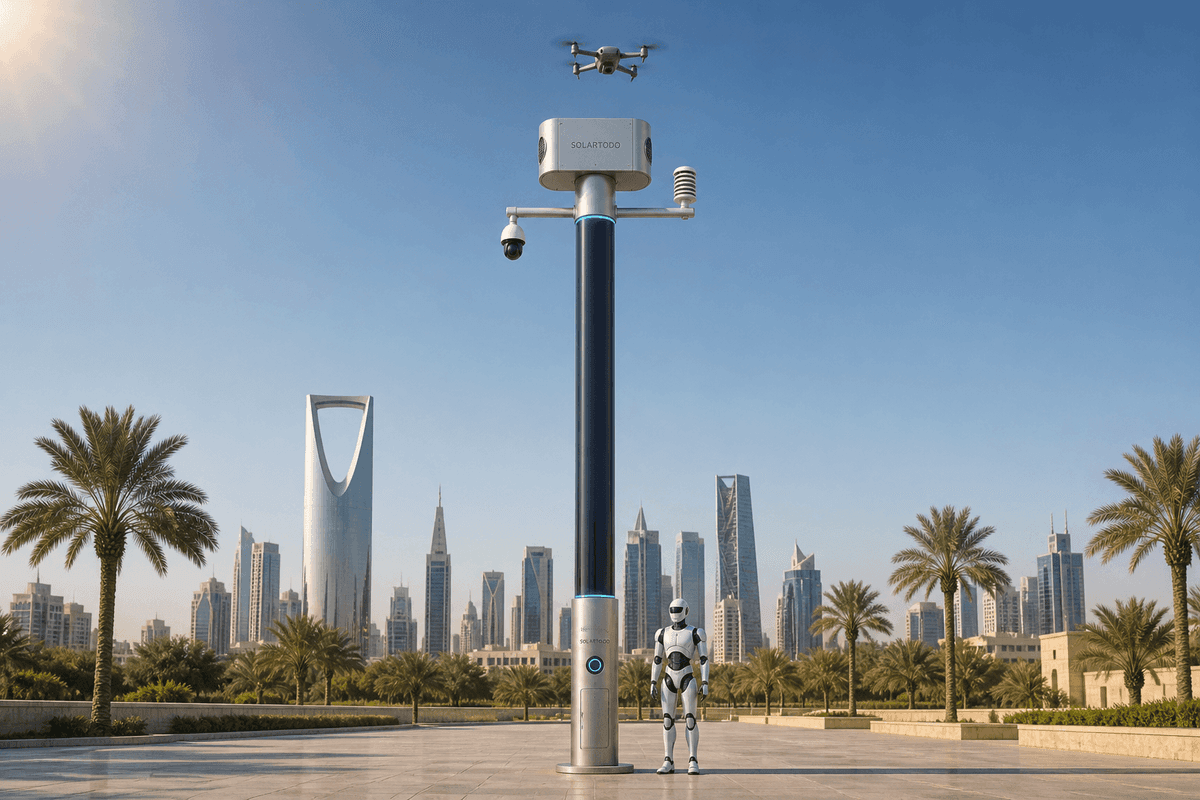
Watch the video
TL;DR
SOLARTODO Sky Hub is a pure smart pole for aerial emergency response, not a lighting product. Each off-grid node combines local AI, drone launch and return, automated battery exchange, 5-20 kWh storage, and 0.8-1.1 kW clear-sky solar replenishment. Raw data stays on the pole; only de-identified metadata leaves for command workflows.
SOLARTODO Sky Hub enables aerial emergency response from off-grid smart pole hubs with 0.8-1.1 kW clear-sky solar replenishment, 5-20 kWh storage, and local AI that keeps raw data on the pole.
Summary
SOLARTODO Sky Hub enables aerial emergency response from off-grid smart pole hubs with 0.8-1.1 kW clear-sky solar replenishment, 5-20 kWh storage, and local AI that keeps raw data on the pole.
Key Takeaways
Use these 8 actions to specify a Sky Hub emergency-response network with measurable energy, autonomy, compliance, and ROI assumptions.
- Specify pure smart pole hubs for 24/7 emergency staging where each node combines sensing, edge compute, drone service, and 5-20 kWh battery buffering.
- Model on-pole solar replenishment at 0.8-1.1 kW DC clear-sky peak and 6-9 kWh/day in high-irradiance regions, not unlimited solar output.
- Keep raw video and sensor streams local on the pole, transmitting only de-identified event metadata, mission logs, alarms, and health status.
- Plan drone response workflows around launch, patrol, inspection, return, battery hot-swap, and redeployment across multiple consecutive sorties.
- Use the 9-parameter environmental station to gate flight decisions with wind speed, wind direction, temperature, humidity, pressure, noise, PM10, PM2.5, and illuminance.
- Require human authorization for counter-UAS escalation; limit actions to detection, tracking, coordination, soft aerial net-capture, or close-approach deterrence.
- Compare EPC value against avoided trenching, separate camera poles, manual patrol labor, and drone support shelters, targeting 3-6 year payback where access costs are high.
- Request engineering confirmation for site spacing, storage autonomy, aviation permissions, foundation design, and communications planning before releasing 50+ unit procurement.
Aerial Emergency Response From Smart Pole Hubs
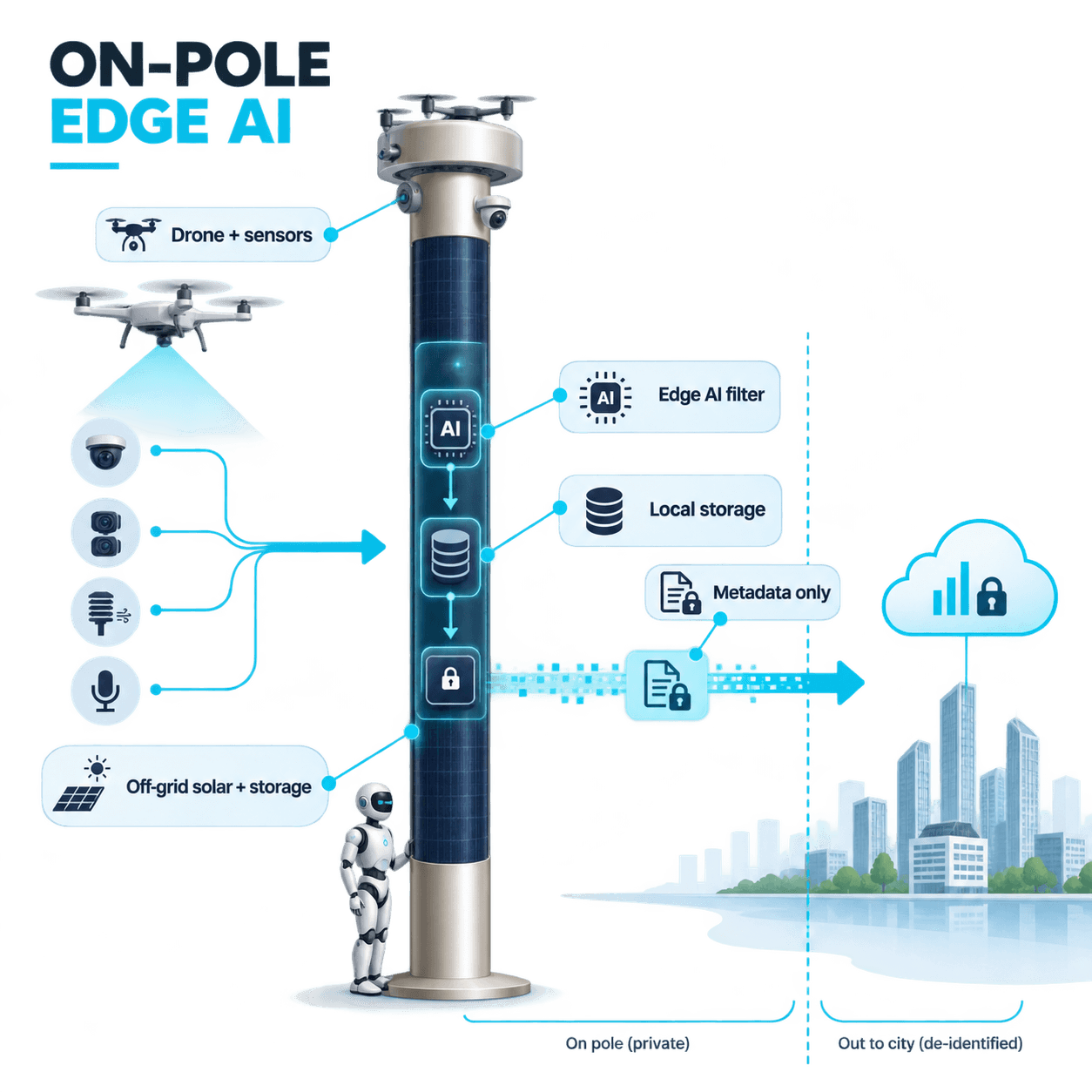
Sky Hub turns a distributed pole network into an emergency-response layer by combining local AI, autonomous drone service, and 5-20 kWh storage per node.
For procurement teams, the practical question is not whether a drone can fly from a fixed point. The harder question is whether the field infrastructure can detect an event, launch the right sortie, maintain energy autonomy, document the response, and keep sensitive data local. SOLARTODO Sky Hub addresses that problem as a pure smart pole, not as a lighting product, by integrating edge sensing, compute, communications, drone service, ground-robot coordination, and battery-backed off-grid power.
A typical emergency workflow begins with local perception at the pole. The system can classify operational events such as intrusion, crowd density changes, perimeter movement, anonymous vehicle volume, equipment-zone activity, or environmental threshold breaches. The pole then creates an event record, assigns a severity level, and sends de-identified metadata to the command view while raw video and sensor streams remain on the pole for local processing.
This architecture is useful for ports, industrial parks, campuses, smart districts, logistics corridors, utility perimeters, and critical-infrastructure zones. It is especially relevant where trenching, separate utility connections, and manual patrol dispatches add cost or delay. According to IEA (2025), clean energy accounted for over 80% of global electricity-generation growth in 2024, reinforcing the infrastructure trend toward electrified, distributed, and digitally managed assets.
SOLARTODO positions Sky Hub as an in-service physical-AI edge node for operational response, inspection, and field coordination. The product does not rely on city, site, or grid power for normal operation. It uses battery storage as the operating buffer and on-pole solar as a replenishment layer, so project engineers must size the duty cycle rather than assuming continuous high-power operation without limits.
Technical Architecture and Emergency Workflow
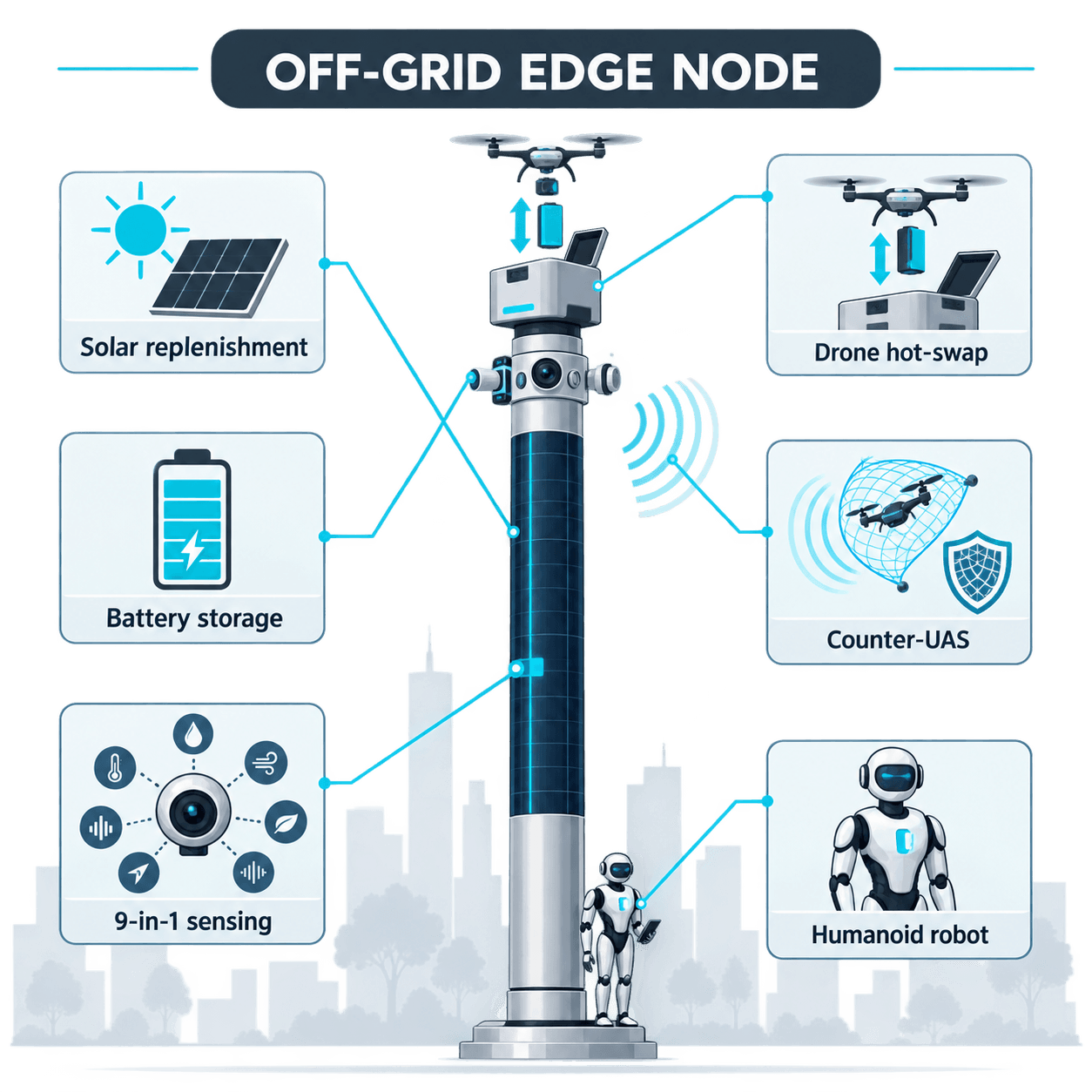
A Sky Hub emergency workflow connects sensing, authorized assessment, compute scheduling, field action, and maintenance reporting across 4 operating phases.
The core loop is straightforward: detect the condition, assess it under an approved operating rule, schedule the field asset, then record the outcome. At the pole level, edge compute processes video, environmental data, drone state, robot state, battery state, and communications health. At the command level, operators receive event summaries, task status, and decision prompts rather than continuous raw sensor feeds.
Edge AI and Local Data Handling
The edge AI layer uses Jetson-class compute to run local inference and workload scheduling. It supports anonymous vehicle counting, crowd-density estimation, intrusion detection, perimeter awareness, environmental threshold logic, and drone task prioritization. It does not require face recognition or licence-plate recognition to support emergency workflows, and those should not be specified as active deployed capabilities.
Raw data remains on the pole by default. Event packets can include location, time, event category, severity, confidence score, battery state, environmental readings, and mission state. This data-minimization approach is PDPL/LGPD-oriented because it is designed around local processing, retention control, and reduced upstream exposure, but buyers should not treat it as a substitute for jurisdiction-specific legal review.
According to NREL PVWatts (2025), PV performance estimates include assumptions and uncertainties, and the model uses long-term weather data to show expected variation. That point matters for Sky Hub because emergency availability depends on local solar resource, storage capacity, cleaning practice, wind rules, communications reliability, and mission frequency.
Drone Service and Hot-Swap Operations
The drone subsystem supports launch, patrol, inspection, return, automated battery exchange, and redeployment. After a drone lands, a multi-bay battery magazine exchanges the depleted pack for a charged one so the aircraft can re-enter the task queue without a technician attending every sortie. This is the difference between a single-use launch point and an operational response node.
Mission management includes route planning, task queueing, battery state control, swap-state supervision, fleet health, and mission logs. For emergency response, the system can verify alarms, inspect blocked access routes, check fence lines, survey incident perimeters, and provide rapid situational awareness for the command team. It should still follow applicable aviation rules, site geofencing, weather thresholds, and operator authorization procedures.
The FAA states, "Keep your drone within sight" for Part 107 operations in the United States, with detailed conditions for visual observers. That quote is jurisdiction-specific, but it illustrates a global procurement principle: drone infrastructure does not override aviation law. Each deployment needs country-specific flight permissions, operating procedures, and responsible operator roles.
Counter-UAS Coordination
Counter-UAS coordination is non-lethal and human-authorized. Sky Hub can detect and track an unauthorized drone using available local sensors or optional partner-sensor inputs, then coordinate a friendly drone for soft aerial net-capture or close-approach deterrence when an authorized operator approves the action. It must not be specified for destructive interception, jamming, denial effects, or autonomous attack.
Radar should be treated as an optional external or partner-sensor input, not as built-in pole hardware. This distinction matters in tenders because regulated RF systems, aviation permissions, and enforcement authority usually sit outside a pole bill of materials. The pole’s role is local sensing, command coordination, evidence handling, and controlled dispatch.
Off-Grid Energy and Storage Assumptions
Sky Hub is fully off-grid for normal operation, with about 0.8-1.1 kW DC clear-sky solar replenishment and 5-20 kWh storage.
The energy design should be described as a battery-backed micro-station with solar replenishment, not as a promise of unlimited solar self-sufficiency. The on-pole CIGS surface is approximately 15 m² and about 2.4-2.7 kWp nameplate, but field output depends on solar angle, temperature, soiling, seasonal irradiance, and the fact that only part of the surface receives strong direct sun at one time.
In a high-irradiance region, realistic clear-sky output is roughly 0.8-1.1 kW DC peak and about 6-9 kWh/day. Peak generation may occur away from solar noon depending on geometry and site exposure. High-power drone and robot tasks are therefore scheduled through the battery, with solar extending endurance and reducing service visits rather than eliminating all duty-cycle limits.
According to IRENA (2025), battery storage costs declined 93% from 2010 to 2024, reaching USD 192/kWh at the global weighted-average level reported in its renewable-cost analysis. IRENA also states, "Renewables remained the most cost-competitive option for new electricity generation in 2024." These cost trends support distributed battery-backed infrastructure, but each Sky Hub project still needs a site energy model.
| Engineering item | Practical specification range | Procurement implication |
|---|---|---|
| On-pole solar replenishment | 0.8-1.1 kW DC clear-sky peak | Use for daily replenishment, not unlimited mission power |
| Daily solar energy | 6-9 kWh/day in high-irradiance regions | Apply soiling, season, and cleaning derates |
| Battery storage | 5-20 kWh class | Size around drone sorties, robot charging, and communications uptime |
| Environmental sensing | 9 measured parameters | Gate flight, inspection, and maintenance decisions |
| Data transmission | Metadata and status only | Keep raw streams local to reduce privacy and bandwidth risk |
| C-UAS response | Human-authorized, non-lethal only | Align with local law and operator rules of engagement |
Applications, Benefits, and Limits
A 50-250 node Sky Hub program can reduce separate field assets while improving emergency verification, patrol frequency, and response documentation.
The strongest use cases are locations where emergency response is slowed by distance, restricted access, fragmented systems, or a lack of permanent power. A port perimeter may need drone verification after a fence-line alarm. A campus may need rapid inspection after a crowd-density event. An industrial park may need recurring inspection of utility corridors, storage yards, and restricted zones without dispatching a technician for every check.
Compared with conventional infrastructure, Sky Hub consolidates multiple field layers into one pole node: sensing, edge compute, off-grid power, drone operations, drone battery exchange, mission management, ground-robot coordination, environmental monitoring, and command reporting. This can reduce separate equipment cabinets, utility service points, and manual inspection dispatches, especially in brownfield sites where civil work can dominate installation cost.
The limits should be stated clearly in engineering documents. Solar replenishment is finite; drone operations remain weather- and regulation-dependent; storage autonomy depends on duty cycle; and local processing requires disciplined retention and access-control policy. According to IEC 60529 (2013), IP ratings classify enclosure protection for electrical equipment up to 72.5 kV, but an IP target alone does not replace full environmental, thermal, corrosion, and maintenance planning.
EPC Investment Analysis and Pricing Structure
EPC procurement should price Sky Hub as an engineered emergency-response system with 3 supply tiers, volume discounts, and 3-6 year payback modeling.
EPC means engineering, procurement, and construction. For Sky Hub, engineering covers site survey, pole loading, foundation assumptions, solar yield model, storage autonomy, communications design, aviation workflow, data interfaces, and commissioning scripts. Procurement covers the pole node, sensing package, edge compute, battery storage, solar replenishment, drone service subsystem, environmental station, and control software. Construction covers foundation work, installation, configuration, acceptance testing, and operator handover.
| Pricing tier | Scope | Indicative unit range |
|---|---|---|
| FOB Supply | Equipment supply, export packing, ex-works China | USD 4,030-8,840 |
| CIF Delivered | Equipment plus ocean freight and insurance | USD 4,527-9,931 |
| EPC Turnkey | Installed, commissioned, and covered by 1-year warranty support | USD 6,500-13,000 |
| Volume band | Indicative discount | Typical buyer scenario |
|---|---|---|
| 50+ units | 5% | Campus, logistics park, or small industrial perimeter |
| 100+ units | 10% | Multi-zone port, smart district, or regional utility corridor |
| 250+ units | 15% | Large framework procurement with phased deployment |
ROI depends on avoided trenching, avoided utility tie-ins, reduced manual patrols, fewer separate drone support assets, and faster alarm verification. Where conventional deployment requires camera poles, power service points, manual inspection rounds, and separate drone charging locations, an EPC Sky Hub program may target 3-6 year payback. A bankable model should include local labor cost, civil-work cost, inspection frequency, downtime risk, battery replacement policy, and communications fees.
Standard payment terms are typically 30% T/T advance plus 70% against bill of lading, or 100% irrevocable L/C at sight for qualified international trade. Project financing can be discussed for large programs above USD 1,000K. Buyers should contact [email protected] with site coordinates, quantity, required storage autonomy, drone duty cycle, and civil-work assumptions.
Specification and Selection Guide
Select Sky Hub when the project needs 4 capabilities together: off-grid power, edge AI, autonomous drone service, and local data control.
Procurement teams should first decide whether the site needs a pure smart pole edge node or a conventional utility-connected pole package. Sky Hub is appropriate when autonomous field response, local processing, and off-grid resilience are central to the project. It is not a lighting system and should not be specified around roadway illumination requirements.
| Requirement | Sky Hub fit | Conventional separate systems |
|---|---|---|
| Emergency drone launch | Integrated with mission queue and battery exchange | Usually requires a separate drone base or operator kit |
| Power availability | Fully off-grid with storage and solar replenishment | Often depends on utility service or generator planning |
| Data governance | Raw streams stay local; metadata leaves the node | Often cloud-centric unless separately engineered |
| Perimeter awareness | Local AI supports intrusion and density events | Camera-only systems may need centralized analytics |
| C-UAS coordination | Non-lethal and human-authorized | Often requires separate sensor and response architecture |
| Maintenance | One consolidated node per location | Multiple cabinets, mounts, and service contracts |
According to IEEE 1547-2018, distributed energy resources require interconnection and interoperability requirements when connected with electric power systems. Sky Hub normally operates off-grid, but the standard remains relevant when hybrid site designs, service charging, or local DER integration are added. IEC 61215 and IEC 61730 are also relevant reference families for PV qualification and safety review.
FAQ
These 10 answers cover Sky Hub emergency response, energy limits, pricing, installation, maintenance, and compliance in 40-80 words each.
Q: What is an aerial emergency response hub in the Sky Hub architecture? A: An aerial emergency response hub is a pure smart pole node that hosts sensing, local AI, battery-backed off-grid power, drone service, and command reporting. In a Sky Hub deployment, each node can detect events, launch a drone, support battery exchange, log missions, and return de-identified metadata to operators while raw data stays local.
Q: Is SOLARTODO Sky Hub a smart streetlight or lighting product? A: No. Sky Hub is a pure smart pole and has no lighting system. It is designed for edge compute, sensing, autonomous drone operations, ground-robot coordination, environmental monitoring, and emergency response workflows, not for roadway illumination or any lighting duty.
Q: How does the drone launch workflow work during an emergency? A: The pole detects an event locally, creates a metadata alert, and presents the response option to the command workflow. After authorization and weather checks, the drone launches for patrol or inspection, returns to the pole, receives an automated battery exchange if required, and can redeploy for another sortie.
Q: How much solar energy can one Sky Hub node realistically produce? A: In high-irradiance regions, the on-pole solar layer should be modeled at roughly 0.8-1.1 kW DC clear-sky peak and about 6-9 kWh/day. The 5-20 kWh battery class buffers drone, robot, compute, and communications loads, so output should be engineered by duty cycle.
Q: Does raw video leave the pole for cloud processing? A: No. The design keeps raw video and sensor data on the pole for local processing. Only de-identified event metadata, status data, mission logs, alarms, battery state, and maintenance summaries may leave the node, which supports PDPL/LGPD-oriented data-minimization practices.
Q: What emergency use cases are best suited for Sky Hub? A: Strong use cases include port perimeter alarms, industrial-yard intrusion checks, restricted-zone response, utility corridor inspection, campus incident verification, environmental threshold events, and post-alarm aerial assessment. The platform is strongest where separate power, cabinets, drone bases, and manual patrol dispatches create cost or delay.
Q: Can Sky Hub perform counter-UAS actions automatically? A: Sky Hub can support detection, tracking, and command coordination, but mitigation must be human-authorized and non-lethal. Permitted response concepts include soft aerial net-capture or close-approach deterrence by a friendly drone. It must not be specified for jamming, destructive interception, autonomous attack, or weaponized use.
Q: Is radar included in the pole hardware? A: Radar is not standard pole hardware in the Sky Hub architecture. If a project requires radar, it should be specified as an optional partner-sensor input or integration with an existing site security system. The pole then uses that input for event correlation and command coordination.
Q: What does EPC turnkey delivery include for Sky Hub? A: EPC turnkey delivery covers engineering, procurement, construction, commissioning, and 1-year warranty support. Unit pricing is typically USD 6,500-13,000 for EPC scope, with FOB and CIF tiers available for equipment supply. Volume guidance is 5% discount at 50+ units, 10% at 100+, and 15% at 250+.
Q: What maintenance planning is required? A: Maintenance planning should cover solar-surface cleaning, battery health checks, drone battery magazine inspection, enclosure checks, firmware updates, sensor calibration, communications tests, and mission-log review. In dusty or coastal environments, cleaning intervals and corrosion inspections should be defined before procurement because solar yield and enclosure life depend on site conditions.
References
- IRENA (2025): Renewable Power Generation Costs in 2024; reports utility-scale solar PV at USD 0.043/kWh and battery storage at USD 192/kWh. — https://www.irena.org/Data/View-data-by-topic/Capacity-and-Generation
- IEA (2025): Global Energy Review 2025 electricity analysis; reports clean energy supplied over 80% of 2024 electricity-generation growth. — https://www.iea.org/reports/world-energy-outlook-2024
- NREL PVWatts (2025): PVWatts Calculator version 8.5.2; documents PV yield modeling assumptions, weather-data basis, and interannual variability. — https://www.nrel.gov/research/data-tools.html
- IEC 60529 (2013): Degrees of protection provided by enclosures, IP Code; reference for outdoor electrical enclosure protection classification. — https://webstore.iec.ch/
- IEC 61215-2 (2021): Terrestrial photovoltaic modules design qualification and type approval; test procedures for long-term outdoor PV operation. — https://webstore.iec.ch/
- IEC 61730-2 (2023): Photovoltaic module safety qualification; testing requirements related to fire, electric shock, and personal injury risks. — https://webstore.iec.ch/
- IEEE 1547-2018 (2018): Interconnection and interoperability requirements for distributed energy resources with electric power systems. — https://standards.ieee.org/ieee/1547/7382/ These 8 references support PV modeling, renewable-cost assumptions, enclosure ratings, DER integration, aviation operations, and industrial cybersecurity evaluation.
- IRENA (2025): Renewable Power Generation Costs in 2024; reports utility-scale solar PV at USD 0.043/kWh and battery storage at USD 192/kWh.
- IEA (2025): Global Energy Review 2025 electricity analysis; reports clean energy supplied over 80% of 2024 electricity-generation growth.
- NREL PVWatts (2025): PVWatts Calculator version 8.5.2; documents PV yield modeling assumptions, weather-data basis, and interannual variability.
- IEC 60529 (2013): Degrees of protection provided by enclosures, IP Code; reference for outdoor electrical enclosure protection classification.
- IEC 61215-2 (2021): Terrestrial photovoltaic modules design qualification and type approval; test procedures for long-term outdoor PV operation.
- IEC 61730-2 (2023): Photovoltaic module safety qualification; testing requirements related to fire, electric shock, and personal injury risks.
- IEEE 1547-2018 (2018): Interconnection and interoperability requirements for distributed energy resources with electric power systems.
- FAA Part 107 (2026): Small UAS operating requirements for commercial and government drone operations in the United States.
Conclusion
Sky Hub gives emergency-response teams a 5-20 kWh off-grid edge node that can detect events, launch drones, and keep raw data local.
The bottom line: SOLARTODO Sky Hub is best specified for sites that need aerial emergency response, local AI, solar replenishment, and disciplined data handling in one pure smart pole platform. For 50+ node programs, buyers should request site-specific EPC modeling before final pricing, aviation approval, and commissioning release.
About SOLARTODO
SOLARTODO is a global integrated solution provider specializing in solar power generation systems, energy-storage products, smart street-lighting and solar street-lighting, intelligent security & IoT linkage systems, power transmission towers, telecom communication towers, and smart-agriculture solutions for worldwide B2B customers.
About the Author

Cinn Song
Founder & Chief Solutions Architect
Cinn Song founded SOLARTODO LIMITED and leads its smart-city infrastructure engineering — from solar, storage and integrated smart poles to the company's push into physical-AI city edge nodes: pole-mounted edge computing, vertical LLMs for smart cities, drone-based O&M with autonomous battery swapping, robotic maintenance, and high-speed counter-UAS interception. Since 2010, he has directed turnkey EPC + BOT delivery across 50+ countries, including telecom monopole supply for national grid operators, off-grid solar street-lighting for African municipalities, and integrated smart-pole programs for Gulf smart cities.
Cite This Article
Cinn Song. (2026). Aerial Emergency Response: Drones Launched from Smart…. SOLARTODO. Retrieved from https://solartodo.com/knowledge/aerial-emergency-response-drones-launched-from-smart-streetlight-hubs
@article{solartodo_aerial_emergency_response_drones_launched_from_smart_streetlight_hubs,
  title = {Aerial Emergency Response: Drones Launched from Smart…},
  author = {Cinn Song},
  journal = {SOLARTODO Knowledge Base},
  year = {2026},
  url = {https://solartodo.com/knowledge/aerial-emergency-response-drones-launched-from-smart-streetlight-hubs},
  note = {Accessed: 2026-10-13}
}
Published: August 14, 2026 | Available at: https://solartodo.com/knowledge/aerial-emergency-response-drones-launched-from-smart-streetlight-hubs
Subscribe to Our Newsletter
Get the latest solar energy news and insights delivered to your inbox.
View All Articles