Agricultural Weather Station Supplier Guide

Cinn Song
Founder & Chief Solutions Architect
Watch the video
TL;DR
An agricultural weather station supplier should provide sensors, power, communications, cloud software, and EPC support as one engineered package. SOLARTODO’s 10 ha model uses 9 weather channels, 10-minute telemetry, LoRaWAN range planning above 10 km, solar-LFP power, REST API access, and EPC pricing of USD 1,800-2,300, with payback scenarios from about 2.1 to 5.3 years.
SOLARTODO supplies solar-powered agricultural weather stations for 10 ha pilots with 9 weather channels, LoRaWAN range planning above 10 km, 10-minute telemetry, and EPC pricing of USD 1,800-2,300.
Summary
SOLARTODO supplies solar-powered agricultural weather stations for 10 ha pilots with 9 weather channels, LoRaWAN range planning above 10 km, 10-minute telemetry, and EPC pricing of USD 1,800-2,300.
Key Takeaways
- Specify 9 weather channels to capture temperature, humidity, wind, rainfall, radiation, pressure, evapotranspiration, and trend data for 10 ha irrigation decisions.
- Deploy 1 LoRaWAN gateway for a 10 ha pilot and plan 500+ low-rate sensor capacity when scaling to soil, pest, and water-quality nodes.
- Configure 10-minute telemetry to generate 144 records per day, supporting rainfall-event review, spray-window validation, and ET-based irrigation scheduling.
- Select IP67/IP68 outdoor hardware and IEC 61215-aligned solar modules to support field operation through dust, rain, heat, and remote power interruptions.
- Compare FOB Supply at USD 1,116-1,564, CIF Delivered at USD 1,164-1,631, and EPC Turnkey delivery at USD 1,800-2,300 before procurement approval.
- Budget ROI against USD 400-700 annual savings for a 3.0-5.3 year payback, or about 2.1 years when high-value crops save USD 1,000 per year.
- Require REST API access, SMS/email/app alerts, 2-year hardware warranty, and 1-year cloud support in B2B tender documents.
- Confirm 1 regional LoRaWAN band, 1 mast location, and 1 gateway backhaul route before final quotation and shipment.
Agricultural Weather Station Supplier Overview
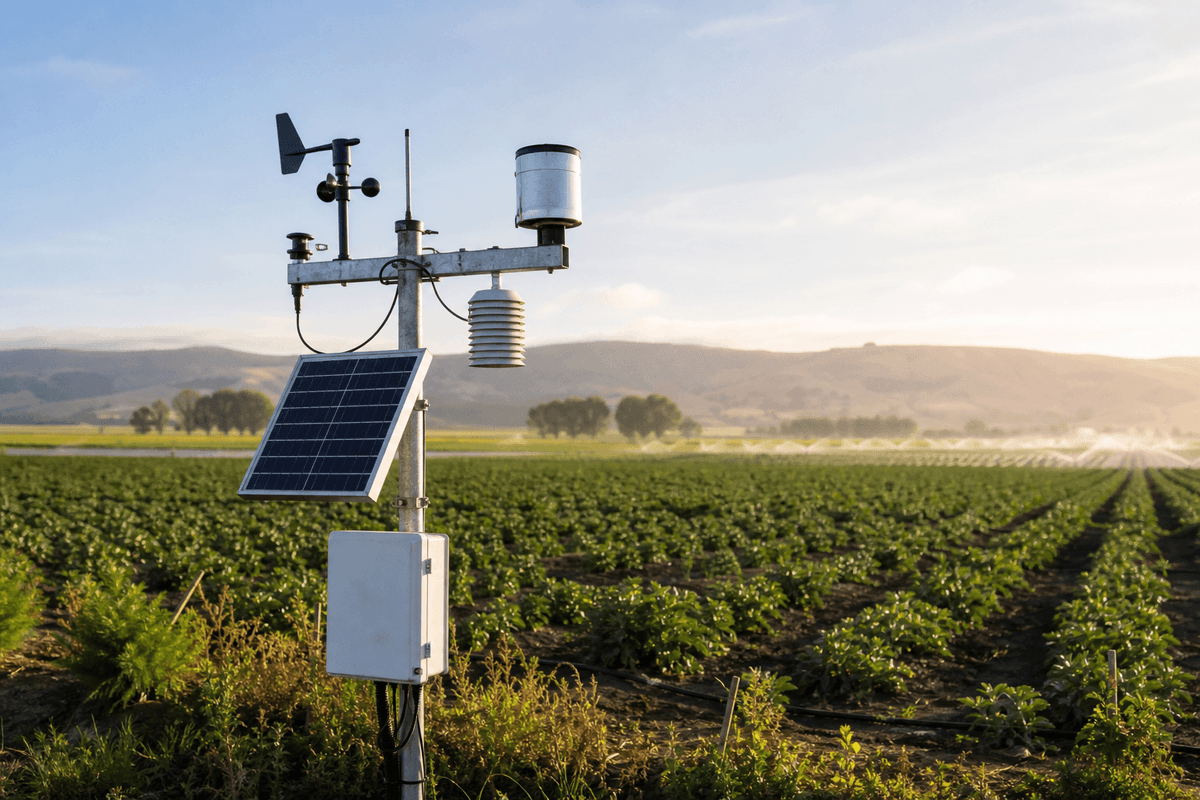
A qualified agricultural weather station supplier should deliver 9-channel sensing, 10-minute telemetry, solar-LFP power, and EPC support for 10 ha to 250 ha farm programs.
For B2B procurement teams, an agricultural weather station is not only a sensor purchase; it is a field-data infrastructure decision. The station must survive heat, rain, dust, weak backhaul, and inconsistent maintenance while producing records that engineers, agronomists, and project managers can trust. SOLARTODO positions its Basic Weather Station 10ha as an entry weather layer for open-field crops, orchard blocks, irrigation districts, seed farms, and pilot farms that need defined coverage and predictable pricing.
The SOLARTODO package monitors temperature, relative humidity, wind speed, wind direction, rainfall, solar radiation, atmospheric pressure, evapotranspiration, and local weather trend data. With a default 10-minute reporting interval, one node produces 144 timestamped records per day and more than 52,000 records per year. That density is useful for identifying missed rainfall, wind-driven spray risk, heat-stress periods, and irrigation timing errors that are invisible in a once-daily manual log.
According to WMO (2024), WMO-No. 8 provides guidance for measuring meteorological variables, automatic weather stations, quality management, calibration, and sampling. The World Meteorological Organization states, "standardization of instruments and methods" is a core objective of its observation program. For farm buyers, this matters because sensor placement, height, exposure, and obstruction distance can change the quality of wind, rain, radiation, and temperature data.
SOLARTODO is a B2B manufacturer and exporter, not an online marketplace. Its business model is inquiry, engineering review, offline quotation, and project financing review where applicable. Buyers in Latin America, the Middle East, Africa, Southeast Asia, and Europe can use SOLARTODO as one supplier for solar power, energy storage, smart agriculture monitoring, smart streetlights, telecom towers, power towers, smart traffic, security systems, and related infrastructure.
Technical Architecture and Specifications
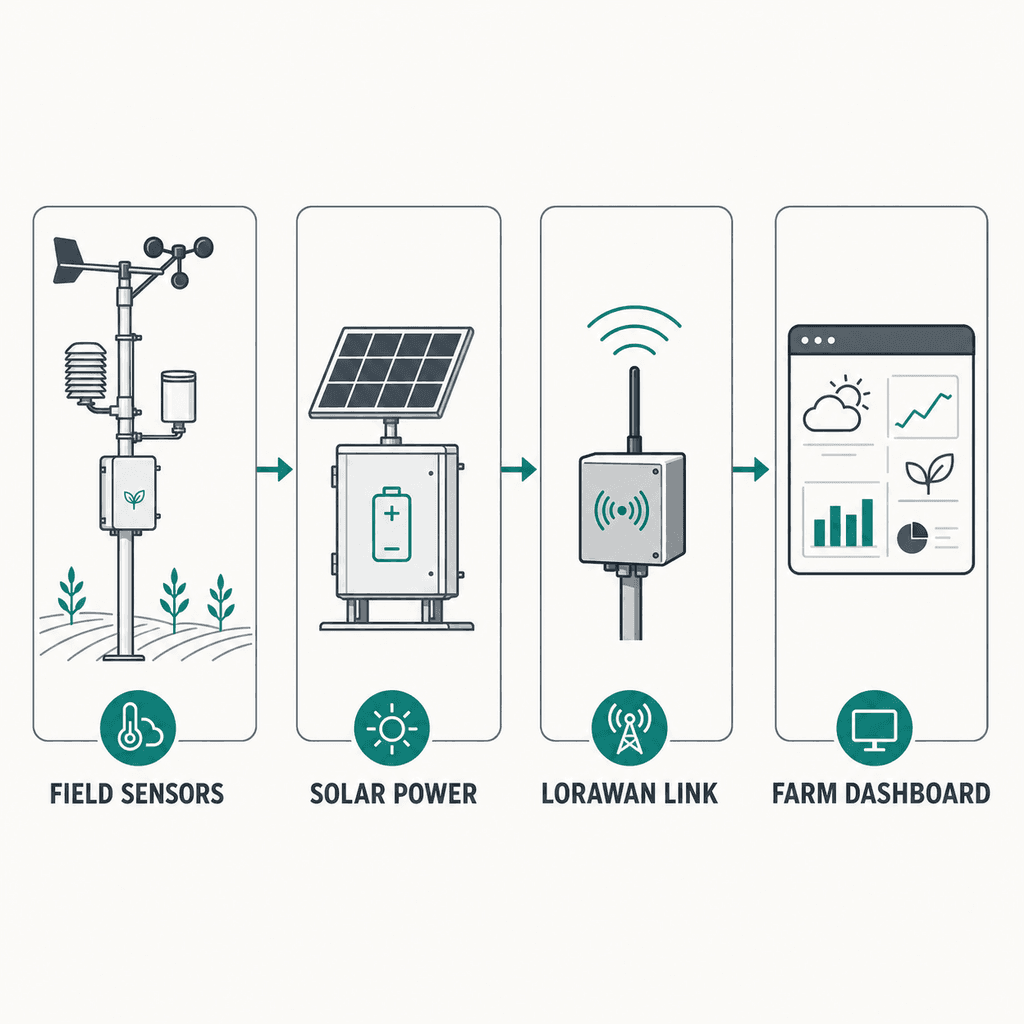
The SOLARTODO 10 ha station combines 1 sensor node, 1 LoRaWAN gateway, 1 solar-LFP power kit, and 1 professional cloud dashboard.
The system architecture has four layers: the field sensor assembly, the solar-LFP power module, the LoRaWAN communication layer, and the professional cloud platform. The field assembly collects weather values, the power kit supports off-grid operation, the gateway aggregates low-bandwidth packets, and the cloud layer stores data for dashboards, alerts, REST API calls, and export files.
LoRaWAN is selected because agricultural weather data is small, periodic, and distributed across wide terrain. According to the LoRa Alliance (2020), LoRaWAN TS1-1.0.4 was published to support global deployment and interoperability, while IoT Analytics data cited by the alliance found LoRaWAN represented more than one third of LPWAN deployments at that time. The LoRa Alliance also states, "LoRaWAN is by design very secure," while noting that implementation practices still matter.
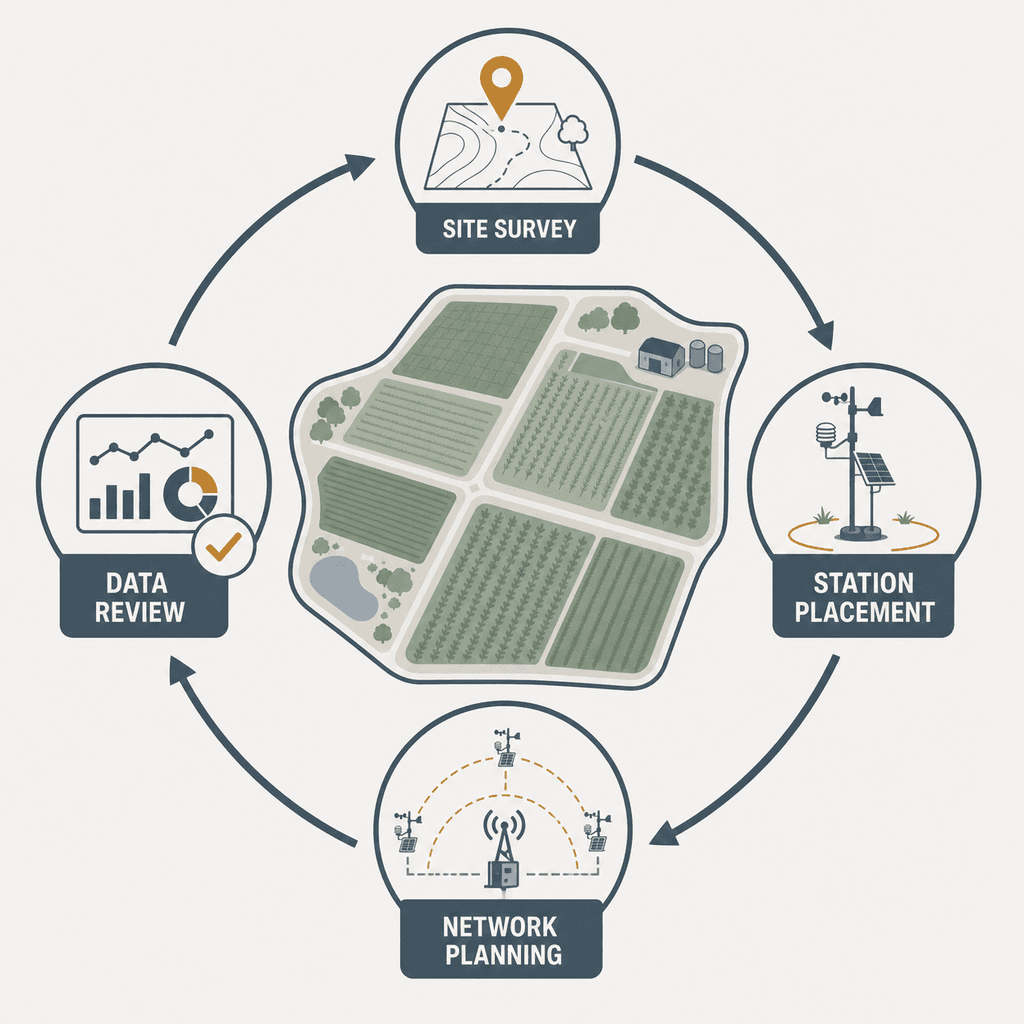
A typical SOLARTODO planning model uses a 10 km+ line-of-sight range in suitable open terrain and 500+ low-rate sensor capacity per gateway architecture. For a 10 ha block, this usually means one representative weather station and one elevated gateway, assuming terrain, vegetation, and backhaul are acceptable. For estates scaling to 50 ha, 100 ha, or 250 ha, the same gateway architecture can support soil probes, pest traps, tank-level sensors, pump-room data, and water-quality nodes.
| Parameter | SOLARTODO Basic Weather Station 10ha |
|---|---|
| Coverage area | 10 hectares |
| Weather channels | 9 measurements |
| Communication | LoRaWAN, 10 km+ planning range in open terrain |
| Gateway architecture | 500+ low-rate sensors per gateway |
| Data interval | 10 minutes, configurable 1-60 minutes |
| Daily records | 144 per node at 10-minute telemetry |
| Power supply | Small solar panel plus LFP battery |
| Cloud functions | Dashboard, history, AI alerts, REST API, export |
| Alert channels | SMS, email, app push |
| Warranty | 2 years hardware, 1 year cloud support |
According to IEC (2021), IEC 61215-2 defines test procedures for terrestrial photovoltaic modules intended for long-term outdoor operation. That reference does not certify every small solar kit by itself, but it gives engineers the correct procurement language for PV module durability. For sensor enclosures and field hardware, IEC 60529 ingress-protection terminology is relevant when buyers specify IP67/IP68 protection against dust and water exposure.
For farm-data interoperability, ISO 11783-1:2017 specifies a serial data network for agricultural and forestry machinery communication, including data transfer between sensors, actuators, control elements, displays, and storage units. A weather station does not become an ISOBUS tractor device by default, but API design and data formatting should respect structured agricultural data exchange when the buyer plans future integration.
Applications and Supplier Selection
A 10 ha agricultural weather station supports at least 7 operational uses: irrigation scheduling, heat alerts, spraying, disease screening, insurance records, reporting, and remote monitoring.
The primary use case is irrigation scheduling. Rainfall and evapotranspiration allow operators to compare actual weather demand with fixed irrigation schedules. According to IRENA (2015), renewable energy technologies can address trade-offs between water, energy, and food while improving water security and reducing exposure to conventional energy constraints. In practical terms, weather-based irrigation can reduce unnecessary pumping cycles when compared with calendar-only irrigation.
The second use case is spray-window management. Wind speed, wind direction, humidity, temperature, and rainfall determine whether spraying is technically and legally acceptable for many crops. A 10-minute record can show whether a two-hour window stayed inside project limits, and alerts can warn managers before wind or rainfall invalidates a planned application.
The third use case is heat-stress and disease-risk screening. Temperature and humidity support vapor pressure deficit calculations, while rainfall and leaf-wetness extensions can improve fungal-risk workflows in larger systems. SOLARTODO treats reported industry outcomes, such as up to 50% water reduction, 30% pesticide reduction, and 15-25% yield improvement, as possible precision-agriculture program outcomes, not guaranteed site-specific results.
Supplier selection should focus on engineering accountability, not only device price. Procurement teams should request a defined bill of materials, channel list, LoRaWAN band plan, gateway backhaul plan, enclosure rating, power autonomy assumption, cloud access scope, API availability, warranty terms, and commissioning checklist. Engineers should also confirm whether the station is intended for open-field weather monitoring, greenhouse control, soil monitoring, pest detection, or closed-loop irrigation.
| Supplier decision factor | Low-risk B2B requirement | Why it matters |
|---|---|---|
| Sensor scope | 9 weather channels for 10 ha | Avoids under-specified weather-only tenders |
| Telemetry interval | 10 minutes, configurable 1-60 minutes | Balances resolution and traffic |
| Network | LoRaWAN with regional band confirmation | Reduces SIM-card management at scale |
| Power | Solar panel plus LFP battery | Supports remote fields without grid access |
| Cloud | Dashboard, export, REST API, alerts | Enables reporting and software integration |
| Standards language | WMO, IEC 60529, IEC 61215, ISO 11783 | Improves tender clarity and acceptance criteria |
| Commercial model | FOB, CIF, EPC options | Aligns procurement with project responsibility |
| Warranty | 2 years hardware, 1 year cloud support | Defines post-commissioning accountability |
According to NREL (2024), long-term solar-agriculture research shows site-specific climate and field conditions can affect outcomes in agrivoltaic and ecovoltaic projects. NREL researcher Chong Seok Choi said, "we need to study more sites," which is a useful reminder for procurement teams: representative pilot data is more defensible than generic yield claims.
EPC Investment Analysis and Pricing Structure
SOLARTODO EPC delivery for a 10 ha weather station is priced at USD 1,800-2,300 and includes engineering, procurement, construction, commissioning, and support.
EPC means SOLARTODO or its project partners take responsibility for a complete engineered delivery path rather than only shipping hardware. Engineering covers sensor selection, gateway placement, pole and power layout, 10-minute data configuration, alert rules, and API readiness. Procurement covers the weather-station hardware, LoRaWAN gateway, solar power kit, mounting accessories, enclosure set, cloud license, quality control, packing, and export documentation.
The three-tier pricing model helps procurement teams compare responsibility levels. FOB Supply is equipment only, ex-works China, and normally fits buyers with their own logistics and installation teams. CIF Delivered adds ocean freight and insurance to the destination port. EPC Turnkey adds installation, commissioning, training, warranty support, and project management, which is usually the more realistic comparison for farms without internal IoT deployment teams.
| Pricing tier | Scope | Price range, USD |
|---|---|---|
| FOB Supply | Equipment only, ex-works China | 1,116-1,564 |
| CIF Delivered | Equipment plus ocean freight and insurance | 1,164-1,631 |
| EPC Turnkey | Installed, commissioned, and supported for 1 year | 1,800-2,300 |
| Volume band | Discount from standard equipment pricing |
|---|---|
| 50+ systems | 5% discount |
| 100+ systems | 10% discount |
| 250+ systems | 15% discount |
The representative EPC bill uses USD 1,564 of FOB equipment value and reaches about USD 2,114 after engineering, installation, commissioning, training, warranty, and support. Payment terms are 30% T/T deposit plus 70% against B/L, or 100% L/C at sight. Financing review is available for qualified projects above USD 1,000K, and quotation requests can be sent to [email protected] or through SOLARTODO contact channels.
ROI depends on crop value, irrigation cost, labor rate, and whether operators act on the weather data. If a 10 ha block avoids USD 400-700 per year in excess pumping, field checks, and spray rescheduling, the simple payback on a USD 2,114 representative EPC package is about 3.0-5.3 years. If water scarcity penalties or high-value crops raise savings to USD 1,000 per year, payback can shorten to about 2.1 years.
FAQ
These 10 FAQ answers cover 9-channel specifications, 10 ha deployment, LoRaWAN networking, installation, maintenance, pricing, warranty, and supplier selection.
Q: What is an agricultural weather station supplier? A: An agricultural weather station supplier provides field sensors, communication hardware, power systems, cloud software, and technical support for farm weather monitoring. For B2B buyers, the supplier should define coverage, sensor channels, data interval, installation scope, warranty, and integration options. SOLARTODO supplies a 10 ha package with 9 weather channels and 10-minute telemetry.
Q: How many sensors does the SOLARTODO 10 ha weather station include? A: The SOLARTODO Basic Weather Station 10ha monitors 9 weather channels: temperature, relative humidity, wind speed, wind direction, rainfall, solar radiation, atmospheric pressure, evapotranspiration, and local weather trend data. This configuration is designed for open-field weather monitoring rather than full soil, pest, or greenhouse control.
Q: Why use LoRaWAN instead of cellular weather loggers? A: LoRaWAN is better for farms that need many low-data-rate sensor nodes across wide areas. One gateway can support a 500+ low-rate sensor architecture and 10 km+ planning range in suitable open terrain. Compared with cellular-only loggers, it can reduce recurring SIM management when farms scale beyond one weather point.
Q: What does EPC turnkey delivery include? A: EPC turnkey delivery includes engineering, procurement, construction, commissioning, training, and 1-year warranty support for the deployed package. For the 10 ha station, EPC covers sensor configuration, gateway placement, solar power layout, alert setup, and cloud/API readiness. SOLARTODO’s EPC price range is USD 1,800-2,300.
Q: How much does a 10 ha agricultural weather station cost? A: SOLARTODO pricing is structured in three tiers: FOB Supply at USD 1,116-1,564, CIF Delivered at USD 1,164-1,631, and EPC Turnkey at USD 1,800-2,300. Volume discounts are 5% for 50+ systems, 10% for 100+ systems, and 15% for 250+ systems.
Q: What is the expected payback period? A: A representative USD 2,114 EPC package can pay back in about 3.0-5.3 years if it saves USD 400-700 annually in pumping, field checks, and spray rescheduling. If high-value crops or water scarcity increase savings to USD 1,000 per year, simple payback can shorten to about 2.1 years.
Q: How should the station be installed in the field? A: The station should be installed on a stable pole at a representative point with clear exposure and minimal obstruction. Sensor height, rainfall clearance, wind turbulence, grounding, and gateway visibility should be reviewed before commissioning. WMO-No. 8 is the relevant guidance family for meteorological observation methods and siting discipline.
Q: What maintenance is required after commissioning? A: Maintenance usually includes visual inspection, cleaning dust from exposed surfaces, checking the rain gauge, confirming solar panel charging, verifying battery condition, and reviewing missing-data alerts. A practical schedule is monthly visual checks and seasonal technical inspection. The standard SOLARTODO package includes a 2-year hardware warranty and 1-year cloud support.
Q: Can the weather station integrate with farm software? A: Yes, the professional cloud tier includes REST API access and data export for third-party farm software. Typical integrations include irrigation controllers, farm ERP systems, agronomy dashboards, and alert workflows. Buyers should specify data fields, interval, API authentication, export format, and ownership requirements before final quotation.
Q: When should buyers choose a larger smart agriculture package? A: Buyers should choose a larger package when weather-only monitoring is not enough for operational decisions. Soil moisture probes, water-quality sensors, pest traps, camera traps, storage sensors, and valve control are relevant for multi-zone irrigation or crop-protection programs. The 10 ha weather station is best as a defined pilot or baseline weather layer.
References
These 8 references give procurement teams recognized standards and research sources for weather monitoring, LoRaWAN communication, solar power, and agricultural data integration.
- [WMO] (2024): Guide to Instruments and Methods of Observation, WMO-No. 8, covering meteorological variables, automatic weather stations, calibration, sampling, and quality management.
- [LoRa Alliance] (2020): LoRaWAN TS1-1.0.4 Specification Package, including link-layer specification and end-device certification resources for LoRaWAN deployments.
- [LoRa Alliance Technical Committee] (2024): LoRaWAN Is Secure, but Implementation Matters, describing AES-128 security, session keys, authentication, and implementation practices.
- [IEC 61215-2] (2021): Terrestrial photovoltaic modules design qualification and type approval test procedures, used for PV durability language in outdoor solar-powered systems.
- [ISO 11783-1] (2017): Tractors and machinery for agriculture and forestry serial control and communications data network, defining data communication concepts for agricultural machinery systems.
- [IRENA] (2015): Renewable Energy in the Water, Energy and Food Nexus, explaining how renewables can reduce water-energy-food trade-offs.
- [NREL] (2024): Utility-Scale Solar Fields Can Foster Abundant Biodiversity, summarizing long-term research on solar sites, soil, pollinators, and site-specific performance.
- [SAE J1939-02] (2023): Agricultural Forestry Off-Road Machinery Control and Communication Network, describing communication-network requirements relevant to agricultural and forestry equipment.
Conclusion
For 10 ha farm pilots, SOLARTODO’s agricultural weather station supplier model combines 9 weather channels, LoRaWAN networking, solar-LFP power, and USD 1,800-2,300 EPC delivery.
The bottom line: agricultural buyers should select a supplier that can prove sensor scope, data interval, LoRaWAN planning, outdoor protection, cloud access, warranty, and EPC responsibility before purchase. For weather-only monitoring above 10 ha, SOLARTODO offers a practical B2B baseline that can expand into soil, pest, water-quality, and irrigation-control systems as the project scales.
About SOLARTODO
SOLARTODO is a global integrated solution provider specializing in solar power generation systems, energy-storage products, smart street-lighting and solar street-lighting, intelligent security & IoT linkage systems, power transmission towers, telecom communication towers, and smart-agriculture solutions for worldwide B2B customers.
About the Author

Cinn Song
Founder & Chief Solutions Architect
Cinn Song founded SOLARTODO LIMITED and leads its smart-city infrastructure engineering — from solar, storage and integrated smart poles to the company's push into physical-AI city edge nodes: pole-mounted edge computing, vertical LLMs for smart cities, drone-based O&M with autonomous battery swapping, robotic maintenance, and high-speed counter-UAS interception. Since 2010, he has directed turnkey EPC + BOT delivery across 50+ countries, including telecom monopole supply for national grid operators, off-grid solar street-lighting for African municipalities, and integrated smart-pole programs for Gulf smart cities.
Cite This Article
Cinn Song. (2026). Agricultural Weather Station Supplier Guide. SOLARTODO. Retrieved from https://solartodo.com/knowledge/agricultural-weather-station-supplier
@article{solartodo_agricultural_weather_station_supplier,
  title = {Agricultural Weather Station Supplier Guide},
  author = {Cinn Song},
  journal = {SOLARTODO Knowledge Base},
  year = {2026},
  url = {https://solartodo.com/knowledge/agricultural-weather-station-supplier},
  note = {Accessed: 2026-09-08}
}
Published: July 25, 2026 | Available at: https://solartodo.com/knowledge/agricultural-weather-station-supplier
Subscribe to Our Newsletter
Get the latest solar energy news and insights delivered to your inbox.
View All Articles