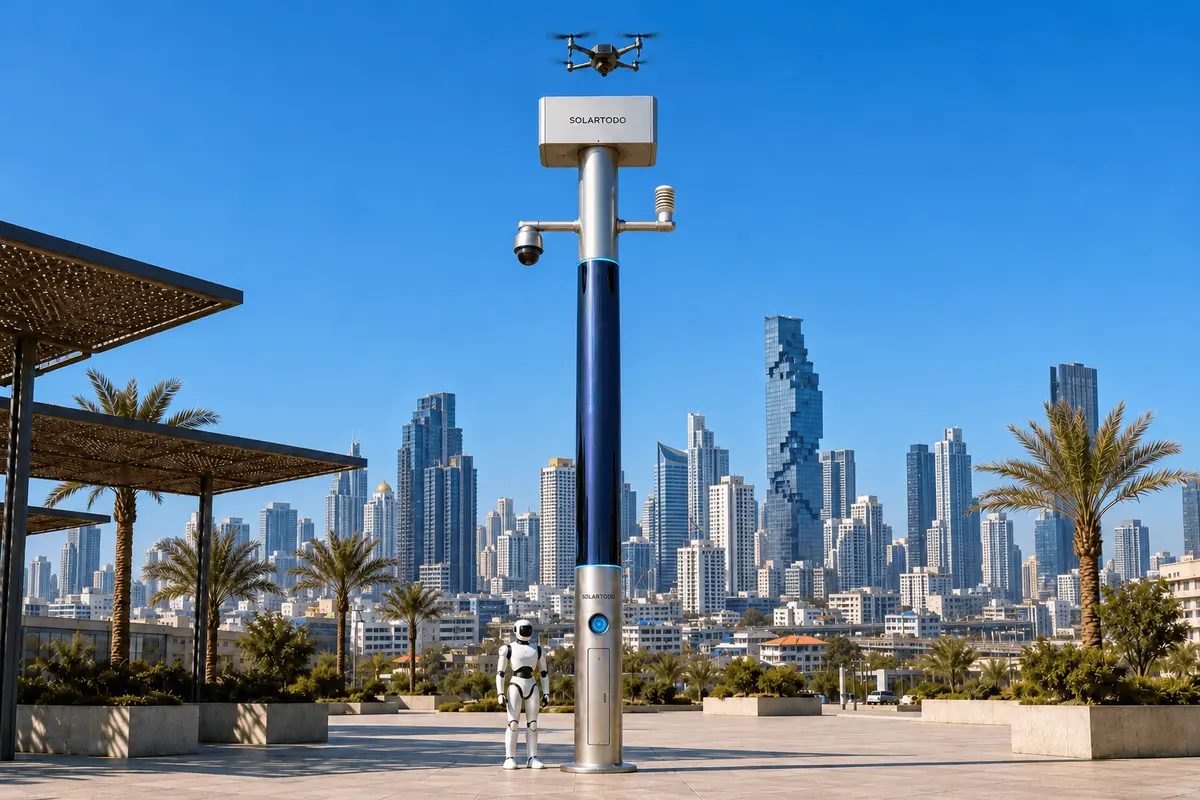
A City AI Pole is a physical-AI urban edge node combining local computing, security sensing, environmental monitoring and coordinated drone and ground-robot operations. SOLARTODO Sentinel’s Sky Hub is a fully off-grid, non-lighting pole running OTATODO. This proposed Bangkok deployment uses ground-robot inspection to assess sports-event traffic incidents, support human-authorized responses and evaluate false alarms while keeping raw data on-pole.
1. Incident under review: an ambiguous obstruction during sports-event dispersal
The incident reviewed here is an illustrative planning case, not a reported Bangkok event. Following a sports fixture, pedestrians converge on a transport interchange while coaches, taxis and service vehicles use adjacent access lanes. A vehicle stops near a pedestrian crossing, movement slows, and people gather around the curb. The security question is whether this is routine boarding, a breakdown, a collision or an obstruction requiring intervention.
For the eco-environment team involved in temporary-event planning, that distinction matters. Unnecessary dispatches consume staff attention and add movement around an already congested interface. Delayed assessment can leave pedestrians exposed and prolong vehicle queuing. Environmental observations also need context: a short-lived noise or particulate increase should not automatically become a security incident or an unsupported claim about a particular vehicle.
Slow manual patrol is the central operational problem. A person receiving an ambiguous camera alert may have to walk through dispersing spectators before establishing what happened. During that interval, repeated observations can generate duplicate alerts. A crowded scene can therefore increase both assessment time and the apparent incident count without representing additional hazards.
The proposed response uses SOLARTODO Sentinel’s mature Sky Hub capability set in a temporary-event configuration. This article describes deployment design and evaluation, not an installed Bangkok customer reference or achieved results. Ground-robot assessment is the primary intervention; aerial operations remain a supporting resource. The buyer’s principal evaluation metric is false-alarm rate, with safeguards against suppressing genuine incidents merely to improve the score.
2. Reconstructing the first decision: sensing before dispatch
The proposed node sits within an approved event operations area beside the interchange approach, subject to survey and final engineering confirmation. Placement must preserve pedestrian circulation, accessible routes, emergency access and a protected robot return path. A temporary installation still needs engineered anchoring, equipment clearance, drainage assessment and an agreed removal procedure; temporary does not mean unrestrained or ready for placement anywhere.
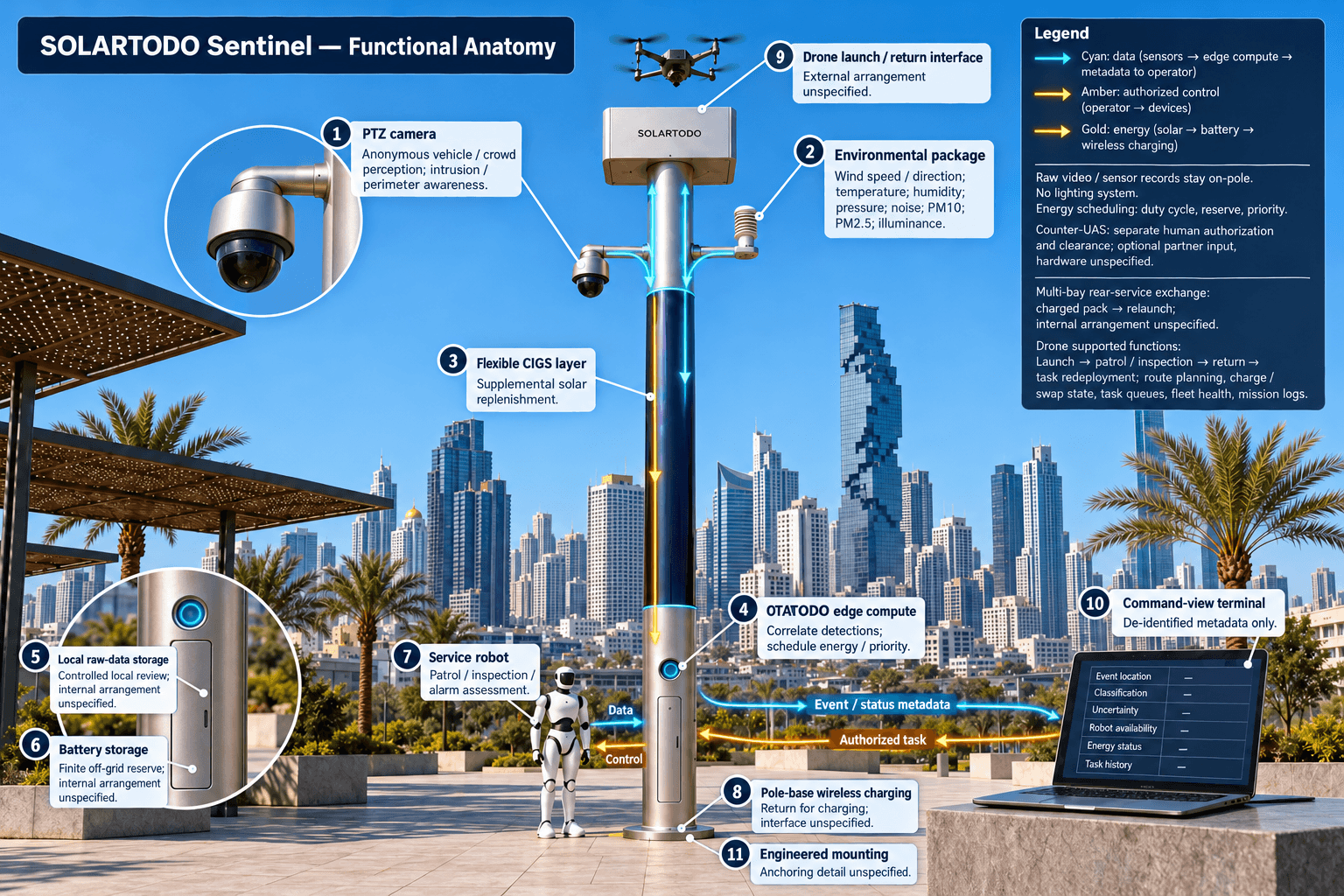
A PTZ camera supplies local perception for anonymous vehicle counts, crowd density, intrusion and perimeter awareness. For the illustrative incident, the initial trigger is a stopped vehicle combined with changing pedestrian movement. OTATODO processes those observations on the pole, associates related detections and presents a de-identified event summary for assessment. Counting the same obstruction repeatedly should not create separate incidents simply because the camera revisits it.
The environmental package measures wind speed, wind direction, temperature, humidity, atmospheric pressure, noise, PM10, PM2.5 and illuminance. These nine measurements add operating context. Illuminance is a sensed variable; Sky Hub is a PURE smart pole with no lighting system. Environmental changes inform review but do not establish collision severity, identify an emission source or replace a field assessment.
The common-operating-picture command view brings together the event location, classification, uncertainty, robot availability, energy status and task history. Remote operators receive only de-identified event and status metadata. Raw video and sensor data stay on the pole and are processed locally. Where a detailed raw-record review is necessary, the proposed procedure provides controlled access at the node without exporting those records. This constraint shapes the operating procedure from the outset.
3. Reviewing the response: the ground robot closes the observation gap
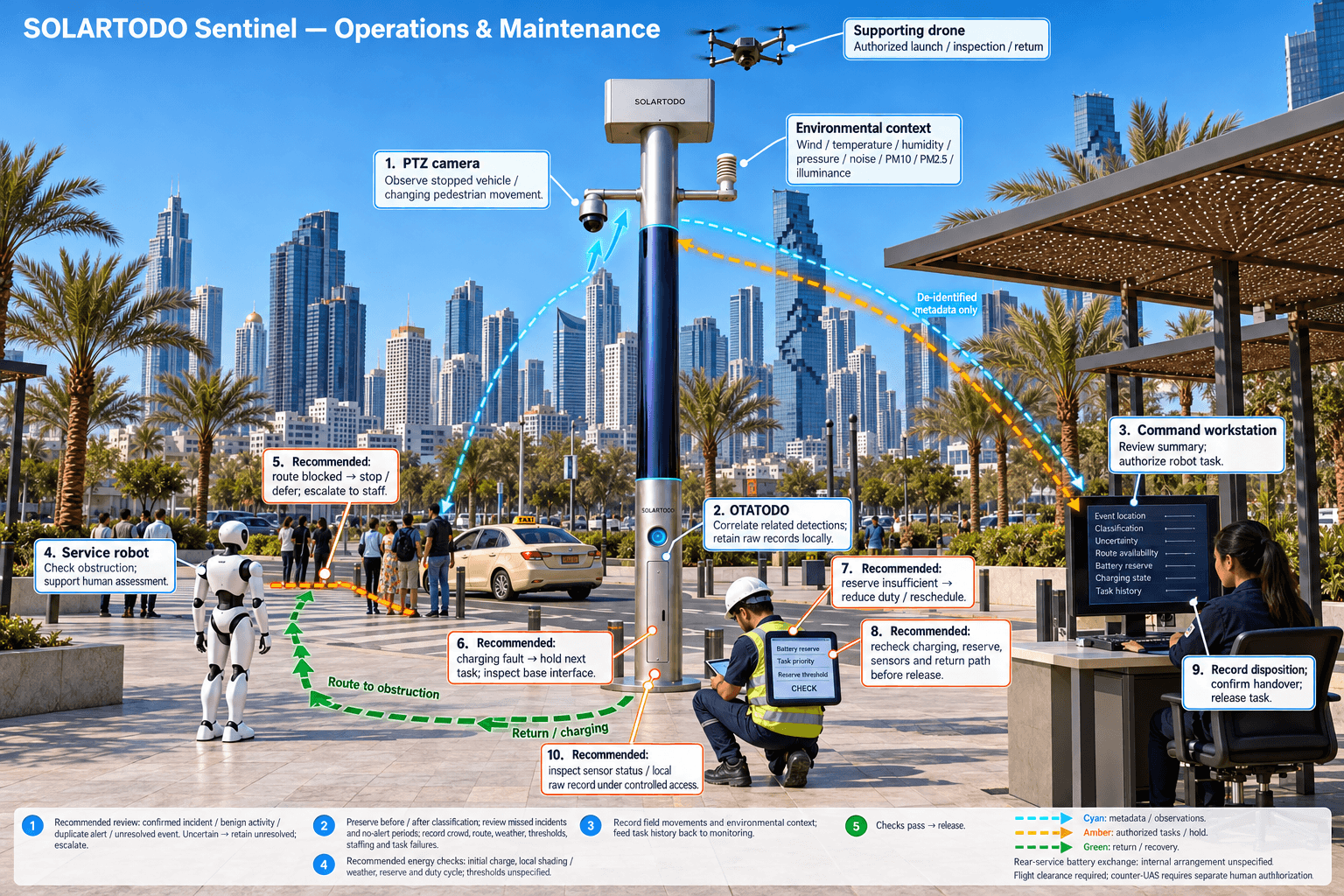
After an authorized operator assesses the event summary, the command view assigns a service robot an inspection task within a surveyed operating area. The robot approaches through an approved route, maintaining separation from passengers and vehicles. Its role is to establish conditions around the obstruction and support situational awareness, rather than direct traffic or assume emergency-service authority.
For this case, the relevant questions are concrete: is the pedestrian route blocked, is the vehicle still stationary, and does the situation require a human responder? Robot observations support on-pole assessment, with only de-identified conclusions entering the wider command view. Where the scene remains uncertain, the event stays unresolved and escalates to staff. An inaccessible or crowded route is a reason to stop or defer the robot task, not a reason to push through spectators.
This changes the manual-patrol workflow. Staff can prioritize incidents supported by additional observations while retaining responsibility for emergencies and ambiguous cases. The robot also supports autonomous patrol, alarm response, inspection and air-ground coordination. After completing its assignment, it returns to the pole base for wireless charging. Its route availability and charging state remain visible alongside the incident, so the next dispatch reflects actual readiness.
Drone operations provide a complementary regional view where authorized operating conditions permit. The node supports autonomous launch, patrol, inspection, return and task redeployment without an operator stationed at the pole. A multi-bay battery magazine performs an automated rear-service exchange after landing, fitting a charged pack for relaunch. Multiple bays support consecutive sorties, while route planning, charge/swap state management, task queues, fleet health and mission logs coordinate the sequence. None of this requires an aerial sortie for every traffic alert.
4. Reviewing operational limits: energy, authorization and local data
Sky Hub operates fully off-grid using battery storage and on-pole solar replenishment, with no grid, city or site power. Its approximately 8 m tall, 0.6 m-wide cylindrical body carries approximately 15 m² of 360°-wrapped flexible CIGS thin-film, with approximately 2.4–2.7 kWp nameplate capacity. That nameplate figure must not be treated as available operating output throughout the day.
Only the cylinder’s sun-facing projection receives direct sunlight at a given moment. In a high-irradiance reference region such as Saudi Arabia, realistic clear-sky output is approximately 0.8–1.1 kW DC peak and 6–9 kWh/day, with peaks in mid-morning or afternoon rather than noon. These reference values are not a Bangkok yield forecast. Event-site shading, cloud, rain, temperature and installation geometry require a local energy assessment.
The CIGS layer supplies supplemental replenishment to a battery-backed micro-station. Storage in the 5–20 kWh class buffers higher-power drone and robot tasks; OTATODO schedules workloads by duty cycle, available energy and operational priority. Stored energy remains finite. Temporary-event planning therefore needs an initial charge requirement, reserve thresholds and a reduced-duty procedure. If the assessed energy budget cannot sustain the event schedule, the configuration or task schedule must change before deployment.
A separate authorization boundary governs counter-UAS coordination. Sentinel detects and tracks an unauthorized drone and can command its own friendly drone for soft aerial net-capture or close-approach deterrence only after human authorization and applicable operating clearance. Radar is not built into the pole; an optional partner sensor may supply additional input. This workflow remains separate from routine traffic assessment.
The data architecture is designed for local processing and is PDPL/LGPD-oriented, without asserting certification or established legal compliance. A Bangkok buyer must separately validate applicable Thai privacy requirements, retention, access controls and operating permissions.
5. Closing the review: measure false alarms without hiding missed incidents
The proposed evaluation begins with an agreed definition. For this deployment, false-alarm rate means reviewed security alerts determined not to require the specified security response, divided by all reviewed security alerts. This operational measure is distinct from the statistical false-positive rate calculated against all genuinely negative observations. The distinction prevents procurement documents and operating reports from using the same label for different denominators.
Reviewers should apply consistent categories: confirmed incident, benign activity, duplicate alert and unresolved event. Routine boarding could be benign; repeated notifications about one obstruction could be duplicates. An unresolved case must remain visible rather than being counted as benign. A correctly detected minor obstruction can still be useful even when it does not justify an emergency dispatch, so response thresholds need explicit definitions.
To evaluate whether robot assessment improves decisions, compare comparable event periods and record crowd conditions, route availability, weather, alert thresholds and staffing. Preserve classifications before and after robot inspection. Review a sample of periods without alerts as well, because lowering the alarm count alone cannot demonstrate better security. Missed incidents, unresolved cases and robot task failures provide necessary checks on an apparently improving headline metric.
For the eco-environment stakeholder, the review should also record unnecessary field movements and the availability of environmental context. Those observations may support later operational decisions, but they do not establish emissions reductions or environmental health benefits. Any such conclusion would require an additional measurement method and evidence.
The incident closes when the authorized operator records the disposition, confirms any responder handover and releases the robot task. Maintenance then checks charging, battery reserve, sensors and return-path condition before the next assignment. This completes one operating loop: sensing, authorized assessment and response, edge-compute scheduling, and field operations and maintenance. The procurement decision should rest on this traceable workflow and measured evaluation results, with the final Bangkok configuration subject to engineering confirmation.
System Configuration
| Parameter | Configuration |
|---|---|
| Pole and deployment | PURE non-lighting Sky Hub; approximately 8 m cylindrical body, approximately 0.6 m wide; engineered temporary-event installation |
| Off-grid energy | Approximately 15 m² wrapped flexible CIGS, approximately 2.4–2.7 kWp nameplate; 5–20 kWh-class battery storage; final sizing subject to energy assessment |
| Edge compute and data | On-pole AI inference and OTATODO workload scheduling; local raw-data storage; outbound de-identified event/status metadata only |
| Security and environment | PTZ camera with anonymous local perception; wind speed/direction, temperature, humidity, pressure, noise, PM10, PM2.5 and illuminance sensing |
| Ground operations | Service robot for patrol, inspection and alarm assessment; surveyed routes and pole-base wireless charging |
| Aerial operations | Autonomous drone launch/return interface, multi-bay rear-service battery exchange and mission management; human-authorized counter-UAS coordination |
How It Works
- The on-pole PTZ flags a stopped vehicle and changing pedestrian movement.
- OTATODO correlates observations locally and creates a de-identified event summary.
- An authorized operator assesses the summary and approves a ground-robot inspection.
- The edge scheduler checks route availability, battery reserve and task priority.
- The robot inspects, supports responder handover if required, and returns for wireless charging.
- The operator records disposition and false-alarm classification while raw records remain on-pole.
Planning Assumptions (Indicative)
Illustrative planning inputs a buyer can recompute — target metrics, not achieved results. Subject to final engineering confirmation.
| Metric | Planning assumption | Indicative value |
|---|---|---|
| Alert review workload | ILLUSTRATIVE ONLY: 40 alerts per event day across 3 event days, requiring 2 minutes of review each. | 40 × 3 × 2 = 240 minutes of planned review effort |
| False-alarm evaluation target | ILLUSTRATIVE ONLY: use a 120-alert review set and a target ceiling of 30 alerts classified as not requiring the specified security response. | 30 ÷ 120 × 100 = 25% illustrative target, not an achieved result |
| Avoided manual assessment effort | ILLUSTRATIVE ONLY: robot-supported assessment avoids 10 unnecessary manual visits, each requiring 8 staff-minutes; validate classification and safety separately. | 10 × 8 = 80 staff-minutes of hypothetical avoided effort |
| Energy planning screen | ILLUSTRATIVE ONLY: 10 kWh nominal storage with an assumed 70% usable allocation serves a 0.5 kW average scheduled load; exclude solar for this calculation. | 10 × 0.70 ÷ 0.5 = 14 hours of illustrative energy coverage before conversion losses; not guaranteed runtime |
Deployed Equipment
- Non-lighting Sky Hub pole with engineered temporary mounting
- Wrapped flexible CIGS solar replenishment layer and battery storage
- On-pole compute cabinet running OTATODO with local storage
- PTZ security camera and nine-variable environmental sensor package
- Service robot and pole-base wireless charging interface
- Drone launch/return interface and multi-bay battery exchange magazine
- Command-view terminal configured for de-identified event and status metadata
Frequently Asked Questions
Is this an existing Bangkok deployment report?
No. This is a proposed Bangkok transport-hub configuration and an illustrative incident review using Sentinel’s mature capability set. It does not identify an installed customer, report an actual sports-event incident or claim achieved results. Site selection, installation, permissions and evaluation criteria require buyer agreement and final engineering confirmation.
Why prioritize a ground robot for traffic-incident security?
A ground robot can provide additional observations around an obstruction when a remote alert is ambiguous and manual patrol would take time to reach it. Its usefulness depends on a surveyed, accessible route and safe separation from people and vehicles. It supports human assessment and responder prioritization without replacing emergency personnel or taking traffic-control authority.
Can the pole operate throughout an event using solar alone?
Continuous solar-only operation is not promised. Sky Hub is fully off-grid, combining finite battery storage with supplemental solar replenishment. The supplied high-irradiance reference is approximately 6–9 kWh/day, not a Bangkok forecast. Engineers must assess local yield, initial stored energy, conversion losses, reserve requirements and drone/robot duty cycles against the event schedule.
How should buyers interpret the false-alarm KPI?
The proposed operational KPI divides reviewed alerts not requiring the agreed security response by all reviewed alerts. Buyers should define response thresholds before evaluation and track duplicates and unresolved cases separately. They should also examine missed incidents and comparable operating conditions, because fewer alerts alone do not demonstrate more accurate or safer security operations.
What data reaches the command center?
Only de-identified event and status metadata may leave the pole. Raw video and sensor data stay on the pole for local processing. The remote command view therefore supports decisions through summaries, task states and equipment status. Detailed raw-record review requires controlled local access, with retention and permissions established for the deployment.
What permissions govern drone and counter-UAS activity?
Drone operations require applicable airspace, site and event operating permissions. Counter-UAS mitigation requires human authorization and an approved operating procedure for soft aerial net-capture or close-approach deterrence by the node’s friendly drone. Detection does not itself authorize intervention. Radar is not pole hardware, although an optional partner sensor can provide input.
Explore Further
- City AI Pole / smart streetlight product line
- More smart-city deployment cases
- Talk to our engineering team
Planning a similar physical-AI deployment for streets, campuses or public spaces? Request an engineering consultation