Larger PV Inverters: Compare Energy at the Export Limit

Cinn Song
Founder & Chief Solutions Architect
TL;DR
Request matched baseline and larger-inverter simulations with the same array and existing export limit. Compare pre-grid recovery with additional annual delivery after restrictions. Base the purchase on the delivered increment and quoted costs; verify load and storage boundaries separately.
Compare baseline and larger inverters using the same PV array, weather, losses and existing export restrictions. Calculate annual AC energy gains before and after grid limits, then assess the quoted premium against the delivered increment. Confirm the modeled export boundary for sites with loads or storage.
Summary
Compare baseline and larger inverters using the same PV array, weather, losses and existing export restrictions. Calculate annual AC energy gains before and after grid limits, then assess the quoted premium against the delivered increment. Confirm the modeled export boundary for sites with loads or storage.
Key Takeaways
- Keep array capacity, weather, losses and export restrictions unchanged when comparing inverter sizes.
- State inverter kWac and array kWdc explicitly; verify the DC-to-AC ratio against the documented equation.
- Calculate both pre-grid energy gain and energy gain after existing grid restrictions.
- Inspect time-series results to identify recovered energy that coincides with a binding export ceiling.
- Separate capacity-related gains from changes in inverter efficiency or other assumptions.
- Require a verified delivery boundary, control-cost scope and incremental quotation before approving the premium.
Larger PV Inverters: Compare Delivered Energy at the Existing Export Limit
Before paying for more inverter capacity, request a paired simulation with the same PV array and existing grid export limit. Compare the additional annual AC energy before grid restrictions with the additional energy remaining after those restrictions. Reduced inverter clipping alone is insufficient evidence of additional delivered energy.
1. Fix the comparison boundary and inputs
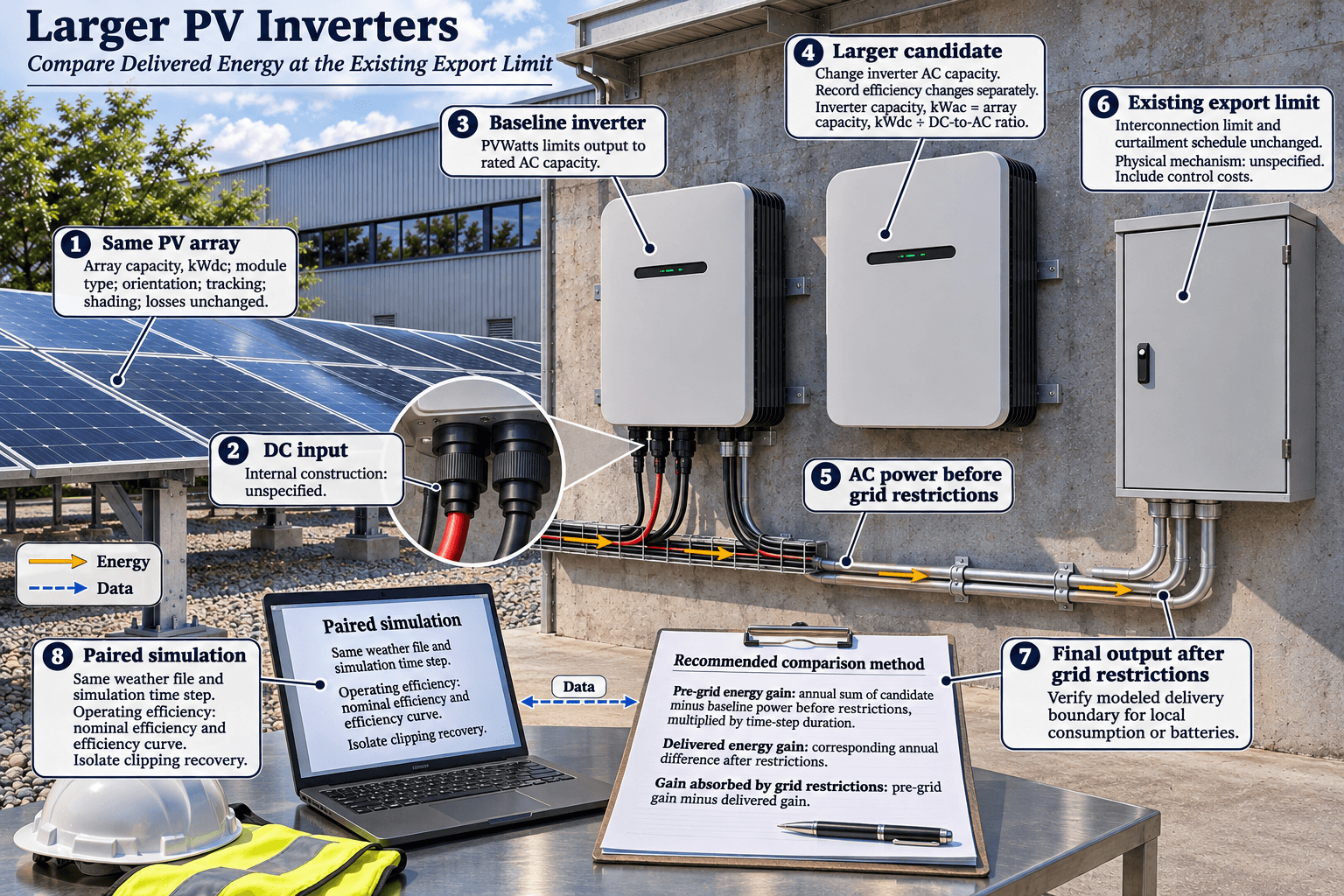
SAM’s PVWatts System Design help explains that PVWatts models inverter clipping by limiting inverter output to its rated AC capacity. Separately, Grid Limits explains that SAM applies interconnection and curtailment limits to calculated AC output at each simulation time step. These are distinct restrictions: removing an inverter bottleneck can leave the grid restriction binding. PVWatts System Design; Grid Limits.
For a procurement comparison, ask the engineer to hold the weather file, simulation time step, DC array capacity, module type, orientation, tracking, shading and other losses constant. Keep the existing export limit and any curtailment schedule unchanged. Change inverter AC capacity, recording any accompanying efficiency change separately.
Use the relationship in PVWatts System Design:
Inverter capacity, kWac = array capacity, kWdc ÷ DC-to-AC ratio.
The page’s introductory ratio wording conflicts with its equation and worked example. Require the simulation report to state both capacities explicitly and verify the ratio against that equation. Do not let a ratio label conceal an increase in array size. PVWatts System Design.
2. Calculate two annual energy differences
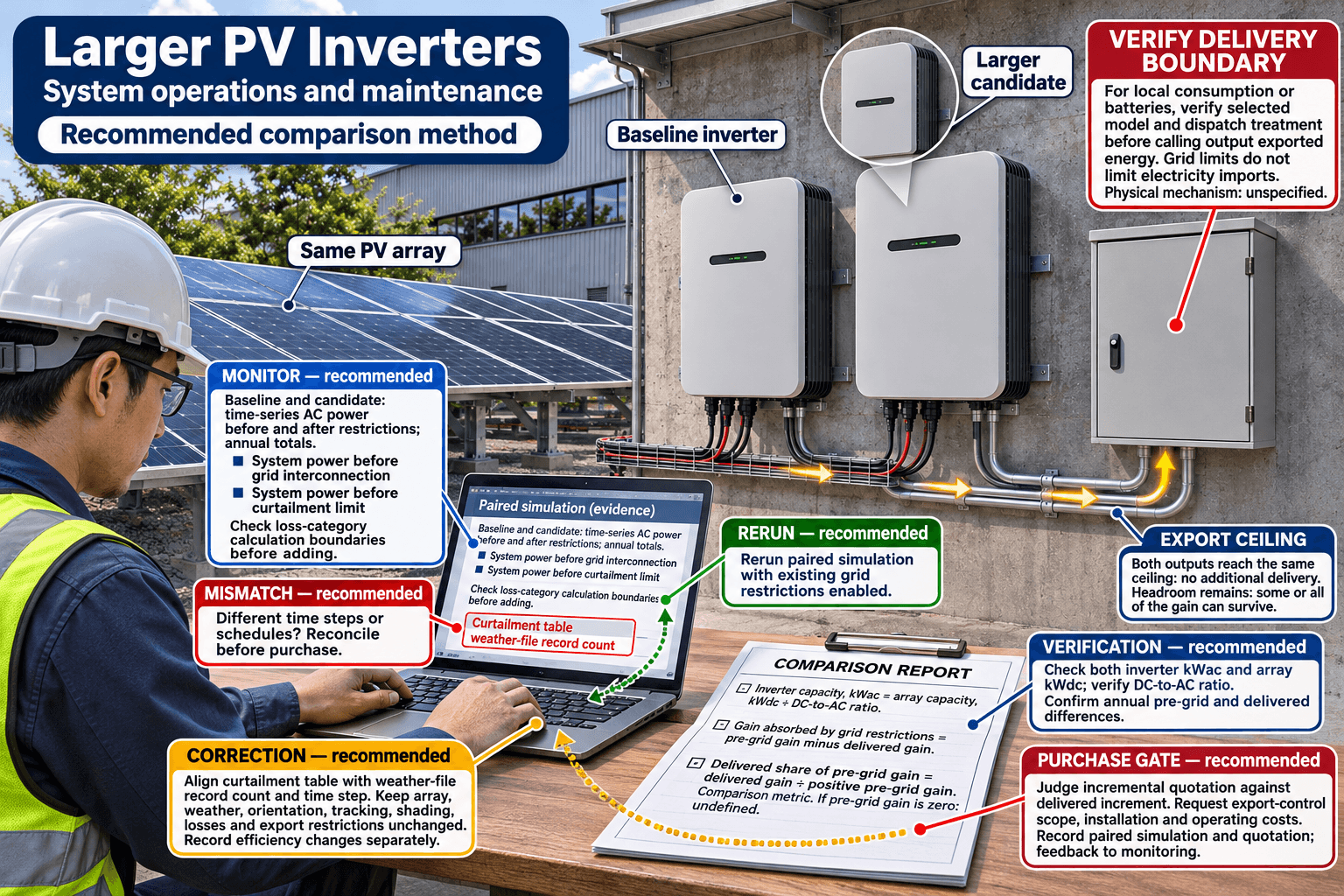
Request results for the baseline inverter and the larger candidate, each with the existing grid restrictions enabled. Obtain time-series AC power before grid restrictions and final output after them.
For an export-only comparison whose modeled output represents delivery to the grid, calculate:
- Pre-grid energy gain: sum of candidate minus baseline AC power before grid restrictions, multiplied by each time-step duration.
- Delivered energy gain: the corresponding annual difference after the unchanged interconnection limit and curtailment schedule.
- Gain absorbed by grid restrictions: pre-grid energy gain minus delivered energy gain.
These calculations are a recommended comparison method derived from SAM’s separate inverter and grid-limit treatments. They distinguish energy recovered upstream from energy that survives the existing delivery constraint. PVWatts System Design; Grid Limits.
If only inverter capacity changes, describe the pre-grid difference as the modeled benefit of increased inverter capacity. If efficiency or other assumptions also change, do not attribute the whole difference to reduced clipping. PVWatts calculates operating inverter efficiency using nominal efficiency and an efficiency curve; ask the engineer to document how clipping recovery was isolated. PVWatts System Design.
3. Check when the recovered energy occurs
Review the time steps where the larger inverter increases pre-grid output. If baseline and candidate output both reach the same export ceiling, the additional upstream power produces no additional delivery during those time steps under the modeled limit. Where headroom remains, some or all of the increase can survive. This follows from SAM’s rule that output exceeding the interconnection limit is reduced to that limit. Grid Limits.
Ask for annual totals alongside a time-series comparison showing baseline and candidate power before and after restrictions. SAM’s Grid Limits identifies the “System power before grid interconnection” and “System power before curtailment limit” series, plus annual energy-loss results for each restriction. Use these to check where the gain disappears; do not assume that separately reported loss categories can be added without checking their calculation boundaries. Grid Limits.
Keep curtailment inputs aligned with the weather-file time step. SAM requires the curtailment table to match the weather-file record count. A comparison using different time steps or schedules should be reconciled before it supports a purchase decision. Grid Limits.
4. Make the purchase conditional on usable gain
Request a comparison sheet containing both inverter capacities, the unchanged export limit, annual pre-grid energy, annual delivered energy, their differences, and the incremental quotation. Recommend judging the premium against the delivered increment rather than the clipping-recovery figure alone.
An optional diagnostic is the delivered share of pre-grid gain: delivered energy gain divided by positive pre-grid energy gain. Label this as a comparison metric, not equipment efficiency. If the pre-grid gain is zero, report the ratio as undefined.
For sites with local consumption or batteries, require the engineer to identify the modeled delivery boundary before calling final system output “exported energy.” Grid Limits describes limits on system AC output and notes that storage dispatch can consider grid restrictions for some dispatch options; it does not establish a universal net-metering calculation for every site arrangement. Verify the selected model and dispatch treatment. Grid Limits.
Finally, SAM assumes a physical mechanism exists to enforce grid limits and instructs users to include its costs. Request the actual control scope and associated installation or operating costs. The help pages establish modeling methods, not project-specific energy gains or payback; obtain the paired simulation and quotation before approving the upgrade. Grid Limits.
FAQ
Does reduced clipping equal additional exported energy?
No. Recovered upstream energy can be removed by the unchanged interconnection limit or curtailment schedule.
Which inputs should remain unchanged?
Keep the DC array, weather file, time step, orientation, tracking, shading, losses, export limit and curtailment schedule consistent.
How should inverter capacity be checked?
Use inverter kWac = array kWdc divided by the DC-to-AC ratio, and record both capacities explicitly.
Which annual difference matters for the purchase?
Use the energy increment after existing grid restrictions, with the delivery boundary clearly identified.
Why request time-series results?
They show whether recovered output occurs while the export ceiling is already binding or while delivery headroom remains.
Can every pre-grid gain be called clipping recovery?
Only attribute it that way after isolating changes in efficiency and other assumptions. Otherwise call it the modeled capacity-upgrade benefit.
Do SAM’s grid limits also restrict imports?
No. Grid Limits explicitly states that interconnection and curtailment inputs do not limit electricity imports.
What should accompany the energy comparison?
Request the incremental quotation, export-control scope and associated costs, plus confirmation of load and storage modeling where applicable.
About the Author

Cinn Song
Founder & Chief Solutions Architect
Cinn Song founded SOLARTODO LIMITED and leads its smart-city infrastructure engineering — from solar, storage and integrated smart poles to the company's push into physical-AI city edge nodes: pole-mounted edge computing, vertical LLMs for smart cities, drone-based O&M with autonomous battery swapping, robotic maintenance, and high-speed counter-UAS interception. Since 2010, he has directed turnkey EPC + BOT delivery across 50+ countries, including telecom monopole supply for national grid operators, off-grid solar street-lighting for African municipalities, and integrated smart-pole programs for Gulf smart cities.
Cite This Article
Cinn Song. (2026). Larger PV Inverters: Compare Energy at the Export Limit. SOLARTODO. Retrieved from https://solartodo.com/knowledge/before-paying-for-larger-pv-inverters-how-should-a-buyer-compare-the-additional-annual-energy-delivered-at-the-existing
@article{solartodo_before_paying_for_larger_pv_inverters_how_should_a_buyer_compare_the_additional_annual_energy_delivered_at_the_existing,
  title = {Larger PV Inverters: Compare Energy at the Export Limit},
  author = {Cinn Song},
  journal = {SOLARTODO Knowledge Base},
  year = {2026},
  url = {https://solartodo.com/knowledge/before-paying-for-larger-pv-inverters-how-should-a-buyer-compare-the-additional-annual-energy-delivered-at-the-existing},
  note = {Accessed: 2026-11-07}
}
Published: November 7, 2026 | Available at: https://solartodo.com/knowledge/before-paying-for-larger-pv-inverters-how-should-a-buyer-compare-the-additional-annual-energy-delivered-at-the-existing
Subscribe to Our Newsletter
Get the latest solar energy news and insights delivered to your inbox.
View All Articles