Summary
For Córdoba, Argentina, as a proposed site, permit supervised STTBOT-T1 pick-and-place work only for item and placement combinations that pass repeated mock-up trials with the delivered robot and its fitted end effector. Start by testing a rigid, non-fragile mock item between fixed, marked surfaces. Score successful placements, drops and unintended contact separately, and limit each approval to the tested posture and motion profile. Site approval remains pending configuration confirmation, a workstation survey and observed trial results.
Key Takeaways
- Identify the delivered STTBOT-T1 and confirm its fitted end effector before choosing candidate items.
- Vary item mass and placement in planned steps, and record robot posture at grasp, transfer and release.
- Mark the fixtures and reset the item and starting stance before each scored attempt.
- Record successful placement, drops, unintended contact and operator intervention separately.
- List each approved item and placement combination with its tested posture, motion profile and supervision conditions.
- Repeat affected trials after a tool, software, posture, motion profile or fixture change before authorizing the changed task.
Proposed problem
The buyer needs to determine which light items the delivered robot may move between specific locations in a service area under human supervision. Define each candidate by its item identifier, as-handled mass, pickup point, destination, approach and supervision conditions. Record item geometry, grip surface and balance in the trial plan so each decision can be traced to the item actually tested.
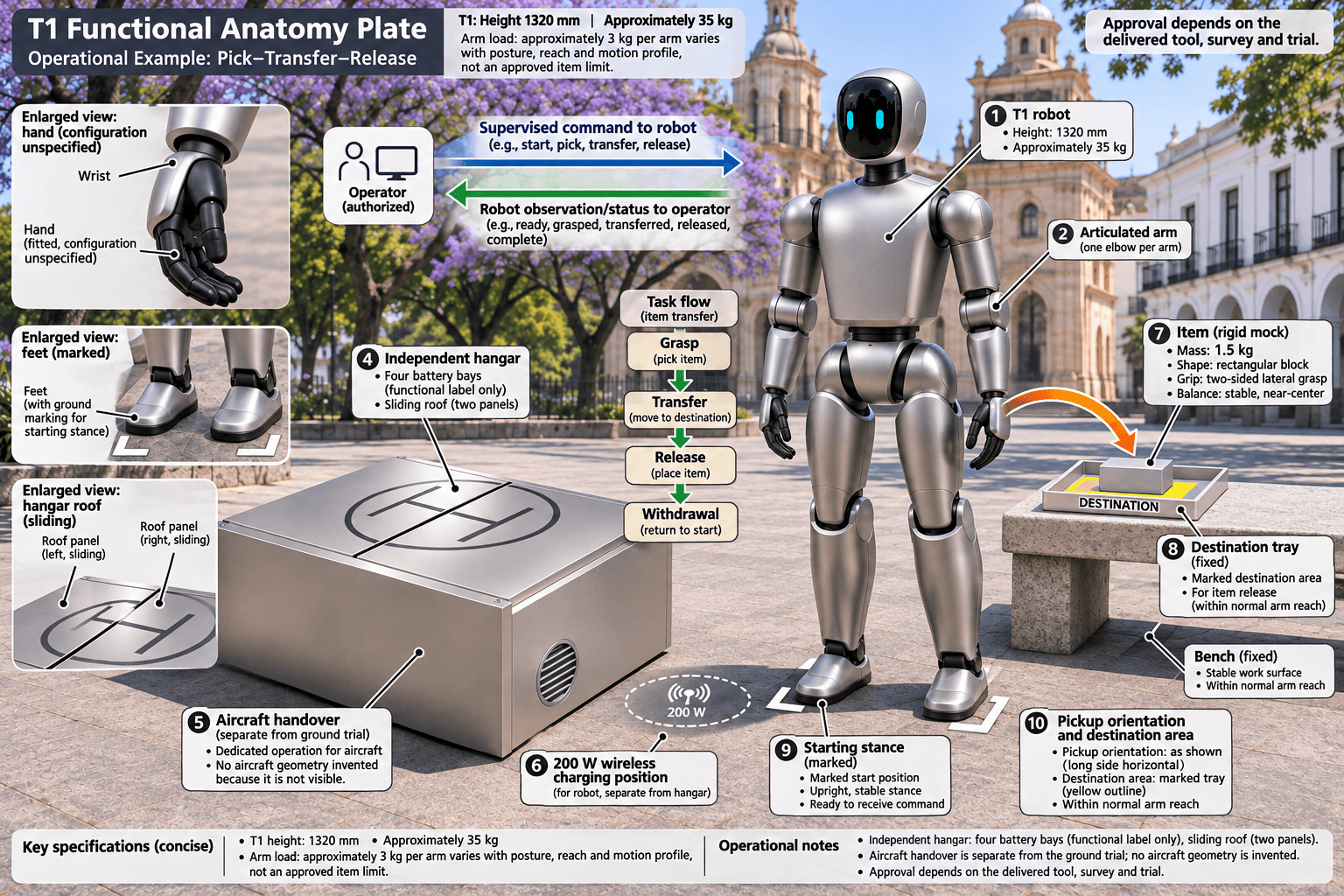
Hypothetical evaluation assumption: The first candidate is a bench-to-tray transfer of a rigid, non-fragile mock item between fixed fixtures from a marked standing position.
For a follow-up trial, vary the destination height or horizontal offset while keeping the item fixed, subject to supplier confirmation of the delivered configuration’s limits. Keep hand-to-hand transfers, fragile or spillable contents, and moving destinations outside the initial exercise. Plan the mock-up as a ground-robot trial independent of aircraft operations.
Source-backed product boundary
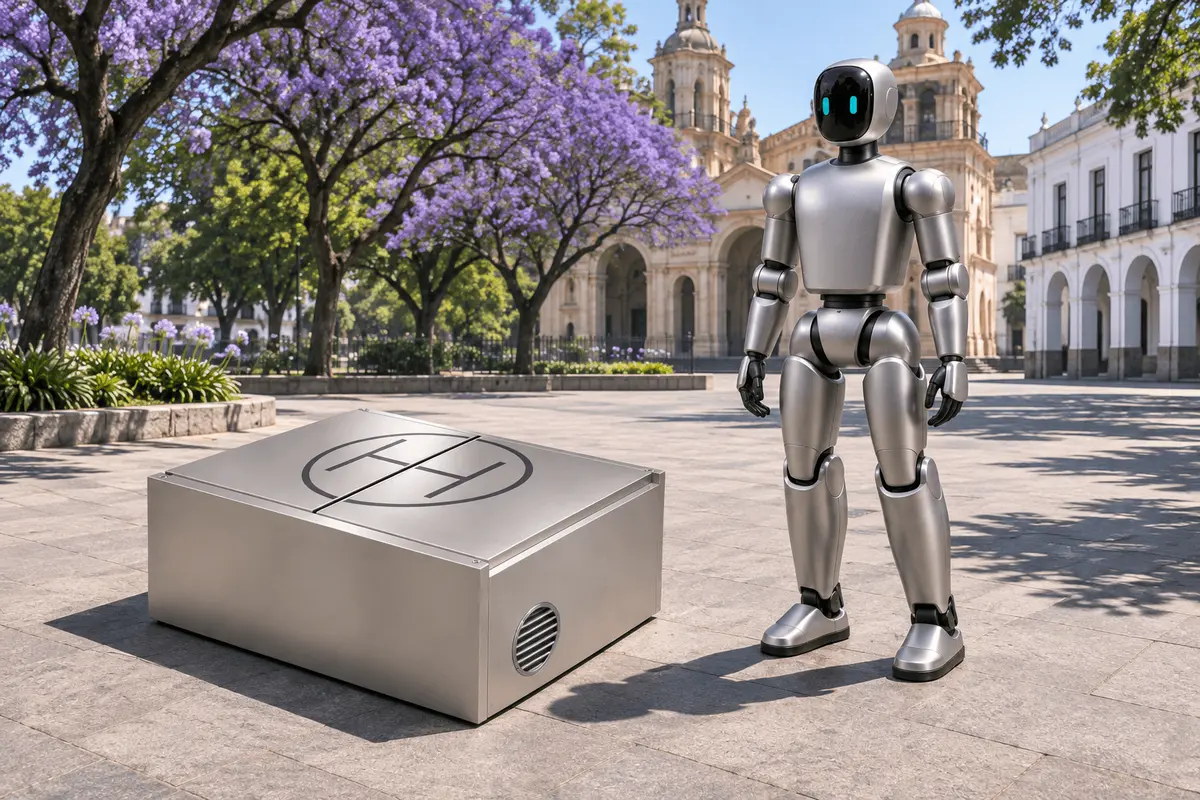
The English SkyHub Air–Ground Coordinated System manual, Revision 1.3 dated 27 September 2026, identifies the STT 1S MAX aircraft, the STT-HUB1101 battery exchange hangar, and the STTBOT-S1 and STTBOT-T1 ground robots. The manual describes the STT-HUB1101 as an independent four-bay ground hangar paired with the STT 1S MAX and its matched battery module. The exchange clock starts when the hangar detects touchdown on the landing deck and ends when E10 confirms release height, a clear transfer tool, reconciled battery inventory and AIRCRAFT READY. The later operator Handover request, aircraft preflight checks, flight authorization and departure occur outside that clock. The proposed handling trial uses the STTBOT-T1 and its fitted tool. Manual cover, p. 1 · STT-HUB1101 configuration, p. 24 · Exchange timing, p. 25
The manual describes service assistance as carrying or manipulating permitted light items within model and posture limits, using the configured end effector and human supervision for physical contact. It lists the STTBOT-T1 at 1320 mm standing height and approximately 35 kg including the battery. The comparison lists an arm load of approximately 3 kg per arm for the T1, varying with posture. Page 59 also identifies reach and the permitted motion profile as arm-load conditions. The manual specifies that the standard T1 configuration has no independent dexterous-hand degrees of freedom and that the supplied-unit record identifies the actual fitted tool. The STTBOT-S1 is a distinct compact model with a standard two-finger end-effector configuration. Its effective reach and the T1’s specified arm span use different measurement definitions. Service assistance, p. 57 · Model comparison, p. 58 · Tool record and arm loading, p. 59
Proposed design
Build the mock-up around the proposed workstation. Mark the robot’s starting foot positions, the item’s pickup location and orientation, and the destination’s acceptable resting area and orientation. Weigh each item in its as-handled state. Where practical, use the same exterior and grip surfaces across mass variants, secure any added mass and document the balance. Give variants with different grip surfaces, shapes or balance their own identifiers.
Run repeated trials for each mass and placement combination. Start with an open destination, then vary height, offset or orientation in planned steps. Keep the fitted tool and motion profile fixed within each series. Record the starting stance and actual posture at grasp, transfer and release, including any foot movement or change in approach. Give a placement reached by stepping or changing the motion profile its own configuration and trial record. Reset the fixtures and item before each attempt, and distinguish practice attempts from scored runs.
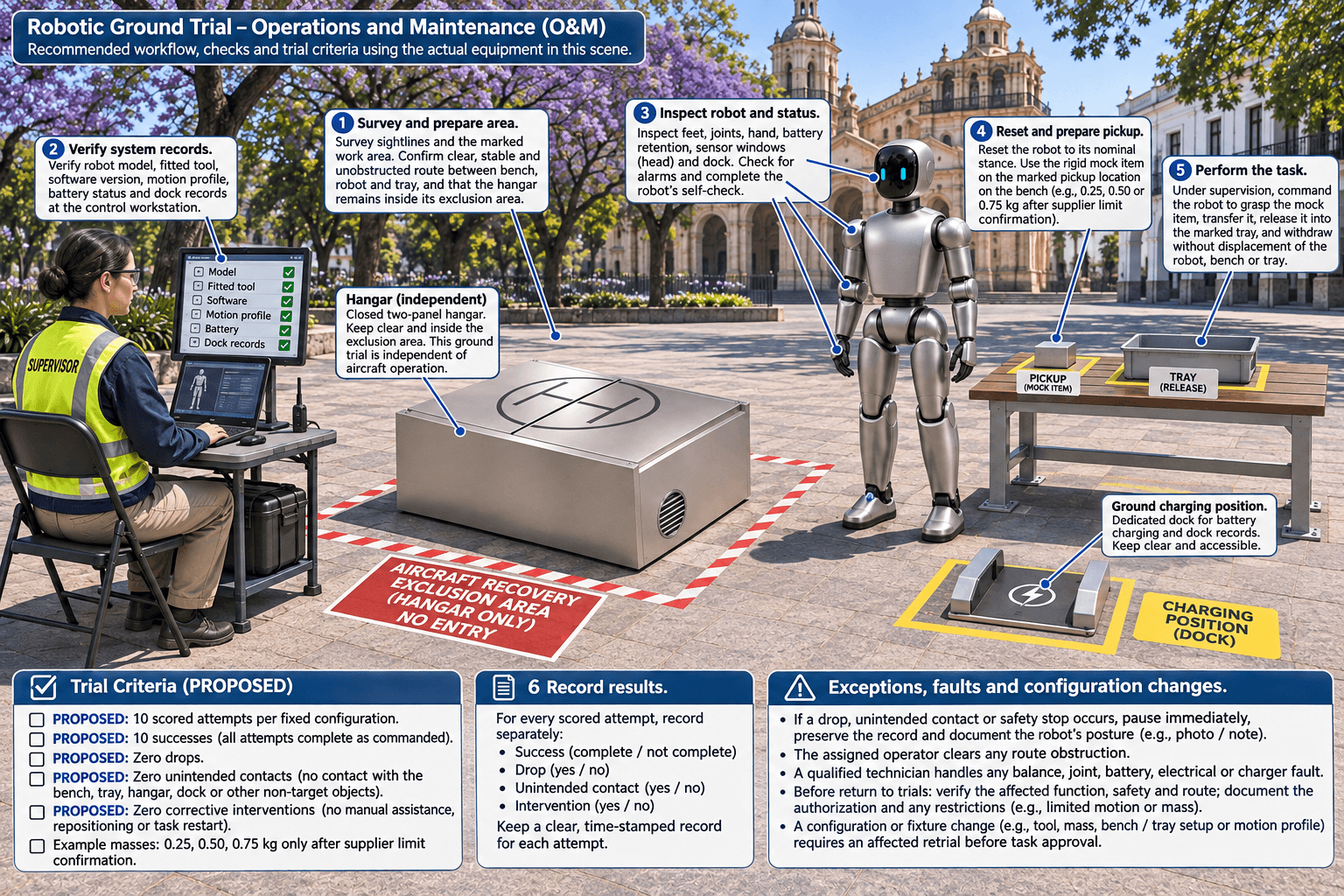
Score a successful placement when the planned release leaves the item resting within the marked area and allowable orientation, and the tool withdraws without displacing it. Log a drop if the item leaves the tool unintentionally, even if it lands inside the destination. Designate expected contact surfaces in advance and record any other contact by surface and phase of motion. Log stops, aborts and operator interventions separately. Keep every started scored attempt in the record, including its disposition. Report the number of scored attempts, successful placements, drops and unintended contacts for each combination. NIST’s ground robot methods provide context for repeatable fixtures, scripted procedures and quantitative scoring. NIST ground robot tests
Explicitly hypothetical measurable evaluation assumptions
Confirm the supplier’s written limits for the delivered tool, posture and motion before adopting these screening values.
Hypothetical evaluation assumption: The initial mass series uses otherwise comparable mock items with measured as-handled masses of 0.25 kg, 0.50 kg and 0.75 kg.
Hypothetical evaluation assumption: Each item, pickup, destination and posture combination receives 10 scored attempts under the same documented configuration.
Hypothetical evaluation assumption: A combination qualifies for consideration only with 10 successful placements in 10 scored attempts.
Hypothetical evaluation assumption: A qualifying combination has zero drops.
Hypothetical evaluation assumption: A qualifying combination has zero unintended contacts.
Hypothetical evaluation assumption: A qualifying combination has zero corrective operator interventions after a scored attempt begins.
Agree in advance on when a scored attempt starts, how observers judge the target and how they log ambiguous outcomes. Pause after a drop, unintended contact or safety stop, preserve the record and follow the applicable recovery procedure. Give any changed setup a separately identified series. Use the screening result to decide which exact combination merits approval. Assess reliability over longer use separately.
Survey and acceptance checklist
- Survey the work area. Measure pickup and destination geometry, usable floor space, approaches, obstructions and operator sightlines. Mark the planned work and exclusion areas and locate the operator’s control position. Page 58 excludes robots from the aircraft’s landing and rotor exclusion zone while the cabinet receives or releases the aircraft. Ground coordination, p. 58
- Record the delivered configuration. Use the asset fields listed on page 77 to record the model, serial number, fitted end effector, software and motion-profile revisions, battery ID and dock ID. Assign an operator and confirm the local stop and recovery procedures. Use the applicable inspection and self-check results to decide whether to begin the mock-up. The manual prohibits dispatch while a safety or balance alarm remains active. Inspection and recovery, p. 76 · Operating and maintenance records, p. 77
- Check the trial record. Match the run identifier to the item, measured mass, fixtures, fitted tool, observed posture and operator. Retain the outcome flags, intervention details and relevant fault records. Where the site permits recordings, use a view that shows the grip, release and nearby surfaces.
- Approve a defined task. Record each approved combination with its item identifier, mass, grip orientation, pickup and destination, tool revision, allowed posture, motion profile and supervision conditions. Keep failed and untested combinations off the permitted-task list pending successful trials and approval. Test each mass variant and destination independently.
- Control recovery and changes. For a stop or fault, record the physical posture before moving the robot and follow the applicable manual recovery and return-to-service checks. Record who authorizes return to service and any remaining restrictions. Review affected task permissions after configuration or workstation changes and repeat the relevant trials before authorizing the changed task. Controlled recovery, p. 76 · Change records, p. 77
Limitations
Approval for the proposed site depends on the delivered tool record, the surveyed workstation and observed trial outcomes. Apply each decision to the recorded item, surfaces, approach, supervision and configuration. Review the affected permission if the fixture, grip or posture changes, even when item mass stays the same.
Evaluate the aircraft and hangar separately if the buyer later includes them. Page 10 lists a maximum forward-flight time for the STT 1S MAX of 54 minutes at 12 m/s in windless conditions, in photo mode with obstacle action off, from 100% to 0% state of charge. It lists a maximum hover time of 47 minutes in windless conditions from 100% to 0% state of charge. Assess any proposed route duration and flight permission separately. The NIST aerial reference describes methods for evaluating aircraft capabilities and remote-pilot proficiency. Aircraft specification context, p. 8 · Aircraft conditions, p. 10 · NIST aerial drone test FAQ
Procurement questions
- Which end effector and software revision will ship on the identified T1, and what documentation defines compatible grips, postures and motion profiles?
- Which item geometry, load distribution and placement conditions will the supplier support for the initial mock-up?
- Who supervises the trial, calls a stop, scores the outcomes and signs each permitted-task entry?
- Which trial and fault records will the buyer receive, and how will each record identify the tested configuration?
- Which tool, software or maintenance changes require return-to-service checks, and who is responsible for repeating the affected task trials?
FAQ
Which task should be considered first?
Start by testing a supervised transfer of a rigid, non-fragile mock item between fixed, marked surfaces. Consider permission after the combination meets the screening criteria with the fitted tool, tested posture and documented motion profile.
Can the T1 arm-load figure set the item limit?
Use the manual figure to frame supplier questions. Set a task-specific limit using the documented tool, reach, posture and motion profile and the trial record for the exact item and placement.
Can S1 trial results be used for the T1?
Run separate trials for each model and fitted configuration. The S1 and T1 have distinct arm and end-effector specifications, and their reach descriptions use different measurement definitions.
What counts as successful placement?
After the planned release, the item must rest within the marked destination and allowable orientation, and the tool must withdraw without displacing it.
How should drops and unintended contact be scored?
Record them as separate outcome flags for each attempt. An unplanned release counts as a drop even if the item lands in the target, and contact outside designated surfaces counts as unintended contact.
What happens after a stop or configuration change?
Preserve the record, follow the applicable recovery and return-to-service checks, and repeat the affected trials before restoring an affected task permission.
Does the handling trial require a flight or hangar exchange?
The proposed mock-up is a ground-robot trial. The STT 1S MAX aircraft and independent STT-HUB1101 hangar have separate operating and acceptance conditions.
What do the NIST references contribute?
The ground reference provides context for repeatable fixtures, procedures and scoring. The aerial reference addresses aircraft capabilities and remote-pilot proficiency. Confirm any applicable site permissions separately for the proposed Córdoba evaluation.
References
- SkyHub Air–Ground Coordinated System product manual, English Rev 1.3. Family identity, p. 1 · STT 1S MAX aircraft specification notes, p. 8 · Airframe and flight table, p. 9 · Flight operating conditions, p. 10
- STT-HUB1101 independent ground hangar. Battery exchange overview, p. 22 · Matched equipment, p. 24 · Exchange clock, p. 25 · Zones and operating states, p. 27
- STTBOT-S1 and STTBOT-T1 ground robots. Service assistance, p. 57 · Model comparison, p. 58 · Fitted tool and loading, p. 59 · Recovery and inspection, p. 76 · Operating and maintenance records, p. 77
- U.S. NIST evaluation methods for context. Ground robot tests · Aerial drone test FAQ
Proposed Equipment
- STTBOT-T1 bipedal ground robot
- End effector for the proposed STTBOT-T1 trial, with the fitted tool to be confirmed from the supplied-unit record
- Assigned wireless charging position for the STTBOT-T1
- STT 1S MAX multirotor aircraft (separate SkyHub system component)
- STT-HUB1101 independent ground four-bay battery exchange hangar (separate SkyHub system component)