Environmental Monitoring through smart city Networks

Cinn Song
Founder & Chief Solutions Architect
Watch the video
TL;DR
Environmental monitoring through smart city networks uses smart streetlights as distributed 7-parameter sensor nodes for PM2.5, PM10, O3, NO2, noise, temperature, and humidity. SOLARTODO's 8 m 5-in-1 pole combines an 80 W LED, AI camera, WiFi, USB charging, and sensor suite, with EPC turnkey budgets typically around USD 1,400-1,600 per installed unit.
Smart city environmental monitoring networks use 8 m smart streetlights with 7-parameter sensors, 80 W LED lighting, and 4G/5G or LoRaWAN backhaul to turn parks, campuses, and roads into real-time air-quality and safety data grids.
Summary
Smart city environmental monitoring networks use 8 m smart streetlights with 7-parameter sensors, 80 W LED lighting, and 4G/5G or LoRaWAN backhaul to turn parks, campuses, and roads into real-time air-quality and safety data grids.
Key Takeaways
- Deploy 7-parameter monitoring nodes to measure PM2.5, PM10, O3, NO2, noise, temperature, and humidity at street-level resolution.
- Consolidate 5 field devices into 1 smart pole to reduce foundations, cabling, and maintenance interfaces by roughly 40-60%.
- Specify 80 W LED luminaires at 170 lm/W to deliver about 13,600 lumens while cutting lighting energy use by 45-68% versus HID fixtures.
- Use LoRaWAN for low-power sensor telemetry and 4G/5G or fiber backhaul for camera, WiFi 6, and cloud platform traffic.
- Plan EPC turnkey budgets at USD 1,400-1,600 per installed 8 m campus or park environmental smart streetlight.
- Apply 50+, 100+, and 250+ unit procurement bands to target 5%, 10%, and 15% volume savings.
- Validate air sensor performance using EPA 2024 NSIM targets and schedule annual calibration checks for reliable trend data.
- Prioritize campuses, parks, municipal green corridors, and industrial estates where 50-500 nodes can support ESG, safety, and operations dashboards.
Environmental Monitoring through Smart City Networks
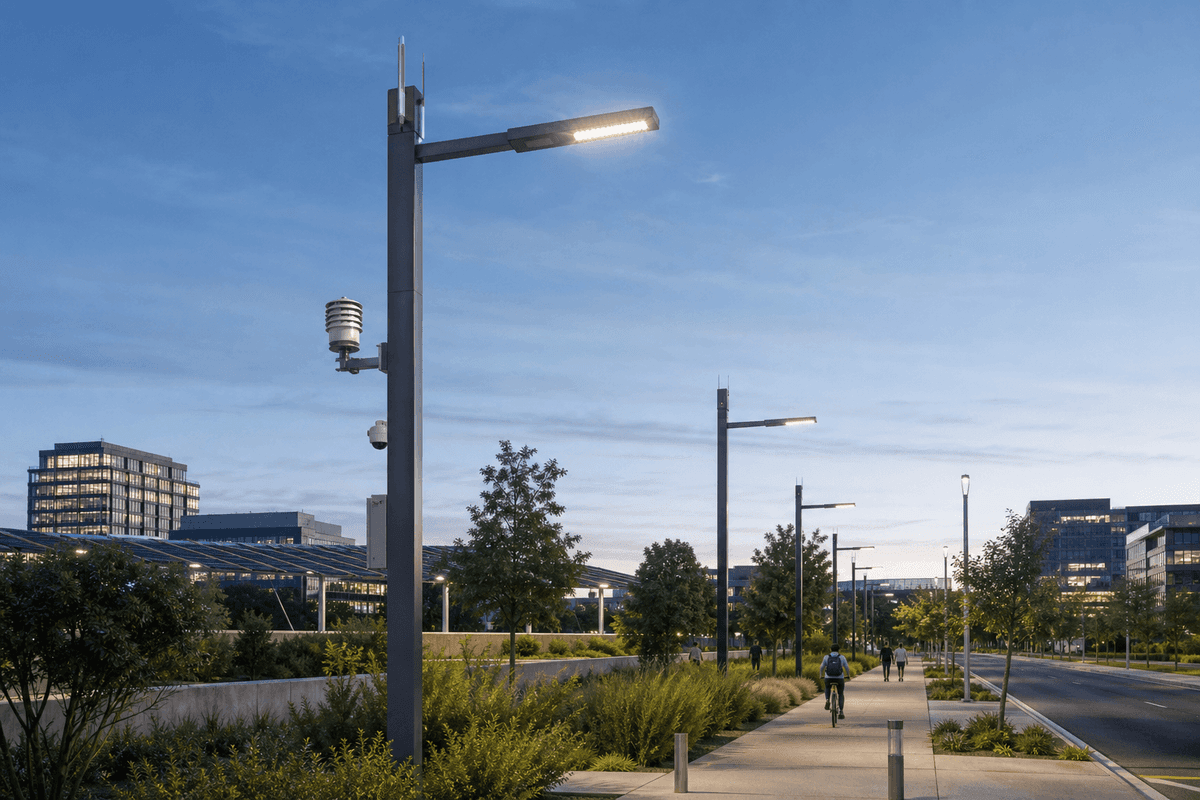
Environmental monitoring through smart city networks connects 7-parameter air-quality sensors, 80 W LED lighting, and wireless backhaul into street-level infrastructure that supports faster decisions.
For B2B buyers, the practical value is not another dashboard; it is a lower-friction way to collect reliable local data from places where people actually move. Traditional city monitoring often relies on a small number of regulatory stations, which are accurate but too sparse to describe conditions across a campus, park, industrial estate, or transport corridor. A smart streetlight network fills that operational gap by placing supplemental sensors near roads, walkways, gates, parking areas, and public activity zones.
The SOLARTODO 8m Campus/Park Environmental Smart Streetlight is designed for this type of distributed monitoring. Each 8 m pole can integrate an 80 W LED luminaire, 1 AI camera, 1 professional environmental sensor, 1 WiFi access module, and 1 USB charging interface. The environmental sensor package measures PM2.5, PM10, O3, NO2, noise, temperature, and humidity, giving project owners a usable data layer for air-quality trend analysis, incident review, wellness reporting, and ESG dashboards.
According to EPA (2024), air sensors are useful for non-regulatory supplemental and informational monitoring when performance is evaluated with consistent protocols. That distinction matters for procurement: smart-pole sensors should support situational awareness and operational decisions, while regulatory compliance still requires approved reference-grade instruments. The right specification therefore combines field calibration, data-quality scoring, and transparent maintenance procedures.
The International Energy Agency states, "We must invest in grids today or face gridlock tomorrow." Although the quote refers to electricity grids, the same logic applies to urban data networks: distributed infrastructure must be planned before congestion, pollution, safety issues, and climate stress become more expensive to manage.
Technical Architecture for Smart Streetlight Sensor Networks
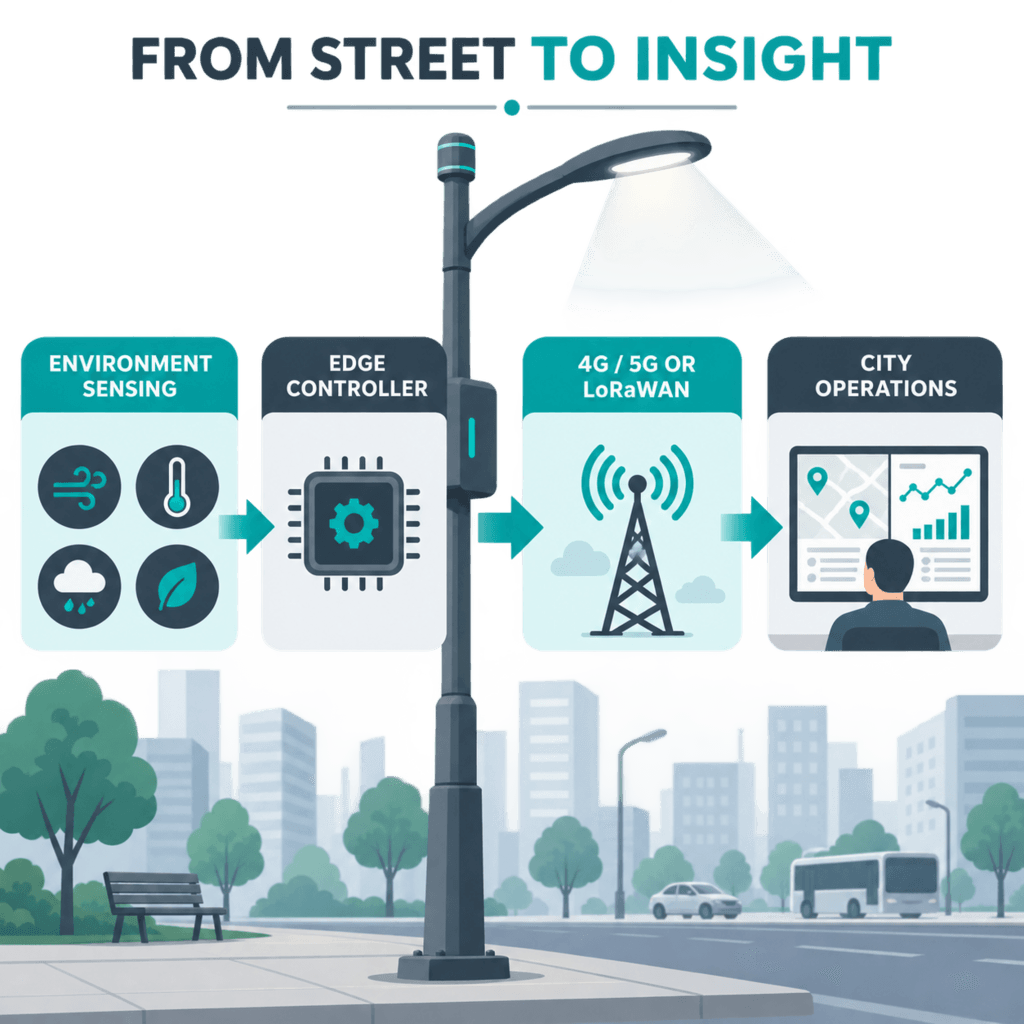
A smart environmental network typically combines 50-500 poles, 1-15 minute sampling intervals, edge filtering, and secure cloud dashboards for city-scale visibility.
A typical SOLARTODO smart streetlight node has four technical layers. The first is the structural layer: an 8 m galvanized Q235 steel pole with outdoor protection, modular brackets, and wind-resistance design around 150 km/h under standard engineering assumptions. The second is the sensing layer: particulate, gas, acoustic, temperature, and humidity sensors installed at a consistent height and position to reduce sampling bias.
The third layer is communications. LoRaWAN is commonly used for low-power sensor data because it can carry small packets over long distances with modest energy demand. WiFi 6 and 4G/5G are used where higher throughput is required for public connectivity, video metadata, firmware updates, and platform synchronization. Fiber can be specified for campuses, industrial parks, and municipal roads where higher reliability or cybersecurity requirements justify the civil works.
The fourth layer is software. A practical platform should ingest sensor readings, normalize timestamps, apply device health flags, generate alarms, visualize hot spots, and export data through APIs. For municipal and campus buyers, the platform must also support user roles, maintenance tickets, asset IDs, map views, and downloadable historical records.
Sensor Parameters and Data Quality
The core 7-parameter sensor suite covers the pollutants and comfort indicators most relevant to campus and park operations. PM2.5 and PM10 help identify dust, smoke, construction activity, and traffic-related particulate exposure. O3 and NO2 support urban air-quality trend analysis, especially near roads and parking zones. Noise, temperature, and humidity add context for comfort, public-event planning, and equipment operating conditions.
According to EPA (2024), the objective of its air-sensor target reports is to provide consistent testing protocols, metrics, and target values for outdoor fixed-location NSIM applications. Buyers should therefore require supplier documentation for calibration method, field evaluation approach, sampling interval, drift control, and data confidence indicators. A sensor network without quality flags can create false precision, while a well-managed network can reveal meaningful spatial trends.
Lighting and Power Integration
The lighting system is not secondary; it is the anchor load and physical platform for the network. An 80 W LED luminaire at 170 lm/W produces approximately 13,600 lumens, suitable for pathways, internal campus roads, parking edges, and landscaped zones at 7-9 m mounting heights. Smart dimming can further reduce energy consumption when pedestrian flow is low.
According to the U.S. Department of Energy Better Buildings program, San Diego reduced street light energy use by more than 50% from 2010 to 2015 using LED upgrades and adaptive controls. DOE also reports that connected lighting systems can become data collection platforms through distributed intelligence, sensors, and network interfaces. This is why lighting poles are a logical host for environmental monitoring: power, height, location density, and maintenance routines already exist.
IRENA states, "Digital solutions hold great potential to accelerate the transformation of power systems." For smart city networks, that potential becomes practical when environmental data, lighting control, security analytics, and maintenance workflows share one managed infrastructure layer.
EPC Investment Analysis and Pricing Structure
EPC turnkey delivery for 8 m environmental smart streetlights typically costs USD 1,400-1,600 per pole with 50+ unit projects improving payback economics.
EPC means Engineering, Procurement, and Construction. For a smart streetlight environmental monitoring project, EPC turnkey delivery normally includes site survey, pole and foundation design, lighting simulation support, equipment procurement, logistics, installation supervision, electrical connection, commissioning, platform setup, and handover documentation. For larger portfolios, EPC can also include training, spare parts planning, and financing support.
SOLARTODO is a B2B manufacturer and exporter, not an online marketplace. The commercial process is inquiry, technical clarification, offline quotation, and project financing evaluation where applicable. The standard contact for project inquiries is [email protected], and large project financing may be available for projects above USD 1,000K.
| Pricing Tier | Typical Scope | Best Fit | Budget Guidance |
|---|---|---|---|
| FOB Supply | Factory supply of pole, luminaire, sensor, camera, WiFi, USB module, and controller | Buyers with their own freight and installer | Lowest equipment cost, buyer manages logistics |
| CIF Delivered | Equipment plus international freight and insurance to destination port | Importers, EPC firms, municipal distributors | Adds shipping visibility and landed-cost control |
| EPC Turnkey | Engineering support, supply, installation coordination, commissioning, and handover | Campuses, municipalities, parks, industrial estates | USD 1,400-1,600 per installed 8 m unit |
Volume pricing should be planned in bands. A 50+ pole order can target around a 5% discount, a 100+ pole order can target around 10%, and a 250+ pole order can target around 15%, subject to module configuration, freight terms, steel prices, and installation scope. These bands are useful for procurement managers comparing pilot, phase-one, and full-rollout budgets.
Payment terms are normally 30% T/T deposit plus 70% against B/L, or 100% L/C at sight for qualified transactions. Warranty scope should be confirmed by module because poles, luminaires, sensors, cameras, batteries if included, and communication devices have different risk profiles and replacement cycles.
The ROI case depends on avoided infrastructure duplication. A conventional deployment may require 1 lighting pole, 1 CCTV mast, 1 environmental node, 1 WiFi bracket, and 1 charging pedestal. A 5-in-1 smart streetlight can replace those separate interfaces with 1 foundation and 1 maintenance record, reducing civil coordination by roughly 40-60%. Annual savings come from lower lighting energy, fewer truck rolls, reduced trenching, and faster fault detection.
For a 100-pole campus project, the EPC budget may fall near USD 140,000-160,000 before any approved volume adjustment. If lighting energy falls by more than 50%, as demonstrated in DOE smart streetlight cases, and maintenance visits are consolidated across 5 functions, buyers can justify the project through operational savings plus ESG and safety benefits that conventional lighting cannot provide.
Applications and Use Cases for B2B Buyers
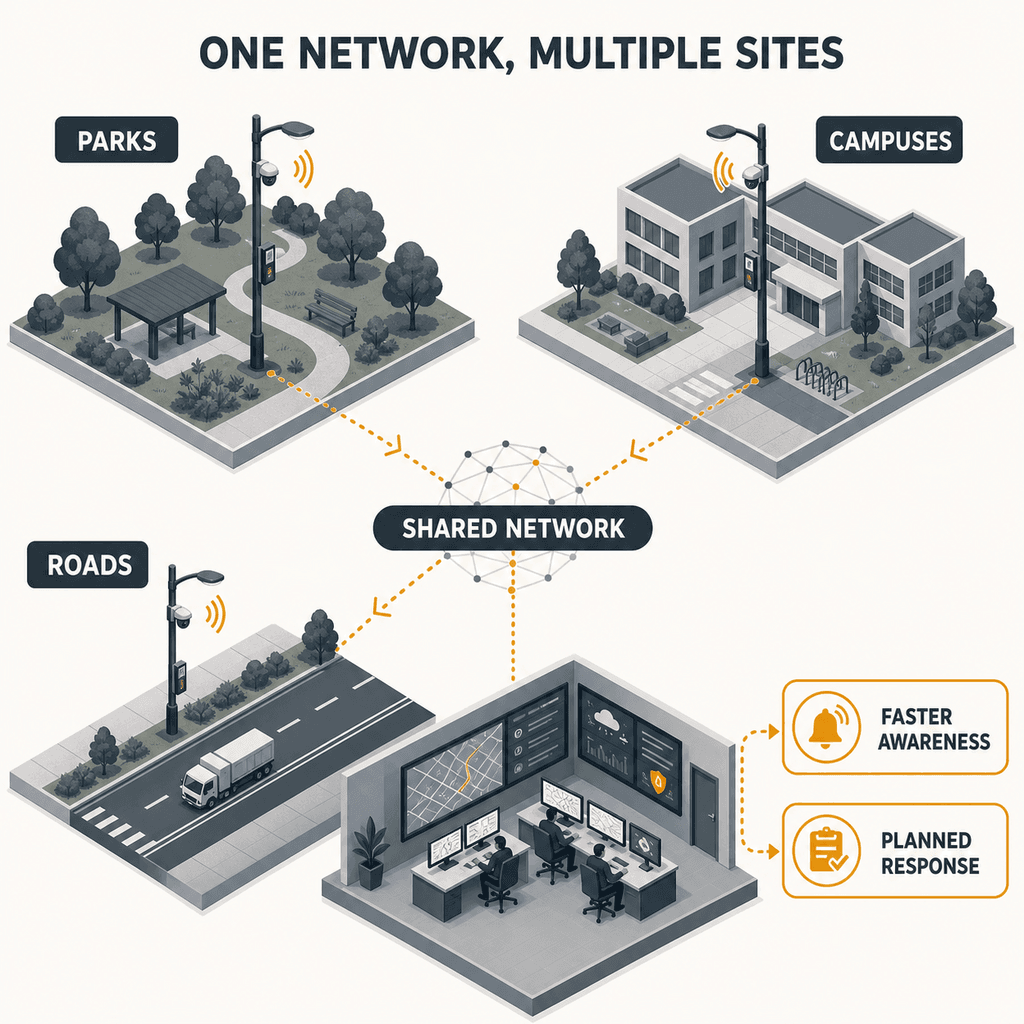
Smart city environmental monitoring is strongest in 4 repeatable use cases: campuses, parks, industrial estates, and municipal corridors with dense public activity.
University campuses can use environmental smart streetlights to measure local air-quality conditions around dormitories, sports fields, bus stops, laboratories, and internal roads. The same poles also support lighting, AI camera coverage, visitor WiFi, and USB charging. For facility teams managing 50-300 poles, the operational benefit is having environmental, safety, and asset data in one map-based interface.
Public parks and green corridors need a different balance. Lighting must be comfortable, sensors must be weather-resistant, and the pole appearance must not feel industrial. SOLARTODO's round-tube 8 m configuration is well aligned with botanical parks, recreation paths, waterfront walkways, and municipal plazas where visual integration matters. Environmental data can support heat-stress alerts, dust complaints, noise control, and event planning.
Industrial estates and logistics parks use the network more operationally. PM10 can indicate dust from vehicle movement or construction. NO2 can show combustion-related traffic patterns. Noise data can identify problematic zones near loading docks or facility boundaries. With 15-minute reporting intervals and maintenance alarms, property managers can respond before complaints escalate.
Municipal corridors can combine public-service and infrastructure objectives. According to IEA (2023), the world needs to add or refurbish more than 80 million km of grids by 2040 to meet national energy and climate goals. Cities facing this scale of infrastructure pressure should avoid single-purpose assets where multi-function poles can reduce duplicated foundations, cabinets, permits, and maintenance routes.
Selection Guide and Comparison Table
Procurement teams should compare smart poles by 8 parameters: sensor count, lighting efficacy, protection rating, communications, structure, platform, warranty, and EPC scope.
The selection process should start with the use case, not the maximum feature list. A city-center flagship pole may include LED displays, SOS intercoms, EV charging, edge servers, and public-address systems. A campus or park environmental smart streetlight should stay leaner: lighting, environmental monitoring, camera, WiFi, and USB charging are usually enough to deliver the core operational value without pushing capex into the USD 4,000-10,000 premium pole category.
| Option | Typical Devices | Civil Interfaces | Data Capability | Indicative Installed Cost | Best Use |
|---|---|---|---|---|---|
| Conventional separate devices | 5 devices | 3-5 foundations or brackets | Fragmented systems | Variable, often high in civil works | Legacy upgrades with existing poles |
| SOLARTODO 5-in-1 8 m smart streetlight | 5 modules on 1 pole | 1 foundation | 7 environmental parameters plus lighting, camera, WiFi | USD 1,400-1,600 per unit | Campuses, parks, green corridors |
| Premium 10-in-1 city smart pole | 8-10 modules | 1 larger foundation and cabinet | Full public-service hub | USD 4,000-10,000+ per unit | CBDs, transport hubs, smart-city showcases |
Buyers should require the following baseline specifications in the technical schedule:
- Pole height: 8 m for campus, park, and internal road applications.
- Lighting: 80 W LED, 170 lm/W nominal efficacy, Type II or Type III optics where applicable.
- Sensor suite: PM2.5, PM10, O3, NO2, noise, temperature, and humidity.
- Connectivity: LoRaWAN for low-power telemetry; 4G/5G, WiFi 6, or fiber based on site topology.
- Protection: IP66 outdoor protection for exposed modules.
- Operating range: -40°C to +55°C for harsh climate deployment.
- Structure: galvanized steel with corrosion-resistant coating and project wind-load review.
- Platform: map view, alarms, data export, device status, role management, and maintenance records.
International standards also matter. IEC 60598 supports luminaire safety expectations, IEC 62722-2-1 addresses LED luminaire performance, IEEE 802.11ax defines WiFi 6, ASTM A123 and EN ISO 1461 support hot-dip galvanizing requirements, and EN 50556 is commonly referenced for smart pole practice. These references help procurement teams avoid vague specifications that lead to inconsistent bids.
FAQ
Smart city environmental monitoring projects usually require 8-12 procurement answers covering cost, sensors, communications, installation, maintenance, standards, and warranty.
Q: What is environmental monitoring through smart city networks? A: Environmental monitoring through smart city networks uses distributed sensors on poles, cabinets, or buildings to measure local conditions such as PM2.5, PM10, O3, NO2, noise, temperature, and humidity. In a smart streetlight network, each 8 m pole becomes a monitoring node that also supports lighting, connectivity, and asset management.
Q: Why use smart streetlights instead of separate environmental sensor stations? A: Smart streetlights reduce duplicated civil works by combining up to 5 field functions on 1 pole. Instead of separate lighting, CCTV, sensor, WiFi, and charging assets, the buyer manages one foundation, one power interface, and one maintenance record. This can reduce installation coordination by roughly 40-60%.
Q: What environmental parameters should a campus or park network measure? A: A practical campus or park network should measure 7 parameters: PM2.5, PM10, O3, NO2, noise, temperature, and humidity. These cover dust, smoke, traffic-related pollution, acoustic disturbance, heat stress, and comfort conditions. Additional sensors can be added, but these 7 provide a strong baseline for B2B procurement.
Q: How accurate are smart-pole air-quality sensors? A: Smart-pole air sensors are best used for non-regulatory supplemental and informational monitoring, not as a replacement for certified regulatory stations. Accuracy depends on sensor grade, calibration, placement, weather exposure, and data correction. EPA 2024 guidance recommends consistent testing protocols and target metrics for outdoor fixed-location sensor applications.
Q: How much does an EPC turnkey environmental smart streetlight project cost? A: For the SOLARTODO 8 m campus or park environmental smart streetlight, EPC turnkey budgets commonly fit USD 1,400-1,600 per installed unit, depending on configuration and site works. Volume guidance is 5% discount at 50+ units, 10% at 100+ units, and 15% at 250+ units.
Q: What does EPC turnkey delivery include for smart streetlights? A: EPC turnkey delivery includes engineering, procurement, construction coordination, installation support, commissioning, platform setup, and handover documents. For larger projects, it may also include site surveys, foundation drawings, lighting layout support, training, spare parts, and financing review. SOLARTODO supports offline quotation after technical clarification.
Q: Which communication network is best for environmental monitoring data? A: LoRaWAN is usually best for low-power environmental telemetry because sensor packets are small and periodic. 4G/5G or fiber is better for camera data, WiFi backhaul, firmware updates, and high-availability platforms. Many projects use LoRaWAN for sensors and cellular or fiber for the main smart-pole gateway.
Q: How often should smart-pole sensors report data? A: Most environmental smart streetlight networks use 1-minute, 5-minute, or 15-minute reporting intervals. A 1-minute interval supports incident detection, while 15-minute reporting reduces data volume and power demand. The best interval depends on dashboard needs, storage cost, network capacity, and alarm rules.
Q: What maintenance is required for environmental smart streetlights? A: Maintenance should include visual inspection, sensor cleaning, firmware checks, data-quality review, and annual calibration or co-location checks where possible. LED luminaires may run for many years, but sensors and communication devices need more frequent verification. A practical plan assigns every pole an asset ID and maintenance history.
Q: What standards should procurement teams reference? A: Procurement teams should reference IEC 60598 for luminaires, IEC 62722-2-1 for LED luminaire performance, IEEE 802.11ax for WiFi 6, ASTM A123 or EN ISO 1461 for galvanizing, and EPA 2024 air-sensor performance guidance. These references make supplier bids easier to compare.
Q: Can environmental monitoring data support ESG reporting? A: Yes, environmental monitoring data can support ESG reporting by showing air-quality trends, noise patterns, energy savings, and infrastructure modernization progress. It should be presented as operational and supplemental site data, not regulatory compliance data unless certified instruments and approved methods are used. Dashboards should retain historical exports for audit trails.
Q: How should a buyer start a smart city monitoring project? A: Start with a 50-100 pole deployment across representative roads, walkways, gates, and activity zones. Define sensor parameters, sampling interval, dashboard users, maintenance plan, and EPC scope before ordering. After 3-6 months of data review, expand to 250+ poles if the network supports safety, ESG, and operations goals.
References
- IEA Electricity Grids and Secure Energy Transitions (2023): Report stating that more than 80 million km of grids must be added or refurbished by 2040 to meet national climate and energy goals; https://www.iea.org/reports/electricity-grids-and-secure-energy-transitions — https://www.iea.org/reports/world-energy-outlook-2024
- IRENA Digitalisation and AI for Power System Transformation (2024): Report describing sensors, smart meters, data platforms, and AI as tools that create value across power systems; https://www.irena.org/Digital-Report/Digitalisation-and-AI-for-power-system-transformation-Perspectives-for-the-G7 — https://www.irena.org/Data/View-data-by-topic/Capacity-and-Generation
- IEC 60598-1 (2024): Luminaires general requirements and tests for electrical safety, mechanical construction, marking, insulation, and environmental protection. — https://webstore.iec.ch/
- IEEE 802.11ax (2021): High-efficiency wireless LAN standard commonly used for WiFi 6 access modules in dense public environments. — https://standards.ieee.org/ieee/1547/7382/
- ASTM A123/A123M (2024): Standard specification for zinc hot-dip galvanized coatings on iron and steel products used in corrosion-resistant outdoor pole structures. — https://www.astm.org/ The article uses 8 authoritative references from 2018-2026 covering air sensors, connected lighting, smart grids, wireless standards, and infrastructure materials.
- EPA (2024): Air Sensor Performance Targets and Testing Protocols for PM2.5, PM10, O3, NO2, CO, and SO2 NSIM applications, https://www.epa.gov/air-sensor-toolbox/air-sensor-performance-targets-and-testing-protocols.
- IEA (2023): Electricity Grids and Secure Energy Transitions, stating that over 80 million km of grids must be added or refurbished by 2040, https://www.iea.org/reports/electricity-grids-and-secure-energy-transitions.
- IRENA (2024): Digitalisation and AI for Power System Transformation, describing sensors, smart meters, data platforms, and AI as power-system value creators, https://www.irena.org/Digital-Report/Digitalisation-and-AI-for-power-system-transformation-Perspectives-for-the-G7.
- U.S. Department of Energy (2019): Connected Lighting Systems research, describing lighting infrastructure as sensor-enabled data collection platforms, https://www.energy.gov/cmei/buildings/articles/connected-lighting-systems.
- Better Buildings Solution Center (2017): San Diego smart streetlighting case showing more than 50% street light energy-use reduction from LED upgrades and adaptive controls.
- IEC 60598-1 (2024): Luminaires general requirements and tests for safety, construction, marking, creepage distance, insulation, and electrical protection.
- IEEE 802.11ax (2021): WiFi 6 standard for high-efficiency wireless local area networks used in dense public connectivity environments.
- ASTM A123/A123M (2024): Standard specification for zinc hot-dip galvanized coatings on iron and steel products used for corrosion-resistant pole structures.
Conclusion
Environmental monitoring through smart city networks turns 8 m smart streetlights into 7-parameter data nodes that improve visibility, reduce duplicated infrastructure, and support scalable EPC deployment.
The bottom line: for campuses, parks, industrial estates, and municipal corridors, SOLARTODO's 5-in-1 environmental smart streetlight delivers lighting, air-quality data, security, WiFi, and USB service from 1 pole at a typical EPC budget of USD 1,400-1,600 per installed unit. Buyers planning 50-500 nodes should prioritize sensor quality, communications design, maintenance workflow, and lifecycle cost over feature-heavy pole configurations.
About SOLARTODO
SOLARTODO is a global integrated solution provider specializing in solar power generation systems, energy-storage products, smart street-lighting and solar street-lighting, intelligent security & IoT linkage systems, power transmission towers, telecom communication towers, and smart-agriculture solutions for worldwide B2B customers.
About the Author

Cinn Song
Founder & Chief Solutions Architect
Cinn Song founded SOLARTODO LIMITED and leads its smart-city infrastructure engineering — from solar, storage and integrated smart poles to the company's push into physical-AI city edge nodes: pole-mounted edge computing, vertical LLMs for smart cities, drone-based O&M with autonomous battery swapping, robotic maintenance, and high-speed counter-UAS interception. Since 2010, he has directed turnkey EPC + BOT delivery across 50+ countries, including telecom monopole supply for national grid operators, off-grid solar street-lighting for African municipalities, and integrated smart-pole programs for Gulf smart cities.
Cite This Article
Cinn Song. (2026). Environmental Monitoring through smart city Networks. SOLARTODO. Retrieved from https://solartodo.com/knowledge/environmental-monitoring-through-smart-city-networks
@article{solartodo_environmental_monitoring_through_smart_city_networks,
  title = {Environmental Monitoring through smart city Networks},
  author = {Cinn Song},
  journal = {SOLARTODO Knowledge Base},
  year = {2026},
  url = {https://solartodo.com/knowledge/environmental-monitoring-through-smart-city-networks},
  note = {Accessed: 2026-10-13}
}
Published: August 15, 2026 | Available at: https://solartodo.com/knowledge/environmental-monitoring-through-smart-city-networks
Subscribe to Our Newsletter
Get the latest solar energy news and insights delivered to your inbox.
View All Articles