Климатические требования к EV charging в условиях…

Cinn Song
Founder & Chief Solutions Architect
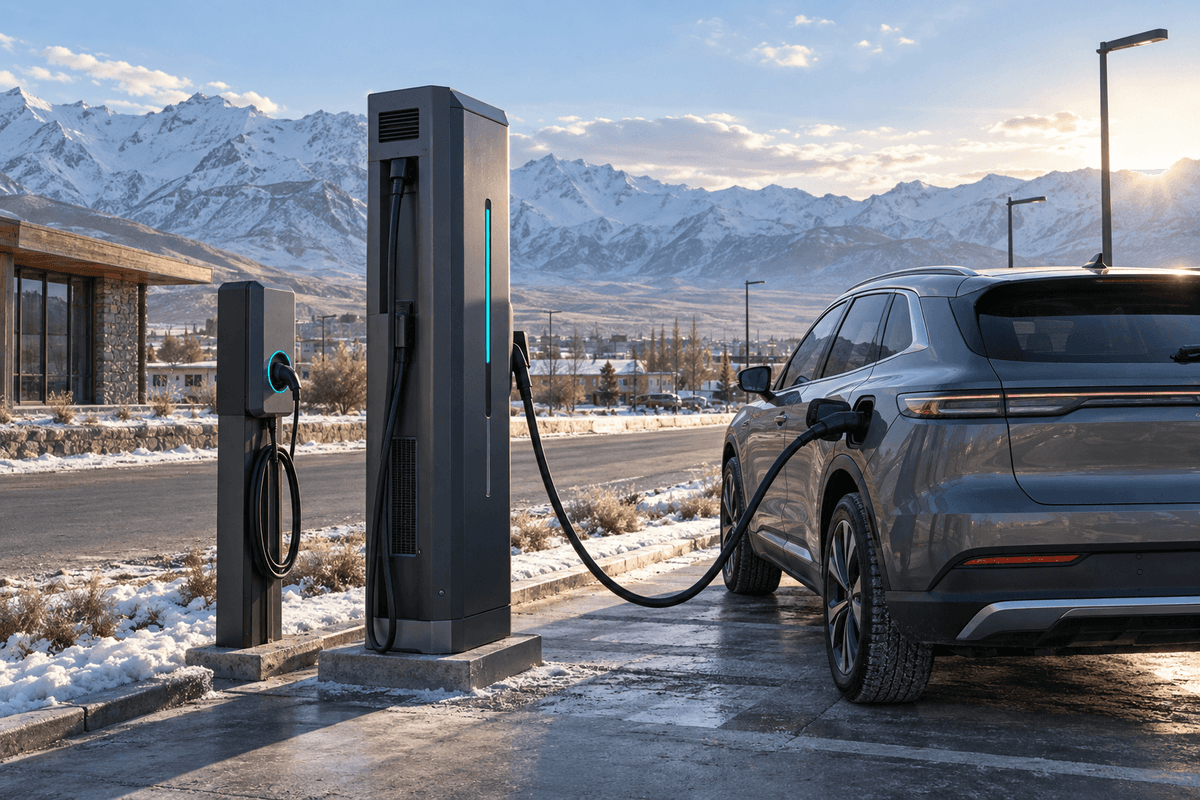
Watch the video
TL;DR
Central Asian EV charging should be specified for harsh continental climates, not mild urban benchmarks. Use -40°C to +50°C hardware, IP65 outdoor protection, heated cables, dust filtration, and derating checks above 40°C. For weak feeders, combine 60-180 kW DC chargers with 500 kWh-1.5 MWh LFP storage and structure procurement as FOB, CIF, or EPC turnkey.
Central Asian EV charging needs -40°C to +50°C climate design, IP54-IP65 enclosures, heated cables, dust filtration, and 20-80% battery SOC controls to keep AC/DC chargers reliable across Kazakhstan, Uzbekistan, Kyrgyzstan, Tajikistan, and Turkmenistan.
Summary
Central Asian EV charging needs -40°C to +50°C climate design, IP54-IP65 enclosures, heated cables, dust filtration, and 20-80% battery SOC controls to keep AC/DC chargers reliable across Kazakhstan, Uzbekistan, Kyrgyzstan, Tajikistan, and Turkmenistan.
Key Takeaways
Central Asian charging projects should specify at least -40°C to +50°C hardware, because winter cold, summer heat, dust, wind, and weak feeders affect uptime.
- Specify -40°C cold-start capability and heated cable management for northern Kazakhstan and high-altitude corridors.
- Select IP54 indoor cabinets and IP65 outdoor dispensers to protect electronics from dust, snow, and wind-driven rain.
- Derate DC fast chargers by 10-25% above 40°C unless liquid cooling and oversized HVAC are included.
- Use 7-22 kW AC charging for parking dwell times above 2 hours and 60-180 kW DC charging for highway stops.
- Add 500 kWh-1.5 MWh LFP buffer storage where utility feeders cannot support 10-20 simultaneous chargers.
- Require IEC 61851, IEC 62196, IEC 61000 EMC, and UL 2202 alignment for safety, connectors, and grid compatibility.
- Model ROI with $0.12-$0.18/kWh retail tariffs, 15-40% demand-charge reduction, and 5-9 year payback targets.
- Plan maintenance every 3-6 months in dusty areas and after major snow, sandstorm, or freeze-thaw events.
Climate Requirements for EV Charging in Central Asia
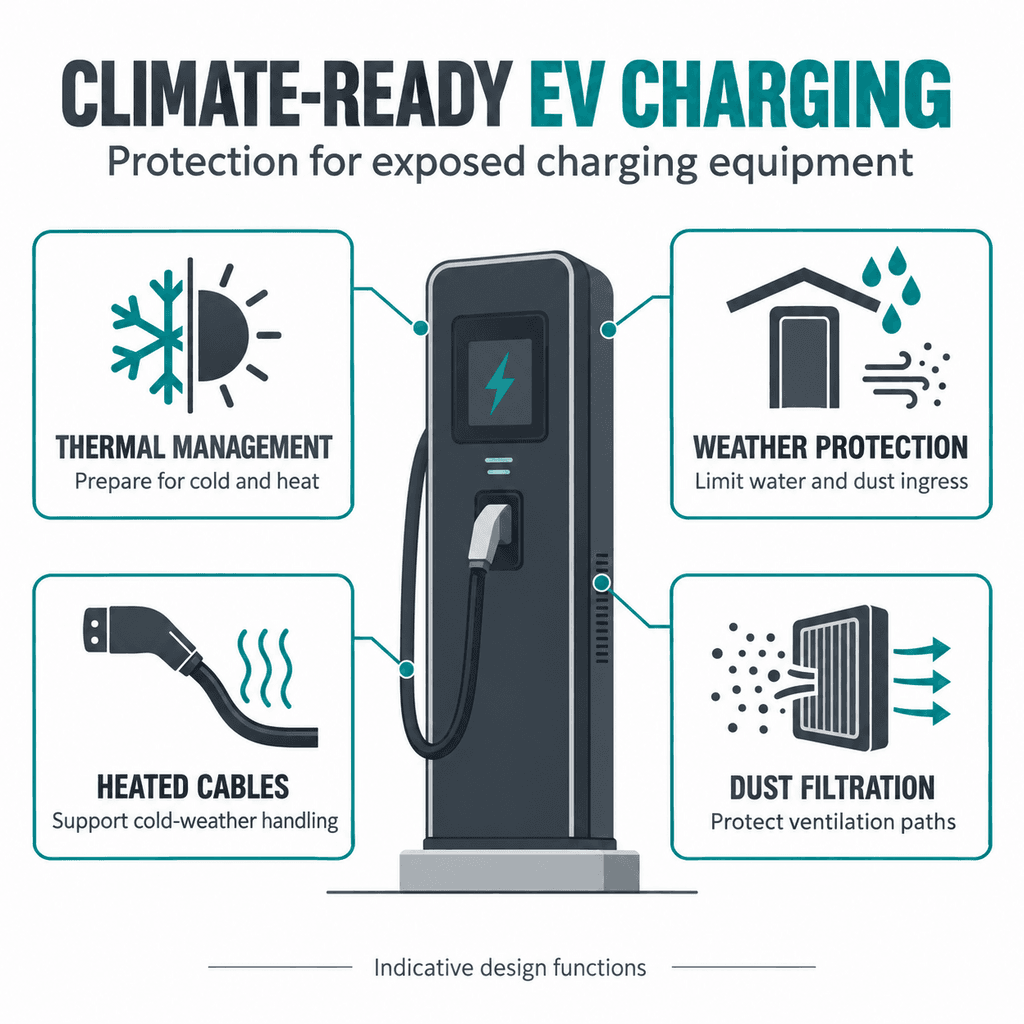
EV charging in Central Asia should be engineered for a -40°C to +50°C operating envelope, 30-60°C annual surface swings, and high dust exposure. The region combines sharply continental winters, desert and semi-desert summers, mountainous routes, and long intercity distances, so standard mild-climate EVSE specifications are often insufficient.
Kazakhstan is the clearest benchmark for the region because it covers northern steppe, southern semi-desert, and high-elevation transition zones. According to Kazhydromet (2026), January temperatures can fall to -42°C to -54°C in some regions, while July heat can reach 40°C to 45°C. For procurement teams, that means charger datasheets must be checked for cold start, full-load operation, enclosure protection, cable flexibility, and condensation control, not only nominal kW rating.
The World Bank Climate Change Knowledge Portal uses 1991-2020 climatology to show Kazakhstan's large seasonal temperature cycle and strong regional variation. That matters for EV charging because a 120 kW charger that performs well in Tashkent may need extra cabinet heating in Astana, while the same charger in Almaty may need seismic anchoring and snow-splash protection. A regional EVSE framework should therefore use climate zones rather than one national specification.
According to the IEA (2025), more than 1.3 million public charging points were added globally in 2024, increasing public charger stock by over 30%. The IEA states, "Public chargers have doubled since 2022," which confirms that charging deployment is moving from pilots to infrastructure-scale procurement. Central Asian buyers can use that trend, but they should avoid copying temperate-market designs without adaptation.
For SOLARTODO, the practical requirement is a project-specific charging package that can connect EV chargers with solar carports, smart streetlight poles, surveillance, grid cabinets, and optional LFP battery storage. SOLARTODO is not an online marketplace; the normal process is inquiry, engineering review, offline quotation, and financing support for large projects.
Technical Design Criteria for Harsh-Climate EVSE
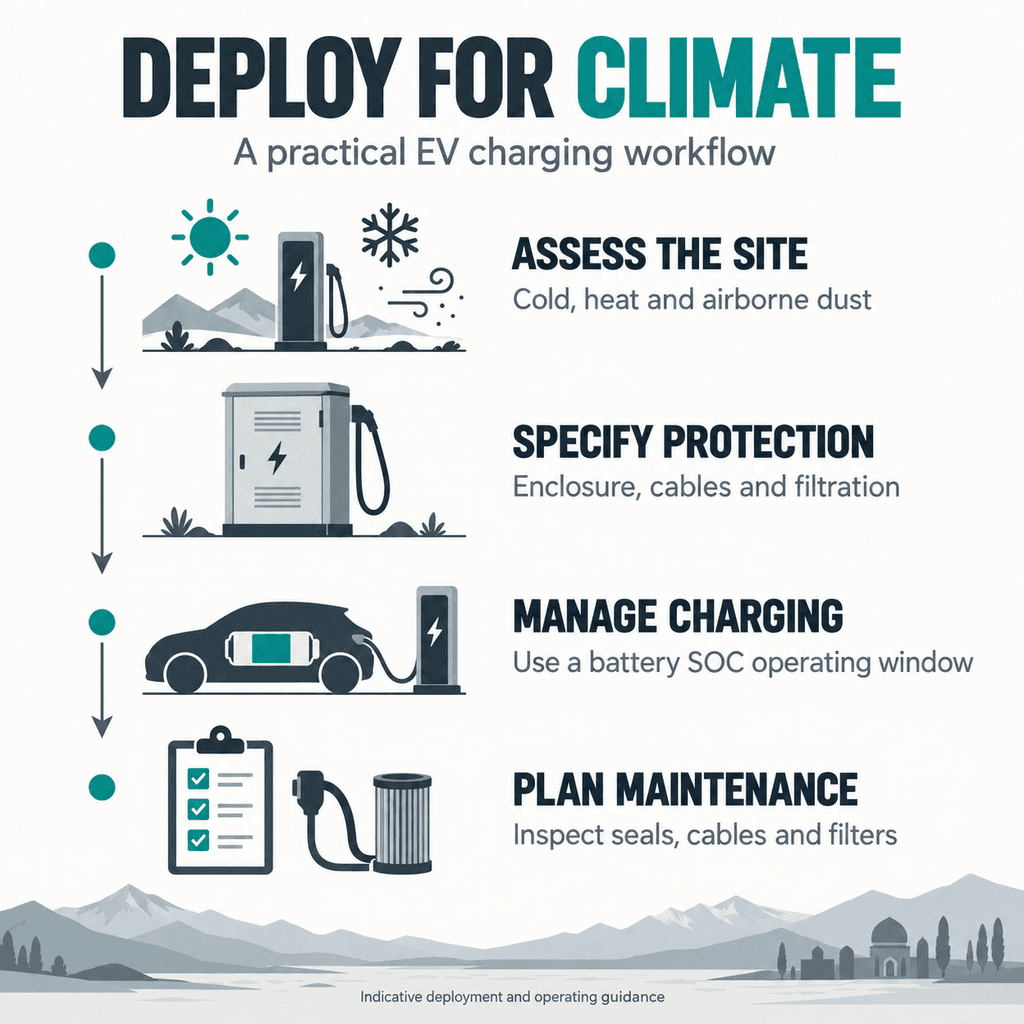
A Central Asia EVSE design should combine -40°C electronics, IP65 outdoor protection, surge protection, cable heating, thermal derating control, and remote monitoring. These requirements are especially important for B2B sites such as municipal streets, malls, bus depots, logistics yards, fuel stations, and border corridors.
Temperature, Heating, and Cooling
Cold affects LCD screens, contactors, insulation, metering accuracy, cable stiffness, and battery acceptance rates. In northern Kazakhstan and mountain areas of Kyrgyzstan and Tajikistan, charging stations should use cabinet heaters, thermostatic control, low-temperature seals, anti-condensation coatings, and flexible cables rated for sub-zero bending. Touchscreens should be readable through gloves or supported by RFID, app, or fleet-card authentication.
Heat is equally important. Desert and semi-desert sites in Uzbekistan, Turkmenistan, southern Kazakhstan, and western Kazakhstan can expose equipment to high solar gain on metal cabinets. If ambient temperature exceeds 40°C, power modules may derate by 10-25% unless the design includes oversized air ducts, liquid-cooled charging cables, shaded placement, or canopy structures. A solar carport can reduce direct cabinet heat while also generating energy.
Dust, Water, Snow, and Wind
Central Asian charging projects should not treat IP ratings as paperwork. Outdoor dispensers should normally target IP65, while backend power cabinets should use filtered positive ventilation or sealed thermal systems where dust storms are expected. Fine dust can clog fan filters, reduce cooling efficiency, and increase failure rates in power electronics.
Snow and freeze-thaw cycles create different risks. Cable holsters must drain, connector pins must avoid ice accumulation, and pedestal bases should sit above expected snow and splash levels. In windy steppe locations, charger foundations, canopy structures, smart poles, cameras, and signage should be checked against local wind loads instead of using a generic catalog baseplate.
Electrical Safety and Interoperability
IEC 61851-1:2017 covers general EV conductive charging requirements up to 1,000 V AC and 1,500 V DC, while IEC 62196-1:2022 covers plugs, socket-outlets, vehicle connectors, and inlets up to 690 V AC and 1,500 V DC. IEC states that the standard addresses "thermal stresses and stability," a key point for hot-cold regional design.
For DC systems, UL 2202 Ed. 3-2022 applies to DC conductive charging equipment with up to 1,000 V AC or 1,500 V DC input and up to 1,500 V DC output. IEEE 1547-2018 is relevant where chargers, solar PV, and BESS operate behind a shared point of interconnection. IEC 61000-series EMC planning is also important because unstable feeders, long cable runs, and nearby telecom equipment can create interference problems.
Application Scenarios for Smart Streetlight and EV Charging Projects
Central Asian EV charging sites should match charger power to dwell time, grid capacity, and climate exposure across 4 common B2B deployment types. A city street pole, mall carport, highway rest stop, and bus depot each needs a different mix of AC charging, DC fast charging, storage, and monitoring.
Municipal smart streetlight projects are suitable for 7-22 kW AC chargers where vehicles park for 2-8 hours. A smart pole can combine LED lighting, CCTV, emergency call, 4G/5G equipment, environmental sensors, and one or two EV charging sockets. For cities, the strongest business case is not maximum charging speed; it is shared civil works, metered public access, better street safety, and managed load growth.
Mall and retail parking projects can combine a 150 kWp solar carport with 10 EV charging stations. SOLARTODO's reference configuration uses bifacial modules at about 22% efficiency and can generate roughly 190-240 MWh/year depending on irradiance, shading, soiling, and albedo. For malls, 7-22 kW AC chargers suit 45-180 minute dwell times, while selected DC chargers can support premium turnover.
Highway and logistics corridors require more power resilience. A site with 10-20 DC chargers may request 1 MW to 3 MW of coincident capacity, but the local feeder may only support 500 kW to 1,000 kW. In these cases, a 750 kW / 1.5 MWh LFP battery buffer can clip peaks, reduce grid import, and support 2-4 peak-shaving cycles per day.
Bus depots and fleet yards need scheduled charging logic. Instead of letting 20 buses start charging at the same minute, the EMS should stagger sessions, hold a site import ceiling, preheat batteries when needed, and prioritize vehicles by departure time. According to IRENA (2024), renewable power and electrification together are central decarbonization pathways, so depot charging should be planned with PV and BESS when land and tariffs allow.
EPC Investment Analysis and Pricing Structure
EPC delivery for Central Asian EV charging should price FOB supply, CIF delivered equipment, and turnkey construction separately with 5-15% volume discounts. This structure helps procurement teams compare equipment cost, logistics exposure, civil works, grid connection, commissioning, and long-term maintenance without hiding risk inside one headline price.
A SOLARTODO EPC package normally includes site survey review, charger selection, single-line diagram support, cable and protection sizing, solar or BESS integration, civil foundation guidance, factory acceptance testing, export packing, commissioning support, and remote monitoring setup. Local licensed contractors are still required for utility interconnection, permits, grounding tests, and final energization where national rules require domestic certification.
The pricing model should be separated into three commercial tiers. FOB Supply covers charger hardware, smart pole or carport equipment, core electrical cabinets, spare parts, and factory documentation. CIF Delivered adds international freight, insurance, export packing, and port delivery. EPC Turnkey adds installation design coordination, local construction scope, testing, commissioning, training, and handover documents.
| Pricing tier | Buyer receives | Best fit | Main cost variable |
|---|---|---|---|
| FOB Supply | EV chargers, cabinets, smart poles, solar/BESS hardware | Experienced EPCs and distributors | Factory specification and order volume |
| CIF Delivered | FOB scope plus freight and insurance to destination port | Importers needing logistics support | Shipping route, container count, duties excluded |
| EPC Turnkey | Delivered equipment plus installation and commissioning scope | Cities, malls, depots, and public agencies | Civil works, grid upgrade, labor, permits |
Volume pricing should be applied transparently. For charger or smart-pole programs, SOLARTODO can use guidance such as 50+ units for a 5% discount, 100+ units for a 10% discount, and 250+ units for a 15% discount, subject to final specification. For large projects above $1,000K, project financing can be discussed during quotation, especially where municipal or infrastructure buyers need staged delivery.
ROI depends on electricity tariffs, charger utilization, demand charges, and grid upgrade avoidance. Compared with grid-only charging, storage-backed sites can reduce peak import by 25-50% and lower monthly demand charges by 15-40% when tariffs exceed $10-$30 per kW-month. For mall solar-carport charging, annual PV value from 225,000 kWh can reach $27,000-$40,500 at $0.12-$0.18/kWh before O&M and financing.
Standard payment terms are 30% T/T deposit and 70% against bill of lading, or 100% L/C at sight for qualified buyers. Procurement teams should request a climate-adapted datasheet, warranty exclusions, spare-part list, O&M schedule, and commissioning checklist before purchase. For quotations, contact SOLARTODO at [email protected].
Selection Guide and Specification Table
A climate-ready EV charging specification should compare operating temperature, enclosure rating, cooling method, grid interface, and storage need before selecting kW capacity. The table below gives a practical shortlisting framework for Central Asian B2B buyers.
| Site type | Recommended charging | Climate requirements | Optional integration | Procurement note |
|---|---|---|---|---|
| Smart streetlight pole | 7-22 kW AC | -40°C cable option, IP65 socket, surge protection | CCTV, LED lighting, 4G/5G, sensors | Best for 2-8 hour parking |
| Mall or retail carport | 10 AC points or mixed AC/DC | Shaded cabinets, IP65 dispensers, dust filters | 150 kWp PV carport, billing platform | Strong daytime load match |
| Highway charging stop | 60-180 kW DC | Liquid-cooled cable option, heater, wind-rated canopy | 500 kWh-1.5 MWh BESS | Useful where feeders are weak |
| Bus or fleet depot | 60-240 kW DC | Cold preheat logic, EMS scheduling, IP65 | Solar canopy, 750 kW PCS, LFP BESS | Requires load management |
| Industrial yard | 22 kW AC plus 120 kW DC | Dust protection, grounding, EMC filtering | Security cameras, access control | Plan for 3-6 month maintenance |
The most important selection rule is to avoid buying charger nameplate power before checking the site feeder. A 180 kW charger may operate below rating if transformer capacity, upstream cable size, or utility demand limits are not aligned. Where expansion is likely, specify modular cabinets so power modules can be added in 30 kW or 40 kW increments.
Maintenance planning should be written into procurement documents. Dusty locations need filter checks every 3 months, while urban sites may use 6-month intervals. Winter inspections should verify heater operation, insulation resistance, cable condition, connector locking, payment terminal function, and emergency stop response. Remote monitoring should alert on cabinet temperature, charger derating, ground faults, failed sessions, and offline communication.
FAQ
Central Asian EV charging FAQs should cover climate rating, standards, cost, EPC delivery, maintenance, and solar-plus-storage integration in 40-80 word answers.
Q: What temperature range should EV chargers support in Central Asia? A: EV chargers for Central Asia should normally support -40°C cold start and up to +50°C ambient design. Northern Kazakhstan and mountain corridors create the cold-case requirement, while Uzbekistan, Turkmenistan, and southern Kazakhstan create the heat case. Buyers should verify both storage temperature and full-load operating temperature.
Q: Why is IP65 protection important for outdoor EV charging? A: IP65 protection helps protect outdoor dispensers against dust ingress and water jets, which is important in windy, dusty, snowy, and roadside environments. Power cabinets may use different thermal designs, but exposed connectors, screens, cable holsters, and payment terminals should be specified for dust, splash, UV, and freeze-thaw exposure.
Q: Should Central Asian projects use AC chargers or DC fast chargers? A: Use 7-22 kW AC chargers where vehicles park for 2-8 hours, such as streets, offices, hotels, and malls. Use 60-180 kW DC chargers for highway stops, fleets, and high-turnover commercial sites. Many B2B projects use both to balance cost, dwell time, and grid capacity.
Q: How does cold weather affect EV charging performance? A: Cold weather reduces vehicle battery acceptance rates and can make charger cables stiff or difficult to handle. The charger itself also needs cabinet heating, condensation control, and low-temperature components. A good design includes preheating logic, flexible cold-rated cables, and user interfaces that work with gloves.
Q: How does extreme heat affect DC fast charging? A: Extreme heat can force DC chargers to derate because power modules and cables must stay within safe thermal limits. Above 40°C ambient, buyers should ask for derating curves, cooling-system capacity, shaded installation, and alarm thresholds. Liquid-cooled cables and canopy shading can improve summer reliability.
Q: When should a charging station include battery energy storage? A: Add battery storage when charger demand exceeds available feeder capacity, when demand charges are high, or when the utility upgrade timeline is too long. A 750 kW / 1.5 MWh LFP buffer can support 10-20 chargers, clip peaks, and reduce grid import by roughly 25-50% in suitable profiles.
Q: What does EPC turnkey delivery include for EV charging projects? A: EPC turnkey delivery includes engineering coordination, procurement, logistics, civil works, electrical installation, testing, commissioning, training, and handover documentation. SOLARTODO can quote FOB Supply, CIF Delivered, or EPC Turnkey separately. Large projects above $1,000K may qualify for financing discussion during the offline quotation stage.
Q: What payment terms are typical for SOLARTODO EV charging projects? A: Typical payment terms are 30% T/T deposit and 70% against bill of lading, or 100% L/C at sight for qualified buyers. Final terms depend on buyer credit, destination country, order value, and delivery scope. Procurement teams should request warranty, spare-parts, and commissioning documents with the quotation.
Q: Which standards should be referenced in an EVSE specification? A: A strong EVSE specification should reference IEC 61851 for conductive charging systems, IEC 62196 for connectors, IEC 61000 for EMC, IEEE 1547 for distributed energy interconnection, and UL 2202 for DC charging equipment where relevant. Local grid codes, metering rules, and electrical permits remain mandatory.
Q: How often should EV chargers be maintained in dusty Central Asian sites? A: Dusty sites should be inspected every 3 months, while cleaner urban sites may use 6-month service intervals. Maintenance should include filter cleaning, connector checks, insulation testing, cable inspection, firmware review, thermal alarms, grounding, and payment-terminal testing. Extra inspections are recommended after sandstorms, heavy snow, or flooding.
Q: Can EV charging be integrated with smart streetlights? A: Yes, smart streetlight poles can integrate 7-22 kW AC charging with LED lighting, CCTV, emergency call, communications, and environmental sensors. This works best where parking dwell time is long and grid capacity is limited. The pole foundation and electrical cabinet must be sized for combined loads and local wind conditions.
Q: Who should buyers contact for a climate-adapted quotation? A: Buyers should contact SOLARTODO at [email protected] with location, charger quantity, target kW rating, feeder capacity, installation type, and climate requirements. SOLARTODO reviews the project and provides an offline quotation. For urgent commercial discussion, the brand contact number is +6585559114.
Conclusion
Climate-adapted EV charging in Central Asia requires -40°C to +50°C equipment, IP65 outdoor protection, and site-specific grid and storage design. The bottom line: SOLARTODO recommends climate-rated AC/DC chargers with optional 150 kWp solar carports or 1.5 MWh LFP buffers for B2B projects that need reliable uptime, controlled peak demand, and bankable EPC delivery.
References
- IEA Global EV Outlook (2025): Reports more than 1.3 million public charging points added in 2024 and global public charger stock above 5 million. https://www.iea.org/reports/global-ev-outlook-2025/electric-vehicle-charging — https://www.iea.org/reports/world-energy-outlook-2024
- IEA Global EV Outlook (2024): States public charging points grew 40% in 2023 and public charging needs to increase sixfold by 2035. https://www.iea.org/reports/global-ev-outlook-2024 — https://www.iea.org/reports/world-energy-outlook-2024
- IEC 61851-1 (2017): Electric vehicle conductive charging system standard covering EV supply equipment up to 1,000 V AC and 1,500 V DC. https://webstore.iec.ch/en/publication/33644 — https://webstore.iec.ch/
- IEC 62196-1 (2022): General requirements for EV plugs, socket-outlets, vehicle connectors, inlets, and cable assemblies up to 690 V AC and 1,500 V DC. https://webstore.iec.ch/en/publication/59922 — https://webstore.iec.ch/
- UL 2202 Ed. 3 (2022): Standard for DC charging equipment for electric vehicles with up to 1,000 V AC or 1,500 V DC input. https://webstore.ansi.org/standards/ul/ul2202ed2022 — https://www.ul.com/
- IEEE 1547 (2018): Standard for interconnection and interoperability of distributed energy resources with electric power systems interfaces. — https://standards.ieee.org/ieee/1547/7382/
- IEA (2025): Global EV Outlook 2025 reports more than 1.3 million public charging points added in 2024 and global public charger stock above 5 million. https://www.iea.org/reports/global-ev-outlook-2025/electric-vehicle-charging
- IEA (2024): Global EV Outlook 2024 states public charging points grew 40% in 2023 and public charging needs to increase sixfold by 2035. https://www.iea.org/reports/global-ev-outlook-2024
- IEC 61851-1 (2017): Electric vehicle conductive charging system standard covering EV supply equipment up to 1,000 V AC and 1,500 V DC. https://webstore.iec.ch/en/publication/33644
- IEC 62196-1 (2022): General requirements for EV plugs, socket-outlets, vehicle connectors, inlets, and cable assemblies up to 690 V AC and 1,500 V DC. https://webstore.iec.ch/en/publication/59922
- UL 2202 Ed. 3 (2022): Standard for DC charging equipment for electric vehicles with up to 1,000 V AC or 1,500 V DC input. https://webstore.ansi.org/standards/ul/ul2202ed2022
- IEEE 1547 (2018): Standard for interconnection and interoperability of distributed energy resources with electric power systems interfaces.
- Kazhydromet (2026): Kazakhstan climate data notes winter drops to -42°C to -54°C in some regions and summer highs of 40°C to 45°C. https://www.kazhydromet.kz/ru/klimat/klimat-kazahstana
- World Bank and Asian Development Bank (2021): Climate Risk Country Profile for Kazakhstan identifies faster-than-global-average warming, drought risk, and dust storm relevance. https://www.preventionweb.net/publication/climate-risk-country-profile-kazakhstan
About SOLARTODO
SOLARTODO is a global integrated solution provider specializing in solar power generation systems, energy-storage products, smart street-lighting and solar street-lighting, intelligent security & IoT linkage systems, power transmission towers, telecom communication towers, and smart-agriculture solutions for worldwide B2B customers.
Procurement paths
About the Author

Cinn Song
Founder & Chief Solutions Architect
Cinn Song founded SOLARTODO LIMITED and leads its smart-city infrastructure engineering — from solar, storage and integrated smart poles to the company's push into physical-AI city edge nodes: pole-mounted edge computing, vertical LLMs for smart cities, drone-based O&M with autonomous battery swapping, robotic maintenance, and high-speed counter-UAS interception. Since 2010, he has directed turnkey EPC + BOT delivery across 50+ countries, including telecom monopole supply for national grid operators, off-grid solar street-lighting for African municipalities, and integrated smart-pole programs for Gulf smart cities.
Cite This Article
Cinn Song. (2026). Климатические требования к EV charging в условиях…. SOLARTODO. Retrieved from https://solartodo.com/knowledge/ev-charging
@article{solartodo_ev_charging,
  title = {Климатические требования к EV charging в условиях…},
  author = {Cinn Song},
  journal = {SOLARTODO Knowledge Base},
  year = {2026},
  url = {https://solartodo.com/knowledge/ev-charging},
  note = {Accessed: 2026-09-09}
}
Published: September 9, 2026 | Available at: https://solartodo.com/knowledge/ev-charging
Subscribe to Our Newsletter
Get the latest solar energy news and insights delivered to your inbox.
View All Articles