PV Snow Loss: Weather-File Checks and Method Selection

Cinn Song
Founder & Chief Solutions Architect
TL;DR
Without snow depth in the primary weather file, use a justified annual allowance. Test the older archive separately, document its limits, and avoid applying both snow-loss methods together.
When the selected PV weather file lacks snow depth, use a justified annual snow-loss allowance for the primary estimate. Evaluate an older snow-depth archive separately, verify its suitability, and prevent duplicate snow deductions.
Key Takeaways
- Verify usable snow-depth data in the actual weather file before enabling SAM’s coverage model.
- The documented absence of snow depth applies specifically to NSRDB PSM V3; check other dataset releases individually.
- Dataset Query V2 identifies weather sources and locations but does not document a snow-depth availability flag.
- An annual snow-loss allowance needs project-relevant evidence; SAM’s zero default is not a site assessment.
- Use paired runs of the older weather file to examine snow-model sensitivity without mixing in a weather-file change.
- When using the snow coverage model, set the separate Snow loss category to zero to avoid duplicate deductions.
PV Snow-Loss Estimates: Choose the Method by Weather-File Evidence
Summary
For a snow-exposed PV site whose selected weather file lacks snow depth, use an explicitly justified annual snow-loss allowance for the primary yield estimate, rather than enabling a coverage model without its required input. Treat an older snow-depth archive as a separate sensitivity case unless its suitability for the project is established. This is a recommended assessment approach, not a prescribed allowance or a guarantee of accuracy. Verify the actual weather-file fields, document the allowance’s basis, and avoid counting snow losses twice.
1. Check the weather file before choosing the method
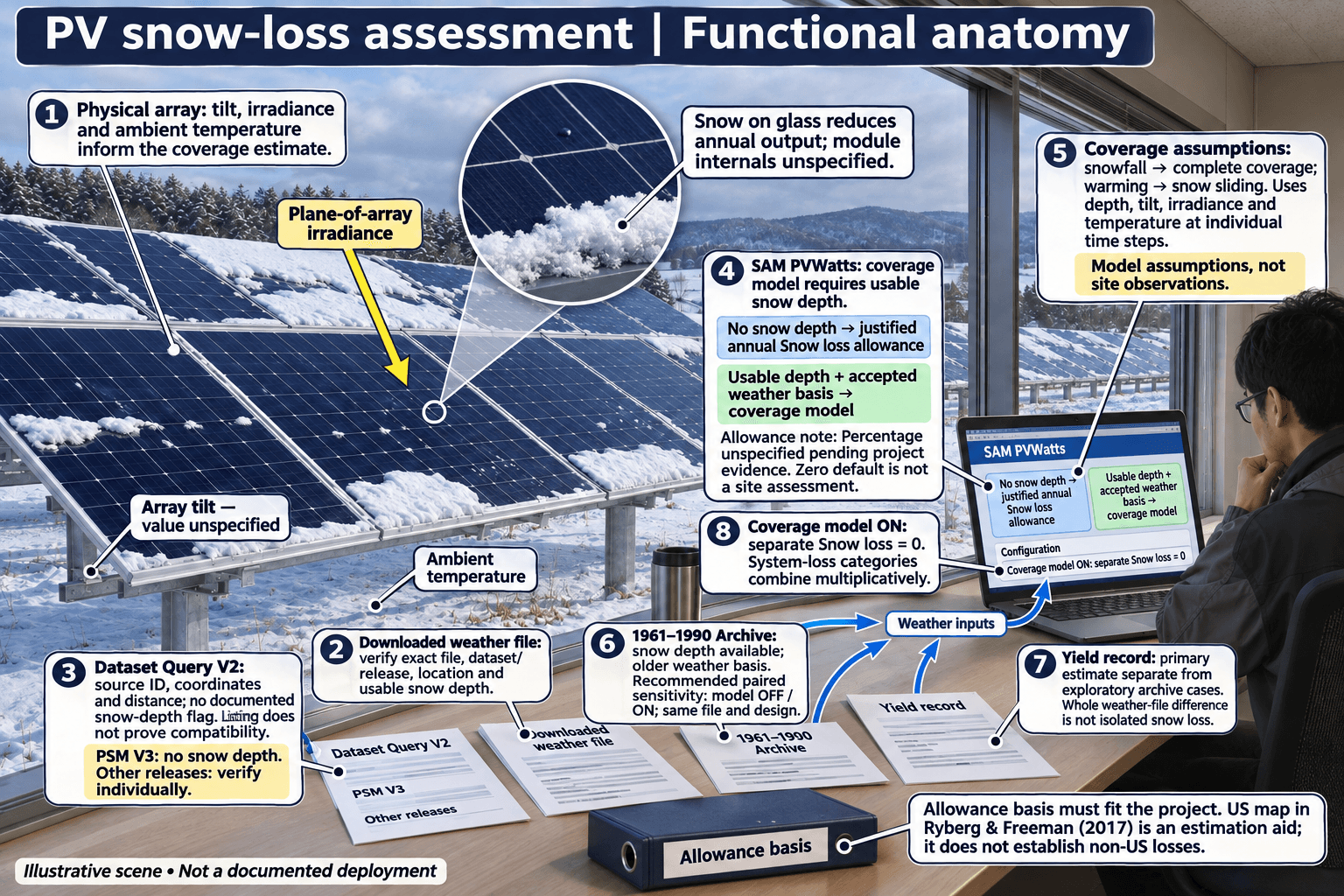
SAM’s PVWatts System Design help states that its snow coverage model requires a weather file containing snow-depth data. It specifically identifies NSRDB PSM V3 as lacking snow depth and the NSRDB 1961–1990 Archive as containing it. The help also cautions that the older archive does not represent the best up-to-date NSRDB data, although it may be useful for testing the snow model. SAM PVWatts System Design
Keep that statement within its documented scope. It does not establish whether every newer NSRDB dataset contains snow depth. Solar Dataset Query V2 lists several dataset generations and returns weather-source identifiers, coordinates and distance, but its documented response fields do not include a snow-depth availability flag. A dataset appearing in the query therefore does not establish that it supports the snow model. Solar Dataset Query V2
Ask the yield analyst to identify the exact downloaded file, its dataset and release, location, and whether its snow-depth field contains usable data. Recommend retaining this record with the yield report so competing proposals can be assessed against a clear weather-data basis.
2. Use an annual allowance when the selected file lacks snow depth
SAM describes the Snow loss input as a reduction in annual output caused by snow covering the array. Its default is zero, assuming either no snow on the array or that the array is kept clear. A zero default consequently does not establish that snow losses are negligible at a snow-exposed site. SAM PVWatts System Design
For a primary estimate using a weather file without snow depth, the recommended route is to retain that file and apply a separately justified annual snow-loss allowance. Request the basis for the selected percentage and an explanation of its relevance to the project. Neither documentation page establishes a suitable percentage for an individual site; the value remains unknown until supporting evidence is assessed.
The SAM help points to annual average snow-loss values on a United States map in Ryberg and Freeman’s 2017 report as a possible estimation aid when snow depth is unavailable. That reference does not establish an allowance for a project in another country. For a non-US procurement, request a locally applicable basis rather than transferring a US map value without justification. SAM PVWatts System Design
3. Use the older archive to examine model sensitivity
SAM’s coverage model estimates losses during individual time steps. It uses snow depth and estimates array coverage using tilt, plane-of-array irradiance and ambient temperature. It assumes complete coverage when the snow-depth data indicate snowfall, with snow sliding off as ambient temperature increases. These are model assumptions to review, rather than observations of the proposed installation. SAM PVWatts System Design
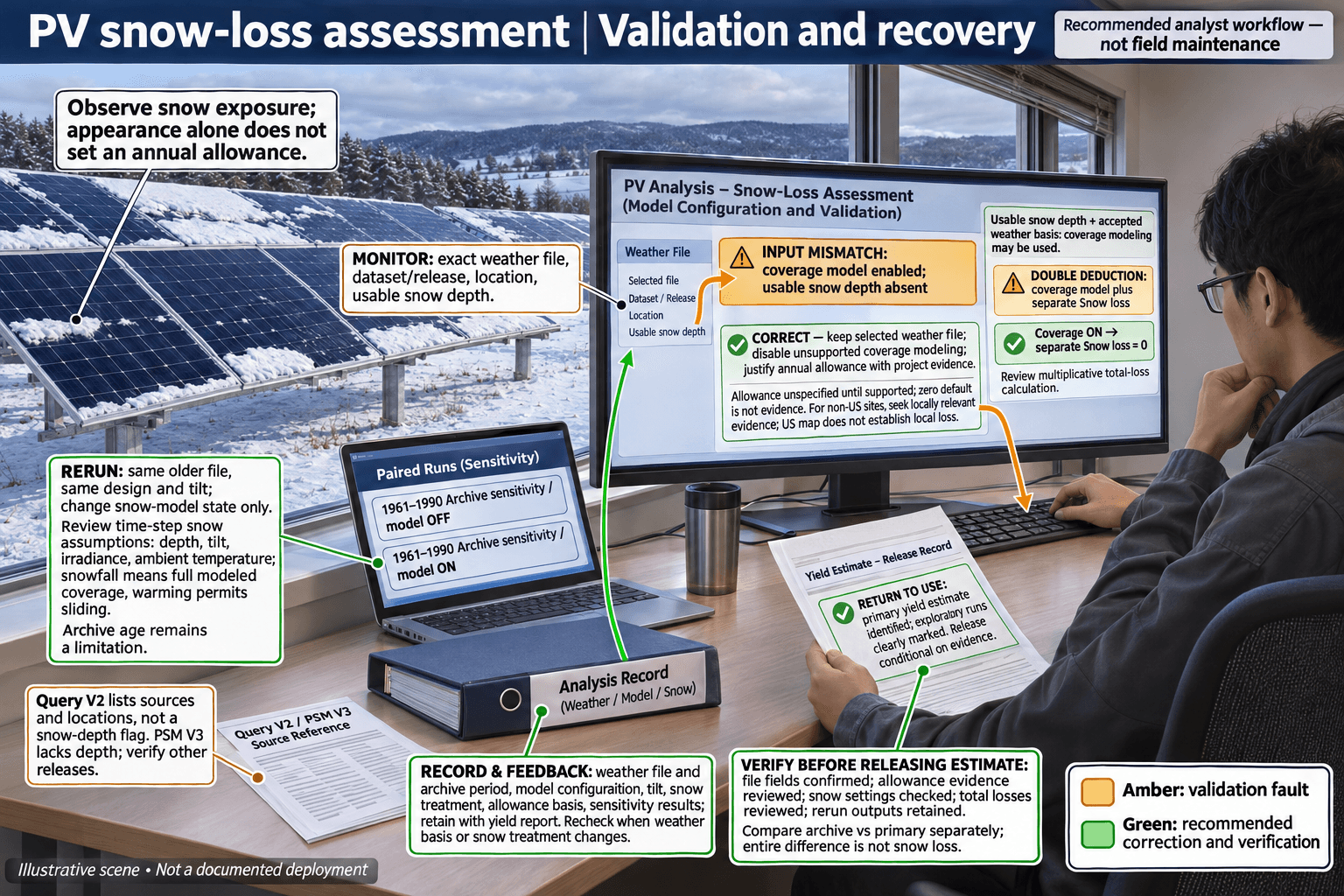
Where the available snow-depth file is older, recommend reporting it as a separate sensitivity case. Run that file with the snow model disabled and enabled, keeping other design assumptions unchanged. Compare those results to examine the modelled snow effect within that weather basis.
Then compare the older-file case with the primary estimate separately. Changing both the weather file and snow treatment does not isolate the snow effect, so do not present the entire yield difference as snow loss. Label the archive period and explain why the analyst considers the file useful. Greater modelling detail alone does not resolve the archive’s age limitation.
4. Require a reproducible snow-loss decision
Recommend requesting a short calculation record containing the selected weather file, model configuration, array tilt, snow treatment, allowance evidence and sensitivity results. Require the analyst to identify which estimate supports the procurement decision and which runs are exploratory.
Avoid duplicate deductions. SAM advises setting the Snow loss category to zero when using its snow model. It also combines system-loss categories multiplicatively, rather than simply adding their percentages. Ask the analyst to show the snow settings and total-loss calculation before accepting the reported yield. SAM PVWatts System Design
The decision is therefore conditional: use a justified allowance when the primary weather file lacks snow depth; use coverage modelling when its required input is available and its weather basis is accepted. Keep an older-archive model run visible as sensitivity evidence until its role in the project estimate is justified.
FAQ
Which method should support the primary yield estimate?
If its selected weather file lacks snow depth, use a justified annual snow-loss allowance. Treat this as a recommended approach and document the percentage’s project relevance.
Can SAM run its snow coverage model without snow depth?
SAM’s PVWatts System Design help specifies snow-depth data in the weather file as a requirement.
Does newer NSRDB data necessarily lack snow depth?
The SAM help specifically identifies PSM V3 as lacking snow depth. Verify the actual fields in other dataset releases.
Does Dataset Query V2 confirm snow-model compatibility?
No. Its documented response identifies weather files and their locations, but includes no snow-depth availability flag.
Should the older snow-depth archive be discarded?
Not automatically. SAM identifies it as potentially useful for snow-model testing. Recommend a separate sensitivity case with its age clearly stated.
What annual snow-loss percentage should the buyer accept?
No site-specific percentage is established here. Request the analyst’s supporting evidence and justification for the project.
Can US snow-loss map values be used internationally?
The US map referenced in SAM’s help does not establish losses elsewhere. Request a locally applicable basis before accepting an international allowance.
How should duplicate snow losses be prevented?
When enabling the coverage model, set the separate Snow loss category to zero and review the remaining loss settings.
About the Author

Cinn Song
Founder & Chief Solutions Architect
Cinn Song founded SOLARTODO LIMITED and leads its smart-city infrastructure engineering — from solar, storage and integrated smart poles to the company's push into physical-AI city edge nodes: pole-mounted edge computing, vertical LLMs for smart cities, drone-based O&M with autonomous battery swapping, robotic maintenance, and high-speed counter-UAS interception. Since 2010, he has directed turnkey EPC + BOT delivery across 50+ countries, including telecom monopole supply for national grid operators, off-grid solar street-lighting for African municipalities, and integrated smart-pole programs for Gulf smart cities.
Cite This Article
Cinn Song. (2026). PV Snow Loss: Weather-File Checks and Method Selection. SOLARTODO. Retrieved from https://solartodo.com/knowledge/for-a-snow-exposed-pv-site-should-the-yield-estimate-use-a-snow-depth-driven-coverage-model-or-an-annual-snow-loss
@article{solartodo_for_a_snow_exposed_pv_site_should_the_yield_estimate_use_a_snow_depth_driven_coverage_model_or_an_annual_snow_loss,
  title = {PV Snow Loss: Weather-File Checks and Method Selection},
  author = {Cinn Song},
  journal = {SOLARTODO Knowledge Base},
  year = {2026},
  url = {https://solartodo.com/knowledge/for-a-snow-exposed-pv-site-should-the-yield-estimate-use-a-snow-depth-driven-coverage-model-or-an-annual-snow-loss},
  note = {Accessed: 2026-11-03}
}
Published: November 3, 2026 | Available at: https://solartodo.com/knowledge/for-a-snow-exposed-pv-site-should-the-yield-estimate-use-a-snow-depth-driven-coverage-model-or-an-annual-snow-loss
Subscribe to Our Newsletter
Get the latest solar energy news and insights delivered to your inbox.
View All Articles