Mixed-Duty Battery Bids | SAM Cycle-Life and Dispatch Inputs

Cinn Song
Founder & Chief Solutions Architect
TL;DR
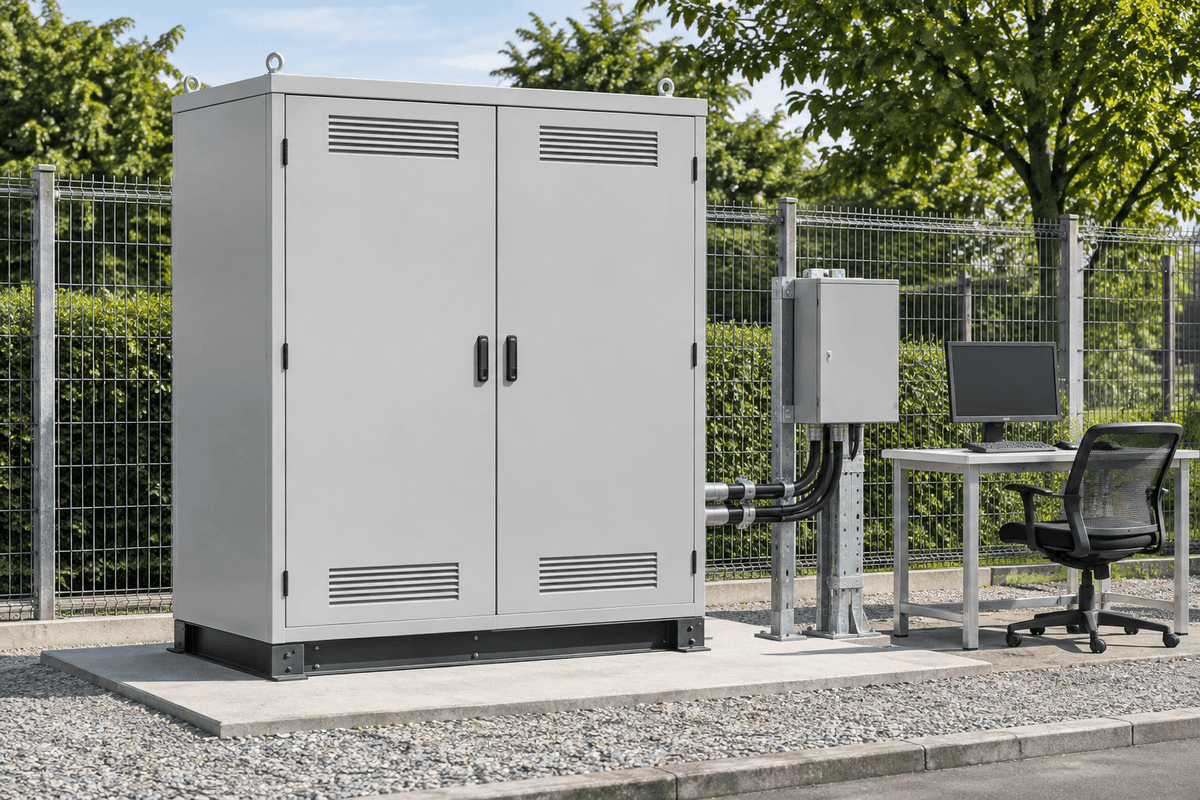
Yes. Require cycle-life curves at multiple discharge depths for SAM’s customizable degradation model. Use common power targets at a matching time step, then compare modeled retention under disclosed calendar-aging and replacement assumptions.
Require multi-depth cycle-life data for mixed-duty standalone battery bids using SAM’s Cycle and Calendar Degradation option. Run the same custom power targets at a matching simulation interval and compare retention under disclosed calendar-aging and replacement assumptions.
Summary
Require multi-depth cycle-life data for mixed-duty standalone battery bids using SAM’s Cycle and Calendar Degradation option. Run the same custom power targets at a matching simulation interval and compare retention under disclosed calendar-aging and replacement assumptions.
Key Takeaways
- Request retained-capacity data versus cycle count at distinct discharge depths spanning the expected duty of the quoted battery.
- SAM’s customizable cycle degradation table requires at least three rows. Multiple depths allow the model to consider average depth as well as cycle count.
- A single-depth table makes SAM’s cycle-fade calculation depend on cycle count using rainflow counting.
- Issue the same power-target file to bidders and require its interval to match the standalone SAM simulation step.
- Request the overall, cycling and calendar relative-capacity outputs alongside the model version and assumptions.
- Compare retention at common review points and document the replacement policy used in each run.
Require multi-depth cycle-life data for mixed-duty battery bids
Yes. If a standalone battery will alternate between shallow and deep discharges, ask bidders using SAM’s Cycle and Calendar Degradation option for cycle-life data at multiple depths of discharge (DoD) for the quoted battery. Give every bidder the same time series of power targets and require its interval to match the simulation time step. With a multi-depth table, SAM uses both average DoD and cycle count to estimate available capacity. This gives the buyer a basis for comparing modeled capacity retention under the intended duty. SAM Help — Battery Life · SAM Help — Battery Time Step
1. Request capacity-retention curves across the expected discharge depths
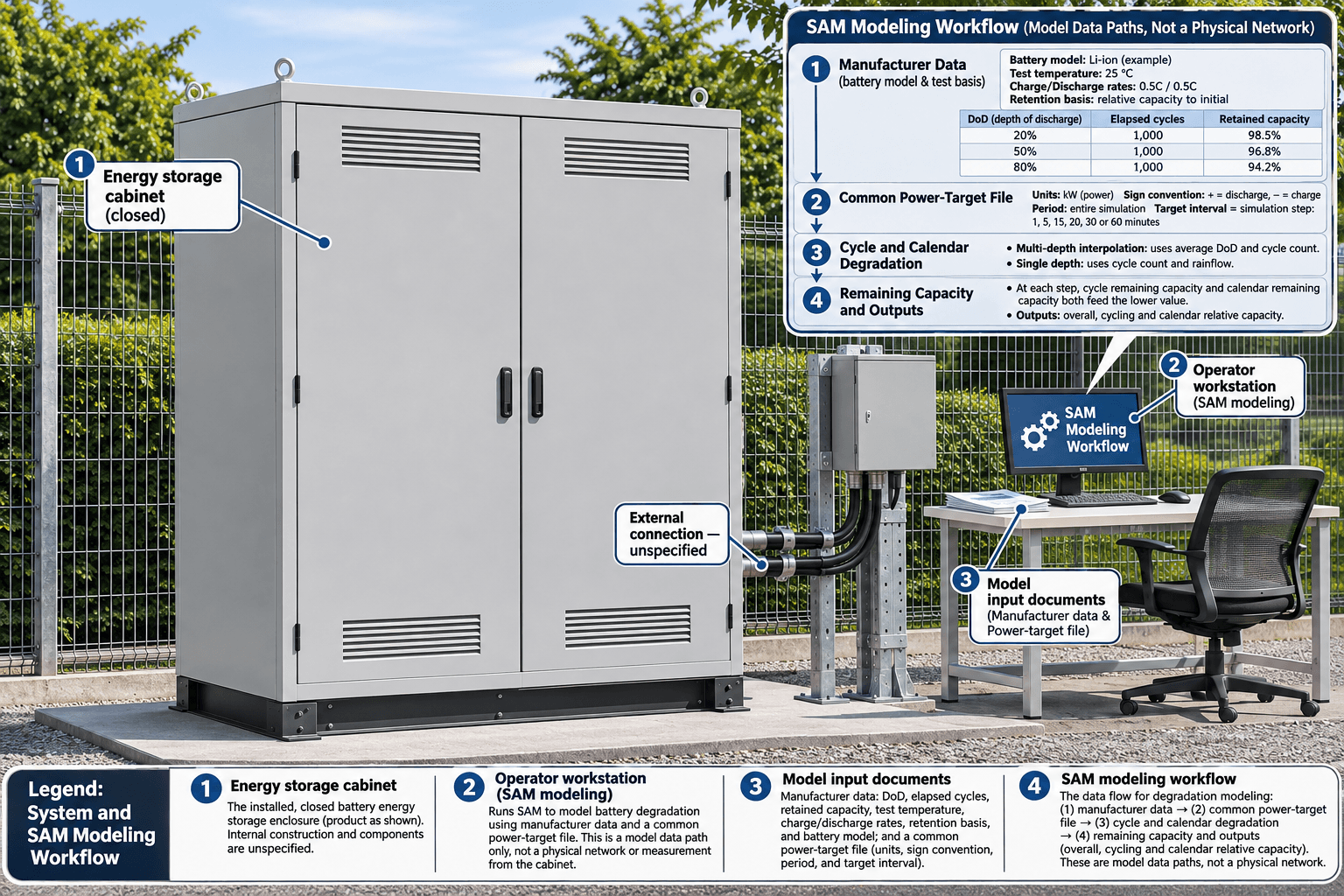
Ask each bidder for a table showing DoD, elapsed cycles and retained capacity. Request data that span the expected shallow and deep discharges, along with the underlying datasheet or test record. Have the bidder identify the battery model represented by the data and state the test temperature, charge and discharge rates, and the basis for the retained-capacity percentage. SAM requires at least three rows for a custom cycle degradation table. For this procurement, specify multiple distinct DoD values as well. SAM Help — Battery Life
SAM uses bilinear interpolation when the table contains multiple DoD values, considering both average DoD and cycle count. For a table containing a single DoD value, the help describes a capacity-fade calculation based only on cycle count using rainflow counting. If a bidder submits a single-depth curve, ask for a run with data covering the expected DoD range or record the depth-dependent estimate as unknown. Ask bidders using chemistry defaults to identify those inputs and explain how they relate to the quoted battery. SAM Help — Battery Life
2. Run the bids on the same power-target time series
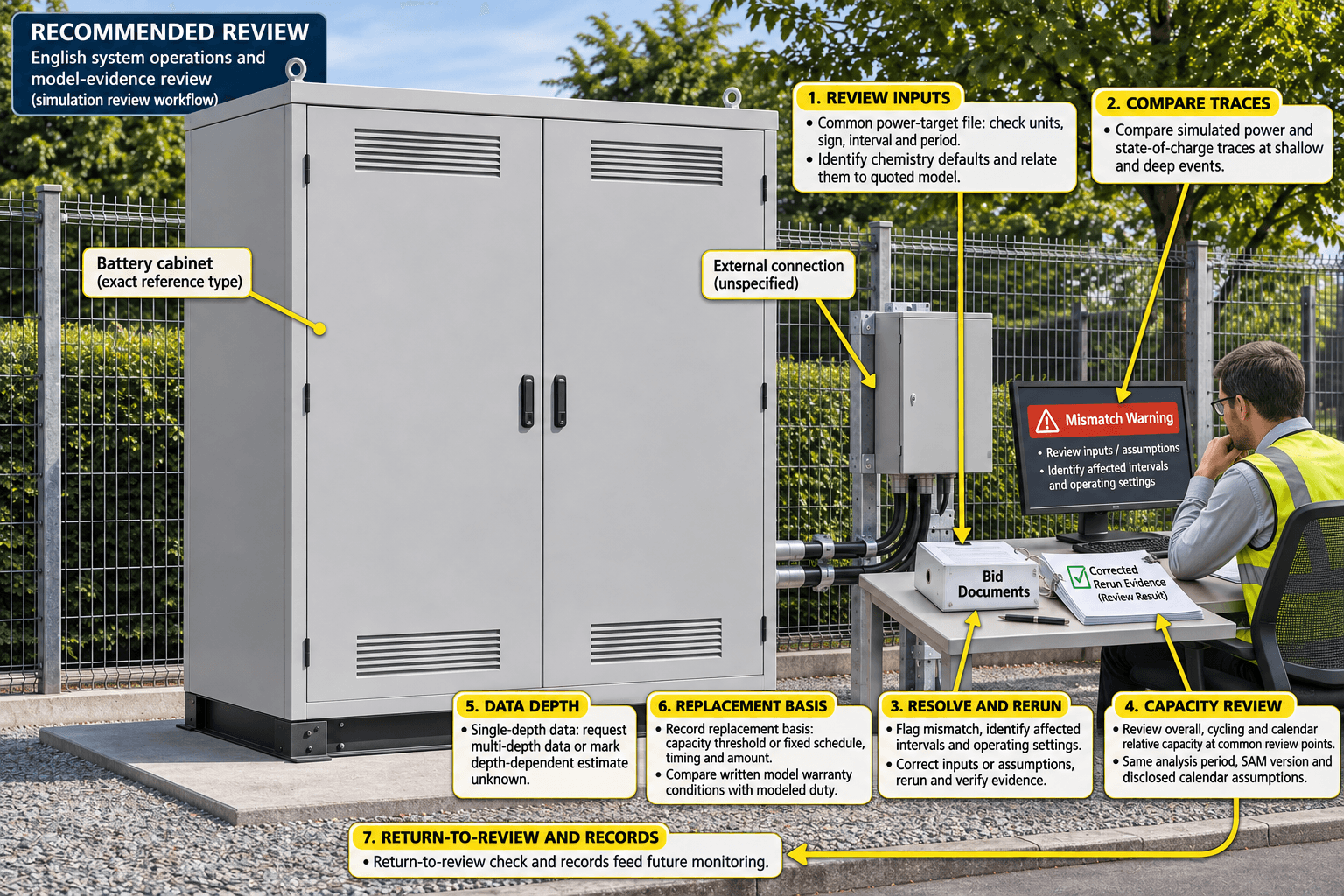
Issue a common target file that preserves the intended sequence of shallow and deep operation. Specify the target units, sign convention, time interval and period covered so bidders can reproduce the run. SAM requires the target interval to match the standalone simulation time step for front-of-meter custom time-series dispatch and behind-the-meter battery power targets. The documented standalone steps are 1, 5, 15, 20, 30 and 60 minutes. SAM Help — Battery Time Step
Ask for the input file and simulated battery power and state-of-charge traces. Review those traces around the intended shallow and deep events. This is a practical check that the simulation reflects the duty the buyer intends to evaluate. If the modeled response differs from the requested dispatch, ask the bidder to identify the affected intervals and explain the operating settings used. SAM Help — Battery Time Step
3. Compare retention on a common basis
Ask bidders to record their SAM version, battery life option and calendar-aging assumptions. Cycle degradation reflects charge and discharge cycling. Calendar degradation reflects aging over time and, depending on the model, may also depend on temperature and state of charge. In the customizable Cycle and Calendar Degradation option, SAM uses the lower of the cycle-based and calendar-based remaining capacities at each time step. Request the overall, cycling and calendar relative-capacity outputs to see which estimate governs at the buyer’s review points. SAM Help — Battery Life
Use the same analysis period and reporting points across bids. If replacement timing matters, specify the basis for the comparison. SAM can trigger replacement at a stated percentage of nominal capacity or apply a fixed schedule. Ask bidders to show when modeled replacements occur and how much capacity they replace under a fixed schedule, so the buyer can interpret the retention curve alongside the replacement plan. SAM’s Battery Life help describes the model behavior. To assess a quoted retention commitment, request the model-specific warranty and check its operating conditions against the modeled duty. SAM Help — Battery Life
FAQ
What should bidders include in the cycle-life table?
Ask for depth of discharge, elapsed cycles and retained capacity, plus the test conditions and the battery model represented.
Do three rows at one discharge depth support depth-dependent modeling?
Three rows meet the minimum row count. SAM’s multi-depth interpolation also requires more than one distinct DoD value. SAM Help — Battery Life
How does SAM use multiple discharge depths?
In the customizable cycle degradation table, SAM uses bilinear interpolation with average DoD and cycle count to estimate available capacity. SAM Help — Battery Life
How should bidders handle chemistry defaults?
Ask them to identify any defaults used and request a run with manufacturer data when better data are available for the quoted battery. SAM Help — Battery Life
Which time steps does SAM allow for standalone batteries?
The documented steps are 1, 5, 15, 20, 30 and 60 minutes. Use the same interval for the applicable custom dispatch or power-target series. SAM Help — Battery Time Step
How can buyers check whether the modeled duty includes shallow and deep events?
Ask bidders to provide battery power and state-of-charge traces and review the intervals where shallow and deep events are expected.
Which outputs show what drives retained capacity?
Request SAM’s relative capacity to nameplate outputs for the battery overall, calendar aging and cycling. SAM Help — Battery Life
What should buyers verify before relying on a retention commitment?
Check the quoted model’s written warranty for its capacity threshold and operating conditions, and compare them with the assumptions used in the bid simulation.
Procurement paths
About the Author

Cinn Song
Founder & Chief Solutions Architect
Cinn Song founded SOLARTODO LIMITED and leads its smart-city infrastructure engineering — from solar, storage and integrated smart poles to the company's push into physical-AI city edge nodes: pole-mounted edge computing, vertical LLMs for smart cities, drone-based O&M with autonomous battery swapping, robotic maintenance, and high-speed counter-UAS interception. Since 2010, he has directed turnkey EPC + BOT delivery across 50+ countries, including telecom monopole supply for national grid operators, off-grid solar street-lighting for African municipalities, and integrated smart-pole programs for Gulf smart cities.
Cite This Article
Cinn Song. (2026). Mixed-Duty Battery Bids | SAM Cycle-Life and Dispatch Inputs. SOLARTODO. Retrieved from https://solartodo.com/knowledge/for-a-standalone-battery-expected-to-alternate-between-shallow-and-deep-discharge-cycles-should-bidders-use-cycle-life
@article{solartodo_for_a_standalone_battery_expected_to_alternate_between_shallow_and_deep_discharge_cycles_should_bidders_use_cycle_life,
  title = {Mixed-Duty Battery Bids | SAM Cycle-Life and Dispatch Inputs},
  author = {Cinn Song},
  journal = {SOLARTODO Knowledge Base},
  year = {2026},
  url = {https://solartodo.com/knowledge/for-a-standalone-battery-expected-to-alternate-between-shallow-and-deep-discharge-cycles-should-bidders-use-cycle-life},
  note = {Accessed: 2026-11-23}
}
Published: November 23, 2026 | Available at: https://solartodo.com/knowledge/for-a-standalone-battery-expected-to-alternate-between-shallow-and-deep-discharge-cycles-should-bidders-use-cycle-life
Subscribe to Our Newsletter
Get the latest solar energy news and insights delivered to your inbox.
View All Articles