Roadway Dimming Acceptance at the Programmed Minimum

Cinn Song
Founder & Chief Solutions Architect
TL;DR
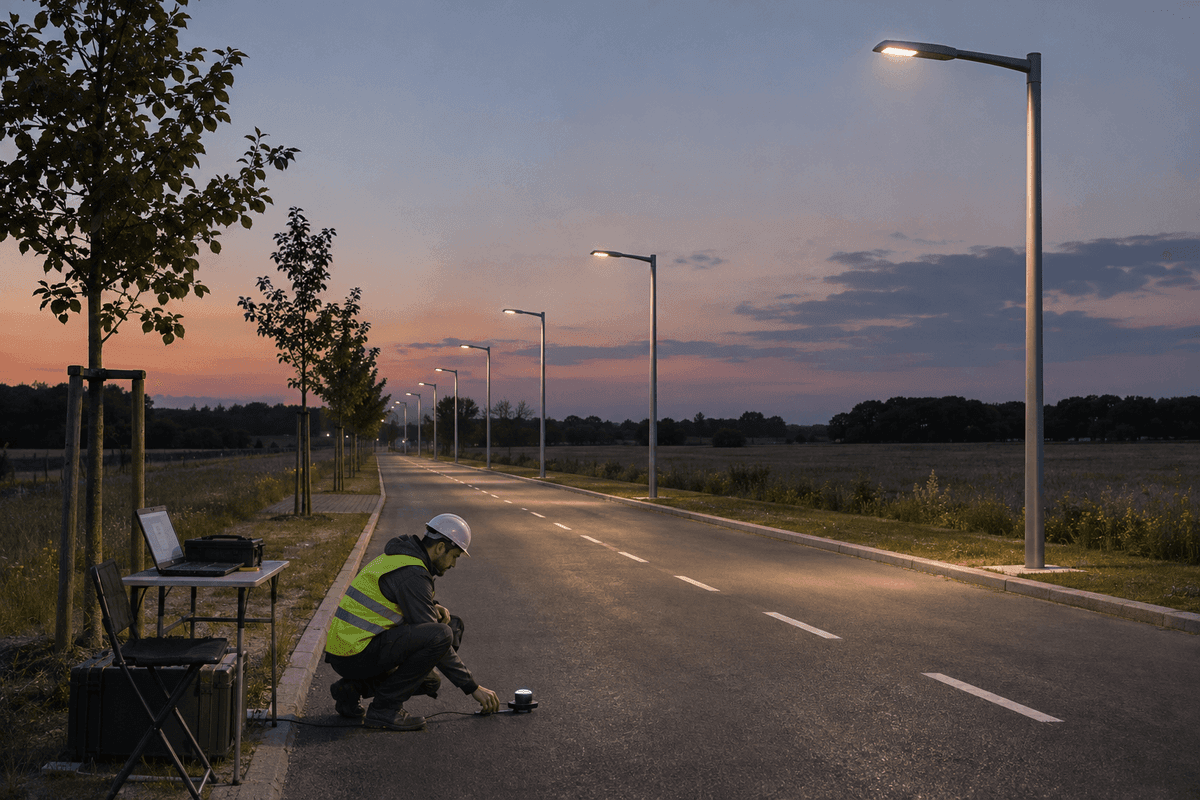
Yes. Specify the lowest programmed operating level, test grid, and project illumination and uniformity limits. Measure the installed roadway with that level active and accept it only if the results meet the agreed criteria.
Require field photometry at the lowest programmed level used in normal roadway operation. Before tendering, identify the applicable illumination and uniformity limits, control profile, measurement grid, and field procedure. Accept the setting based on readings taken while that state is active.
Summary
Require field photometry at the lowest programmed level used in normal roadway operation. Before tendering, identify the applicable illumination and uniformity limits, control profile, measurement grid, and field procedure. Accept the setting based on readings taken while that state is active.
Key Takeaways
- Make minimum-level field photometry an explicit roadway commissioning deliverable.
- Identify the lowest programmed state for each road segment or control group within the test scope.
- Have the lighting engineer specify the governing metrics, uniformity calculation, pass limits, and measurement method.
- Verify the programmed state during the survey and retain the readings for each measurement point.
- Assign control verification, field measurements, and acceptance sign-off to named parties.
- Require correction and retesting where results miss the agreed limits, and record any revised setpoint at handover.
Should buyers require field photometry at the lowest roadway dimming setting?
Yes. If the lowest programmed light level is intended for normal roadway operation, require field photometry at that setting as a condition of acceptance. Have the roadway authority or its designated lighting engineer identify the applicable criteria. Then specify the control setting, test locations, measurement method, and pass limits in the tender. Use readings from the installed roadway to evaluate the required illumination and uniformity metrics at that setting.
1. Specify the operating state and pass criteria
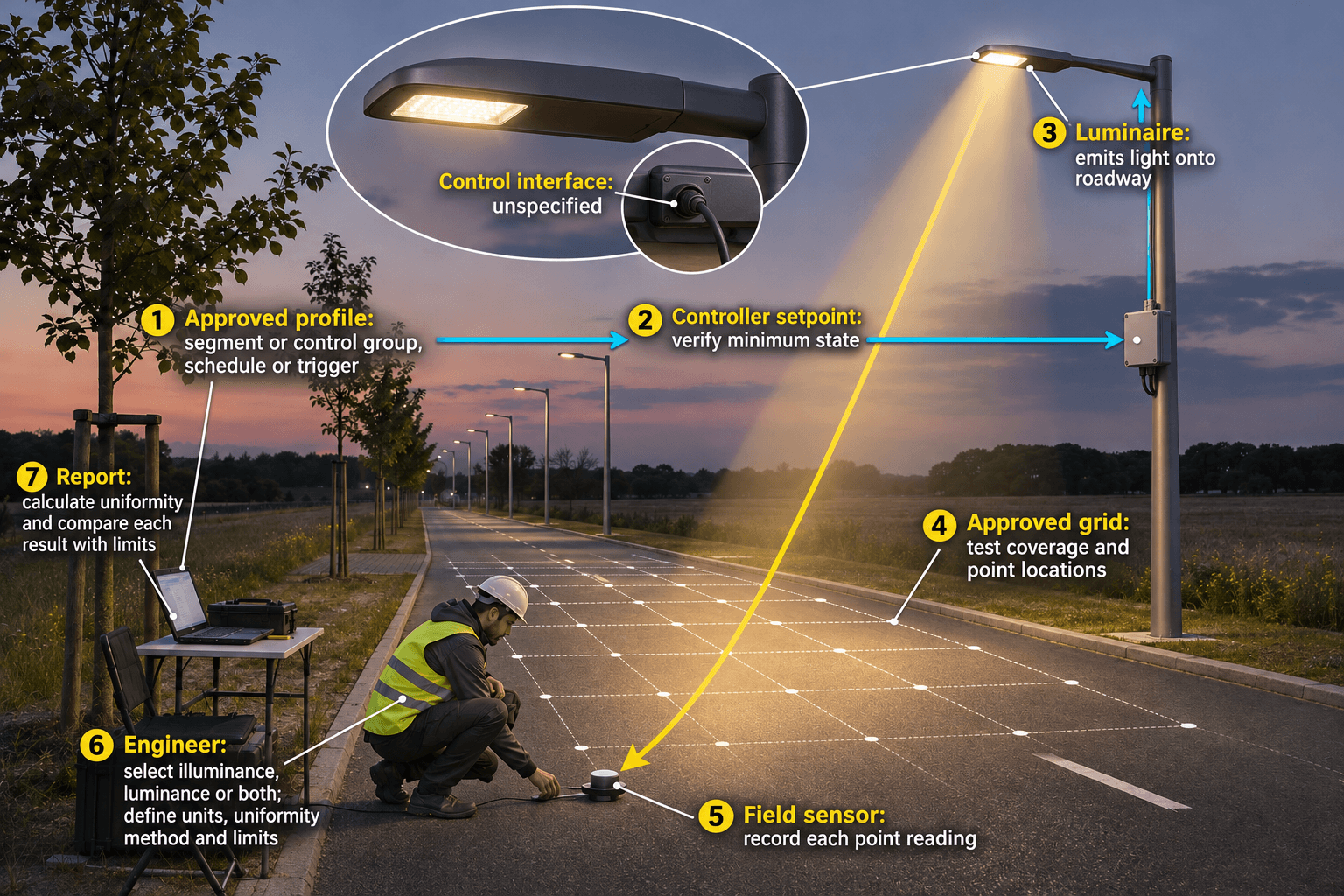
Define the minimum setting by road segment or control group, including the schedule or trigger that calls for it. If the project uses different profiles, identify which minimum applies in each area and where the contractor must test. Specify the operating state in terms the commissioning team can reproduce, such as the approved profile and its controller setpoint.
Ask the lighting engineer to name the governing project criteria and list the quantities to measure, their units, how uniformity will be calculated, and the limits that apply in the dimmed state. Confirm whether the acceptance basis calls for illuminance, luminance, or both. Have the engineer approve the measurement grid and test coverage before bids are evaluated, so bidders can price the same work.
2. Measure the installed roadway while the minimum is active
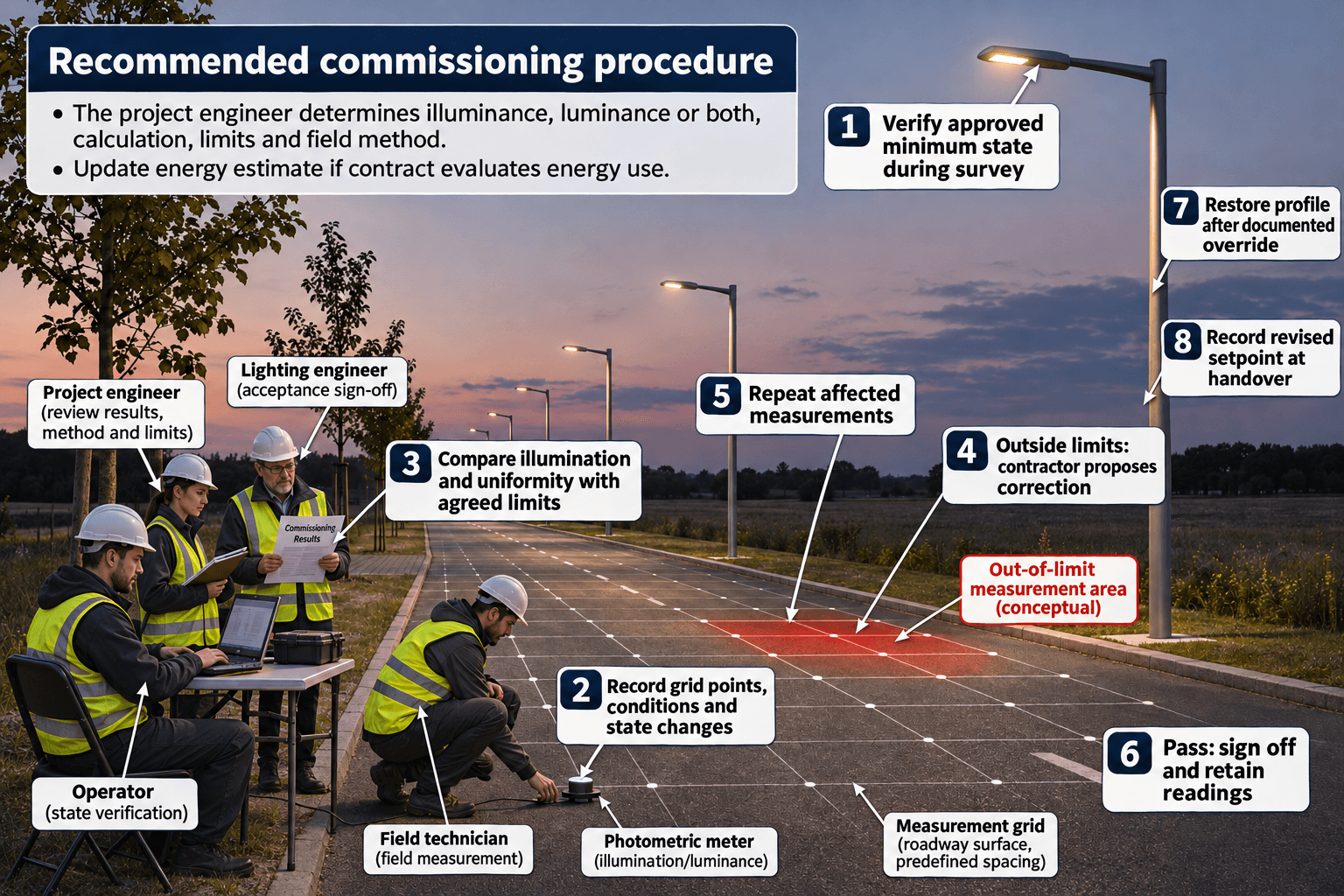
Require the commissioning team to bring the relevant luminaires into the specified minimum state and verify that state during the measurement period. If the team uses a temporary override, require it to document how the override reproduces the approved setting and restore the operating profile afterward. Ask for a record of any state changes during the test, along with measured values at each grid point and the conditions required by the agreed procedure. Have the report show how the point readings were used to calculate uniformity and how each result compares with its acceptance limit.
The U.S. Federal Energy Management Program identifies IES LM-50-13 as a method for photometric measurement of roadway and street lighting installations. It defines luminaire efficacy separately as light output per unit of electrical input. For the tender, have the lighting engineer confirm the field measurement procedure and edition applicable to the project. Use the field readings for the roadway acceptance decision and luminaire efficacy data for the equipment efficiency review. FEMP, Purchasing Energy-Efficient Exterior Lighting, June 2023 acquisition guidance
3. Assign responsibility for commissioning and retesting
DOE’s Model Specification for Networked Outdoor Lighting Control Systems, V2.0, separates start-up and commissioning and supports independent bids for the central management system, backhaul network, and field devices. When those packages are procured separately, name who will command and verify the dimming state, who will take the measurements, and who will sign off on the results. Check the commissioning clauses in V2.0 against the draft tender and state the minimum-level field test explicitly in the project acceptance schedule. DOE, Model Specification for Networked Outdoor Lighting Control Systems, V2.0
If a measured result falls outside the agreed limits, require the contractor to propose a correction and repeat the affected measurements before acceptance. If the correction changes the minimum setpoint, record the revised value in the approved operating profile and handover documents. Where the contract also evaluates energy use, ask the bidder to update the estimate using the revised profile.
FAQ
Which dimming level should the buyer specify for the test?
Specify the lowest programmed light level intended for normal operation on each road segment or control group covered by the acceptance plan.
Can the commissioning team use a temporary override?
Allow it if the test plan explains how it reproduces the approved minimum state. Require the team to document the override and restore the operating profile afterward.
Should the test measure illuminance or luminance?
Ask the roadway authority or its lighting engineer to identify which quantities the project requires and include the corresponding uniformity criteria.
Can full-output measurements close the minimum-level acceptance item?
Keep that item open until the required readings have been taken at the specified minimum level and compared with the applicable limits.
What should the field report include?
Require the test locations, verified dimming state, measurement conditions, point readings, uniformity calculation, and result against each limit.
Is IES LM-50-13 the required method for every project?
FEMP cites IES LM-50-13 in its June 2023 U.S. federal exterior-lighting acquisition guidance. Have the project lighting engineer confirm the applicable field method and edition. FEMP exterior lighting guidance
Who should verify the dimming state if multiple vendors are involved?
Name a party in the contract to establish and verify the state during testing. Identify separately who measures the roadway and who approves the results.
What if the roadway fails at the programmed minimum?
Require a proposed correction and repeat the affected measurements. If the correction changes the setpoint, document the accepted value in the final operating profile.
About the Author

Cinn Song
Founder & Chief Solutions Architect
Cinn Song founded SOLARTODO LIMITED and leads its smart-city infrastructure engineering — from solar, storage and integrated smart poles to the company's push into physical-AI city edge nodes: pole-mounted edge computing, vertical LLMs for smart cities, drone-based O&M with autonomous battery swapping, robotic maintenance, and high-speed counter-UAS interception. Since 2010, he has directed turnkey EPC + BOT delivery across 50+ countries, including telecom monopole supply for national grid operators, off-grid solar street-lighting for African municipalities, and integrated smart-pole programs for Gulf smart cities.
Cite This Article
Cinn Song. (2026). Roadway Dimming Acceptance at the Programmed Minimum. SOLARTODO. Retrieved from https://solartodo.com/knowledge/for-an-adaptively-dimmed-roadway-should-the-buyer-require-field-photometry-at-the-lowest-programmed-light-level
@article{solartodo_for_an_adaptively_dimmed_roadway_should_the_buyer_require_field_photometry_at_the_lowest_programmed_light_level,
  title = {Roadway Dimming Acceptance at the Programmed Minimum},
  author = {Cinn Song},
  journal = {SOLARTODO Knowledge Base},
  year = {2026},
  url = {https://solartodo.com/knowledge/for-an-adaptively-dimmed-roadway-should-the-buyer-require-field-photometry-at-the-lowest-programmed-light-level},
  note = {Accessed: 2026-11-25}
}
Published: November 25, 2026 | Available at: https://solartodo.com/knowledge/for-an-adaptively-dimmed-roadway-should-the-buyer-require-field-photometry-at-the-lowest-programmed-light-level
Subscribe to Our Newsletter
Get the latest solar energy news and insights delivered to your inbox.
View All Articles