From Pilot to City-Wide Rollout: Scaling Smart Streetlight…

Cinn Song
Founder & Chief Solutions Architect
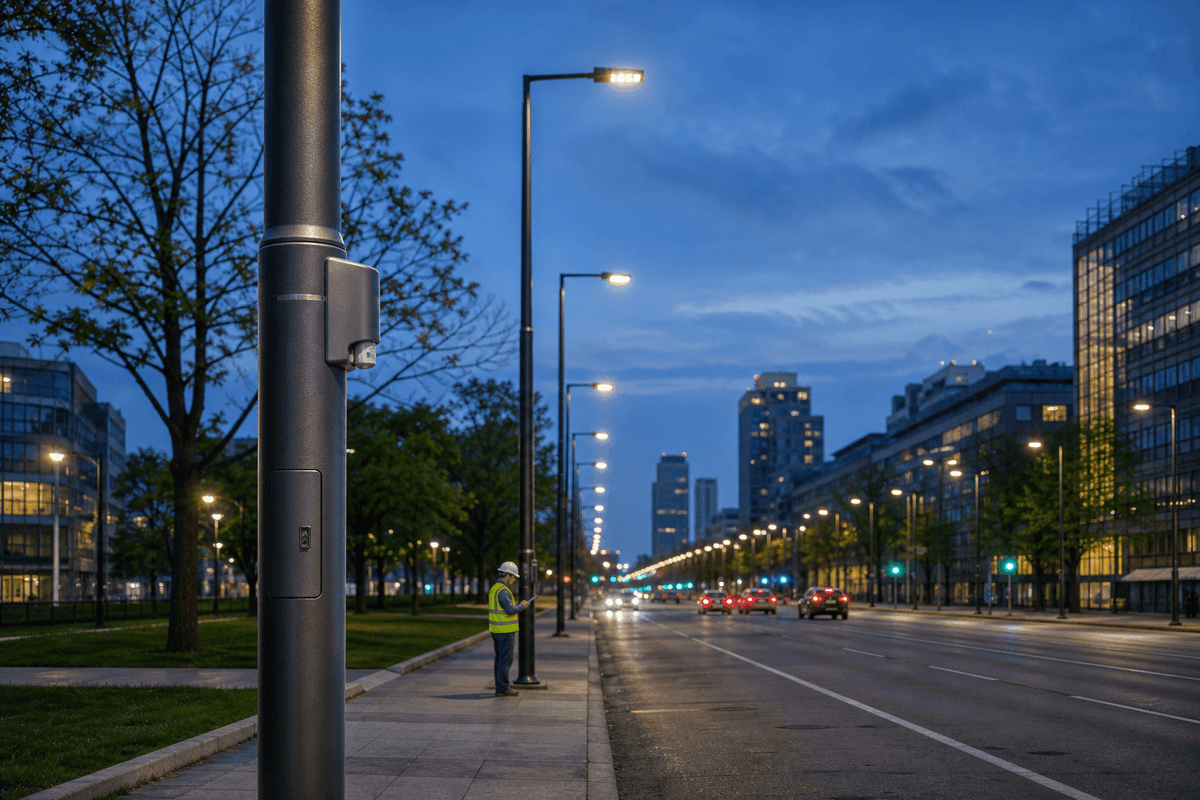
Watch the video
TL;DR
Cities should scale smart streetlights only after a 10-50 pole pilot proves 50%+ energy savings, 99% network uptime, maintainable installation workflows, and clear data governance. SOLARTODO supports phased B2B procurement from FOB Supply to EPC Turnkey, with 5%-15% volume discounts and financing review for projects above USD 1,000K.
Scaling smart streetlight programs moves cities from 10-50 pole pilots to 1,000+ asset rollouts using LED fixtures that cut energy use by 50%+, adaptive controls saving 36-55%, and phased EPC pricing from FOB supply to turnkey delivery.
Summary
Scaling smart streetlight programs moves cities from 10-50 pole pilots to 1,000+ asset rollouts using LED fixtures that cut energy use by 50%+, adaptive controls saving 36-55%, and phased EPC pricing from FOB supply to turnkey delivery.
Key Takeaways
- Define pilot success across 10-50 poles using illuminance, outage response, network uptime, and energy savings above 50% before expanding procurement.
- Standardize 1 pole architecture around 120W-150W LED lighting, IP66 protection, 4G/5G backhaul, and LoRaWAN sensor telemetry.
- Build the rollout in 3 phases: corridor pilot, district deployment of 250-1,000 poles, then city-wide asset integration above 5,000 poles.
- Require IEC 60598, IEC 62722, EN 13201, IEEE 802.11ax, and IEC 62676 alignment to reduce technical approval delays.
- Compare FOB Supply, CIF Delivered, and EPC Turnkey pricing, then apply 5%, 10%, or 15% volume discounts at 50, 100, or 250+ poles.
- Model ROI from 50%+ lighting energy reduction, 25%-40% lower civil works, and 36%-55% adaptive dimming savings over 6-10 years.
- Integrate smart-city data early by mapping every pole ID, GPS point, asset owner, SIM, gateway, camera zone, and maintenance SLA.
- Protect scale-up decisions with 99% network uptime targets, 7-90 day video retention rules, and role-based cybersecurity controls.
Pilot-to-City Rollout Strategy
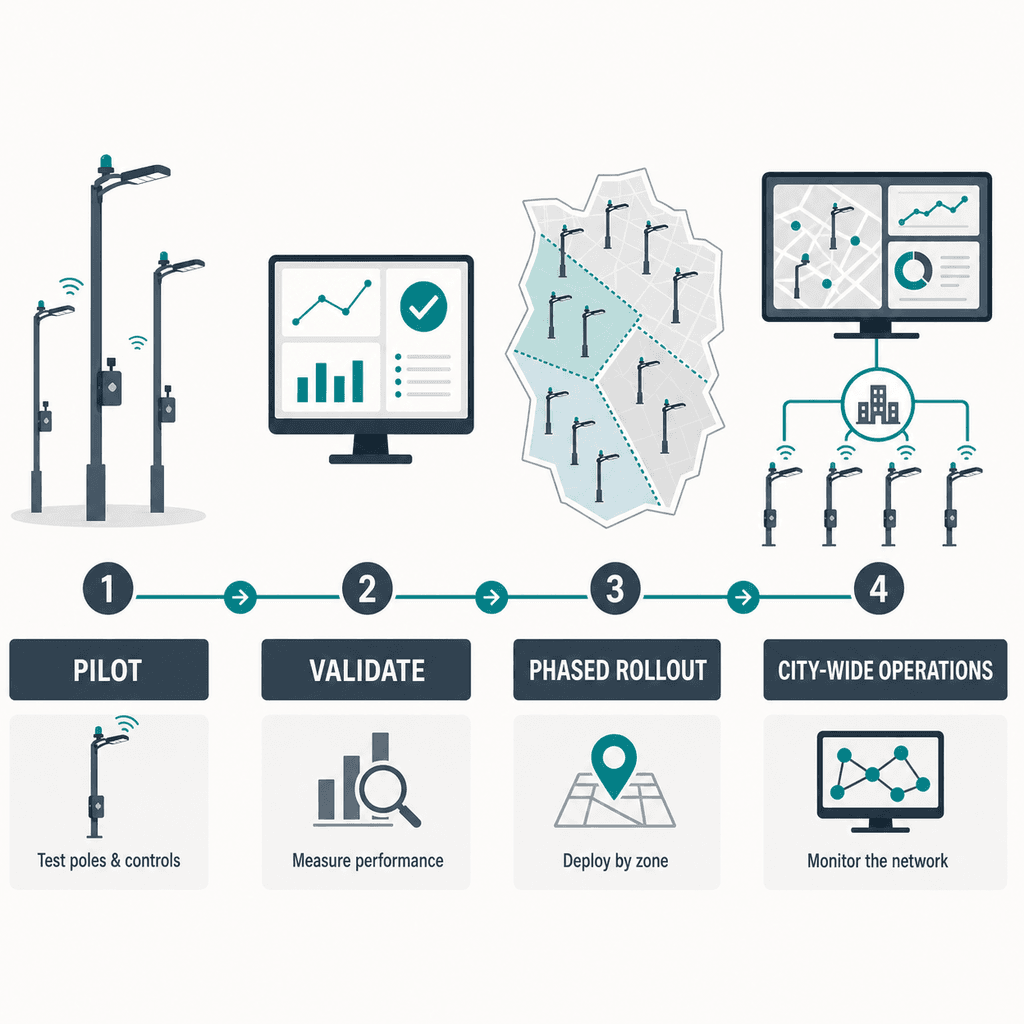
A smart streetlight pilot should prove 50%+ energy savings, 99% communications uptime, and maintainable pole economics before a city commits to 1,000+ assets.
Scaling smart streetlight programs is not mainly a lighting purchase; it is an infrastructure governance exercise. A small pilot can look successful when 10 poles are manually monitored by engineers, but city-wide deployment introduces utility tariffs, fiber or cellular capacity, camera governance, spare-part logistics, cybersecurity review, and public acceptance. The transition from pilot to rollout should therefore use measurable gates, not general satisfaction.
According to the Clean Energy Ministerial, public street and area lighting can account for up to 40% of municipal electricity consumption, while LED street lights can achieve up to 50% energy savings. According to the IEA (2026), lighting in buildings and outdoor applications represented around 8% of global electricity demand in 2024, equal to about 2,200 TWh. These figures explain why smart streetlight upgrades are often funded as energy-efficiency projects first and smart-city platforms second.
The International Energy Agency states, 'a second wave of deployment is now taking shape.' For cities, that second wave means moving beyond basic LED replacement toward networked assets with dimming, monitoring, AI video, environmental sensing, WiFi, public-address, and emergency functions. SOLARTODO positions smart streetlights as B2B infrastructure assets supplied through inquiry, offline quotation, and project financing rather than as online marketplace items.
A practical pilot should include 3 validation tracks. First, the electrical track measures kWh reduction, power factor, surge protection behavior, and driver temperature. Second, the digital track measures gateway stability, latency, camera stream quality, edge analytics accuracy, and dashboard alarms. Third, the civil track confirms foundation design, wind resistance, access-door ergonomics, corrosion protection, and maintenance time per pole.
Technical Architecture for Scalable Smart Streetlights
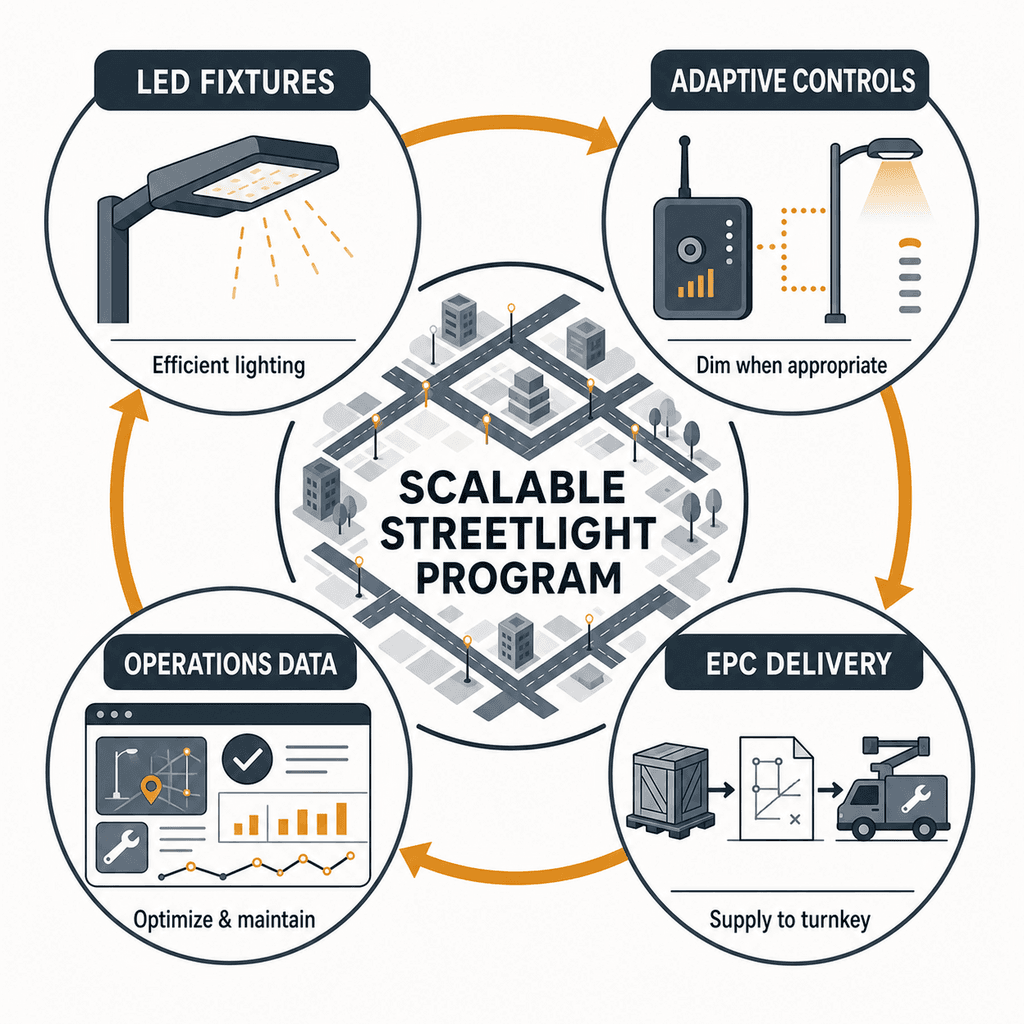
A scalable smart streetlight architecture combines 120W-150W LEDs, IP66 enclosures, 4G/5G backhaul, LoRaWAN sensors, and centralized asset management.
The most common failure in scale-up is allowing each pilot vendor to define a different pole, dashboard, protocol, and maintenance model. City-wide programs need a reference architecture that is strict enough for procurement and flexible enough for different roads, entrances, parks, campuses, and commercial districts. SOLARTODO can configure focused 4-in-1 community security poles or larger 5-in-1 smart city poles depending on the corridor and budget.
For a 10m integrated pole, core technical specifications typically include Q345B steel, hot-dip galvanization, IP66 access protection, 150 km/h wind-resistance design, and internal cable routing. Lighting modules commonly range from 120W to 150W at about 170 lm/W, producing approximately 20,400-25,500 lumens. At 10m mounting height and 35m spacing, a 1 km corridor may require about 29 poles, subject to road class, setback, arm length, and photometric simulation.
The lighting control layer should support scheduled dimming, adaptive dimming, outage alarms, energy metering, and lumen maintenance. According to the U.S. DOE-backed adaptive lighting report on OSTI (2025), dimming energy savings ranged from 55% initially to 36% at end of luminaire life. This matters because many city business cases depend on both LED conversion and intelligent controls, not LED efficacy alone.
The communications layer should separate critical operations from public services. Camera and emergency-call traffic should have priority over public WiFi. Environmental data can often use LoRaWAN uplinks at 1-minute or 5-minute intervals, while AI video may require 4G/5G, fiber, or hybrid backhaul. IEEE 802.11ax, commonly known as WiFi 6, is relevant where public or operational WiFi is included.
Core Deployment Data Model
Every pole should receive a digital asset record before installation. At minimum, the record should include pole ID, GPS coordinate, road segment, foundation type, luminaire wattage, driver serial number, camera serial number, SIM or gateway ID, firmware version, warranty start date, and maintenance owner. Without this data model, a 50-pole pilot can become a 5,000-pole maintenance problem.
Cybersecurity should be designed before the first city-wide tender. Recommended controls include role-based access, encrypted device connections, default password removal, firmware signing, network segmentation, audit logs, and camera retention policies. For face recognition or license-plate analytics, cities should define whether analytics are disabled, used for 1:1 verification, or used for 1:N matching under local privacy law.
EPC Investment Analysis and Pricing Structure
EPC rollout planning should compare FOB, CIF, and turnkey delivery while modeling 5%-15% volume discounts and 6-10 year payback.
EPC delivery means Engineering, Procurement, and Construction. For smart streetlights, engineering covers site survey, lighting calculation, pole structural review, foundation drawings, utility coordination, network design, and commissioning plans. Procurement covers poles, LED luminaires, cameras, sensors, gateways, cabinets, anchors, cables, and spares. Construction covers foundations, trenching or cable pulling, pole erection, electrical termination, testing, dashboard setup, and handover documentation.
SOLARTODO pricing depends on pole height, module count, sensor package, camera level, backhaul method, foundation scope, and installation country. As a planning baseline, a focused 10m community entrance 4-in-1 unit is typically USD 1,600-2,000 per pole, while a fully integrated 10m Smart City 5-in-1 Standard may range from USD 12,000-16,000 per unit on a supply-and-install basis. Final pricing requires offline quotation because freight, civil works, grid connection, and software scope vary by project.
| Pricing tier | What it includes | Best fit | Budget logic |
|---|---|---|---|
| FOB Supply | Factory supply, export packing, standard documents | EPCs with local installers | Lowest equipment price, buyer controls freight and installation |
| CIF Delivered | Equipment plus sea freight and insurance to destination port | Importers and government buyers | Better landed-cost visibility before customs and local transport |
| EPC Turnkey | Engineering, supply, installation, testing, commissioning, handover | Municipal and campus rollouts | Highest scope certainty with installation and performance accountability |
Volume pricing should be included in the procurement model. A 50+ pole order can target a 5% equipment discount, 100+ poles can target 10%, and 250+ poles can target 15%, assuming a standardized configuration and shipment schedule. For large projects above USD 1,000K, financing may be available subject to buyer credit, country risk, payment structure, and project documentation.
Payment terms are typically 30% T/T advance plus 70% against bill of lading, or 100% letter of credit at sight. These terms help balance factory production risk and buyer delivery assurance. Procurement managers should request a bill of materials, photometric files, foundation assumptions, warranty statement, software scope, and spare-parts list before approving the commercial comparison.
ROI should be modeled against the conventional alternative: separate lighting pole, CCTV pole, environmental sensor mast, WiFi access point, emergency speaker, and multiple cabinets. Integrated poles can reduce civil works and roadside device counts by roughly 25%-40% in focused deployments and 40%-60% in fully consolidated smart-city corridors. The San Diego Better Buildings case reported more than 50% streetlight energy-use reduction from lighting upgrades, controls, and rate design between 2010 and 2015.
For a city-wide program, the bottom-line ROI usually comes from 4 sources: electricity savings, lower night patrol or outage-response cost, fewer separate foundations and cabinets, and improved maintenance dispatch through remote monitoring. To request a project quotation or financing discussion, contact SOLARTODO at [email protected] or +6585559114.
Rollout Governance, Operations, and Risk Control
City-wide rollout requires staged procurement, public communication, cybersecurity rules, and maintenance SLAs before scaling beyond 250-1,000 poles.
A pilot can be managed by a project team; a city-wide system must be operated by an institution. Before the second phase starts, cities should decide who owns the pole, who owns the data, who pays the SIM card or network fee, who responds to lighting outages, who accesses camera footage, and who approves firmware updates. These questions become harder after thousands of connected devices are already installed.
The Clean Energy Ministerial states, 'street lighting is typically one of the largest sources of energy consumption under a municipality's direct control.' That makes the finance department a key stakeholder, not only the transport or public works department. Energy savings should be validated with baseline bills, sample metering, tariff assumptions, and a measurement-and-verification method before loan or performance-contract documents are finalized.
A recommended scale-up model uses 3 phases. Phase 1 covers 10-50 poles across different road types to validate technology. Phase 2 covers 250-1,000 poles in one district to validate installation speed, asset data, maintenance workflow, and user feedback. Phase 3 expands to 5,000+ poles with standardized contracts, inventory management, network monitoring, and quarterly performance reporting.
Procurement should avoid overloading every pole. A city may need 150W 5-in-1 poles on boulevards, 120W security poles at community gates, simpler LED-only smart nodes in residential streets, and solar-powered poles for off-grid parks or rural edges. The selection guide should map use case to module count instead of forcing one specification everywhere.
| Use case | Recommended configuration | Typical height | Key decision metric |
|---|---|---|---|
| Community entrance | 4-in-1 lighting, AI camera, emergency call, WiFi | 10m | Identity control and incident response |
| Urban boulevard | 5-in-1 lighting, 4K AI video, sensors, WiFi, PA | 10m | Multiservice consolidation per 35m spacing |
| Campus road | LED, CCTV, WiFi, environmental monitoring | 8m-10m | Maintenance simplicity and coverage |
| Smart district | 5-in-1 or 10-in-1 multifunction pole | 10m-12m | Data integration and public-service density |
| Off-grid perimeter | Solar streetlight with battery and camera option | 6m-10m | Autonomy days and battery sizing |
Maintenance planning should include 1%-3% spare luminaires, spare drivers, surge protectors, camera brackets, access-door locks, SIM inventory, and tested firmware rollback procedures. Service-level agreements should define outage acknowledgement within 24 hours, critical safety repairs within 48-72 hours, and monthly reporting on energy, uptime, faults, and repair closure.
Conclusion
Smart streetlight programs scale successfully when 10-50 pole pilots prove 50%+ savings, then standardize procurement before 1,000+ asset deployment.
The bottom line: SOLARTODO smart streetlight rollouts should move from pilot to city-wide deployment only after energy savings, network uptime, EPC pricing, privacy rules, and maintenance workflows are proven with measurable data. For projects above 250 poles or USD 1,000K, a standardized EPC model with financing review offers the clearest path to bankable scale.
FAQ
Smart streetlight FAQs should answer cost, installation, standards, ROI, maintenance, data, and warranty questions in 40-80 words each.
Q: How many poles should a smart streetlight pilot include? A: A practical pilot should include 10-50 poles across at least 2-3 road or site conditions. This size is large enough to test lighting performance, network coverage, installation time, and maintenance workflow, but small enough to correct specifications before purchasing 250, 1,000, or 5,000+ poles.
Q: What data proves that a pilot is ready for city-wide rollout? A: The pilot should show 50%+ lighting energy savings, 99% target communications uptime, acceptable camera and sensor performance, and a repeatable installation process. Cities should also verify asset records, fault alarms, cybersecurity settings, user feedback, and maintenance response times before approving district or city-wide procurement.
Q: What is included in EPC turnkey smart streetlight delivery? A: EPC turnkey delivery includes engineering design, equipment procurement, logistics, civil works, pole installation, electrical connection, network setup, commissioning, training, and handover documents. For smart streetlights, EPC scope should also define dashboard configuration, SIM or gateway responsibilities, warranty boundaries, and performance acceptance tests.
Q: How much does a SOLARTODO smart streetlight cost? A: A focused 10m community 4-in-1 security pole is typically USD 1,600-2,000 per pole, while a 10m Smart City 5-in-1 Standard may range from USD 12,000-16,000 on a supply-and-install basis. Final pricing depends on modules, freight, civil works, software, installation country, and project volume.
Q: What volume discounts apply to large smart streetlight orders? A: Planning guidance is 5% discount for 50+ poles, 10% for 100+ poles, and 15% for 250+ poles when specifications are standardized. Discounts depend on shipment timing, module mix, payment terms, steel cost, freight conditions, and whether the buyer selects FOB Supply, CIF Delivered, or EPC Turnkey delivery.
Q: Which standards matter for smart streetlight procurement? A: Key standards include IEC 60598 for luminaire safety, IEC 62722 for LED luminaire performance, EN 13201 for road lighting performance, IEC 62676 for video surveillance systems, and IEEE 802.11ax for WiFi 6 networks. Procurement teams should request certificates, test reports, photometric files, and local compliance documents.
Q: How long is the typical payback period for smart streetlights? A: Payback commonly falls in the 6-10 year range when LED conversion, adaptive controls, reduced maintenance, and consolidated civil works are included. Projects with high electricity tariffs, expensive outage response, or multiple integrated services can achieve stronger ROI than LED-only replacements.
Q: How should cities manage smart streetlight cybersecurity? A: Cities should require encrypted communications, role-based access, unique device credentials, firmware update controls, audit logs, and network segmentation. Camera and emergency-call systems should be separated from public WiFi traffic, while device access should be limited to approved operators and maintained under documented cybersecurity procedures.
Q: When should a city choose 4-in-1 instead of 5-in-1 smart poles? A: Choose 4-in-1 poles for focused sites such as community entrances, campuses, checkpoints, and private roads where lighting, camera, emergency call, and WiFi are enough. Choose 5-in-1 poles for city boulevards or districts that also need environmental monitoring, public-address coverage, and broader smart-city data integration.
Q: What maintenance is required after city-wide deployment? A: Maintenance should include monthly dashboard review, quarterly sample inspections, annual electrical checks, firmware management, and spare-part planning. Cities should keep 1%-3% spare critical components and define SLAs for fault acknowledgement, emergency safety repairs, standard repairs, and monthly performance reporting.
Q: Can financing support large smart streetlight rollouts? A: Financing may be available for large SOLARTODO projects above USD 1,000K, depending on buyer credit, country risk, contract structure, and project documentation. Buyers should prepare a pole schedule, energy baseline, budgetary quotation, implementation timeline, and payment preference such as 30% T/T plus 70% against B/L or 100% L/C at sight.
Q: How does SOLARTODO handle quotation and procurement? A: SOLARTODO is a B2B manufacturer and exporter, not an online marketplace, so procurement starts with an inquiry and continues through offline technical quotation. Buyers can request configuration support, FOB/CIF/EPC pricing, financing review for large projects, and commercial follow-up by contacting [email protected] or +6585559114.
References
Authoritative references for smart streetlight scale-up include 8 sources covering LED savings, lighting standards, surveillance, WiFi, and adaptive controls.
- IEA (2026): The next wave of LED lighting reports that lighting in buildings and outdoor applications used about 2,200 TWh in 2024, around 8% of global electricity demand. https://www.iea.org/commentaries/the-next-wave-of-led-lighting-smarter-circular-and-more-efficient
- Clean Energy Ministerial (2026): Street Lighting fact sheet states municipal public lighting can consume up to 40% of municipal electricity and LED street lights can save up to 50%. https://www.cleanenergyministerial.org/efficient_products/street-lighting/
- U.S. DOE / OSTI (2025): Adaptive lighting for streets and residential areas reports dimming-system energy savings from 55% initially to 36% at end of life. https://www.osti.gov/biblio/2569693
- U.S. DOE Better Buildings (2016): San Diego case study reports streetlight energy-use reduction of more than 50% from LED upgrades, adaptive controls, and rate design. https://betterbuildingssolutioncenter.energy.gov/implementation-models/san-diego-more-efficient-street-lighting-smart-technologies-and-utility
- IEC 60598-1 (2024): Luminaires general requirements and tests for electrical, thermal, mechanical, and photobiological safety of lighting equipment.
- IEC 62722-2-1 (2023): LED luminaire performance requirements covering rated input power, luminous flux, efficacy, color, and life-related performance claims.
- IEC 62676-1-1 (2022): Video surveillance systems for use in security applications, defining system requirements for camera-based security infrastructure.
- IEEE 802.11ax (2021): Wireless LAN standard amendment for high-efficiency WiFi 6 operation relevant to smart pole public and operational connectivity.
About SOLARTODO
SOLARTODO is a global integrated solution provider specializing in solar power generation systems, energy-storage products, smart street-lighting and solar street-lighting, intelligent security & IoT linkage systems, power transmission towers, telecom communication towers, and smart-agriculture solutions for worldwide B2B customers.
About the Author

Cinn Song
Founder & Chief Solutions Architect
Cinn Song founded SOLARTODO LIMITED and leads its smart-city infrastructure engineering — from solar, storage and integrated smart poles to the company's push into physical-AI city edge nodes: pole-mounted edge computing, vertical LLMs for smart cities, drone-based O&M with autonomous battery swapping, robotic maintenance, and high-speed counter-UAS interception. Since 2010, he has directed turnkey EPC + BOT delivery across 50+ countries, including telecom monopole supply for national grid operators, off-grid solar street-lighting for African municipalities, and integrated smart-pole programs for Gulf smart cities.
Cite This Article
Cinn Song. (2026). From Pilot to City-Wide Rollout: Scaling Smart Streetlight…. SOLARTODO. Retrieved from https://solartodo.com/knowledge/from-pilot-to-city-wide-rollout-scaling-smart-streetlight-programs
@article{solartodo_from_pilot_to_city_wide_rollout_scaling_smart_streetlight_programs,
  title = {From Pilot to City-Wide Rollout: Scaling Smart Streetlight…},
  author = {Cinn Song},
  journal = {SOLARTODO Knowledge Base},
  year = {2026},
  url = {https://solartodo.com/knowledge/from-pilot-to-city-wide-rollout-scaling-smart-streetlight-programs},
  note = {Accessed: 2026-09-18}
}
Published: August 1, 2026 | Available at: https://solartodo.com/knowledge/from-pilot-to-city-wide-rollout-scaling-smart-streetlight-programs
Subscribe to Our Newsletter
Get the latest solar energy news and insights delivered to your inbox.
View All Articles