Green Telecom Tower Deployment Report 2026: Renewable…

Cinn Song
Founder & Chief Solutions Architect
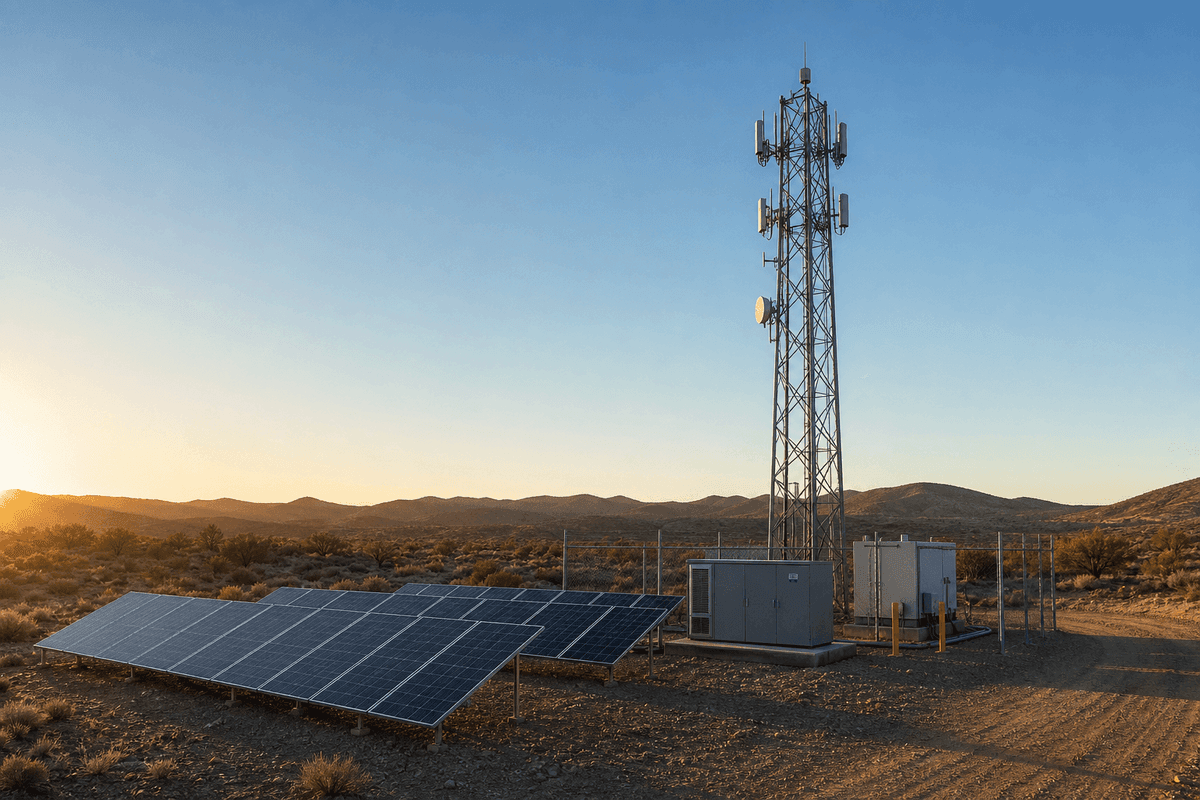
Watch the video
TL;DR
Green telecom towers are moving from diesel-first backup to solar-battery hybrid power. In 2024, operators sourced about 70 TWh of renewable electricity and reached 24% renewable sourcing, while weak-grid tower hybrids can cut diesel use by 60-90%. For 50+ site portfolios, EPC procurement with standardized 5-20 kWp solar and 20-80 kWh battery systems offers the clearest ROI path.
Green telecom towers are shifting from diesel-heavy uptime models to solar-battery hybrid power: GSMA reports 70 TWh of operator renewable electricity in 2024, 24% renewable sourcing, and 115 MtCO2e operational emissions.
Summary
Green telecom towers are shifting from diesel-heavy uptime models to solar-battery hybrid power: GSMA reports 70 TWh of operator renewable electricity in 2024, 24% renewable sourcing, and 115 MtCO2e operational emissions.
Key Takeaways
Use hybrid solar-battery telecom power to cut diesel runtime by 60-90% at off-grid and weak-grid sites while improving outage resilience.
- Prioritize 5-20 kWp solar arrays with 20-80 kWh lithium batteries for rural BTS sites drawing 1-5 kW continuous load.
- Benchmark operators by renewable electricity share: Europe reached about 70%, North America 50%, and Latin America 45% in 2024.
- Replace diesel-only tower power where fuel logistics exceed $0.30/kWh, because solar PV LCOE was about $0.043/kWh in 2024.
- Specify 48 VDC rectifiers, MPPT charge controllers, remote monitoring, and IP65/IP67 outdoor enclosures for telecom-grade uptime.
- Model ROI over 4-7 years for weak-grid sites where diesel savings reach 8,000-25,000 liters per site annually.
- Use EPC contracts for portfolios above 50 sites to standardize civil works, grounding, commissioning, and warranty controls.
- Require IEC 61215, IEC 61730, IEEE 1547, IEC 62109, and UL 9540A-aligned documentation for bankable procurement.
- Compare FOB, CIF, and EPC turnkey pricing before tender award, then apply 5%, 10%, or 15% volume discounts at 50, 100, and 250 sites.
Green Telecom Tower Deployment Report 2026
Green telecom tower deployment in 2026 is driven by 24% operator renewable electricity adoption, 70 TWh of clean sourcing, and diesel reduction targets.
Telecom towers are energy infrastructure before they are radio infrastructure. A base station can carry 4G, 5G, microwave backhaul, edge compute, surveillance, or rural broadband, but its business value depends on continuous power. In emerging markets, tower power still relies on grid-plus-diesel or diesel-only operation, while operators in Europe and North America increasingly procure renewable electricity through PPAs, green tariffs, and certificates.
According to GSMA (2026), mobile operators purchased or generated around 70 TWh of renewable electricity in 2024, and the renewable share of operator electricity rose from 10% in 2019 to 24% in 2024. GSMA also reports operational emissions of about 115 MtCO2e in 2024, equal to roughly 0.2% of global greenhouse gas emissions. John Giusti of GSMA states, "Access to renewable energy remains one of the biggest factors determining how quickly operators can decarbonise."
For tower owners, the priority is no longer a generic sustainability label. Procurement teams now ask whether a power system reduces diesel deliveries, improves uptime during grid outages, supports 48 VDC telecom loads, and produces auditable energy data. SOLARTODO positions green telecom tower systems as B2B infrastructure packages, not online marketplace products, with inquiry-led engineering, offline quotation, and project financing for qualified large deployments.
| Indicator | 2019 | 2023 | 2024 | 2026 procurement implication |
|---|---|---|---|---|
| Operator renewable electricity share | 10% | 37% among CDP disclosers | 24% global purchased/generated | Renewable access is now a core tender variable |
| Mobile operational emissions | Baseline year | 8% below 2019 | 115 MtCO2e, 13% below 2019 | Diesel-heavy towers face decarbonization pressure |
| Operator data traffic | Baseline year | About 4x 2019 | More than 4x 2019 | Energy per GB must keep falling |
| Science-based targets | Early adoption | 81 operators committed | 81 near-term targets by June 2026 | Suppliers must provide emissions documentation |
Renewable Energy Adoption by Operator and Region
Operator renewable adoption is uneven: GSMA reports about 70% renewable electricity in Europe, 50% in North America, and 45% in Latin America.
Regional differences explain why one green tower design cannot fit every market. In Europe, renewable procurement often uses PPAs, utility green tariffs, and certificates. In Sub-Saharan Africa, South Asia, and parts of the Middle East, site-level solar and lithium storage are more important because grid access is weak, diesel theft risk is material, and fuel logistics can dominate OPEX.
According to GSMA (2026), 14 operators matched 100% of electricity use with renewables in 2024, mostly in Europe. Telefónica reported 93% renewable electricity overall in its 2025 management and sustainability reporting, after reporting 89% overall in 2024. Vodafone reported 88% group renewable grid electricity purchased in 2024 and 100% renewable electricity in Europe for continuing operations.
Tower companies show the other side of the market. American Tower reported one gigawatt-hour of enhanced energy storage capacity across 24,500 sites in its 2024 sustainability executive reporting. Airtel Africa reported that, as of March 31, 2026, hybrid power systems had been deployed across 65% of Helios Towers sites leased to Airtel in Tanzania, Madagascar, and the Democratic Republic of the Congo, up from 29% in 2024/25.
| Operator or tower company | 2024-2026 renewable or hybrid metric | Deployment signal | Buyer interpretation |
|---|---|---|---|
| GSMA global operator sample | 70 TWh renewable electricity in 2024 | 116 operators covering 85% of connections | Sector baseline for procurement |
| Telefónica | 93% renewable electricity overall in 2025 | Europe and Brazil at 100% | High-maturity corporate procurement model |
| Vodafone | 88% group renewable grid electricity in 2024 | Europe at 100% renewable electricity | Strong PPA/certificate model |
| Airtel Africa with Helios Towers | 65% hybrid systems by March 31, 2026 | Tanzania, Madagascar, DRC | Weak-grid hybridization at scale |
| American Tower | 1 GWh storage across 24,500 sites in 2024 | Global towerco energy program | Storage is becoming standard tower infrastructure |
According to IEA (2026), global renewable generation increased by around 8.5% year-on-year in 2025, while solar PV generation rose by about 600 TWh. IEA states, "Solar PV saw its largest-ever increase in generation," which matters because telecom portfolios need scalable, bankable power rather than pilot-only systems.
Technical Architecture for Green Telecom Tower Power
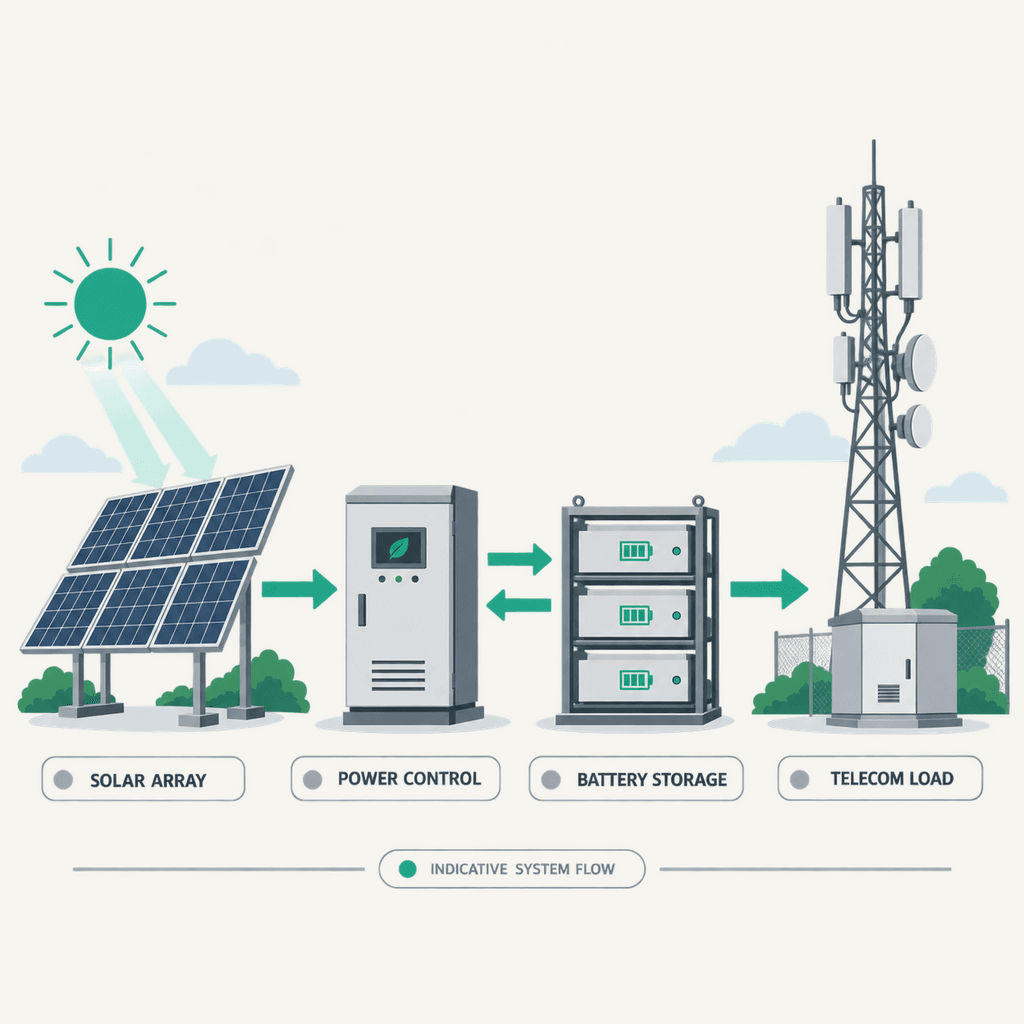
A practical green telecom tower uses 5-20 kWp solar, 20-80 kWh batteries, 48 VDC power electronics, and monitored diesel backup.
The standard architecture has four layers: renewable generation, energy storage, DC power conversion, and supervisory monitoring. Solar modules feed MPPT charge controllers or hybrid inverters, batteries support night operation and grid outages, rectifiers maintain telecom-grade 48 VDC output, and a generator remains available for extended low-irradiance periods. For high-load 5G sites, the design may include a larger battery cabinet, modular rectifiers, and separate DC buses for radio, microwave, security, and IoT equipment.
For procurement, the engineering target is site autonomy, not maximum solar capacity alone. A rural tower consuming 2 kW continuously needs 48 kWh per day before conversion losses. A 10 kWp PV array may generate 35-55 kWh/day in many high-irradiance markets, while a 40-60 kWh lithium battery can cover night hours and short weather events. Weak-grid sites often keep a generator sized at 8-20 kVA for redundancy.
| System type | Typical load | Solar array | Battery storage | Diesel reduction | Best application |
|---|---|---|---|---|---|
| Grid + battery backup | 1-3 kW | 0-5 kWp | 10-30 kWh | 20-50% | Urban weak-grid sites |
| Solar hybrid BTS | 1-5 kW | 5-20 kWp | 20-80 kWh | 60-90% | Rural macro towers |
| Solar + wind hybrid | 2-6 kW | 8-25 kWp plus 1-5 kW wind | 40-100 kWh | 70-95% | Coastal or high-wind sites |
| Diesel-only legacy | 1-5 kW | 0 kWp | 0-10 kWh | 0% | Short-term emergency use |
SOLARTODO telecom tower packages can include PV modules, lithium battery cabinets, hybrid controllers, grounding, surge protection, aviation lights, CCTV, and optional smart monitoring. For harsh outdoor sites, procurement teams should request IP65 or IP67 enclosures, anti-corrosion mounting, hot-dip galvanized tower interfaces, and temperature-managed battery cabinets. For solar modules, IEC 61215 and IEC 61730 are the core qualification standards; for inverters and converters, IEC 62109 and IEC 62116 are common safety and anti-islanding references.
Year-over-Year Market Trends and Forecasts
Green telecom tower adoption is moving from pilots to portfolio procurement as renewables added 585 GW in 2024 and investment reached $2.3 trillion in 2025.
The 2021-2024 period was defined by declining solar and battery costs, data traffic growth, and early operator climate targets. GSMA reported that mobile data traffic more than quadrupled between 2019 and 2024, while operational emissions fell 13%. That decoupling is important: operators are proving that traffic growth does not have to mean proportional energy growth.
According to IRENA (2025), renewable capacity additions reached 585 GW in 2024, representing 92.5% of total global power capacity expansion and 15.1% annual growth. According to BloombergNEF (2026), global energy transition investment reached $2.3 trillion in 2025, up 8% from 2024, with $690 billion invested in renewable energy and $483 billion in grids. BloombergNEF’s Albert Cheung states, "the global energy transition is resilient and provides a number of opportunities for investors."
From 2026 to 2030, tower power decisions will be shaped by three forces. First, more operators will need auditable Scope 1 and Scope 2 reductions to meet science-based targets. Second, diesel logistics will remain expensive in remote regions, especially where road access and fuel security are weak. Third, 5G densification and rural broadband obligations will increase total site count, making energy standardization more valuable.
| Period | Market trend | Quantitative signal | Green tower implication |
|---|---|---|---|
| 2019-2021 | Climate targets begin scaling | Operator renewable share near 10% in 2019 | Early pilots and diesel audits |
| 2022-2024 | Hybrid systems mature | 70 TWh operator renewables in 2024 | Portfolio-level sourcing begins |
| 2025-2026 | Storage becomes operational standard | 1 GWh American Tower storage capacity in 2024 | Battery warranties become bankability criteria |
| 2027-2030 | Renewable procurement accelerates | IEA projects 4,600 GW renewable additions in 2025-2030 | Large EPC rollouts replace single-site pilots |
| 2030-2040 | Net-zero networks mature | GSMA pathway requires 45% emissions reduction by 2030 | Diesel becomes backup-only, not primary power |
The long-term outlook is clear but not uniform. Europe will likely focus on 24/7 renewable matching and grid contracts. North America will emphasize PPAs, battery resilience, and grid-interactive sites. Asia-Pacific, the Middle East/Africa, and Latin America will combine renewable procurement with on-site solar-battery deployments because grid reliability varies widely by market.
EPC Investment Analysis and Pricing Structure
EPC turnkey green tower projects typically bundle engineering, procurement, construction, commissioning, monitoring, and warranty control across 50-250+ sites.
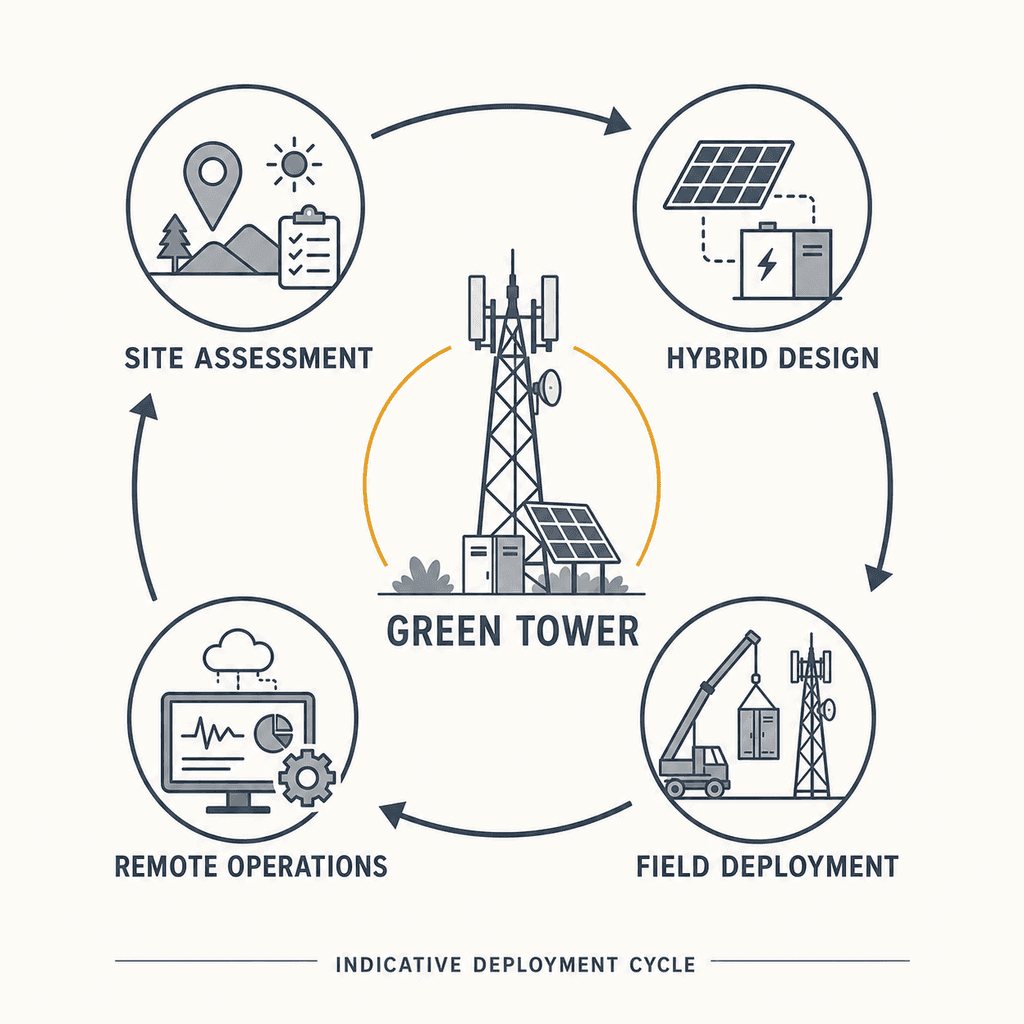
For telecom buyers, EPC means more than equipment delivery. A proper EPC scope includes site survey, load assessment, solar resource modeling, foundation and mounting design, electrical single-line diagrams, grounding, logistics, installation, commissioning, monitoring setup, as-built documentation, and handover training. This structure reduces variation across tower portfolios and gives finance teams a clearer basis for payback analysis.
SOLARTODO can quote green telecom tower systems across three commercial levels. FOB Supply covers factory-ready equipment and export packing. CIF Delivered adds ocean freight, insurance, and destination port delivery. EPC Turnkey adds local installation, civil works, commissioning, and performance documentation where SOLARTODO or approved partners can support execution. Payment terms are typically 30% T/T deposit plus 70% against bill of lading, or 100% L/C at sight. Financing is available for qualified large projects above $1,000K; procurement teams can contact [email protected] or +6585559114 for project screening.
| Pricing tier | Scope included | Typical budget per tower | Buyer profile |
|---|---|---|---|
| FOB Supply | PV, batteries, controllers, cabinets, cables, packing | $18,000-$45,000 | Importers, towercos with local installers |
| CIF Delivered | FOB scope plus freight and insurance | $20,000-$50,000 | Regional EPCs and telecom contractors |
| EPC Turnkey | Design, supply, installation, testing, handover | $28,000-$75,000 | Operators and towercos buying uptime outcomes |
Volume pricing should be negotiated by site count and technical standardization. As guidance, 50+ sites may qualify for a 5% discount, 100+ sites for 10%, and 250+ sites for 15%, assuming repeated designs and consolidated logistics. Warranty structures usually include 25-year PV module coverage, 5-10-year battery terms depending on chemistry and cycles, and 2-5-year power electronics coverage.
ROI depends on diesel displacement and local energy cost. A site consuming 15,000 liters of diesel annually at $1.10/liter has a $16,500 fuel baseline before maintenance and theft losses. If a solar-battery hybrid cuts diesel by 75%, annual fuel savings can reach $12,375, giving a simple payback of about 3-6 years for many $35,000-$60,000 hybrid deployments.
| Region | Diesel and grid context | Typical hybrid payback | Procurement priority |
|---|---|---|---|
| Asia-Pacific | High site growth, mixed grid reliability | 4-7 years | Standardize 48 VDC hybrid cabinets |
| Europe | Strong renewable procurement access | 5-8 years | Match renewable electricity and resilience |
| North America | Grid power dominant, resilience demand rising | 5-9 years | Batteries for outage and peak control |
| Middle East/Africa | Diesel logistics and weak grids common | 3-6 years | Maximize solar fraction and remote monitoring |
| Latin America | Good solar resource, variable tariffs | 4-7 years | Combine PPAs, solar, and lithium backup |
FAQ
Green telecom tower buyers should evaluate load, solar resource, battery autonomy, diesel savings, standards, EPC scope, and warranty before awarding 50+ site projects.
Q: What is a green telecom tower in 2026? A: A green telecom tower is a mobile network site powered partly or mostly by renewable energy, usually solar PV plus lithium battery storage. In 2026, practical systems commonly use 5-20 kWp solar arrays, 20-80 kWh batteries, 48 VDC power electronics, and monitored diesel backup for long cloudy periods or emergency outages.
Q: How much diesel can a solar-battery telecom tower save? A: A well-sized solar-battery hybrid tower can reduce diesel runtime by 60-90% depending on load, irradiance, battery capacity, and grid quality. Sites with 1-5 kW continuous loads and high fuel logistics costs usually achieve the fastest ROI because every avoided generator hour reduces fuel, maintenance, and delivery risk.
Q: Which operators lead renewable electricity adoption? A: European operators generally lead renewable adoption, with GSMA reporting about 70% renewable electricity sourcing in Europe in 2024. Telefónica reported 93% renewable electricity overall in 2025, while Vodafone reported 88% group renewable grid electricity in 2024 and 100% renewable electricity in Europe.
Q: What standards should a telecom solar hybrid system meet? A: Buyers should request IEC 61215 and IEC 61730 for PV modules, IEC 62109 for inverter safety, IEC 62116 for anti-islanding, and IEEE 1547 where grid interconnection applies. Battery documentation should align with UL 9540A-style thermal runaway testing expectations, especially for enclosed outdoor lithium cabinets.
Q: What does EPC turnkey delivery include for telecom towers? A: EPC turnkey delivery includes engineering, procurement, construction, commissioning, monitoring setup, documentation, and handover training. For green tower portfolios, EPC should also include load audits, solar yield modeling, grounding design, battery autonomy calculation, diesel baseline documentation, and acceptance testing for each site.
Q: How much does a green telecom tower power system cost? A: Typical SOLARTODO guidance is $18,000-$45,000 per site for FOB Supply, $20,000-$50,000 for CIF Delivered, and $28,000-$75,000 for EPC Turnkey. Pricing depends on solar size, battery kWh, cabinet protection, logistics, civil works, and whether the site is grid-connected, weak-grid, or off-grid.
Q: What payback period should operators expect? A: Weak-grid and off-grid telecom towers often target 3-7 year payback when diesel displacement is high. A site using 15,000 liters of diesel annually at $1.10/liter can save about $12,375 per year if hybrid power cuts fuel use by 75%, before generator maintenance savings.
Q: How should procurement teams compare FOB, CIF, and EPC quotes? A: Compare FOB when the buyer controls import and installation, CIF when delivered port cost matters, and EPC when the operator wants installed performance accountability. For 50+ sites, request volume discounts of 5%, 10%, and 15% at 50, 100, and 250 sites, plus warranty and commissioning evidence.
Q: Why are batteries becoming central to telecom tower decarbonization? A: Batteries convert intermittent solar into telecom-grade uptime by covering night load, grid outages, and generator start delays. American Tower reported one gigawatt-hour of storage capacity across 24,500 sites in 2024, showing that storage is moving from backup accessory to core tower infrastructure.
Q: Can green telecom tower systems support 5G loads? A: Yes, but 5G sites require stricter load modeling because radios, backhaul, cooling, and edge equipment can increase continuous demand. A 5G macro site may need 10-25 kWp solar, 60-120 kWh batteries, higher-capacity rectifiers, and remote energy management to keep diesel as backup only.
References
- IRENA Renewable Capacity Statistics (2025): Reports 585 GW of renewable capacity additions in 2024, 4,448 GW total renewable capacity, and 92.5% renewable share of global power capacity expansion. — https://www.irena.org/Data/View-data-by-topic/Capacity-and-Generation
- IEA Global Energy Review (2026): Reports renewable electricity generation growth of around 8.5% in 2025 and solar PV generation growth of about 600 TWh. — https://www.iea.org/reports/world-energy-outlook-2024
- BloombergNEF Energy Transition Investment Trends (2026): Reports $2.3 trillion global energy transition investment in 2025, including $690 billion for renewable energy and $483 billion for grids. — https://about.bnef.com/
- IEC 61215 and IEC 61730 (2021-2023): Photovoltaic module design qualification and safety qualification standards used for bankable solar module procurement. — https://webstore.iec.ch/
- IEEE 1547-2018 and IEC 62109/62116 (2018-2024): Distributed energy resource interconnection, inverter safety, and anti-islanding standards relevant to grid-connected telecom tower power systems. — https://standards.ieee.org/ieee/1547/7382/ These 8 sources support the 2026 telecom tower renewable deployment analysis with operator data, energy market statistics, and technical standards.
- GSMA (2026): Mobile Net Zero 2026; reports 70 TWh operator renewable electricity in 2024, 24% renewable sourcing, and 115 MtCO2e operational emissions. https://view.gsma.com/mobile-net-zero-2026
- IRENA (2025): Renewable Capacity Statistics 2025; reports 585 GW renewable additions in 2024 and 4,448 GW total renewable capacity. https://www.irena.org/Publications/2025/Mar/Renewable-capacity-statistics-2025
- IEA (2026): Global Energy Review 2026; reports renewable generation growth of 8.5% in 2025 and solar PV generation growth of about 600 TWh. https://www.iea.org/reports/global-energy-review-2026/electricity-supply
- BloombergNEF (2026): Energy Transition Investment Trends; reports $2.3 trillion global energy transition investment in 2025 and $690 billion renewable energy investment. https://about.bnef.com/insights/clean-energy/bloombergnef-finds-global-energy-transition-investment-reached-record-2-3-trillion-in-2025-up-8-from-2024/
- American Tower (2025): 2024 Sustainability Executive Report announcement; reports 1 GWh enhanced energy storage across 24,500 sites. https://americantower.gcs-web.com/node/28236
- Airtel Africa (2026): Sustainability Report 2026; reports hybrid power systems across 65% of Helios Towers sites leased to Airtel in Tanzania, Madagascar, and DRC. https://cdn-webportal.airtelstream.net/website/investor/main/SR2026/reports/reduction-of-greenhouse-gas-ghg-emissions-24312.html
- IEC 61215 and IEC 61730 (2021-2023): PV module design qualification and safety qualification standards used for bankable solar procurement.
- IEEE 1547-2018 and IEC 62109/62116 (2018-2024): Distributed resource interconnection, inverter safety, and anti-islanding standards relevant to grid-connected telecom power systems.
Conclusion
Green telecom tower deployment in 2026 is now a portfolio-level investment case: 70 TWh of operator renewable electricity and 60-90% diesel reduction potential make solar-battery hybrid systems commercially relevant.
Bottom line: operators and towercos should prioritize standardized SOLARTODO solar-battery EPC packages for weak-grid and off-grid sites above 50 towers, where diesel savings, uptime resilience, and auditable emissions reductions can be measured site by site.
About SOLARTODO
SOLARTODO is a global integrated solution provider specializing in solar power generation systems, energy-storage products, smart street-lighting and solar street-lighting, intelligent security & IoT linkage systems, power transmission towers, telecom communication towers, and smart-agriculture solutions for worldwide B2B customers.
About the Author

Cinn Song
Founder & Chief Solutions Architect
Cinn Song founded SOLARTODO LIMITED and leads its smart-city infrastructure engineering — from solar, storage and integrated smart poles to the company's push into physical-AI city edge nodes: pole-mounted edge computing, vertical LLMs for smart cities, drone-based O&M with autonomous battery swapping, robotic maintenance, and high-speed counter-UAS interception. Since 2010, he has directed turnkey EPC + BOT delivery across 50+ countries, including telecom monopole supply for national grid operators, off-grid solar street-lighting for African municipalities, and integrated smart-pole programs for Gulf smart cities.
Cite This Article
Cinn Song. (2026). Green Telecom Tower Deployment Report 2026: Renewable…. SOLARTODO. Retrieved from https://solartodo.com/knowledge/green-telecom-tower-deployment-report-2026-renewable-energy-adoption-by-operator-2
@article{solartodo_green_telecom_tower_deployment_report_2026_renewable_energy_adoption_by_operator_2,
  title = {Green Telecom Tower Deployment Report 2026: Renewable…},
  author = {Cinn Song},
  journal = {SOLARTODO Knowledge Base},
  year = {2026},
  url = {https://solartodo.com/knowledge/green-telecom-tower-deployment-report-2026-renewable-energy-adoption-by-operator-2},
  note = {Accessed: 2026-10-13}
}
Published: August 20, 2026 | Available at: https://solartodo.com/knowledge/green-telecom-tower-deployment-report-2026-renewable-energy-adoption-by-operator-2
Subscribe to Our Newsletter
Get the latest solar energy news and insights delivered to your inbox.
View All Articles