Summary
Use a site survey to decide which communication and power segments at the proposed security-system site in Guadalajara, Mexico, need restricted access, protective conduit, or both before drawing acceptance. Propose restricted access where unauthorized people could reach critical cables, terminations, or service points. Propose protective conduit where the survey identifies credible physical damage exposure that rerouting cannot resolve. Use both measures where both exposures remain. The supplied material contains no site survey from which to identify specific routes for approval.
Key Takeaways
- Walk each route from source to endpoint, including entries, junctions, and maintenance access points.
- Move reachable critical segments behind a verified access boundary where the layout permits.
- Specify protective conduit where a documented damage exposure remains after reviewing route alternatives.
- Check whether communication and power share a vulnerable crossing, entry, or service point.
- Require drawings, a route schedule, and product documentation that tie each proposed measure to the observed exposure.
- Hold drawing acceptance for unresolved critical segments and verify installed protection before it is concealed.
Proposed problem
Which cable routes require restricted access or protective conduit before installation drawings are accepted? Make the decision at the segment level. Mark changes in access or damage exposure on each route, including transitions between controlled and shared areas and at service points. Show those transitions alongside the route endpoints so the reviewer can assess each segment on its own evidence.
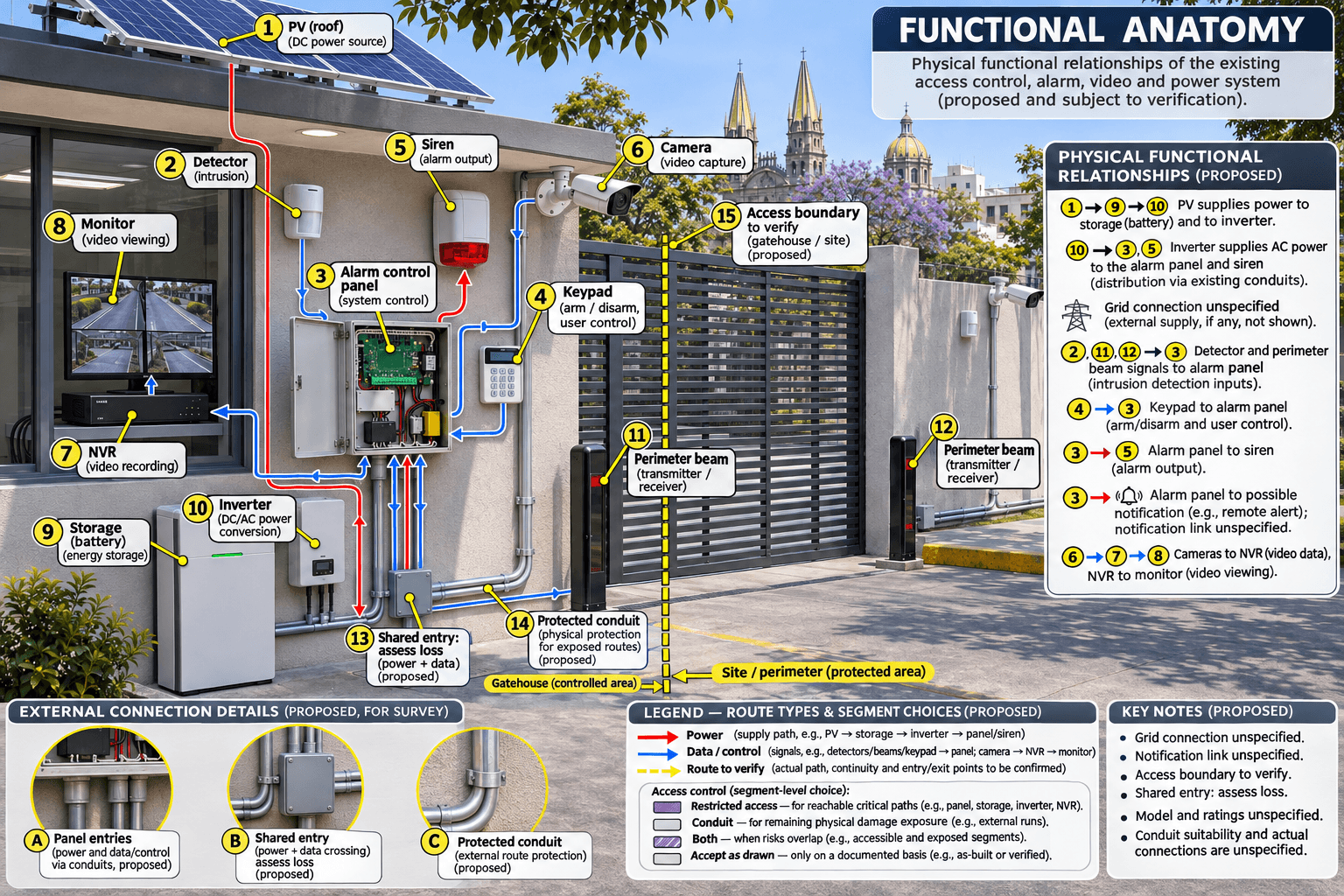
Begin with the consequence of losing each segment. Ask which detection, alarm, recording, or notification functions rely on it, and verify that dependency against the proposed configuration. Repeat the exercise for power circuits that could interrupt those functions. If a single crossing or entry could interrupt both a communication path and its supporting power, document the combined consequence before deciding whether to separate the routes, relocate the crossing, or protect it in place.
Source-backed product boundary
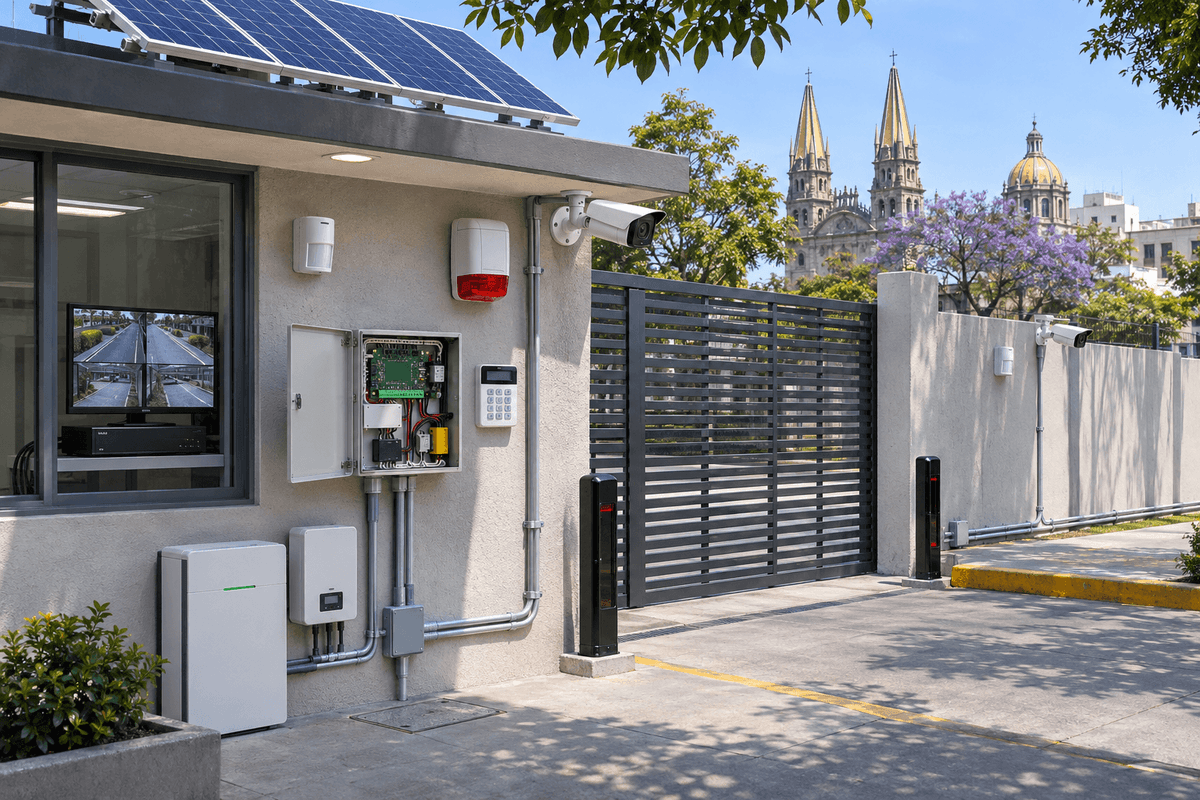
The SOLARTODO modular security-system scope comes from catalog identity city-catalog-2026-11-01-v1. The catalog lists an alarm control panel, detectors, perimeter beams, cameras, a keypad, and a siren/strobe, and describes network video recording. The architecture can combine solar PV, energy storage, and grid supply. Detection can be linked to alarms, recording, and security notification. Use the proposed configuration to establish which devices, power sources, and links the site would use. SOLARTODO security-system product page
The supplied catalog extraction leaves detector quantities, autonomy, response times, recognition accuracy, certified protection class, and dispatch service open for the proposed site. The supplied material includes no product PDF URL, page, model identifier, or model-specific operating conditions. Request the manufacturer document, relevant page, exact model, and applicable operating and installation conditions for any quoted item whose tamper resistance, enclosure suitability, or cable protection affects the routing decision.
Proposed design
CMS describes placing information-system transmission lines in restricted areas, using metal conduit for sensitive circuits, protecting power equipment and cabling from damage, and limiting access to critical infrastructure to authorized personnel. These practices provide design-review context from the CMS institutional setting. CMS Physical & Environmental Protection
Restrict access where reachability is the issue. Propose restricted routing for segments that unauthorized people could reach and whose loss could interrupt a critical security function. Include reachable ports, splices, terminations, and enclosure access points in the Guadalajara survey. Prefer a verified controlled route where the site permits it. If a segment must remain in a shared area, require the drawing to show how access to the enclosure or entry will be controlled and identify who can service it. Show the transitions into and out of the controlled section.
Use protective conduit where physical damage remains credible. During the survey, check for potential contact during routine work, movement through service areas, and exposure at enclosure entries. If rerouting does not resolve an observed exposure, require a specified conduit assembly with installation details appropriate to the cable and the recorded conditions. Where a vendor proposes metal conduit for a sensitive communication circuit, ask for the rationale and documentation for the proposed assembly and its installation requirements.
Use both measures where the risks overlap. Check for damage exposure during authorized work inside controlled areas. Check whether junctions and terminations remain reachable at the ends of protected runs. If unauthorized reach and physical damage exposure both remain after reviewing route alternatives, specify both measures. If the route stays in a verified controlled area, the survey identifies no credible damage exposure, and the manufacturer instructions support the installation, record the basis for accepting the route as drawn.
Review power and communication dependencies together. Trace the proposed communication paths and their supporting power feeds. If the design uses multiple power sources, check where they enter the installation and which downstream portions they share. Verify any proposed continuity of critical functions against the site design, including shared segments. Mark common crossings and entries on the drawing and ask the designer which functions would be lost if a shared point became unavailable.
The U.S. federal PACS guide describes inventorying critical assets, mapping categorized assets, and then categorizing security areas. Its procurement checklist calls for involving facilities, physical security, and IT stakeholders. Use those practices to organize the project survey and assign review responsibilities. Physical Access Control Systems 101
Hypothetical evaluation assumptions
Hypothetical evaluation assumption: The buyer sets a drawing-review target of zero route segments without a unique identifier and a recorded protection disposition.
Hypothetical evaluation assumption: The buyer sets a survey-evidence target of at least one annotated photograph or field sketch for each observed access boundary, exposed crossing, or enclosure entry that drives a protection decision.
Hypothetical evaluation assumption: The buyer sets a drawing-acceptance target of zero unresolved dispositions for segments whose loss could interrupt an agreed critical security function.
Hypothetical evaluation assumption: The buyer requires at least one documented pre-concealment inspection for each approved route segment that will later be inaccessible for visual inspection.
Track each check in the route schedule against the drawing revision under review. If evidence is missing, assign the issue to the party responsible for producing it and record where the evidence will appear. When a field change alters who can reach a route or how it is protected, update the schedule and review the affected dependency before closing the change.
Survey and acceptance checklist
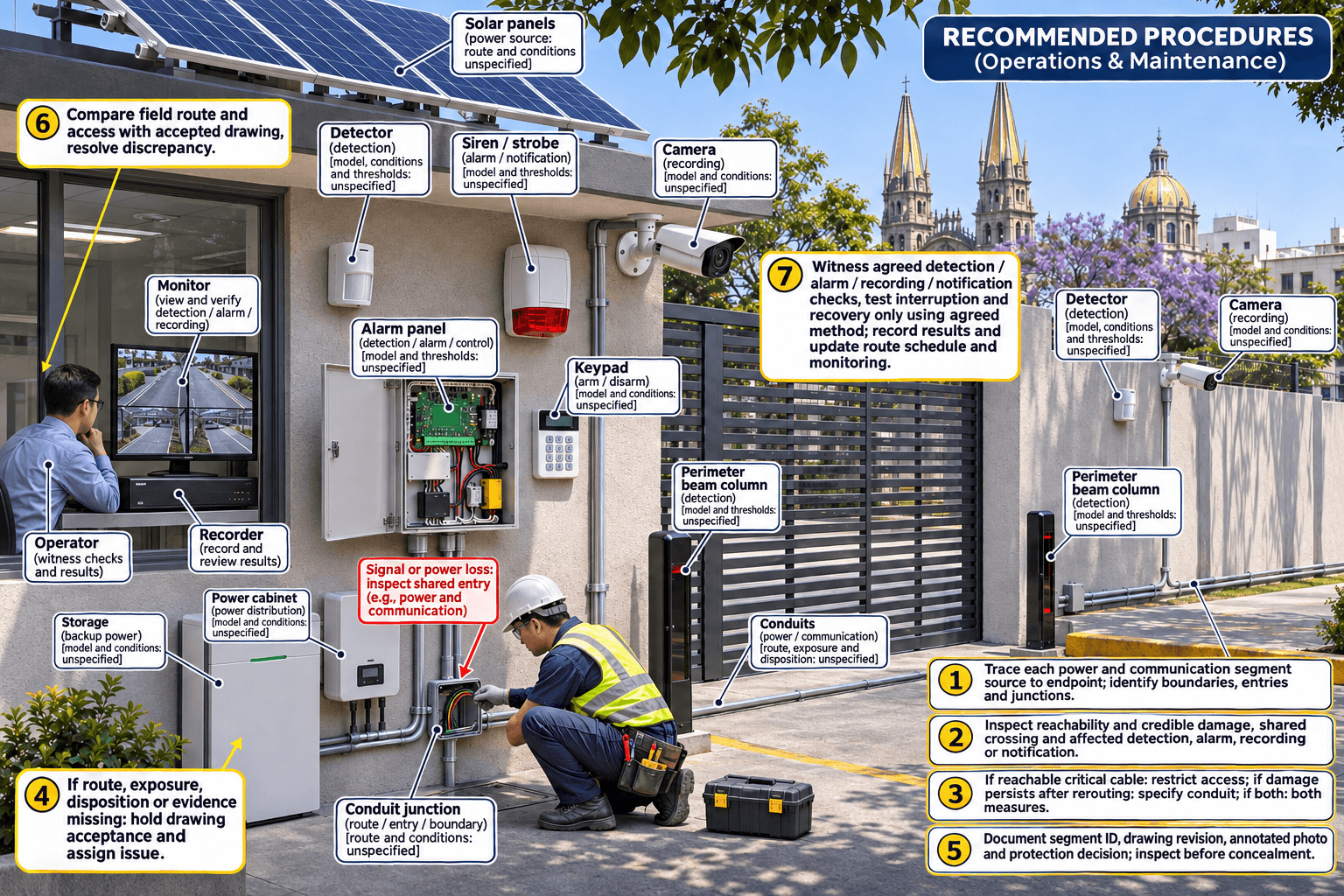
- Trace each segment in the field. Record its endpoints, pathway, access boundaries, enclosure entries, and junctions. Add a field sketch or annotated photo wherever the plan view cannot explain the exposure. Flag concealed or inaccessible existing pathways for verification.
- Establish routine access. Identify who can reach the cable or open each service point during normal operations and maintenance. Check the actual access arrangement with the site representative, including areas shared with other occupants or contractors.
- Document physical and environmental exposure. Record observed sources of contact or damage and any condition relevant to the proposed cable or enclosure. Compare those observations with documentation for the exact quoted installation. Keep unknown conditions open until the survey or supplier documentation resolves them.
- Reconcile the drawing and route schedule. Use matching segment identifiers and record the reason for rerouting, restricted access, conduit, combined measures, or acceptance as drawn. Show transitions and terminations at a level the installer can follow. Record the affected security functions and any shared power and communication exposure.
- Set inspection points before approving drawings. Identify sections that will become inaccessible and specify what the installer must record before covering them. At installation acceptance, compare the actual route, enclosure entries, and access controls with the accepted drawings and resolve discrepancies in the as-built record.
- Witness agreed functional checks. Check the selected detection, alarm, recording, or notification links as applicable. Where continuity or recovery after an interruption is part of the design, agree on a controlled test method, expected behavior, and restoration procedure. Record observed behavior for the specific configuration and test conditions.
Limitations
The supplied material includes no site plan, access map, route observations, or installed configuration for the proposed Guadalajara site. Conditions along individual routes and the suitability of any specific cable, enclosure, conduit assembly, or device remain undetermined.
Functional checks document what the assembled system does under the conditions tested. Claims about runtime, event delivery, or recovery under other conditions need supporting evidence for those conditions. Cite the drawings for routing decisions, the test records for observed behavior, and the contract for any service commitments.
Procurement questions
- Can the bidder provide a marked-up route plan and segment schedule that link every proposed protection measure to an observed exposure and affected security function?
- Which proposed enclosures, terminations, and maintenance points require controlled access, and who will hold that access after handover?
- Which manufacturer documents, model identifiers, pages, and operating or installation conditions support the quoted cables, devices, and protective assemblies?
- Where do power and communication share pathways or entries, and which functions would become unavailable if a shared point were interrupted?
- Who will record concealed work, witness the agreed functional checks, approve route changes, and reconcile the final as-built drawings with the field installation?
- Which routing provisions are priced in the base bid, and which still depend on confirming site access, existing pathways, or installation conditions?
FAQ
Which routes should have restricted access?
Propose restricted access for communication or power segments that unauthorized people could reach and whose loss or interference could interrupt a critical security function. Include accessible junctions, terminations, ports, and service points in the review.
When should the drawings specify protective conduit?
Specify protective conduit where the survey identifies credible physical damage exposure that the proposed routing cannot resolve. Show the assembly and its transitions, and obtain documentation suited to the recorded conditions.
Can a route need both restricted access and conduit?
Yes. Use both where unauthorized reach and physical damage remain credible after reviewing route alternatives. Apply the decision to the run and its endpoints.
When can a route be accepted without added protection under this review?
Record the basis when the route stays in a verified controlled area, the survey identifies no credible damage exposure, and the manufacturer instructions support the proposed installation.
How should shared power and communication crossings be reviewed?
Identify which security functions depend on each shared point. Compare separation, relocation, and protection in place, then document the consequence of losing the shared segment.
How do CMS and U.S. federal PACS practices inform the proposed Guadalajara design?
CMS provides design-review context for transmission-line access and cable protection. The U.S. federal PACS guide provides planning context for mapping categorized assets, categorizing security areas, and assigning project roles. Base drawing acceptance on the Guadalajara site survey, proposed routing, and selected equipment documentation.
Does the catalog establish tamper or environmental protection ratings for the proposed installation?
The supplied catalog establishes product scope and possible architecture. Obtain model-specific manufacturer documentation and match the stated operating and installation conditions to the observed exposures before relying on a rating.
What evidence should hold up drawing acceptance if it is missing?
Hold acceptance when a critical segment lacks a documented route, an exposure assessment, a protection disposition, or a supporting installation detail needed for that disposition. Resolve discrepancies against the current drawing revision.
References
- SOLARTODO modular security-system catalog, identity
city-catalog-2026-11-01-v1. The supplied extraction establishes catalog scope. The supplied material includes no product PDF URL, page, model identifier, or model-specific operating conditions. Public SOLARTODO security-system catalog - U.S. Centers for Medicare & Medicaid Services guidance on transmission-line access, power cabling, and physical and environmental protection. CMS Physical & Environmental Protection
- U.S. federal guide covering critical-asset inventories, mapping categorized assets, categorizing security areas, and procurement planning. Physical Access Control Systems 101
Proposed Equipment
- Alarm control panel
- Detectors
- Perimeter beams
- Cameras
- Keypad
- Siren/strobe
- Solar PV
- Energy storage