Summary
For the proposed Guadalajara application, accept a lighting control profile only after commissioning evidence demonstrates agreement with approved commands, required operating periods, lighting criteria and the system energy design. Revise settings when the evidence identifies a settings problem; investigate equipment, installation and measurement discrepancies before deciding on a correction.
Guadalajara is solely a proposed site in this evaluation. The supplied evidence establishes no installation, local survey, approved control schedule or measured performance there. It also supplies no product PDF, PDF URL, selected model or controller manual. This article therefore proposes an acceptance process without approving a configuration or reporting local results.
Key Takeaways
- Obtain the selected controller’s documentation before specifying scheduling, dimming or adaptive functions.
- Approve a written lighting schedule connecting each commanded level and operating period to a project requirement.
- Check actual lighting delivery as well as controller commands against approved criteria.
- Measure energy across the agreed operating profile and identify the electrical loads included.
- Review the control profile together with photovoltaic generation, battery storage and luminaire load.
- Withhold acceptance when requirements, equipment identity or test evidence are missing, and document corrections and retesting.
Proposed problem
The buyer’s question is what commissioning evidence should determine whether to accept or revise a proposed SOLARTODO solar-streetlight control profile in Guadalajara. The decision concerns commanded lighting levels, actual operating periods, delivered lighting and measured energy consumption.
Do not use a lower consumption reading as the sole acceptance criterion. Check lighting delivery and operating periods alongside energy use, and investigate discrepancies before changing dimming settings. Compare measurements with a design calculation covering the same electrical boundary.
The supplied pack contains no project lighting criteria, operating schedule, energy allowance or approved controller settings. Those omissions prevent a present accept-or-revise verdict on a particular profile. Define the requirements and obtain the equipment documentation before evaluating a configuration.
Source-backed product boundary
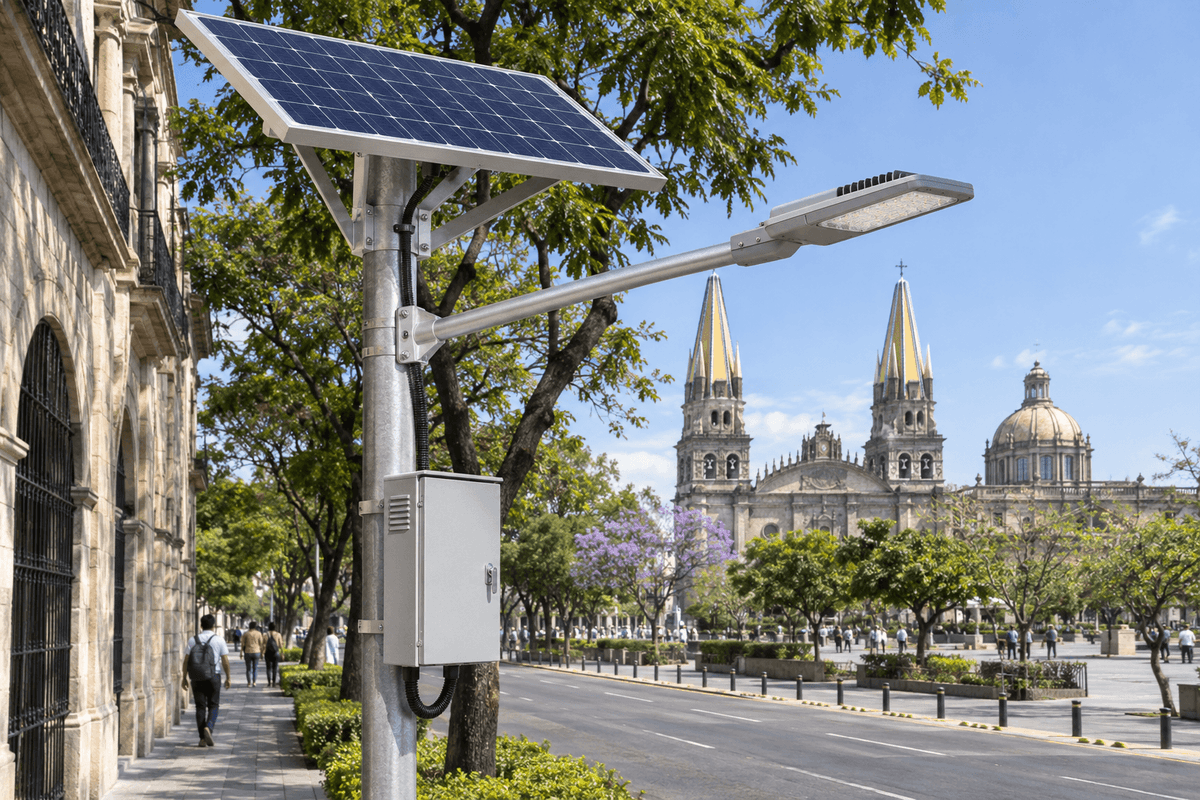
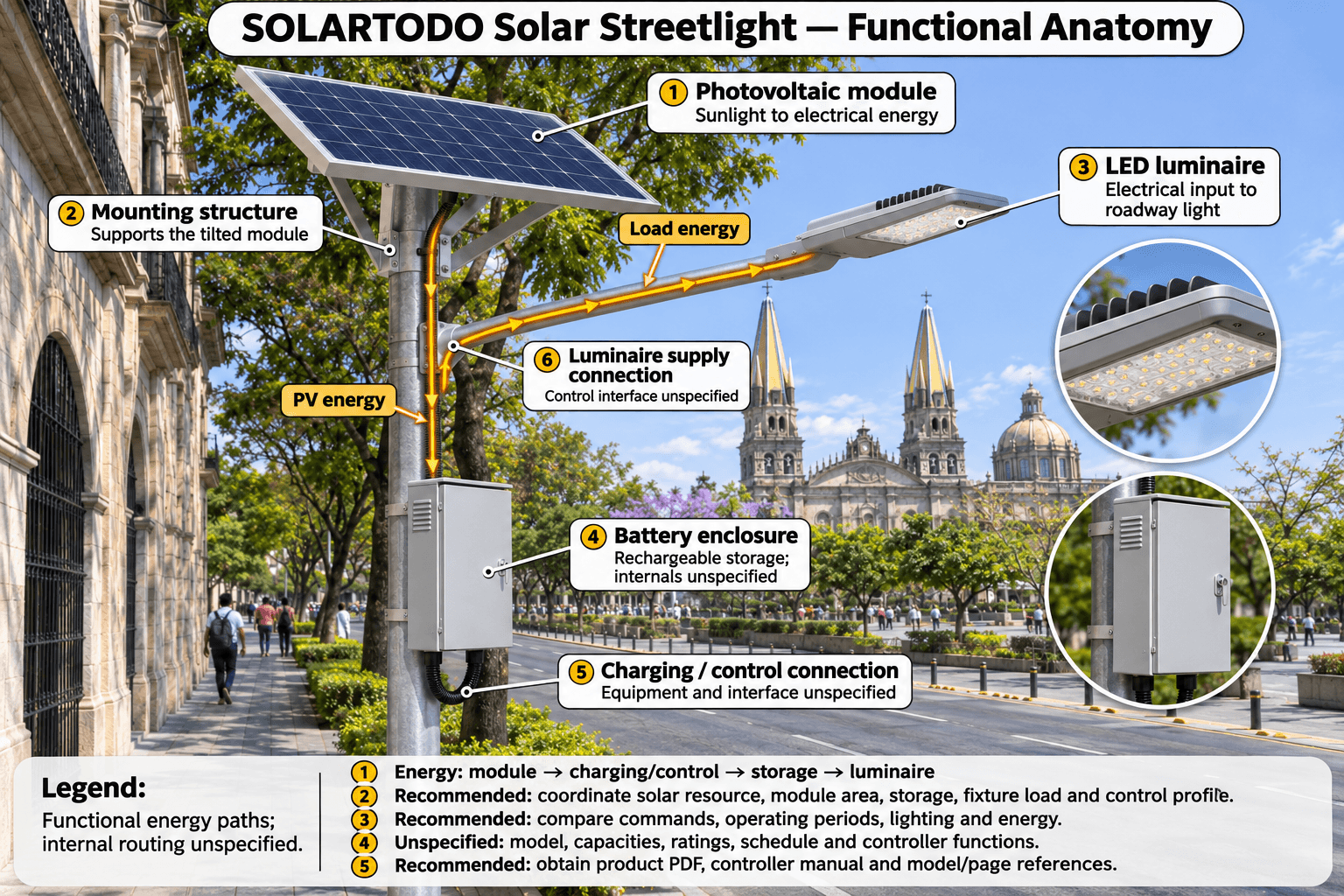
The applicable family is SOLARTODO solar streetlighting, under catalog identity city-catalog-2026-11-01-v1. Its documented scope includes photovoltaic modules, rechargeable battery storage, an LED luminaire and charging/control equipment. The supplied catalog describes a possible split arrangement with a tilted solar module above a side-arm LED and a separate battery enclosure. It does not establish that this arrangement has been selected for Guadalajara. See the SOLARTODO solar-streetlight catalog.
The catalog requires module area, battery capacity, fixture power, mounting structure and control profile to be selected together using site solar resource and load data. It establishes no fixed backup duration or energy-saving percentage for an unconfigured site. Explore the SOLARTODO solar-streetlight family.
No selected equipment model, product PDF, PDF URL or controller manual appears in the supplied pack. Model-specific settings, supported functions and operating restrictions therefore remain unresolved. Obtain the applicable documentation with its actual model and page references before approving those details.
The supplied FEMP guidance discusses advanced lighting controls generally. It does not establish SOLARTODO network connectivity, motion detection, remote reporting, adaptive operation or a particular dimming interface. Require documentary support for each proposed function on the selected equipment.
Proposed design
Establish the approved control schedule
Prepare a controlled schedule identifying each required operating period, its commanded lighting level, the reason for that level and the associated acceptance criterion. State whether a command represents a relative output setting, an electrical control value or another documented quantity. Do not treat a percentage command as evidence of the same percentage of electrical power or ground illumination.
Identify the clock or switching reference, the procedure for setting it and the approved method for handling changes. Specify scheduled transitions only after confirming that the selected controller supports them. For any proposed adaptive behavior, obtain documentation of the inputs, decision logic, available settings and operating restrictions before defining the acceptance test.
Connect controls to the complete energy design
Review the proposed schedule alongside the photovoltaic module, battery, luminaire and charging/control equipment. Request a generation-and-storage assessment supporting the proposed load profile, as required by the catalog’s coordinated selection approach. Evaluate lighting service and energy use together.
The supplied DOE photovoltaic system design guidance explains the roles of modules, mounting structures and storage in a complete photovoltaic system. It supplies general design context, but no Guadalajara site resource assessment or SOLARTODO configuration. Obtain site-specific inputs before finalizing the energy balance or mounting proposal.
Separate commands, lighting and energy evidence
Use distinct records for configuration, observed operation, lighting measurements and electrical consumption. Link them through a common time reference and equipment identity so reviewers can compare the same operating interval across records.
Compare the commanded state with the observed response. Assess lighting readings against the approved criteria at the agreed locations. Compare measured energy with a prediction covering the same loads, operating states and measurement interval. Keep the underlying records available for investigating discrepancies.
The FEMP exterior-lighting purchasing guidance recommends gathering relevant performance, cost and reliability information and discusses controls as an efficiency opportunity. Its United States federal purchasing provisions do not establish requirements for this proposed Guadalajara project. Its examples also do not establish savings for the proposed configuration.
Explicitly hypothetical measurable evaluation assumptions
The following illustrative test arrangements require project approval before use and do not describe supplied equipment capabilities or completed tests.
Hypothetical evaluation assumption: The acceptance trial will cover every operating period and transition in the proposed schedule.
Hypothetical evaluation assumption: Each scheduled transition will have a recorded command, observed response and timestamp referenced to the same agreed clock.
Hypothetical evaluation assumption: The project will define an allowable timing deviation before commissioning begins.
Hypothetical evaluation assumption: Lighting measurements will be taken at an agreed set of survey locations for each required operating level.
Hypothetical evaluation assumption: The project will approve lighting acceptance criteria before reviewing the resulting measurements.
Hypothetical evaluation assumption: Electrical energy will be measured over a complete scheduled operating cycle using a documented measurement boundary.
Hypothetical evaluation assumption: The predicted energy calculation will use documented input-power information applicable to the selected equipment and commanded states.
Hypothetical evaluation assumption: The project will set an allowable difference between predicted and measured energy after considering measurement uncertainty.
Hypothetical evaluation assumption: Any failed criterion will require a documented investigation and a repeat of the affected test after correction.
Survey/acceptance checklist
Before field testing
- Identify the exact equipment offered for the proposed site and obtain its applicable product PDF, controller instructions and configuration record.
- Confirm documentary support for every specified control function and record relevant restrictions.
- Survey the proposed layout, relevant obstructions and measurement locations without substituting city-wide assumptions for site observations.
- Obtain approval for lighting levels, operating periods, transition behavior and energy assessment criteria.
- Record instrument identity, suitability, uncertainty and the measurement method.
- Preserve the approved schedule revision so the installer and reviewer assess the same profile.
During commissioning
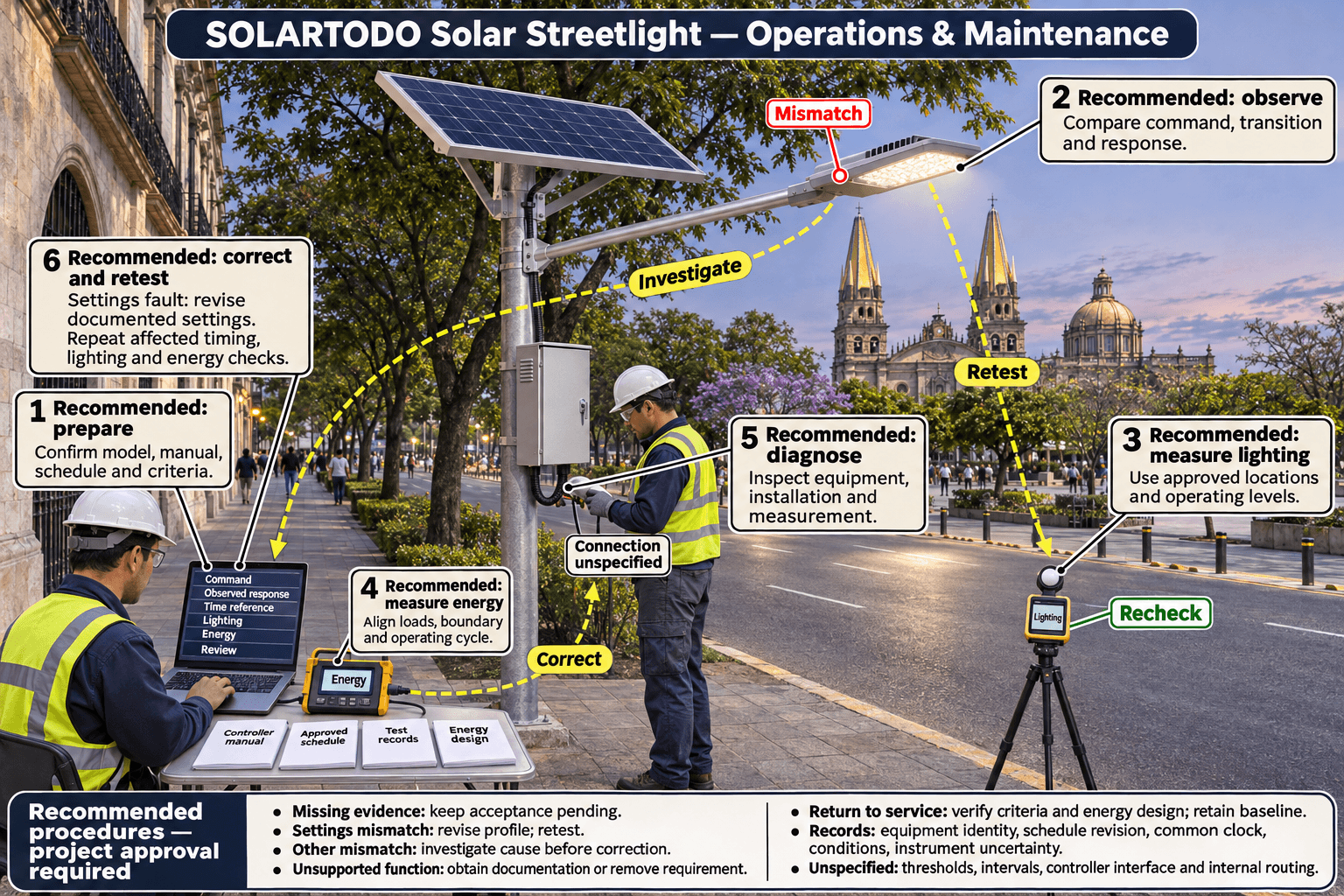
Compare programmed settings with the approved schedule. Observe each transition and record the actual response. Measure lighting at the agreed survey points during the required operating states. Retain underlying readings, timestamps and test conditions alongside the assessment.
Measure consumption at a clearly identified electrical location. State whether the record includes the luminaire alone, charging/control equipment or another defined combination. Where relevant, distinguish energy delivered to the load from energy entering storage. Compare the prediction and measurement only after aligning their boundaries and operating intervals.
Record operating states, interruptions and other conditions needed to interpret the readings. If the selected controller lacks suitable records, agree on an independent observation or measurement method. Do not specify built-in logging or reporting without supporting equipment documentation.
Decide, correct and retest
Accept the profile only when the evidence meets the approved requirements and the configuration matches documented equipment capabilities. Keep accepted settings and test records together as the commissioning baseline, identifying the equipment, schedule revision, test conditions and scope of acceptance.
Revise settings when the evidence identifies an unsuitable schedule or commanded level. Investigate installation, equipment and measurement causes where relevant. For a requested function lacking documentation, obtain authoritative support or remove it from the proposed specification before proceeding. After correction, repeat the affected checks and assess consequences for the overall energy design.
Keep acceptance pending when missing documentation or incomplete measurements prevent a decision. Distinguish an unresolved evidence gap from a demonstrated settings failure.
Limitations
The supplied evidence supports a proposed commissioning framework. It contains no Guadalajara field readings, selected controller, approved lighting criteria, battery sizing, verified autonomy or measured energy savings.
Limit any future acceptance statement to the equipment, configuration, conditions and measurements actually evaluated. Obtain separate design evidence and appropriately scoped verification for storage adequacy and performance under other conditions.
FEMP’s examples and federal procurement provisions do not establish local requirements or promised savings for this project. DOE’s general photovoltaic guidance does not establish a final module orientation, mounting specification or system capacity for the proposed site. The catalog extraction establishes family scope rather than certification or as-built performance.
Procurement questions
Ask the supplier to identify the exact offered configuration and provide the applicable product PDF and controller instructions with model and page references. Request written support for each scheduling, dimming or adaptive function in the offer, including setting ranges and relevant operating restrictions.
Ask the designer to connect every operating period and lighting level to an approved project requirement. Request a consumption prediction with calculation inputs and a defined measurement boundary, plus the generation-and-storage assessment supporting the proposed load profile.
Establish who approves the configuration, witnesses testing, resolves discrepancies and retains the acceptance baseline. Distinguish documented supplied functions from optional proposals and unresolved requests.
FAQ
What evidence should determine acceptance of the control profile?
Acceptance should depend on documented controller capability, agreement with the approved schedule, verified lighting delivery and measured energy assessed against the approved design using a consistent measurement boundary.
Is Guadalajara an established SOLARTODO deployment in this article?
No. Guadalajara is solely a proposed site; the supplied evidence establishes no installation or measured performance there.
Does the catalog prove that networked or motion-responsive controls are included?
No. The catalog establishes charging/control equipment within the family, but the selected controller’s documentation must establish any networked, motion-responsive or adaptive function.
How should energy consumption be checked?
Measure energy over the agreed operating profile, document the electrical measurement boundary and compare the result with a prediction covering the same loads and operating states; assess lighting delivery and operating periods alongside energy use.
Do FEMP purchasing rules apply to this proposed Guadalajara project?
The supplied evidence does not establish that they apply. FEMP provides evaluation context, and its United States federal purchasing requirements must not be presented as Guadalajara requirements.
Can this evaluation promise backup nights or energy savings?
No. The catalog establishes neither a fixed backup duration nor an energy-saving percentage for an unconfigured site.
Which product PDF, model and page support the proposed settings?
None is supplied in the evidence pack. Obtain the applicable product PDF and selected model documentation before making model-specific claims or approving unsupported functions.
What should happen when commissioning reveals a mismatch?
Document the discrepancy, investigate settings, equipment, installation and measurement causes, correct the identified issue and repeat the affected checks before acceptance.
References
- SOLARTODO solar-streetlight catalog: supplied extraction identified as city-catalog-2026-11-01-v1; establishes family scope and coordinated component selection without establishing model-specific settings, certification or as-built performance.
- DOE: Solar Photovoltaic System Design Basics: general context for photovoltaic components, mounting and storage; does not establish a Guadalajara configuration.
- DOE FEMP: Purchasing Energy-Efficient Exterior Lighting: exterior-lighting purchasing and controls context; does not establish SOLARTODO control capabilities, project savings or Guadalajara requirements.
Product PDF reference: absent from the supplied pack. Obtain its actual URL, applicable model and page context before relying on it for model-specific acceptance.
Proposed Equipment
- Photovoltaic modules
- Rechargeable battery storage
- LED luminaire
- Charging/control equipment