Diagnose Manual Battery Discharge and Grid Recharge

Cinn Song
Founder & Chief Solutions Architect
TL;DR
First check whether the active manual period permits both discharge and grid charging. SAM documents discharge to minimum SOC followed by grid recharge under that condition. Verify the calendar, time step and SOC basis, then test one permission change; confirm actual equipment behavior against controller documentation and event records.
Check overlapping grid-charge and discharge permissions before approving battery changes. Use the active calendar, SOC limits, available capacity and simulation time step to reproduce the transition. SAM documents this sequence, but an installed controller requires its own operating documentation and event evidence.
Summary
Check overlapping grid-charge and discharge permissions before approving battery changes. Use the active calendar, SOC limits, available capacity and simulation time step to reproduce the transition. SAM documents this sequence, but an installed controller requires its own operating documentation and event evidence.
Key Takeaways
- SAM explicitly describes discharge to minimum SOC followed by grid charging when both permissions are enabled in one manual period.
- Identify the active weekday or weekend schedule cell; settings for unassigned periods are ignored.
- Manual charge and discharge percentages apply per simulation time step, including subhourly steps.
- Minimum and maximum SOC are based on available capacity, which can change with degradation and replacement.
- Test a correction by changing the overlapping permission while holding other model inputs constant.
- Verify repeated reversals individually and require controller-specific evidence before applying SAM behavior to installed equipment.
Diagnosing Manual Battery Discharge Followed by Grid Recharging
A manual battery schedule that discharges to minimum state of charge (SOC) and then charges from the grid may be following its configured permissions. Before approving equipment changes, ask the integrator to check whether grid charging and discharge are enabled in the same active dispatch period, then reproduce the transition using time-step results.
SAM’s documentation explicitly describes this sequence for both behind-the-meter (BTM) and front-of-meter (FOM) manual dispatch. It does not establish that every repeated reversal in an installed controller has the same cause. SAM Battery Dispatch—BTM, SAM Battery Dispatch—FOM.
1. Check the permissions behind the transition

In SAM BTM manual dispatch, when grid charging and one or both discharge options are enabled for a period, a battery above minimum SOC discharges until it reaches that minimum. It then starts charging from the grid until it reaches maximum SOC or enters a period that does not allow grid charging. The FOM manual-dispatch documentation describes the corresponding behavior when grid charging and discharge to grid are enabled together. BTM—Manual Dispatch, FOM—Manual Dispatch.
The first diagnostic question is therefore whether the observed sequence matches the active permissions. A discharge permission combined with a grid-charge permission can explain the transition without establishing a battery fault.
Ask for the active period number, grid-charge permission, discharge permissions, minimum and maximum SOC, and initial SOC. For BTM, distinguish discharge to load from discharge to grid: SAM allows discharge to grid only during time steps when discharge to load is allowed, using the same discharge rate. BTM—Manual Dispatch.
For installed equipment, request the controller’s manual and software revision before treating SAM’s sequence as its operating specification. The two SAM help pages explain model behavior; they do not verify a particular equipment controller.
2. Verify the calendar and time-step settings
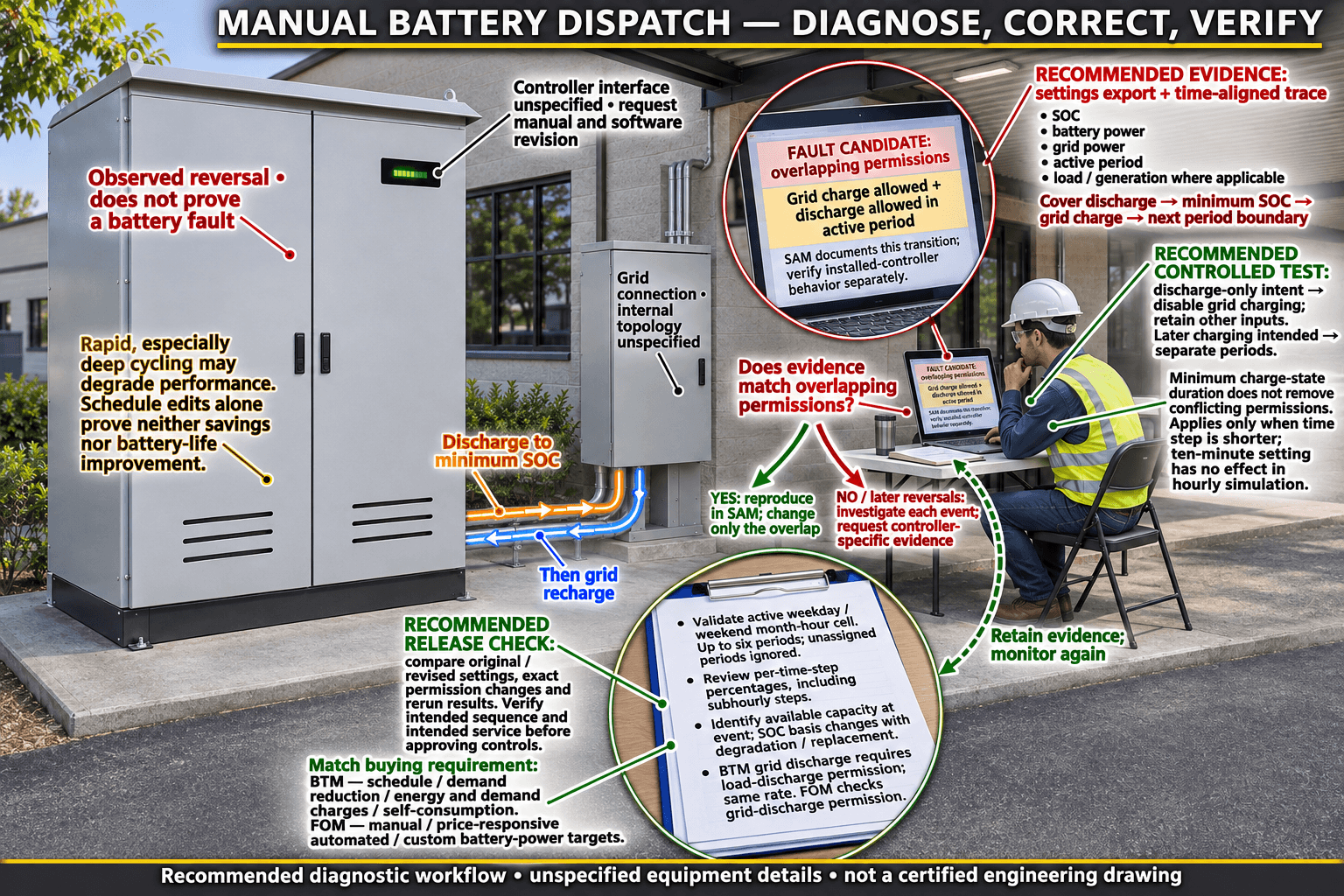
SAM manual dispatch uses up to six periods assigned through month-by-hour weekday and weekend schedules. Charge and discharge settings for an unassigned period are ignored. Check the actual schedule cells covering each event, rather than relying on a period’s name or intended purpose. BTM—Weekday and Weekend Schedules.
Next, verify the simulation time step. Although manual periods are scheduled by hour, charge and discharge percentages apply to each simulation time step, including subhourly steps. A percentage copied unchanged into a finer-resolution simulation therefore needs review; it is not automatically an equivalent hourly operating instruction. BTM—Manual Dispatch, FOM—Manual Dispatch.
Also check the SOC basis. SAM’s minimum and maximum SOC limits refer to available battery capacity, which changes as batteries degrade and are replaced. They are not fixed percentages of an unchanged nominal energy capacity. Ask the analyst to identify the available capacity associated with the event being investigated. BTM—Charge Limits and Priority.
3. Reproduce the event before choosing a correction
A useful verification package should include a settings export and a time-aligned trace covering discharge, arrival at minimum SOC, grid charging, and the next period boundary. Request SOC, battery power, grid power, active period, and—where applicable—load and generation. This is a recommended diagnostic package, not a claim that every controller records these fields.
For a SAM model, request a controlled comparison that changes only the overlapping permission. If the intended period is discharge-only, test it with grid charging disabled while retaining the other inputs. If charging is intended later, test separate charging and discharging periods. Compare the resulting transition and whether the intended service remains achievable.
Do not assume a minimum charge-state duration will resolve the issue. SAM applies that setting only when the simulation time step is smaller than the specified duration. Its documented ten-minute setting has no effect in an hourly simulation. The setting prevents changing between charging and discharging within the specified interval; it does not remove conflicting period permissions. FOM—Charge Limits and Priority.
If the record shows repeated reversals after recharging, investigate each reversal separately. The documented discharge-to-minimum-then-charge sequence alone does not explain every subsequent switch.
4. Match the revised schedule to the buying requirement
Ask the integrator to state the intended service before approving revised controls. For SAM BTM applications, manual dispatch follows schedules; peak shaving targets demand reduction; retail rate dispatch seeks to minimize energy and demand charges; and self-consumption minimizes power exchanged with the grid. These are different modeled objectives. BTM—Storage Dispatch Options.
For FOM applications, SAM distinguishes manual schedules, price-responsive automated dispatch, and custom battery-power targets. Selecting a different mode should follow the project objective and required inputs, rather than simply hiding the observed transition. FOM—Storage Dispatch Options.
Request a revised schedule, the exact permission changes, and comparison results demonstrating the intended sequence. Do not accept a schedule edit alone as evidence of savings or battery-life improvement. SAM notes that rapid cycling, especially deep cycling, may degrade battery performance over time, but these help pages provide no project-specific financial or lifetime result. BTM—Charge Limits and Priority.
FAQ
Does this sequence prove the battery is faulty?
No. SAM documents it as manual-dispatch behavior when grid charging and discharge are enabled together. Equipment diagnosis requires controller settings and event records.
Which setting should the integrator check first?
Check whether grid charging and discharge are both enabled in the period active during the event.
When does SAM stop the subsequent grid charging?
The manual-dispatch documentation specifies maximum SOC or a change to a period that does not allow grid charging.
Why check weekday and weekend schedules?
They determine which period applies to each month and hour. SAM ignores permissions for periods that are never assigned.
Can hourly percentage settings be reused unchanged at finer resolution?
They need review because SAM applies the percentages per simulation time step, even though schedule periods are defined by hour.
Will minimum time at charge state prevent switching?
It constrains switching only when the simulation time step is smaller than the specified duration. It does not change period permissions.
What evidence should accompany a proposed correction?
Request the original and revised settings, a time-aligned operating trace, and a comparison showing whether the intended sequence is achieved.
Does the documented sequence explain every repeated reversal?
No. It explains the stated transition to grid charging. Request settings and event evidence for each later reversal before assigning a cause.
Procurement paths
About the Author

Cinn Song
Founder & Chief Solutions Architect
Cinn Song founded SOLARTODO LIMITED and leads its smart-city infrastructure engineering — from solar, storage and integrated smart poles to the company's push into physical-AI city edge nodes: pole-mounted edge computing, vertical LLMs for smart cities, drone-based O&M with autonomous battery swapping, robotic maintenance, and high-speed counter-UAS interception. Since 2010, he has directed turnkey EPC + BOT delivery across 50+ countries, including telecom monopole supply for national grid operators, off-grid solar street-lighting for African municipalities, and integrated smart-pole programs for Gulf smart cities.
Cite This Article
Cinn Song. (2026). Diagnose Manual Battery Discharge and Grid Recharge. SOLARTODO. Retrieved from https://solartodo.com/knowledge/how-should-a-buyer-diagnose-a-manual-battery-schedule-that-repeatedly-discharges-to-minimum-soc-and-then-recharges-from
@article{solartodo_how_should_a_buyer_diagnose_a_manual_battery_schedule_that_repeatedly_discharges_to_minimum_soc_and_then_recharges_from,
  title = {Diagnose Manual Battery Discharge and Grid Recharge},
  author = {Cinn Song},
  journal = {SOLARTODO Knowledge Base},
  year = {2026},
  url = {https://solartodo.com/knowledge/how-should-a-buyer-diagnose-a-manual-battery-schedule-that-repeatedly-discharges-to-minimum-soc-and-then-recharges-from},
  note = {Accessed: 2026-11-05}
}
Published: November 5, 2026 | Available at: https://solartodo.com/knowledge/how-should-a-buyer-diagnose-a-manual-battery-schedule-that-repeatedly-discharges-to-minimum-soc-and-then-recharges-from
Subscribe to Our Newsletter
Get the latest solar energy news and insights delivered to your inbox.
View All Articles