SAM Battery Acceptance: Match Time Steps and Check Capacity

Cinn Song
Founder & Chief Solutions Architect

TL;DR
Match applicable custom power-target intervals to an allowed SAM simulation step. For Cycle and Calendar Degradation, verify combined remaining capacity equals the lower calendar or cycling value at corresponding time steps. Record inputs and replacements; this checks simulation behavior, not product lifetime.
For SAM standalone-battery acceptance, match custom power-target intervals to the selected simulation time step, then compare combined, calendar, and cycling capacity outputs. The configurable Cycle and Calendar Degradation model must select the lower remaining capacity; the named internal lithium-ion models use a different rule.
Summary
For SAM standalone-battery acceptance, match custom power-target intervals to the selected simulation time step, then compare combined, calendar, and cycling capacity outputs. The configurable Cycle and Calendar Degradation model must select the lower remaining capacity; the named internal lithium-ion models use a different rule.
Key Takeaways
- Standalone-battery simulation time steps can be 1, 5, 15, 20, 30, or 60 minutes.
- FOM custom dispatch and BTM input power targets must use the same interval as the simulation.
- Confirm the exact lifetime option before applying a degradation acceptance rule.
- For Cycle and Calendar Degradation, compare combined capacity with the lower calendar or cycling remaining capacity.
- Retain lifetime inputs, replacement settings, and the three corresponding capacity outputs for review.
- Use manufacturer degradation evidence to assess product applicability; simulation configuration acceptance does not establish a lifetime warranty.
1. Define the acceptance scope and align time steps
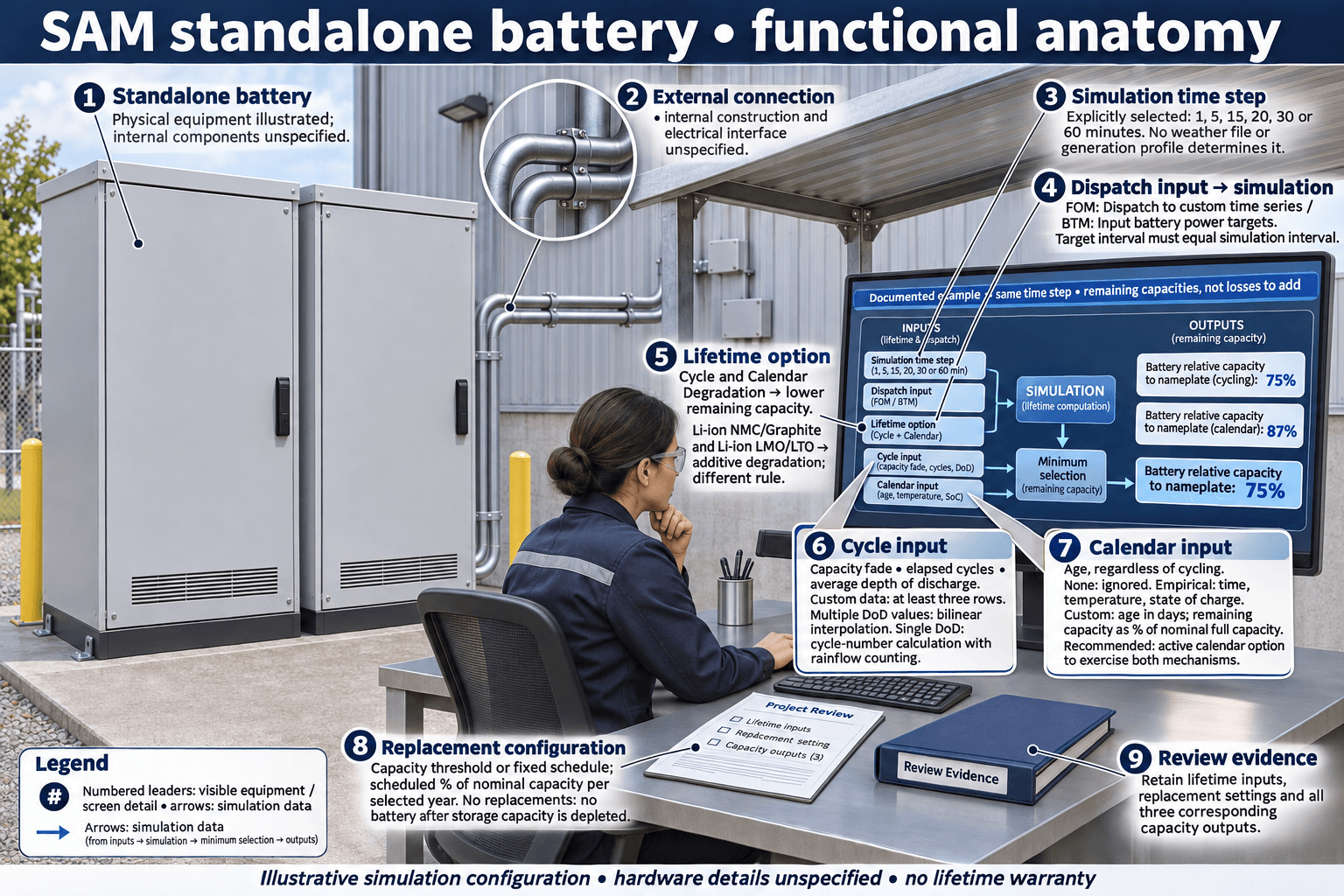
For a standalone-battery lifetime acceptance run in SAM, require two checks: the power-target interval must match the simulation time step for the applicable dispatch mode, and the selected Cycle and Calendar Degradation model must report the lower of the cycling and calendar remaining-capacity values. Treat this as acceptance of a simulation configuration and its results; it does not establish a battery product’s warranted lifetime.
SAM’s Simulation Time Step help explains that standalone batteries have no weather file or generation profile from which SAM can determine the simulation time step. The user therefore sets it explicitly. Allowed values are 1, 5, 15, 20, 30, and 60 minutes. When using Dispatch to custom time series for front-of-meter (FOM) batteries or Input battery power targets for behind-the-meter (BTM) batteries, the target-series time step must equal the simulation time step. SAM Help: Simulation Time Step
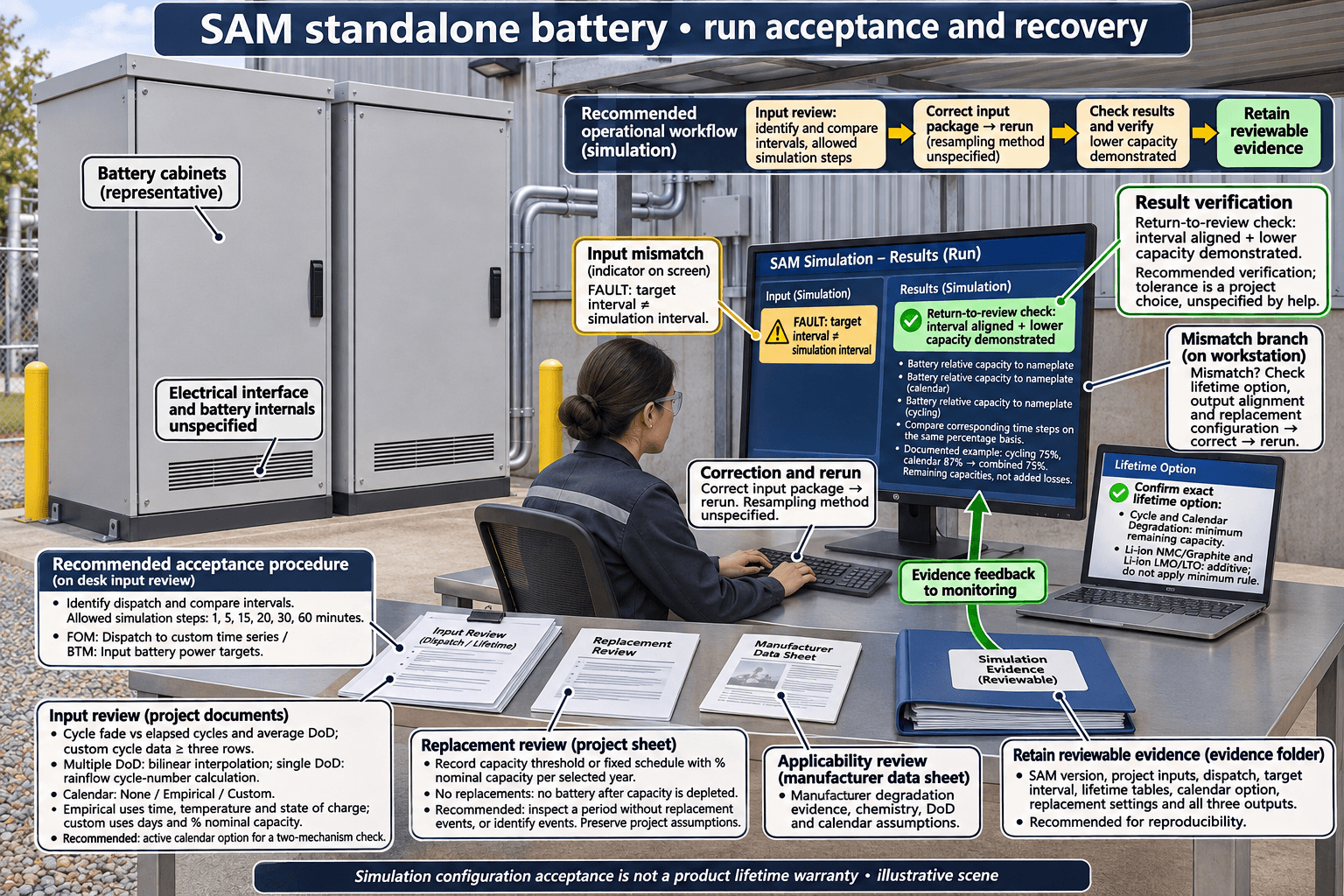
Before accepting a run, ask the analyst to identify the dispatch option and show both the simulation setting and the target-series interval. If they differ, require a corrected input package and a new run. This is a recommended acceptance procedure based on SAM’s matching requirement; the help does not prescribe a resampling method.
2. Confirm the lifetime model and its inputs
Record the exact lifetime option before interpreting degradation results. SAM distinguishes Cycle and calendar degradation, Li-ion NMC/Graphite, and Li-ion LMO/LTO. The configurable Cycle and Calendar Degradation option uses the minimum remaining capacity from its two mechanisms. The two named internal lithium-ion models instead combine calendar and cycle degradation additively. Do not apply the minimum-capacity acceptance rule to those internal models. SAM Help: Battery Life
For the configurable model, cycle degradation depends on capacity-fade data at elapsed cycle counts and average depth of discharge. Custom cycle data require at least three rows. With multiple depth-of-discharge values, SAM uses bilinear interpolation; with a single depth-of-discharge value, the help describes a cycle-number calculation using rainflow counting. SAM Help: Battery Life
Calendar degradation represents capacity reduction with age, regardless of cycling. SAM offers None, Empirical, and Custom options. None ignores calendar degradation; the empirical option accounts for time, temperature, and state of charge; custom data express age in days and remaining capacity as a percentage of nominal full capacity. For a test intended to exercise both mechanisms, recommend using an active calendar option and documenting its inputs. SAM Help: Battery Life
3. Compare the three capacity outputs at matching time steps
Request these simulation-result variables together:
- Battery relative capacity to nameplate
- Battery relative capacity to nameplate (calendar)
- Battery relative capacity to nameplate (cycling)
SAM’s Battery Life help explicitly identifies these variables for verifying the minimum-capacity behavior. At each inspected time step, compare the combined result with the lower remaining-capacity value from the two mechanism-specific outputs. Use corresponding time steps and a consistent percentage basis. SAM Help: Battery Life
The document’s own example gives cycling remaining capacity of 75% and calendar remaining capacity of 87%. For that example, SAM sets available capacity to 75%. These percentages represent remaining capacity; they are not two losses to add before calculating the combined result. SAM Help: Battery Life
As a recommended acceptance method, retain comparisons wherever the mechanism-specific values differ, so the lower-capacity selection is visible. Agree any comparison tolerance before review and document it as a project acceptance choice. The cited minimum-capacity description does not specify a numerical acceptance tolerance. Investigate a mismatch by checking the selected lifetime option, output alignment, and replacement configuration before approving the model setup.
4. Record replacement settings and retain a reviewable run
Replacement settings belong in the acceptance record because SAM can replace batteries either when capacity reaches a specified threshold or according to a fixed schedule. A scheduled replacement can specify the percentage of nominal capacity replaced in each selected year, regardless of degradation. With No replacements, SAM operates without a battery after available storage capacity is depleted. SAM Help: Battery Life
For a focused degradation check, recommend inspecting a period without replacement events, or clearly identifying those events in the results. Do not silently change the project’s replacement assumptions to obtain a simpler comparison.
Ask the analyst to retain the SAM application version used, project inputs, dispatch selection, target-series interval, lifetime tables, calendar option, replacement settings, and the three capacity outputs. Recording the application version is a reproducibility recommendation, not a claim about version information in the help pages.
Accept the configuration check when the applicable target interval matches an allowed simulation time step and the results demonstrate the documented minimum-capacity rule for the selected configurable model. SAM’s Battery Life documentation describes model behavior; it does not establish model-specific product endurance or a supplier warranty. Before using the run in a procurement decision, request the battery manufacturer’s applicable degradation data and check that the entered chemistry, depth-of-discharge data, and calendar assumptions represent the proposed equipment and operating conditions.
FAQ
Why must the standalone-battery time step be entered?
SAM’s Simulation Time Step help says there is no weather file or generation profile from which to determine it.
Which simulation intervals are allowed?
SAM allows 1, 5, 15, 20, 30, and 60 minutes for standalone batteries.
When must power-target and simulation intervals match?
They must match for FOM Dispatch to custom time series and BTM Input battery power targets.
Does Cycle and Calendar Degradation add both losses?
No. This configurable option sets available capacity to the lower of the calendar and cycling remaining capacities.
Which outputs demonstrate that behavior?
Compare Battery relative capacity to nameplate with its calendar and cycling counterparts at corresponding time steps.
Does the minimum rule apply to every SAM lifetime option?
No. Battery Life help describes additive degradation for the internal Li-ion NMC/Graphite and Li-ion LMO/LTO models.
What custom lifetime-data requirements should be checked?
Custom cycle data need at least three rows. Custom calendar data use battery age in days and capacity as a percentage of nominal full capacity.
How should replacement events be handled during review?
Record the replacement configuration and identify events in the results. For a focused check, inspect a period without replacements where practical.
Procurement paths
About the Author

Cinn Song
Founder & Chief Solutions Architect
Cinn Song founded SOLARTODO LIMITED and leads its smart-city infrastructure engineering — from solar, storage and integrated smart poles to the company's push into physical-AI city edge nodes: pole-mounted edge computing, vertical LLMs for smart cities, drone-based O&M with autonomous battery swapping, robotic maintenance, and high-speed counter-UAS interception. Since 2010, he has directed turnkey EPC + BOT delivery across 50+ countries, including telecom monopole supply for national grid operators, off-grid solar street-lighting for African municipalities, and integrated smart-pole programs for Gulf smart cities.
Cite This Article
Cinn Song. (2026). SAM Battery Acceptance: Match Time Steps and Check Capacity. SOLARTODO. Retrieved from https://solartodo.com/knowledge/how-should-a-standalone-battery-lifetime-acceptance-run-align-power-target-and-simulation-time-steps-and-check-that-the
@article{solartodo_how_should_a_standalone_battery_lifetime_acceptance_run_align_power_target_and_simulation_time_steps_and_check_that_the,
  title = {SAM Battery Acceptance: Match Time Steps and Check Capacity},
  author = {Cinn Song},
  journal = {SOLARTODO Knowledge Base},
  year = {2026},
  url = {https://solartodo.com/knowledge/how-should-a-standalone-battery-lifetime-acceptance-run-align-power-target-and-simulation-time-steps-and-check-that-the},
  note = {Accessed: 2026-11-09}
}
Published: November 9, 2026 | Available at: https://solartodo.com/knowledge/how-should-a-standalone-battery-lifetime-acceptance-run-align-power-target-and-simulation-time-steps-and-check-that-the
Subscribe to Our Newsletter
Get the latest solar energy news and insights delivered to your inbox.
View All Articles