Streetlight Acceptance: Undervoltage vs 0–10V Tests

Cinn Song
Founder & Chief Solutions Architect
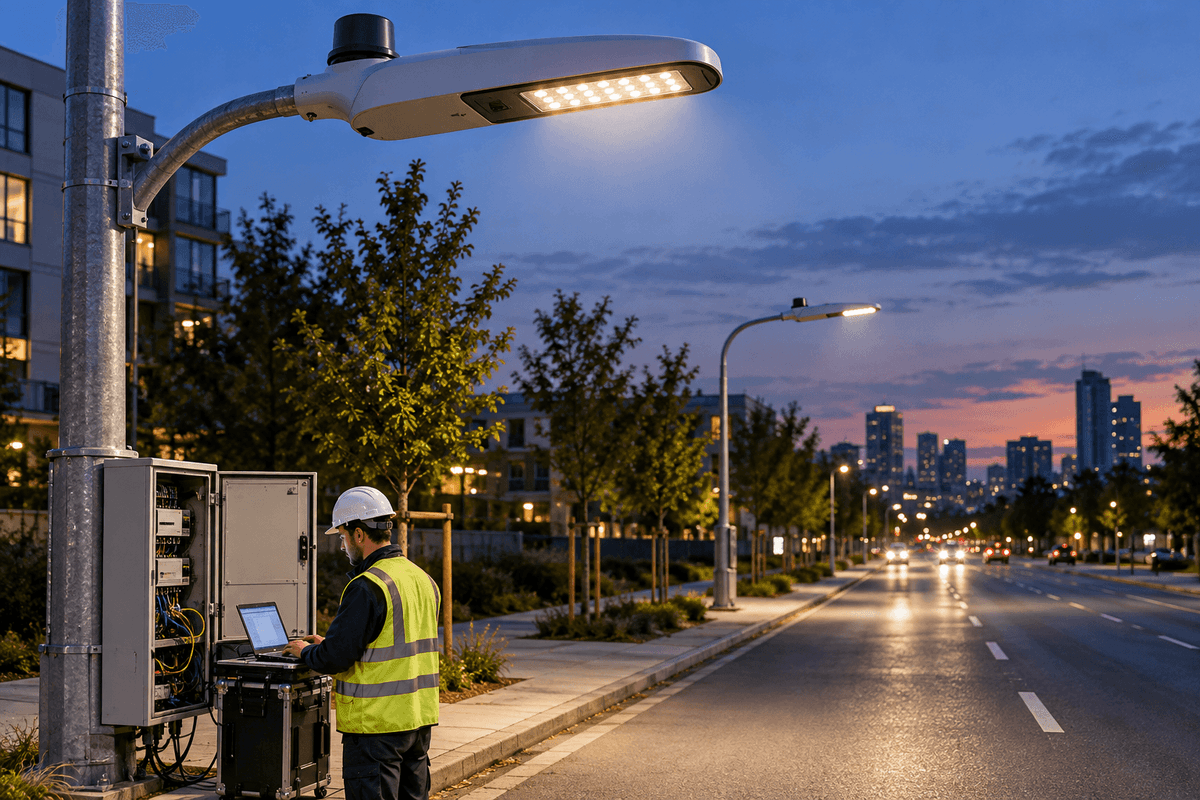
TL;DR
Identify the equipment and agree on limits first. Recommend varying supply voltage with dimming fixed, then varying dimming with supply fixed. Measure both conditions and lighting response; investigate interactions before assigning a cause.
Request separate supply-voltage and 0–10V interface tests, then investigate combined conditions. Define equipment, measurements and acceptance criteria beforehand. The DOE research summaries support investigating both paths but provide no universal fault thresholds or product-specific acceptance results.
Key Takeaways
- Specify separate supply-voltage and dimming-interface investigations before combined-condition testing.
- Identify the exact luminaire, driver, controller, revisions, wiring and settings covered by acceptance.
- Recommend holding the dimming condition fixed during supply tests and the supply fixed during interface tests.
- Request synchronized measurements with stated accuracy and calibration arrangements.
- Keep combined-condition and inconclusive findings open until a discriminating test resolves them.
- Verify applicable ANSI C137.1–2022 requirements and equipment-specific evidence before accepting a compliance claim.
Streetlight Fault Diagnosis: Separate Supply-Voltage Tests from 0–10V Control Tests
Summary
For procurement acceptance, request separate tests of supply voltage and the 0–10V dimming interface, followed by combined-condition testing. Specify the equipment configuration, measurement accuracy, operating conditions and acceptance criteria before testing. Treat the procedure below as a recommended investigation framework: DOE’s research summaries identify both subjects but do not establish universal fault signatures or numerical pass limits.
1. Establish two investigation paths
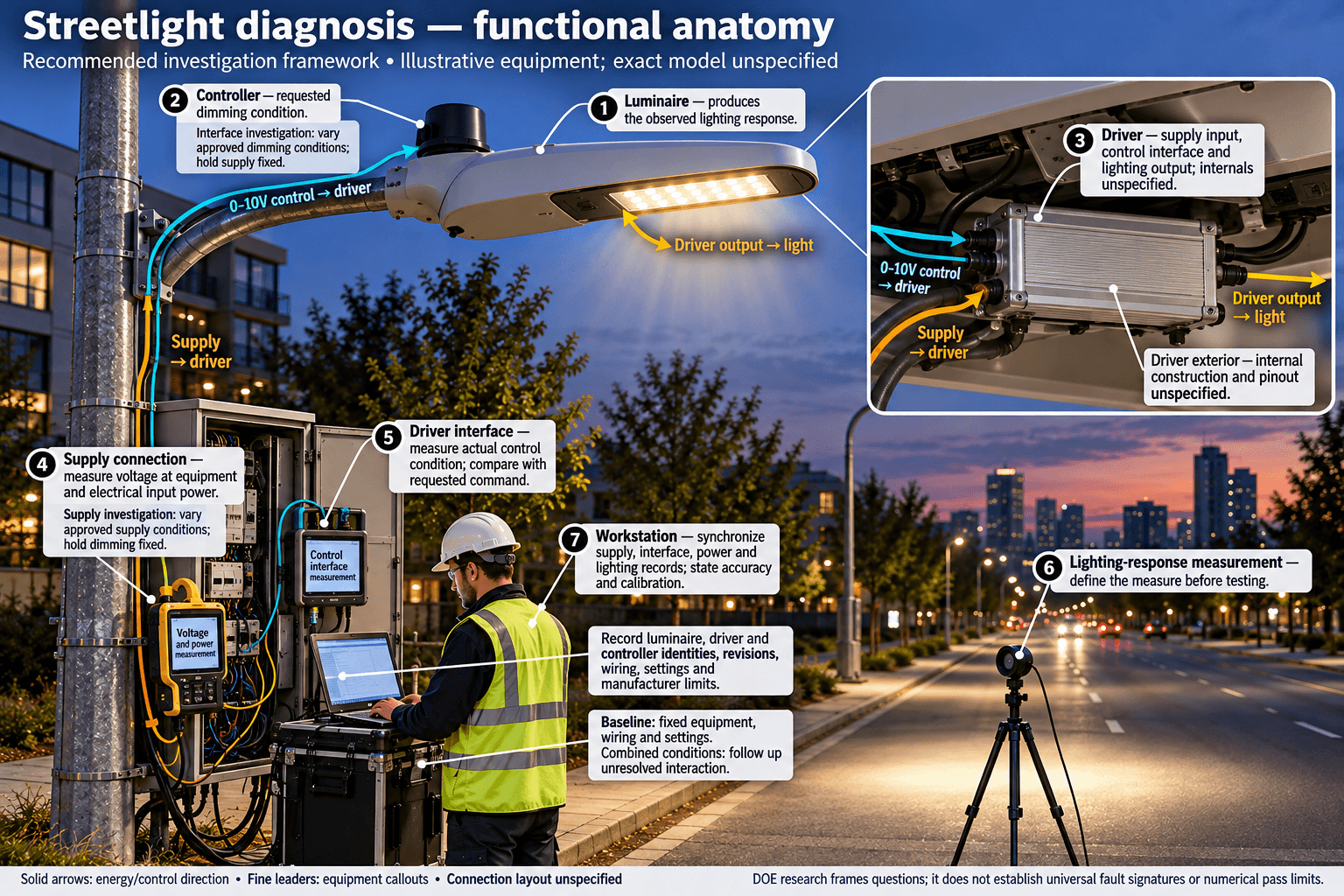
DOE’s Sensors and Fault Detection page describes PNNL research focused on lighting issues associated with undervoltage conditions and related faults. Separately, DOE’s Interoperability page describes a laboratory investigation into operational issues and energy impacts associated with 0–10V streetlight controls. These research topics justify investigating both supply conditions and control behavior; they do not establish the cause of an individual streetlight problem. DOE: Sensors and Fault Detection; DOE: Interoperability.
Buyers should therefore request two investigation paths in the acceptance plan. One should examine behavior as the electrical supply changes while the dimming condition remains fixed. The other should examine behavior as the dimming condition changes while the supply remains fixed. A combined test should follow if the separate tests leave an unresolved interaction.
Before approving the plan, request the exact luminaire, driver and controller identities; applicable revisions; wiring arrangement; configuration settings; and manufacturer-declared operating limits. Ask the test provider to identify the documents used to select each test condition. Do not insert an assumed undervoltage threshold or dimming acceptance curve into the contract.
2. Recommend a controlled comparison
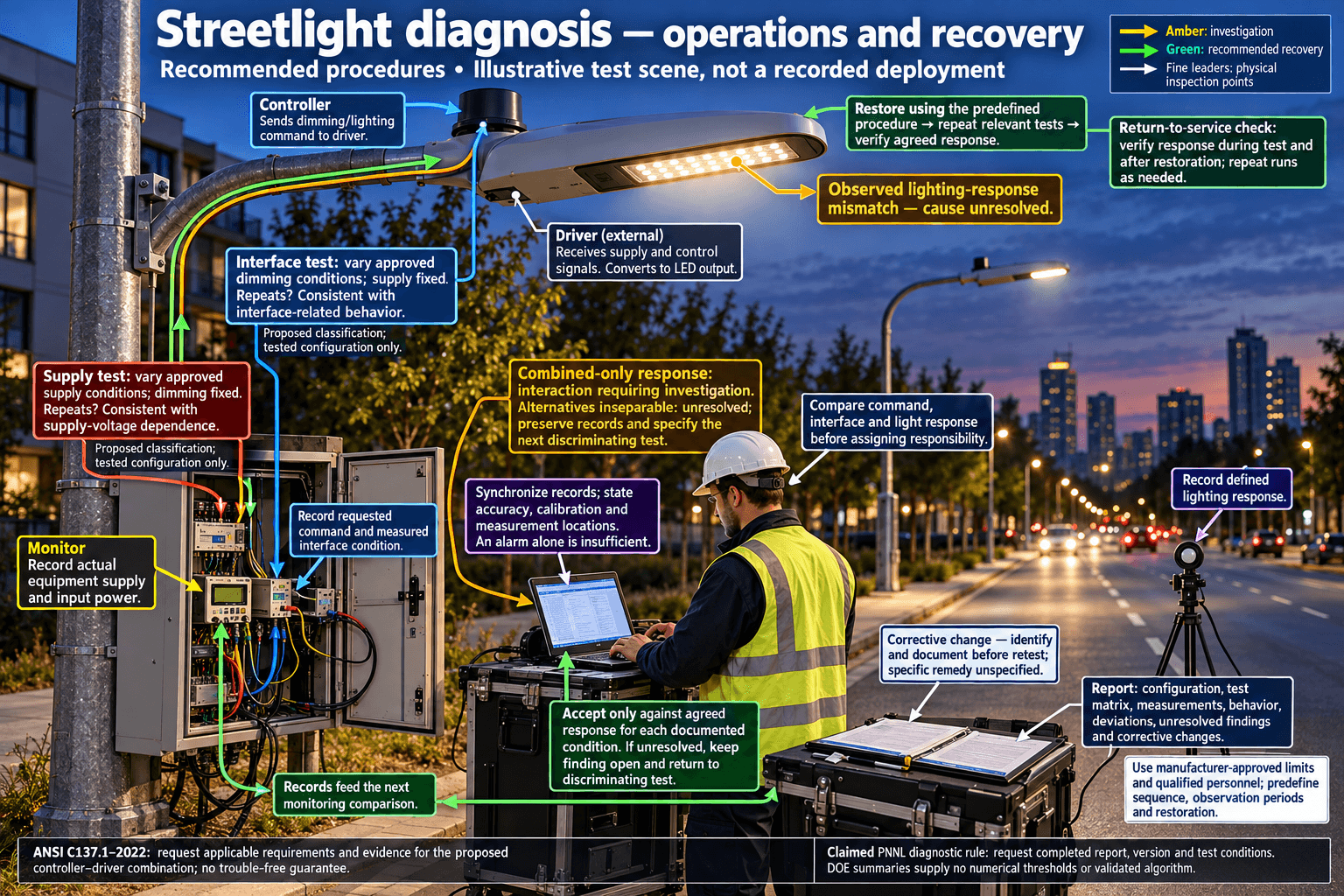
The following matrix is a recommended procurement method, not a reproduction of a PNNL test procedure:
| Test stage | Hold constant | Deliberately vary | Evidence to request |
|---|---|---|---|
| Baseline | Equipment, wiring and selected settings | Nothing intentionally | Supply, control condition, power and lighting response |
| Supply investigation | Selected dimming condition | Approved supply-voltage conditions | Response during each condition and after restoration |
| Interface investigation | Selected supply condition | Approved dimming commands or control conditions | Command, measured interface condition and lighting response |
| Interaction investigation | Equipment configuration | Selected combinations from earlier stages | Whether the observed response changes under combined conditions |
For each stage, recommend recording the actual supply voltage at the equipment under test, the control condition at the driver interface, electrical input power and a defined measure of lighting response. Request synchronized records so reviewers can compare the observations from the same test interval.
Have the supplier define the sequence, observation periods, measurement locations and restoration procedure before execution. Ask for repeat runs where necessary to assess reproducibility. Use manufacturer-approved limits and qualified test personnel when defining electrical test conditions.
3. Classify findings without overstating causation
Recommend classifying an observation as consistent with supply-voltage dependence when it repeats during supply variation with the selected dimming condition held fixed. Record the tested voltage conditions and the measured control condition alongside that finding. This classification should remain limited to the tested configuration.
Recommend classifying an observation as consistent with interface-related behavior when it repeats during control variation under the selected stable supply condition. Ask the reviewer to compare the requested command, measured interface condition and lighting response before assigning responsibility to a component.
If a response appears only under combined conditions, retain an interaction requiring investigation classification. If the measurements cannot separate the alternatives, record the cause as unresolved and specify the next discriminating test. These labels are proposed reporting conventions, not diagnostic categories established by the DOE pages.
DOE also cautions that sensor-data accuracy matters for data-dependent applications and is often inadequately specified. Accordingly, require the test provider to state measurement accuracy and calibration arrangements; do not make a dashboard alarm the sole acceptance record. DOE: Sensors and Fault Detection.
4. Turn the evidence into a purchasing decision
Make acceptance depend on an agreed response for each documented test condition. Request a report containing the configuration, test matrix, measurement records, observed behavior, deviations and unresolved findings. Require any corrective change to be identified before the relevant tests are repeated.
For standards-related claims, DOE’s Interoperability page identifies The Energy and Operational Impacts of Using 0-10V Control for LED Streetlights, dated December 2023. It says the investigation evaluated whether and how ANSI C137.1–2022 might reduce the occurrence or severity of the issues studied. That summary does not establish that the standard eliminates those issues or that a particular controller–driver combination complies. Ask the supplier to identify the applicable requirements and submit evidence for the proposed combination. DOE: Interoperability.
The Sensors and Fault Detection page lists Streetlight Faults Associated with Undervoltage Conditions and Methods for Automated Fault Detection as “in progress.” Before adopting a claimed PNNL diagnostic rule, request the completed report, its version and the relevant test conditions. The page summary alone does not supply numerical thresholds or a validated classification algorithm. DOE: Sensors and Fault Detection.
Use these research references to frame questions and evidence requests. Set contractual limits for the actual equipment and project; neither page establishes a purchasing requirement for other countries.
FAQ
What should the buyer request first?
Request the equipment identities, revisions, wiring, operating limits and a test matrix that separates supply-voltage variation from dimming-interface variation.
How should an undervoltage investigation be structured?
Recommend holding the selected dimming condition fixed while varying supply voltage through approved test conditions and recording the response.
How should the 0–10V interface be investigated?
Recommend holding the selected supply condition fixed while varying approved dimming conditions and comparing commands, interface measurements and lighting response.
When should combined-condition tests be used?
Use them as a recommended follow-up when separate tests leave a possible interaction unresolved.
What measurement evidence should accompany the report?
Request synchronized supply-voltage, interface-condition, input-power and lighting-response records, with measurement locations, accuracy and calibration arrangements.
Does ANSI C137.1–2022 guarantee trouble-free operation?
The DOE Interoperability summary does not establish that guarantee. Request applicable requirements and test evidence for the proposed equipment combination.
What numerical undervoltage threshold should acceptance use?
The DOE page summaries do not specify one. Ask the supplier to justify proposed limits using the actual equipment documentation and agreed test conditions.
How should an inconclusive result be reported?
Recommend recording the cause as unresolved, preserving the measurements and identifying the next test needed to distinguish the alternatives.
Procurement paths
About the Author

Cinn Song
Founder & Chief Solutions Architect
Cinn Song founded SOLARTODO LIMITED and leads its smart-city infrastructure engineering — from solar, storage and integrated smart poles to the company's push into physical-AI city edge nodes: pole-mounted edge computing, vertical LLMs for smart cities, drone-based O&M with autonomous battery swapping, robotic maintenance, and high-speed counter-UAS interception. Since 2010, he has directed turnkey EPC + BOT delivery across 50+ countries, including telecom monopole supply for national grid operators, off-grid solar street-lighting for African municipalities, and integrated smart-pole programs for Gulf smart cities.
Cite This Article
Cinn Song. (2026). Streetlight Acceptance: Undervoltage vs 0–10V Tests. SOLARTODO. Retrieved from https://solartodo.com/knowledge/how-should-streetlight-fault-diagnosis-testing-distinguish-undervoltage-related-faults-from-operational-problems-caused
@article{solartodo_how_should_streetlight_fault_diagnosis_testing_distinguish_undervoltage_related_faults_from_operational_problems_caused,
  title = {Streetlight Acceptance: Undervoltage vs 0–10V Tests},
  author = {Cinn Song},
  journal = {SOLARTODO Knowledge Base},
  year = {2026},
  url = {https://solartodo.com/knowledge/how-should-streetlight-fault-diagnosis-testing-distinguish-undervoltage-related-faults-from-operational-problems-caused},
  note = {Accessed: 2026-10-29}
}
Published: October 29, 2026 | Available at: https://solartodo.com/knowledge/how-should-streetlight-fault-diagnosis-testing-distinguish-undervoltage-related-faults-from-operational-problems-caused
Subscribe to Our Newsletter
Get the latest solar energy news and insights delivered to your inbox.
View All Articles