When to Price Streetlight Sensors as a Tender Option

Cinn Song
Founder & Chief Solutions Architect
TL;DR
Keep environmental sensors out of the base bid when no one has a defined use for the readings. If an option price is useful, compare bids on the same scope and buy only after confirming the data owner, intended action and acceptance criteria.
With no defined use for environmental readings, leave the sensors out of the streetlighting base bid. Request a separate option price if it serves a budgeting purpose, specify common quantities and scope for bid comparison, and exercise the option only after defining who will use the readings, what action they support and how their accuracy will be verified.
Summary
With no defined use for environmental readings, leave the sensors out of the streetlighting base bid. Request a separate option price if it serves a budgeting purpose, specify common quantities and scope for bid comparison, and exercise the option only after defining who will use the readings, what action they support and how their accuracy will be verified.
Key Takeaways
- Evaluate the base bid on the lighting and controls the project requires.
- Request separate sensor pricing when the buyer needs a budget for possible future use.
- Use common sensor quantities, locations and deliverables when comparing firm option prices.
- Ask bidders to itemize integration, commissioning, calibration and recurring charges where applicable.
- Require an operating owner, a defined action and a reporting accuracy requirement before buying sensors.
- Check the offered pole and control interfaces before relying on later installation.
Put environmental sensing on a separate price line
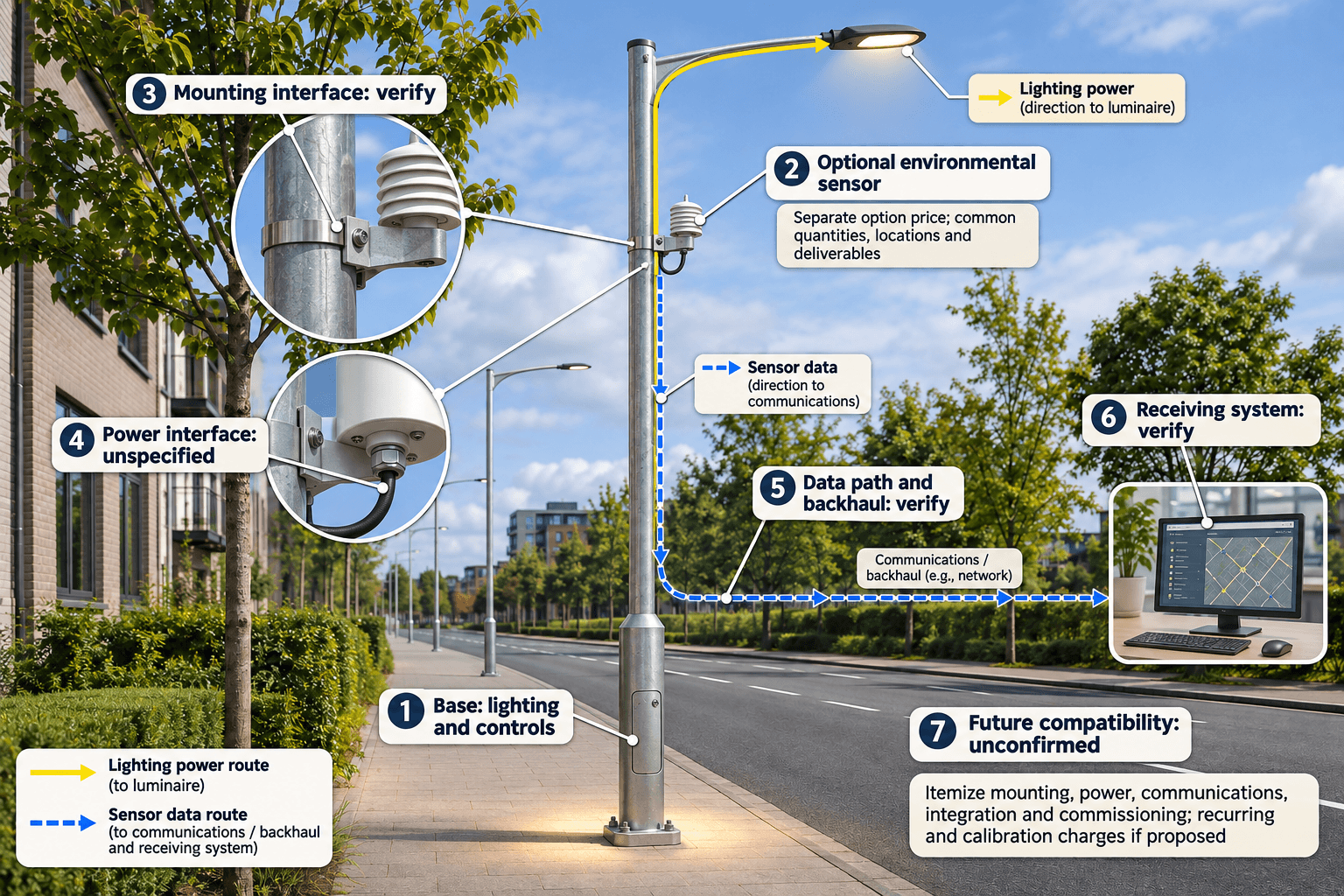
Yes. If the buyer has no identified operational use for environmental readings from streetlight poles, keep the hardware out of the base bid. If the buyer wants a price for possible future use, request a separately priced option and defer purchase until an operating team can specify how it will use the readings. Evaluate the base bid against the lighting and control functions the project actually requires.
The U.S. Department of Energy reports that the value of sensor-based use cases in connected lighting has been difficult to quantify and that reporting accuracy is often poorly specified. The DOE’s Model Specification for Networked Outdoor Lighting Control Systems, V2.0 distinguishes broadly recommended provisions from optional ones. Use that distinction as a drafting reference. Separate pricing for environmental sensors is a project recommendation, and the buyer should check the applicable purchasing rules before issuing the tender. DOE Sensors and Fault Detection · DOE Model Specification V2.0
Ask bidders to price the same scope
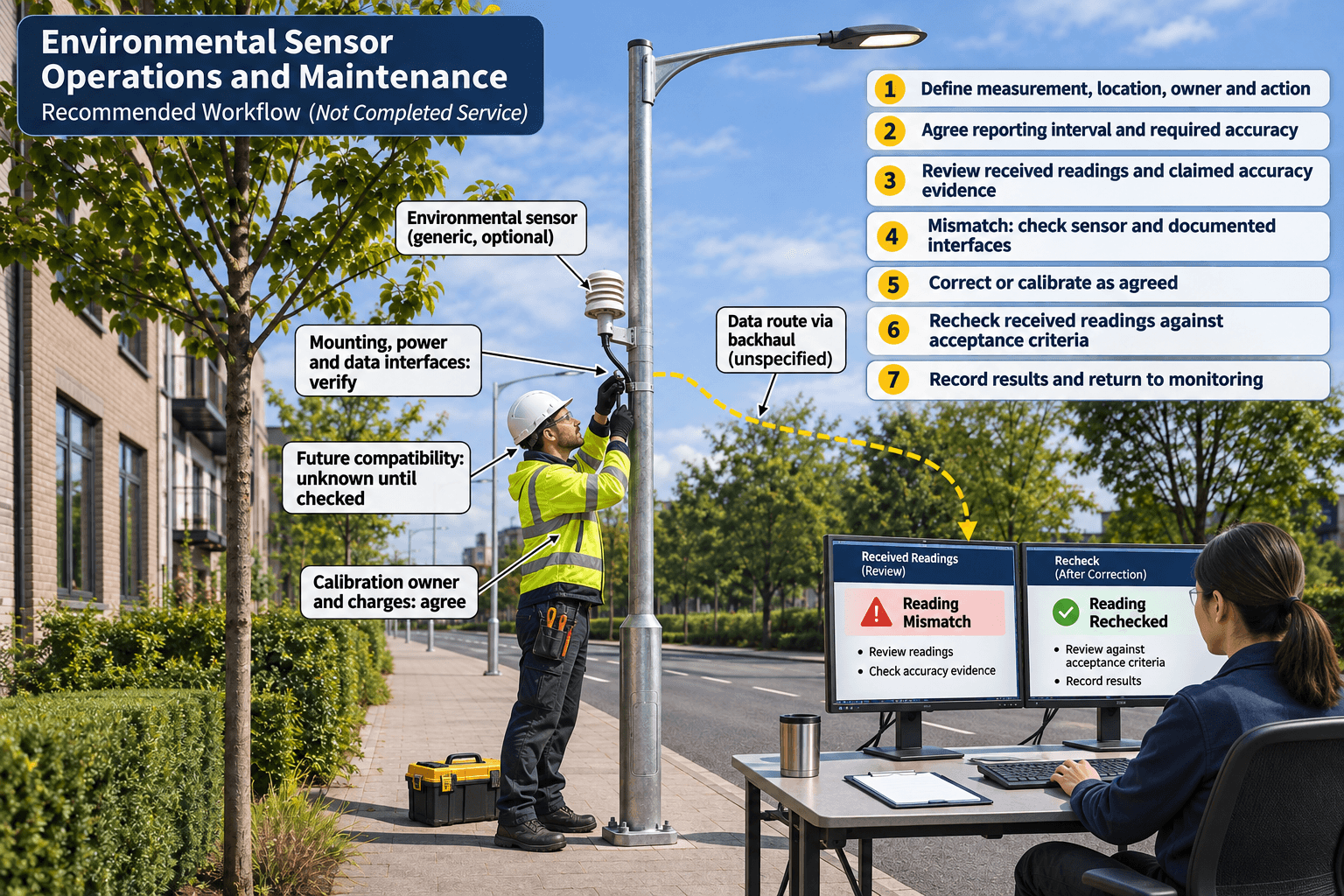
Describe the base lighting and controls in the main price schedule. Give environmental sensing its own line and state whether that line is for budgeting or may be exercised at award. If the tender defines sensor types, quantities and locations, ask bidders to price against those inputs. If those details are still open, request an indicative price with explicit assumptions. Compare optional prices only after checking that bidders have priced comparable quantities and deliverables.
Ask each bidder to identify what its option price covers, including hardware and any mounting, power, communications, software integration or commissioning work its design requires. Request separate prices for any recurring fees or calibration services the bidder proposes. The DOE’s Model Specification V2.0 addresses backhaul, distinguishes start-up from commissioning and supports independent bids for central management systems, backhaul networks and field devices. Use those categories to check who has priced each interface, especially when different suppliers are bidding on the pole and the control system. DOE Model Specification V2.0
Define the operating decision before exercising the option
Ask the prospective data owner to identify what needs to be measured, where readings are needed, who will review them and what action the readings will inform. Then agree on the reporting interval and the accuracy needed for that action. Ask the bidder to state its claimed reporting accuracy, the conditions under which it applies and the evidence it can provide for the proposed sensor. Set an acceptance check for the readings the operator will receive and agree on who will handle calibration. DOE’s Sensors and Fault Detection highlights reporting accuracy and points buyers to PNNL’s September 2020 Specifying Calibration of Environmental Sensors report and specification template for requesting calibration services. DOE Sensors and Fault Detection
Verify separately if installation may come later
If deferred installation matters, ask the bidder to identify which provisions it proposes to include at initial installation and which work it expects to perform later. Request drawings or interface documentation for the offered configuration covering mounting, power, the data path and the receiving system. Ask the bidder to identify any assumptions that affect its later-installation price. The DOE’s Model Specification V2.0 provides a framework for discussing field devices, backhaul and central management. Compatibility with a future sensor remains unknown until the buyer checks the proposed sensor against the documented interfaces for the offered configuration. DOE Model Specification V2.0
FAQ
Should every pole include environmental sensors in the base price?
Leave them out when the buyer has no operational use for the readings. Request a separate price if it will inform a future procurement decision.
What if the sensor type or quantity is undecided?
Request an indicative price and ask bidders to list their assumptions. Define a common scope before comparing firm offers.
Should bidders quote integration separately from hardware?
Ask bidders to itemize any proposed mounting, power, communications, software integration and commissioning so you can see what each price covers.
Who should decide whether to exercise the option?
Ask the team that would use the readings to identify the operating decision and confirm who will act on the data.
What should the buyer ask about accuracy?
Request the claimed reporting accuracy, the conditions under which it applies and evidence for the offered sensor. Agree on an acceptance check tied to the intended use.
How should calibration be quoted?
When calibration is needed, ask what service the bidder proposes, who will perform it and which charges apply. For help specifying the service, see the PNNL calibration template listed by DOE. DOE Sensors and Fault Detection
How can the buyer verify a later installation path?
Check the proposed sensor against the mounting, power and data interfaces documented for the offered pole and control system. Ask the bidder to identify any additional work.
What role should DOE’s model specification play outside the U.S.?
Use V2.0 as a drafting reference for structuring bids and verify the rules governing options and evaluation in the project’s jurisdiction. DOE Model Specification V2.0
Procurement paths
About the Author

Cinn Song
Founder & Chief Solutions Architect
Cinn Song founded SOLARTODO LIMITED and leads its smart-city infrastructure engineering — from solar, storage and integrated smart poles to the company's push into physical-AI city edge nodes: pole-mounted edge computing, vertical LLMs for smart cities, drone-based O&M with autonomous battery swapping, robotic maintenance, and high-speed counter-UAS interception. Since 2010, he has directed turnkey EPC + BOT delivery across 50+ countries, including telecom monopole supply for national grid operators, off-grid solar street-lighting for African municipalities, and integrated smart-pole programs for Gulf smart cities.
Cite This Article
Cinn Song. (2026). When to Price Streetlight Sensors as a Tender Option. SOLARTODO. Retrieved from https://solartodo.com/knowledge/if-the-buyer-has-no-identified-operational-use-for-environmental-readings-from-streetlight-poles-should-environmental
@article{solartodo_if_the_buyer_has_no_identified_operational_use_for_environmental_readings_from_streetlight_poles_should_environmental,
  title = {When to Price Streetlight Sensors as a Tender Option},
  author = {Cinn Song},
  journal = {SOLARTODO Knowledge Base},
  year = {2026},
  url = {https://solartodo.com/knowledge/if-the-buyer-has-no-identified-operational-use-for-environmental-readings-from-streetlight-poles-should-environmental},
  note = {Accessed: 2026-11-27}
}
Published: November 27, 2026 | Available at: https://solartodo.com/knowledge/if-the-buyer-has-no-identified-operational-use-for-environmental-readings-from-streetlight-poles-should-environmental
Subscribe to Our Newsletter
Get the latest solar energy news and insights delivered to your inbox.
View All Articles