LED Street Lighting Energy Savings Report 2026: Before &…

Cinn Song
Founder & Chief Solutions Architect
Watch the video
TL;DR
LED street lighting is one of the most bankable municipal efficiency upgrades in 2026. City programs show 50-70% energy savings, Los Angeles reports 114 GWh saved per year, and Chicago expects $100 million in 10-year electricity savings. Buyers should compare FOB, CIF, and EPC turnkey pricing and add controls where tariffs or maintenance costs are high.
LED street lighting retrofits cut city lighting energy use by 50-70%, with Los Angeles saving 114 GWh/year and Chicago saving $100M over 10 years after 270,000+ smart LED replacements.
Summary
LED street lighting retrofits cut city lighting energy use by 50-70%, with Los Angeles saving 114 GWh/year and Chicago saving $100M over 10 years after 270,000+ smart LED replacements.
Key Takeaways
LED street lighting projects usually deliver 50-70% energy savings, 10-year fixture life, and 3-7 year payback when tariffs exceed $0.12/kWh.
- Audit legacy HPS assets at 250-400 W per fixture before specifying 50-150 W LED replacements for 50-70% lower connected load.
- Prioritize networked controls on arterial roads because adaptive dimming can add 20-40% savings beyond basic LED conversion.
- Benchmark city results against Los Angeles at 114 GWh/year saved and Chicago at $100M expected electricity savings over 10 years.
- Specify IP66 luminaires, 7-pin or Zhaga-D4i sockets, and 100,000-hour L70 drivers for lower maintenance dispatch risk.
- Use smart poles where 4K camera, WiFi, audio, display, and sensing modules can reduce 5 asset locations to 1 integrated pole.
- Model ROI by tariff: payback can be 3-4 years in Europe, 4-6 years in North America, and 5-8 years in emerging markets.
- Procure FOB, CIF, or EPC turnkey packages with volume discounts of 5% at 50+, 10% at 100+, and 15% at 250+ poles.
- Require IEC 60598, IEC 62722, surge protection, and photometric files before approving 9 m or 10 m commercial street deployments.
LED Street Lighting Energy Savings in 2026
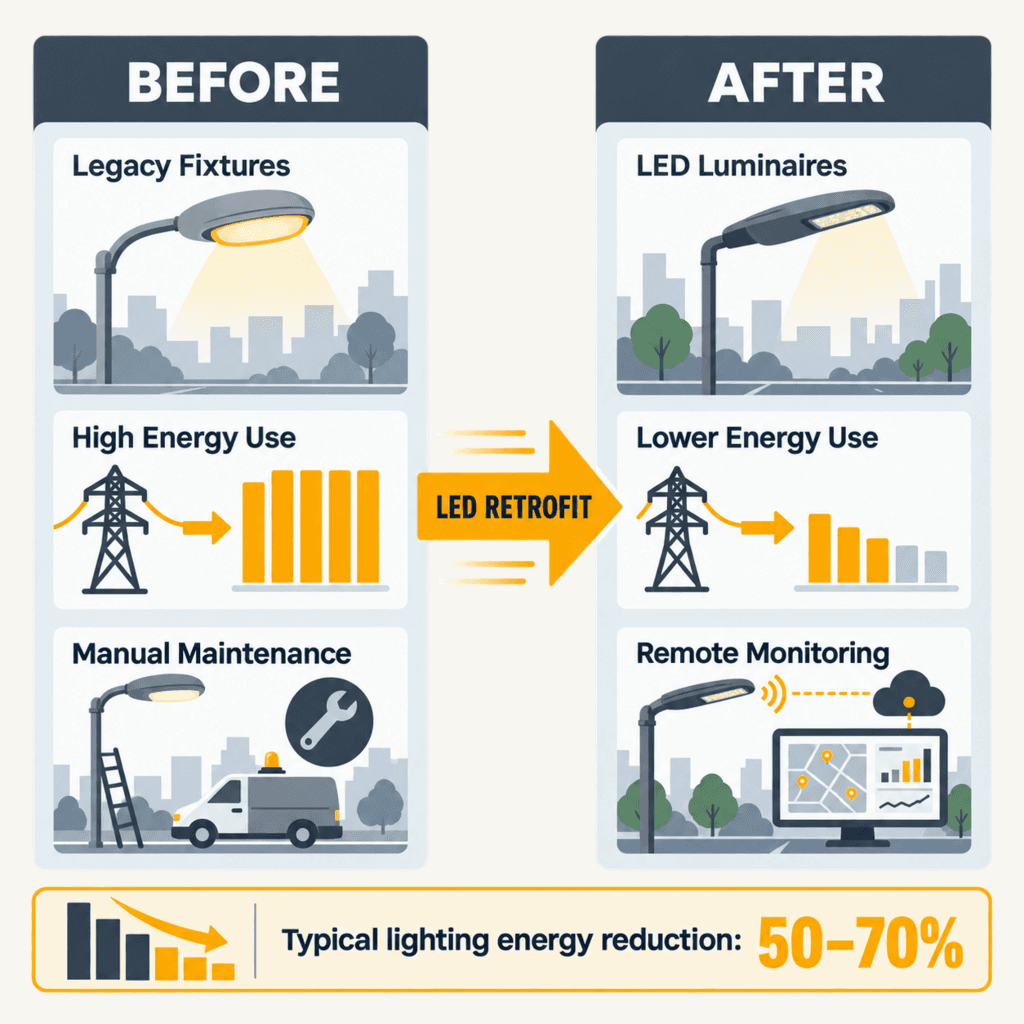
Municipal LED street lighting in 2026 typically reduces fixture energy consumption by 50-70% while improving visibility, maintenance response, and smart-city readiness.
The core before-and-after pattern is consistent: cities replace 250-400 W high-pressure sodium or mercury-vapor fixtures with 50-150 W LED luminaires, then add controls where traffic patterns justify dimming. According to the IEA (2026), lighting in buildings and outdoor applications used around 2,200 TWh in 2024, equal to about 8% of global electricity demand. The IEA states, 'LED technology is the most efficient way to convert electrons into photons.'
For B2B buyers, the energy case is no longer theoretical. Los Angeles reports 64% energy savings, 114 GWh saved annually, and about $10 million in annual energy savings from its LED street lighting program. Chicago replaced more than 270,000 fixtures and expects $100 million in electricity cost savings over 10 years. San Diego reported more than 50% streetlight energy reduction from 2010 to 2015 after LED upgrades and adaptive controls.
SOLARTODO positions LED street lighting as infrastructure modernization, not a lamp swap. A 9 m smart streetlight with a 120 W LED luminaire at 170 lm/W produces about 20,400 lumens and can be spaced around 28 m on commercial streets, subject to photometric design. For developers, EPC contractors, and municipalities, the business value is lower kWh consumption, fewer truck rolls, and a pole platform that can support surveillance, WiFi, display, audio, and environmental sensing.
| Metric | Legacy HPS baseline | 2026 LED retrofit | Typical improvement |
|---|---|---|---|
| Fixture power | 250-400 W | 50-150 W | 50-70% lower load |
| Efficacy | 80-120 lm/W system | 150-200+ lm/W | 40-100% more light per watt |
| Service life | 3-5 years lamp cycle | 10-15 years fixture cycle | 2-4x longer interval |
| Control capability | On/off photocell | Dimming, CMS, outage alerts | 20-40% extra savings possible |
| Maintenance model | Reactive patrols | Remote fault detection | 20%+ faster outage response potential |
Before-and-After City Case Data
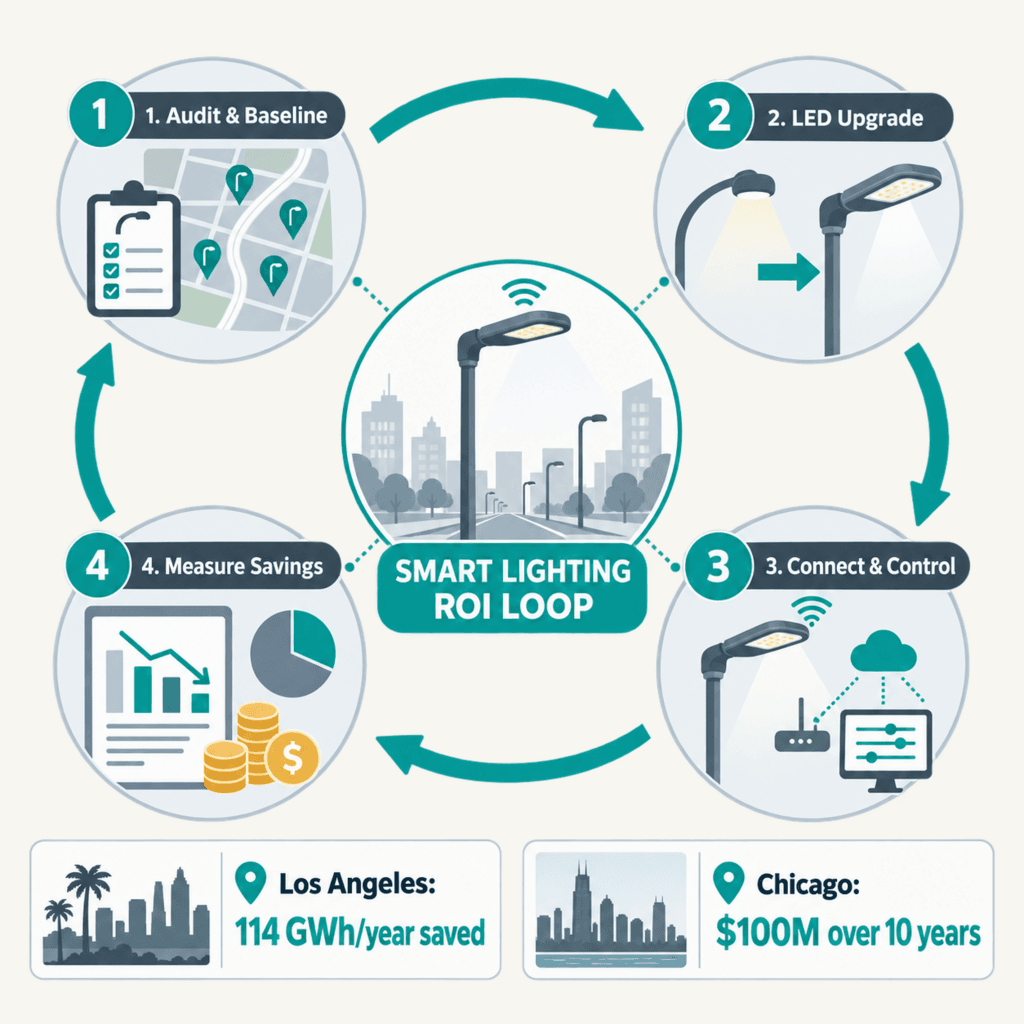
Real city programs show before-and-after savings from 50% to 64%, with annual benefits ranging from $5.4 million to $10 million or more.
According to the Los Angeles Bureau of Street Lighting (2026), the city reached a 98% LED street lighting system and reports 64% energy savings. Its program saves 114 GWh annually, reduces carbon emissions by 67,000 metric tons, and generates about $10 million per year in energy savings. This is a strong benchmark for large cities with mature utility billing and standardized cobrahead replacement programs.
According to the U.S. DOE Integrated Lighting Campaign (2022), Chicago replaced more than 280,000 HPS fixtures with LEDs over four years. The project cost about $160 million, cut the 2021 energy bill by more than half, saved $8.7 million in that year, and received almost $34 million in ComEd rebates. Ameresco reports the program targeted 85% of city streetlights and achieved about 50% energy consumption reduction.
San Diego provides a different case: staged retrofits plus utility rate design. According to the DOE Better Buildings Solution Center, San Diego upgraded 35,000 city-owned streetlights and later added 3,600 LED LightGrid fixtures with wireless controls. The city cut streetlight energy use by more than 50% from 2010 to 2015 and used metered control data to support reduced billing structures.
| City or program | Before condition | After condition | Reported result |
|---|---|---|---|
| Los Angeles | Mixed HPS, incandescent, mercury vapor | 98% LED system by 2022 | 64% energy savings, 114 GWh/year saved |
| Chicago | HPS street, alley, and park lights | 270,000-280,000+ smart LEDs | $100M expected electricity savings over 10 years |
| San Diego | LPS and HPS streetlights | 35,000 upgrades plus 3,600 controlled LEDs | More than 50% energy reduction from 2010-2015 |
| Massachusetts MAPC | Conventional HPS assets | 116,139 LED streetlights | 35.1 million kWh/year and $5.4M/year projected savings |
| SOLARTODO smart pole model | Separate pole, CCTV, speaker, display, sensor | 6-in-1 integrated 9 m pole | Up to 60% fewer visible street furniture points |
Technical Deep Dive: LED, Controls, and Smart Pole Integration
A 120 W, 170 lm/W LED smart streetlight produces about 20,400 lumens and can replace many 250-400 W HID fixtures.
The technical savings come from three layers. First, LED chip and optical efficiency reduces watts per lumen. Second, drivers and optics place usable light on the roadway rather than spilling light upward or behind the pole. Third, controls dim or schedule light output by time, motion, traffic, or central management rules. According to the IEA (2026), LEDs sold today average close to 100 lm/W, while premium and professional LEDs can exceed 200 lm/W.
For a SOLARTODO 9 m commercial smart pole, the lighting module is 120 W at 170 lm/W, with IP66 enclosure protection and operating tolerance from -40°C to +55°C. The pole can integrate a 4K camera, environmental sensor package, LED display, WiFi access point, and IP public audio. On a 12-hour nightly schedule, the 120 W luminaire consumes about 525.6 kWh per year before dimming. A 30% dimming profile over 6 hours nightly can reduce consumption by another 10-15%.
Controls matter most where tariffs, maintenance costs, or outage penalties are high. A city that replaces 10,000 HPS fixtures averaging 250 W with 120 W LEDs reduces connected load by 1.3 MW. At 4,200 operating hours per year, that saves about 5.46 GWh before dimming. At $0.14/kWh, the energy-only savings are about $764,000 per year, excluding maintenance and rebates.
| Specification | Basic LED streetlight | Networked LED streetlight | SOLARTODO 6-in-1 smart pole |
|---|---|---|---|
| Typical wattage | 50-150 W | 50-150 W | 120 W lighting module |
| Efficacy | 130-180 lm/W | 150-200 lm/W | 170 lm/W |
| Controls | Photocell | CMS, dimming, outage alerts | Lighting plus smart modules |
| Protection | IP65-IP66 | IP66 recommended | IP66 |
| Service life | 50,000-100,000 hours | 75,000-100,000 hours | 25-year pole design life |
| Best use | Residential roads | Citywide retrofit | Commercial streets, campuses, mixed-use districts |
Regional Market and ROI Breakdown
LED street lighting payback in 2026 usually ranges from 3 to 8 years, depending on tariffs, rebates, labor, and control scope.
According to MarketsandMarkets (2025), the global smart lighting market was valued at $9.86 billion in 2025 and is projected to reach $17.38 billion by 2030, a 12.0% CAGR. According to Fortune Business Insights (2026), the smart street lighting market was $4.08 billion in 2025 and is projected to reach $19.83 billion by 2034, with Europe holding 41.30% share in 2025.
Asia-Pacific is the fastest procurement region for new smart-city corridors, industrial parks, and utility-led LED upgrades. Europe has high energy tariffs and strong carbon rules, which often shorten payback to 3-4 years when rebates or ESCO financing are available. North America has mature retrofit data and large city programs, while Middle East/Africa and Latin America often favor EPC packages that bundle poles, luminaires, controls, and financing.
According to BloombergNEF (2026), global energy transition investment reached $2.3 trillion in 2025, up 8% from 2024; Asia-Pacific accounted for 47% of the total. That capital environment supports smart infrastructure procurement, although lighting projects still require bankable M&V, clear asset registers, and realistic tariff assumptions.
| Region | 2026 demand driver | Typical LED savings | Indicative payback | Procurement note |
|---|---|---|---|---|
| Asia-Pacific | Smart-city corridors and new roads | 50-70% | 4-7 years | High volume, mixed greenfield and retrofit |
| Europe | Energy prices and carbon mandates | 55-70% | 3-5 years | Strong controls and standards focus |
| North America | Aging HPS stock and utility rebates | 50-64% | 4-6 years | Proven ESCO and citywide programs |
| Middle East/Africa | Urban expansion and heat resilience | 45-65% | 5-8 years | IP66, surge, and wind design critical |
| Latin America | Municipal cost reduction and safety | 50-65% | 5-8 years | Financing and phased EPC delivery important |
EPC Investment Analysis and Pricing Structure
EPC buyers should compare FOB, CIF, and turnkey pricing because logistics, installation, controls, and financing can shift total cost by 20-60%.
For SOLARTODO, EPC delivery normally covers engineering review, luminaire and pole supply, smart module integration, factory testing, packing, shipment support, installation guidance, commissioning, and documentation. A citywide retrofit may focus on luminaires and controls, while a commercial corridor may require 9 m or 10 m poles, foundations, AC 220/380 V integration, displays, cameras, WiFi, and public audio.
The three-tier pricing structure should be separated during procurement. FOB Supply covers factory equipment price and export packing at origin. CIF Delivered adds ocean freight, insurance, and destination port delivery. EPC Turnkey adds civil works, installation labor, commissioning, training, and local compliance support through approved partners. For planning, a 10 m community security smart streetlight may sit around $1,600-2,000 per pole before local civil works, while a display-equipped 6-in-1 commercial pole is project-priced by module set.
Volume guidance is straightforward: 50+ poles can target a 5% discount, 100+ poles can target 10%, and 250+ poles can target 15%, subject to module mix and steel price. Standard payment terms are 30% T/T deposit plus 70% against bill of lading, or 100% L/C at sight. Financing is available for large projects above $1,000K, with inquiries handled through [email protected].
| Pricing tier | Includes | Excludes | Best for |
|---|---|---|---|
| FOB Supply | Pole, LED, modules, export packing | Freight, duty, installation | Buyers with own forwarder and installer |
| CIF Delivered | FOB scope plus freight and insurance | Inland transport, civil works | Importers and municipal procurement teams |
| EPC Turnkey | Supply, delivery, installation, commissioning | Taxes unless specified | Cities, campuses, developers, PPP projects |
ROI should include energy, maintenance, rebates, and avoided asset duplication. A 1,000-pole retrofit from 250 W HPS to 120 W LED saves about 546,000 kWh/year at 4,200 hours. At $0.15/kWh, that equals $81,900/year in energy savings before dimming. If networked controls add 25% nighttime savings and maintenance falls by $25 per pole yearly, total annual benefit can exceed $125,000.
Year-over-Year Trends and 2030-2040 Outlook
The 2026 lighting cycle is moving from basic LED retrofits toward connected assets, with controls becoming standard by 2030 in high-tariff cities.
From 2020 to 2022, leading cities completed first-generation LED conversions, including Los Angeles reaching near-full LED penetration and Chicago finalizing a four-year, 280,000+ fixture program. From 2023 to 2025, the market shifted toward controls, smart-city platforms, and integrated pole assets. According to the IEA (2025), global electricity demand is forecast to rise 3.3% in 2025 and 3.7% in 2026, making municipal efficiency more valuable as grids face new load growth.
For 2027-2030, the strongest projects will pair LED luminaires with central management systems, adaptive dimming, outage tickets, and utility-grade measurement. IRENA states, 'renewables remained the most cost-competitive option' in 2024, and its 2025 report shows battery storage costs declined 93% from 2010 to 2024. That trend supports hybrid solar streetlights, backup storage, and smart poles in areas with unreliable grids.
By 2030-2040, streetlights will become distributed infrastructure nodes. The technical evolution will include 200+ lm/W luminaires, AI-assisted dimming, 4G/5G and LoRaWAN backhaul, 4K video analytics where legally permitted, and environmental sensing for PM2.5, PM10, O3, NO2, noise, temperature, and humidity. SOLARTODO expects B2B demand to move from single-function lighting toward integrated smart streetlight platforms where lighting, communications, safety, and monitoring share one pole.
FAQ
LED street lighting FAQs for 2026 should cover savings, pricing, controls, installation, maintenance, standards, ROI, and smart pole integration.
Q: How much energy can a city save by switching from HPS to LED streetlights? A: Most cities save 50-70% of street lighting electricity after replacing HPS fixtures with LEDs. Los Angeles reports 64% energy savings and 114 GWh saved annually, while Chicago reports more than half its energy bill cut in 2021 after large-scale LED deployment.
Q: What is the typical payback period for LED street lighting retrofits? A: Typical payback is 3-8 years depending on electricity tariff, fixture wattage reduction, rebate availability, labor cost, and maintenance baseline. Europe and high-tariff North American utilities can reach 3-5 years, while emerging-market EPC projects often model 5-8 years with financing.
Q: Are smart controls necessary, or is a basic LED retrofit enough? A: A basic LED retrofit usually captures the first 50-60% of energy savings. Smart controls become valuable when cities need adaptive dimming, outage detection, metered billing, or lower maintenance dispatches; they can add 20-40% savings during low-traffic hours.
Q: What technical specifications should procurement teams require? A: Procurement teams should require IP66 protection, surge protection, photometric files, IEC 60598 luminaire safety alignment, IEC 62722 LED performance alignment, and a 7-pin or Zhaga-D4i socket for controls. For commercial roads, 50-150 W fixtures usually replace 250-400 W HPS units.
Q: How does SOLARTODO price LED streetlight or smart pole projects? A: SOLARTODO prices projects by FOB Supply, CIF Delivered, or EPC Turnkey scope. Volume guidance is 5% discount at 50+ poles, 10% at 100+, and 15% at 250+, with standard terms of 30% T/T plus 70% against B/L or 100% L/C at sight.
Q: What does EPC turnkey delivery include for street lighting? A: EPC turnkey delivery includes engineering review, pole and luminaire supply, smart module integration, logistics support, civil works coordination, installation, commissioning, training, and handover documentation. For large projects above $1,000K, SOLARTODO can discuss project financing through [email protected].
Q: How long do LED streetlights last compared with HPS lamps? A: LED streetlights commonly operate for 50,000-100,000 hours, while HPS lamps often require replacement every 3-5 years. Los Angeles states its replacement LEDs are designed for at least 10 years, nearly five times longer than HPS lamps.
Q: What is the difference between LED streetlights and smart streetlights? A: LED streetlights primarily reduce energy use through efficient luminaires. Smart streetlights add communications, dimming, outage reporting, sensors, cameras, WiFi, public audio, or displays, turning the lighting network into a managed infrastructure platform.
Q: Can smart poles reduce street clutter in commercial districts? A: Yes. A SOLARTODO 6-in-1 smart pole can combine LED lighting, 4K camera, environmental sensing, LED display, WiFi, and IP audio in one 9 m structure. Compared with five separate assets, this can reduce visible street furniture points by up to 60%.
Q: What city data is most useful for before-and-after ROI analysis? A: The most useful data includes fixture count, legacy wattage, LED wattage, annual operating hours, utility tariff, maintenance cost per fixture, rebate value, and outage response cost. With these 7 inputs, buyers can calculate kWh savings, annual cash benefit, and payback.
References
- IEA - The next wave of LED lighting: Smarter, circular and more efficient (2026): Reports that lighting in buildings and outdoor applications used around 2,200 TWh in 2024 and summarizes LED efficacy improvement trends. — https://www.iea.org/reports/world-energy-outlook-2024
- IEA - Electricity Mid-Year Update 2025 (2025): Forecasts global electricity demand growth of 3.3% in 2025 and 3.7% in 2026, supporting the case for municipal efficiency. — https://www.iea.org/reports/world-energy-outlook-2024
- IRENA - Renewable Power Generation Costs in 2024 (2025): Reports 91% of new utility-scale renewable capacity was cheaper than fossil alternatives and battery storage costs fell 93% since 2010. — https://www.irena.org/Data/View-data-by-topic/Capacity-and-Generation
- IEC 60598 luminaire safety standard family (2024): Defines safety and construction requirements used to evaluate outdoor luminaires for municipal street lighting applications. — https://webstore.iec.ch/
- IEC 62722 LED luminaire performance standard family (2024): Provides LED luminaire performance requirements and test discipline for output, endurance, and specification verification. — https://webstore.iec.ch/ The strongest 2026 LED street lighting evidence comes from IEA, IRENA, DOE, city programs, IEC standards, and verified municipal case data.
- IEA (2026): The next wave of LED lighting: smarter, circular and more efficient; reports 2,200 TWh lighting demand in 2024 and LED efficacy trends.
- IEA (2025): Electricity Mid-Year Update 2025; forecasts global electricity demand growth of 3.3% in 2025 and 3.7% in 2026.
- IRENA (2025): Renewable Power Generation Costs in 2024; reports 91% of new utility-scale renewable capacity beat fossil alternatives and battery costs fell 93% since 2010.
- U.S. DOE Integrated Lighting Campaign (2022): Chicago Smart Lighting Program case; documents 280,000+ LED replacements, $160M project cost, and $100M expected 10-year savings.
- Los Angeles Bureau of Street Lighting (2026): LED Program; reports 98% LED penetration, 64% energy savings, 114 GWh/year saved, and 67,000 metric tons CO2 reduction.
- DOE Better Buildings Solution Center (2024): San Diego street lighting implementation model; documents more than 50% streetlight energy reduction from 2010 to 2015.
- IEC 60598 (2024): Luminaire safety standard family used for outdoor lighting fixture construction, electrical safety, ingress protection, and test requirements.
- IEC 62722 (2024): LED luminaire performance standard family used for performance verification, output, endurance, and manufacturer specification discipline.
Conclusion
LED street lighting in 2026 is a proven municipal efficiency investment, with verified city savings of 50-64% and stronger returns when controls are added.
Bottom line: cities replacing 250-400 W HPS fixtures with 50-150 W LED systems can plan for 50-70% energy savings, 3-8 year payback, and lower maintenance risk. For commercial corridors, SOLARTODO smart streetlights add lighting, sensing, communication, and safety modules in one EPC-ready infrastructure platform.
About SOLARTODO
SOLARTODO is a global integrated solution provider specializing in solar power generation systems, energy-storage products, smart street-lighting and solar street-lighting, intelligent security & IoT linkage systems, power transmission towers, telecom communication towers, and smart-agriculture solutions for worldwide B2B customers.
About the Author

Cinn Song
Founder & Chief Solutions Architect
Cinn Song founded SOLARTODO LIMITED and leads its smart-city infrastructure engineering — from solar, storage and integrated smart poles to the company's push into physical-AI city edge nodes: pole-mounted edge computing, vertical LLMs for smart cities, drone-based O&M with autonomous battery swapping, robotic maintenance, and high-speed counter-UAS interception. Since 2010, he has directed turnkey EPC + BOT delivery across 50+ countries, including telecom monopole supply for national grid operators, off-grid solar street-lighting for African municipalities, and integrated smart-pole programs for Gulf smart cities.
Cite This Article
Cinn Song. (2026). LED Street Lighting Energy Savings Report 2026: Before &…. SOLARTODO. Retrieved from https://solartodo.com/knowledge/led-street-lighting-energy-savings-report-2026-before-after-city-case-data-2
@article{solartodo_led_street_lighting_energy_savings_report_2026_before_after_city_case_data_2,
  title = {LED Street Lighting Energy Savings Report 2026: Before &…},
  author = {Cinn Song},
  journal = {SOLARTODO Knowledge Base},
  year = {2026},
  url = {https://solartodo.com/knowledge/led-street-lighting-energy-savings-report-2026-before-after-city-case-data-2},
  note = {Accessed: 2026-09-05}
}
Published: September 5, 2026 | Available at: https://solartodo.com/knowledge/led-street-lighting-energy-savings-report-2026-before-after-city-case-data-2
Subscribe to Our Newsletter
Get the latest solar energy news and insights delivered to your inbox.
View All Articles