Summary
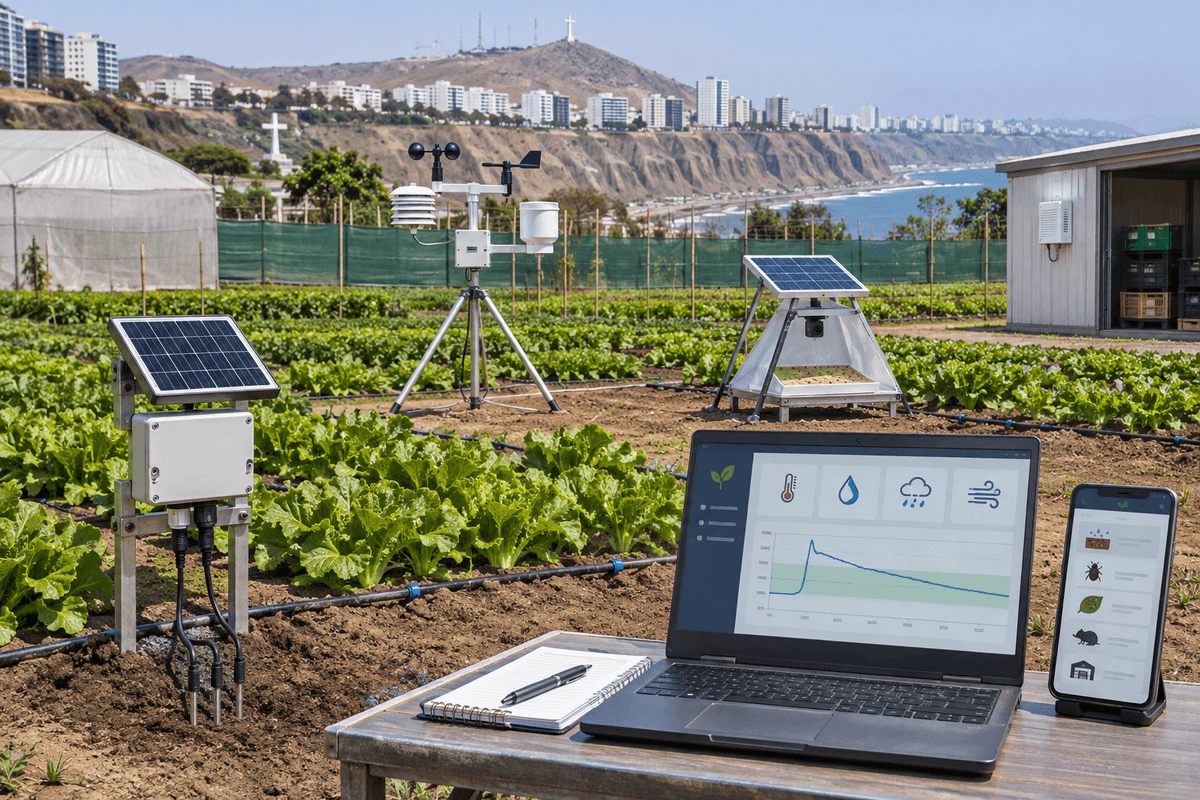
For a proposed Lima smart-agriculture pilot, operators should compare suitable soil measurements before and after irrigation across the crop root profile, then review the applied amount alongside crop observations and application efficiency. Lima is solely a proposed site: the supplied evidence establishes no local installation, soil conditions, crop requirements or measured performance.
The buying decision should depend first on measurement compatibility. The SOLARTODO catalog establishes soil-monitoring scope, but does not identify a soil sensor model, measurement principle, operating range or product PDF. That evidence is insufficient to approve a particular sensor or interpret its zero reading. Proceed with a conditional evaluation specification; defer equipment acceptance until the missing technical documentation is supplied.
Key Takeaways
- Confirm whether the proposed measurement represents volumetric water content or soil water tension before interpreting changes.
- Require sensor-specific units, calibration information, operating conditions and installation instructions.
- Compare pre-event and post-event readings across relevant depths rather than judging irrigation from a single lower-profile value.
- Investigate strong lower-profile wetting as a possible excess-application signal, with its meaning tied to sensor type and placement.
- Investigate absent lower-profile movement before increasing water, including response delay, soil contact and irrigation delivery.
- Keep adjustment decisions with operators and use crop observations, soil observations and application efficiency as feedback.
Proposed problem
The practical question is whether an irrigation event supplied an appropriate amount of water to the intended root profile. A proposed pilot should help operators distinguish an adequately replenished profile from possible underapplication, possible excess application and an inconclusive measurement.
The University of Minnesota Extension source recommends following water movement after irrigation and using lower-profile readings to inform irrigation decisions. Its discussion also calls for crop water use, irrigation system efficiency and soil observations as feedback. Those qualifications matter: a sensor response is evidence about its sensing location, not a complete assessment of the irrigation event.
The same source distinguishes volumetric water content from soil water tension. These quantities require different interpretation. Volumetric water content describes water volume relative to soil volume; tension describes the effort roots must exert to extract water. A reading cannot be evaluated responsibly without knowing which quantity it represents.
No evidence establishes what a proposed Lima plot grows, how its irrigation system distributes water or where its active roots lie. Those are survey questions, not facts to infer from the city name. The pilot should therefore begin with characterization and compatibility checks, followed by supervised decisions about application amounts.
Source-backed product boundary
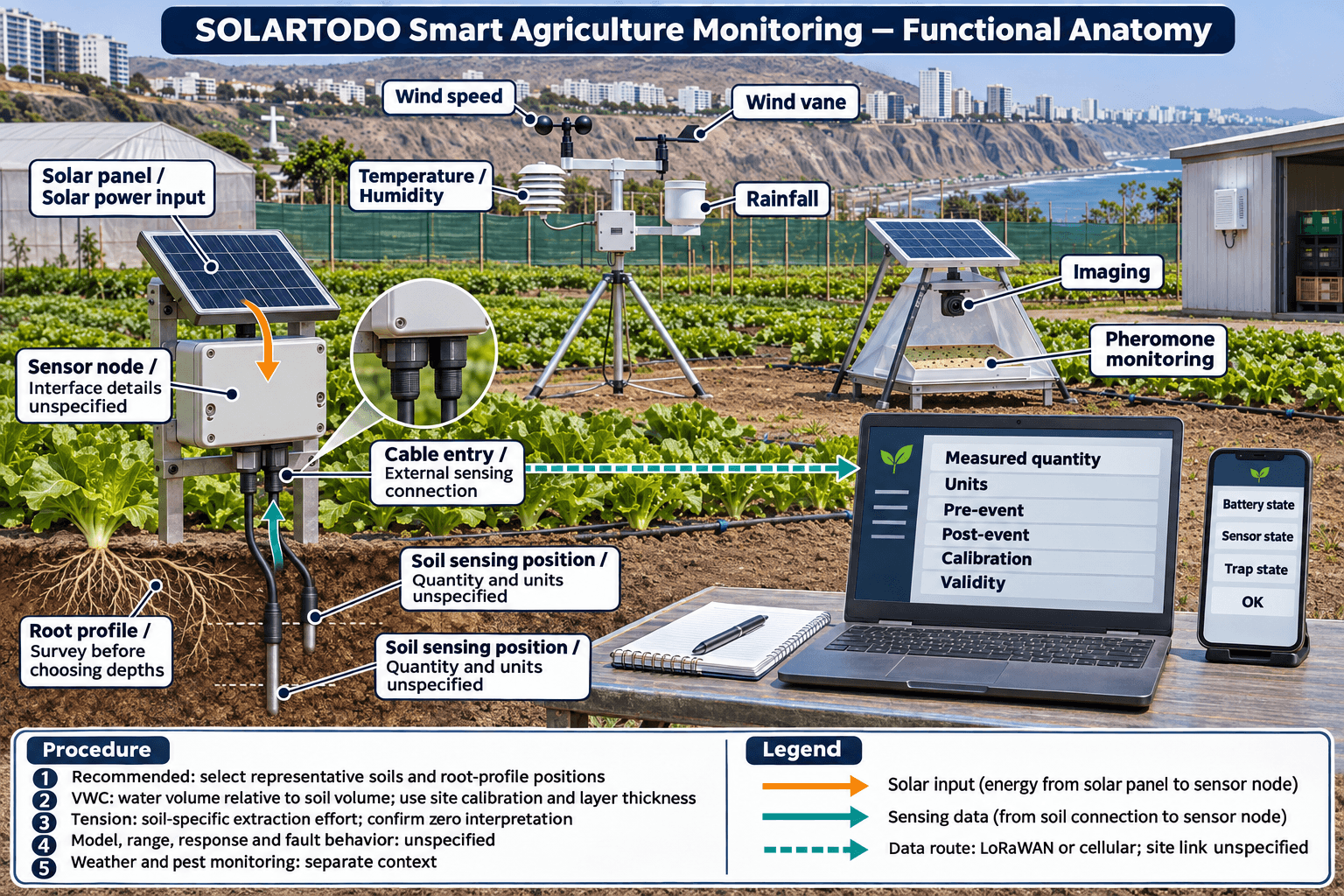
The supplied SOLARTODO extraction identifies the smart-agriculture family under catalog identity city-catalog-2026-11-01-v1. It covers weather, soil, pest, disease, rodent and storage monitoring, with sensor nodes, solar power and LoRaWAN or cellular communications. Soil sensing and site calibration must be selected for the intended task. The SOLARTODO smart-agriculture product page is the appropriate internal product destination.
This scope supports considering SOLARTODO monitoring for the proposed evaluation. It does not establish that a particular supplied soil device measures tension, volumetric water content or both. It also does not establish sampling frequency, depth capability, measurement accuracy, data export, automatic irrigation control or communication performance at the proposed site.
The catalog lists temperature, humidity, rainfall and wind speed for a basic weather station. Those listed variables alone do not establish a documented crop-water-use calculation in the supplied catalog. Pest monitoring uses pheromones and imaging; it has no demonstrated role in deciding irrigation application adequacy in this evidence pack.
No product PDF or PDF URL was supplied. Consequently, there is no PDF page, model or documented operating-condition reference to preserve or cite. Product-specific technical acceptance remains unsupported. If a product PDF is subsequently supplied, its model-specific statements must govern over conflicting descriptions; this article cannot invent that authority or a link to it.
Proposed design
Confirm compatibility before interpreting readings
Request documentation identifying the measured quantity, units, valid range, calibration method, response characteristics and meaning of displayed zero values. Establish how the proposed system distinguishes a valid measurement from missing data or a fault. These are procurement requirements, not verified SOLARTODO capabilities.
For volumetric measurements, interpretation should use appropriate soil and site calibration and a defensible reference for field capacity. The extension source explains that water content must be considered with soil-layer thickness when estimating water stored in a profile. A percentage alone does not describe the total water available across the rooting depth.
For tension measurements, interpretation should account for soil-specific relationships and the instrument's response. The source places its near-zero discussion within the soil-tension section. It does not authorize treating zero from every soil sensor as evidence of excessive irrigation. Confirm the selected device's documentation for zero-value interpretation and the representation of missing data before using a displayed value in an irrigation decision.
Place measurements around the actual question
Survey the crop root profile, soil differences and irrigation arrangement before choosing measurement positions. The extension guidance recommends multiple depths and locations, representative placement, direct soil contact and installation according to the sensor manufacturer's instructions. It also recommends monitoring differing soil types separately.
The proposed design should use upper- and lower-profile observations to examine how wetting progresses through the intended root zone. Final depths and locations should follow the survey and the selected device's installation requirements. No fixed installation depth or number of devices is established here.
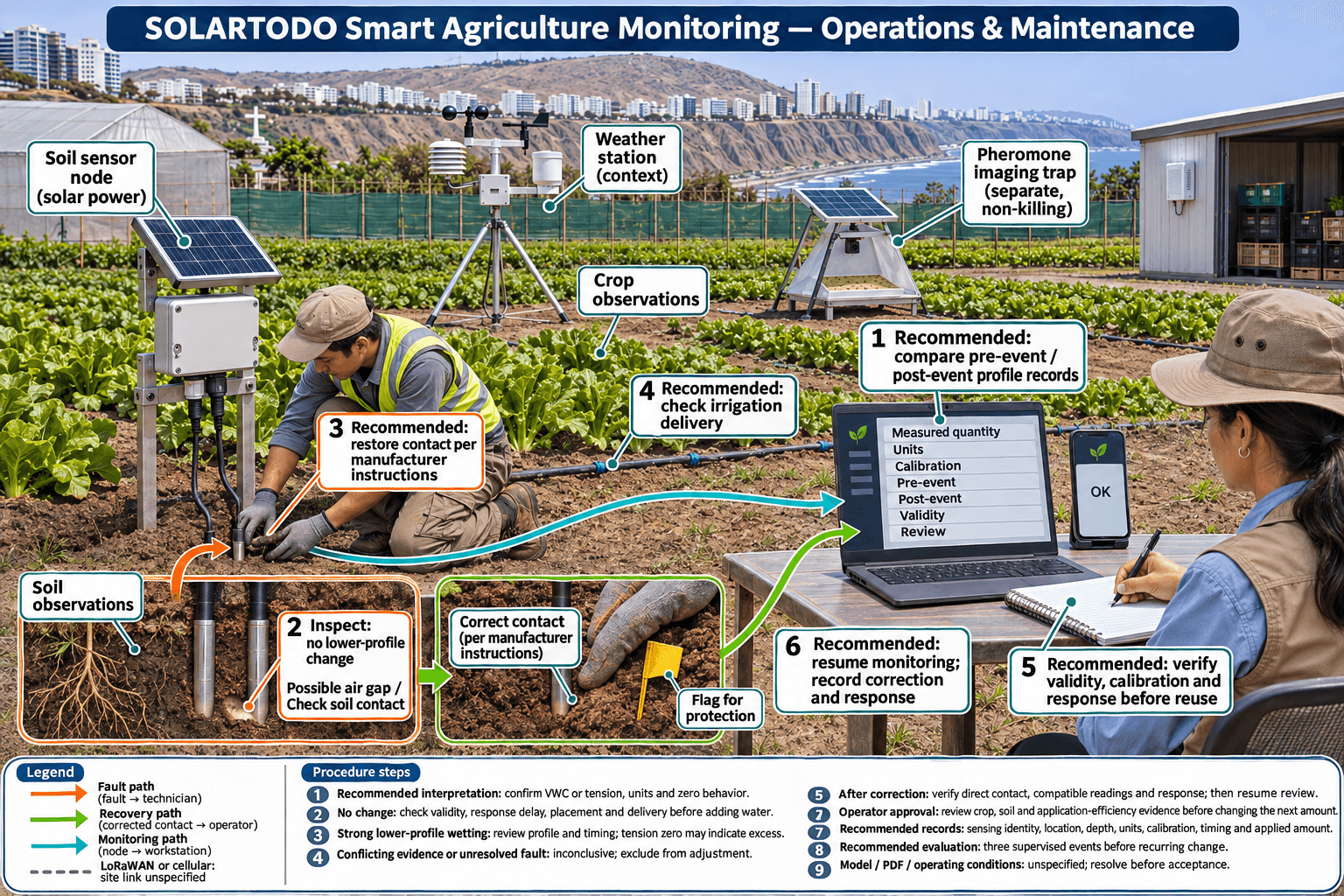
Installation records should explain the relationship between each sensing position, the crop and irrigation delivery. Flag locations to reduce accidental damage. Check for disturbed soil and air gaps, because the source identifies installation contact as relevant to reading quality.
Record the irrigation event and its response
Operators should record the pre-event soil condition, irrigation timing and available evidence of the amount applied. Subsequent readings should be compared with that baseline and interpreted using the selected instrument's response characteristics. A reading taken immediately after irrigation may be useful, but the source also notes that some measurement technologies respond slowly.
The record should connect readings with crop observations and soil observations. It should also explain how the applied amount was determined. Without that connection, operators may see a profile response but lack a sound basis for deciding which irrigation setting to change.
The extension source recommends considering application efficiency when scheduling irrigation. The supplied evidence provides no Lima efficiency value or SOLARTODO efficiency measurement capability. Request the method and supporting records rather than inserting a default percentage.
Decide whether to adjust the amount
When compatible measurements show wetting progressing through the intended profile, review whether the response fits the replenishment objective and crop observations. Do not increase water simply because a lower sensing position remains less wet than an upper position.
In its soil-tension discussion, the extension source identifies a bottom sensor's zero reading immediately after irrigation as an indication of possible excess application. Investigate the response across the profile and its timing before reducing the next application. It does not independently quantify drainage or establish a required reduction.
In its soil-tension discussion, the extension source interprets no movement at the bottom sensor immediately after irrigation as insufficient application; this interpretation should not be generalized to unspecified soil measurements. Review measurement validity, response delay, placement and actual delivery. If the relevant profile remains insufficiently replenished and crop and soil observations support that interpretation, an operator can consider changing the subsequent application amount.
If observations conflict, classify the event as inconclusive. Resolve the disagreement before using it to justify a recurring irrigation change. Keep a record of the interpretation, the operator's decision and the response to any later adjustment. No automatic valve operation or autonomous irrigation control is established by the catalog.
Explicitly hypothetical measurable evaluation assumptions
The following are proposed evaluation criteria, not observed results, catalog specifications or product guarantees.
Hypothetical evaluation assumption: Every event used to justify an application adjustment will have a documented pre-event baseline and a post-event record for each selected profile position.
Hypothetical evaluation assumption: The pilot will evaluate three supervised irrigation events before proposing a recurring change to the application amount.
Hypothetical evaluation assumption: Every interpreted reading will be traceable to its sensor identity, location, depth, units and calibration record.
Hypothetical evaluation assumption: Every proposed adjustment will include a written review of crop observations, soil observations and application efficiency evidence.
Hypothetical evaluation assumption: An event with an unresolved fault or incompatible measurement will be excluded from the adjustment decision.
These criteria test the quality of the decision process. They do not promise water savings, yield improvement, sensor accuracy or a particular irrigation outcome.
Survey/acceptance checklist
- Site definition: Identify the proposed plot, crop, growth stage, root profile, soil differences and irrigation arrangement without extrapolating to all of Lima.
- Technical identity: Obtain the exact soil-device model and authoritative product PDF, including applicable pages and operating conditions.
- Measurement compatibility: Confirm the measured quantity, units, calibration requirements, response characteristics and zero-value interpretation.
- Installation: Verify representative placement, direct soil contact, protection from field operations and compliance with manufacturer instructions.
- Records: Demonstrate that readings can be associated with the relevant irrigation event and field observations through an agreed recording method.
- Delivery evidence: Establish how operators determine the applied amount and assess application efficiency.
- Interpretation: Demonstrate that operators can distinguish potential excess, potential insufficiency and inconclusive evidence.
- Acceptance boundary: Separate documented catalog functions from functions that still require supplier confirmation.
Acceptance should be withheld where a missing measurement definition prevents meaningful interpretation. A plausible-looking chart cannot substitute for instrument identity and valid installation.
Limitations
This is an evaluation framework for a proposed site, not a report of a Lima deployment. The evidence supplies no local climate assessment, demand estimate, customer outcome or measured water-saving result. It establishes no guaranteed farm-area coverage, yield benefit or prediction accuracy.
The University of Minnesota material is agronomic context from another jurisdiction. Its examples and regional resources are not Lima site data or Peruvian requirements. Its numerical examples should not be copied into local irrigation settings without an appropriate site basis.
The catalog is a scope statement rather than a complete technical specification. Missing product documentation prevents confirmation that an offered SOLARTODO measurement can support the intended interpretation. No substitute model or different product family is proposed to fill that gap.
Procurement questions
Use SOLARTODO catalog identity city-catalog-2026-11-01-v1 as the scope reference when asking the supplier to identify a proposed soil-device model, its measured quantity and its authoritative product PDF with applicable page references. Require an explanation of calibration, applicable soil conditions, installation and response limitations before agreeing to acceptance criteria.
Ask how valid zeros, missing values and faults are represented. Ask how readings will be associated with field locations and irrigation events, and what recording or retrieval functions are actually included. Confirm whether the proposed communications and solar-power arrangement can be assessed at the surveyed site; neither option establishes site performance by itself.
Finally, establish responsibility for installation checks, interpretation and approval of irrigation changes. A buyer can use the contact page to request the missing technical evidence, but should keep monitoring procurement separate from any unsupported expectation of automatic control.
FAQ
How should operators decide whether to change the applied amount?
Compare compatible pre-event and post-event readings across the intended profile, then review crop observations, soil observations and application efficiency before making an operator-approved adjustment.
Does a zero reading always mean too much irrigation?
No. The extension source discusses near-zero values in the soil-tension context; the selected instrument's units, valid range and fault behavior must be confirmed before interpreting zero.
Does no lower-profile movement automatically justify more water?
No. Check response delay, installation, measurement validity and irrigation delivery before deciding that the intended profile received insufficient water.
Can the catalog confirm the required soil sensor model?
No. It establishes soil-monitoring scope but supplies no soil sensor model, measurement principle or authoritative product PDF.
Where should measurements be taken?
Choose representative locations and relevant root-profile depths after surveying the crop, soils and irrigation arrangement, then follow the selected manufacturer's installation instructions.
Is one post-irrigation reading enough?
A single reading lacks the baseline and profile context needed for this evaluation; compare observations over the event while accounting for instrument response.
Does this proposal include automatic irrigation control?
No. The supplied catalog establishes monitoring scope, and this proposal keeps irrigation adjustments under operator approval.
What role does application efficiency play?
The extension source recommends considering application efficiency in irrigation scheduling and using irrigation system efficiency as decision feedback. Obtain site-specific supporting evidence and an assessment method before assigning an efficiency value to the proposed pilot.
Has this system demonstrated results in Lima?
No. Lima is solely a proposed site, and the evidence pack contains no local deployment or measured outcome.
References
- SOLARTODO smart-agriculture public catalog: supplied extraction identified as city-catalog-2026-11-01-v1; establishes family scope, with no soil-model or PDF-page specification.
- University of Minnesota Extension: Soil moisture sensors for irrigation scheduling: supplied text supports measurement distinctions, placement, post-irrigation interpretation and feedback from crop water use, efficiency and soil observations.
A product PDF reference cannot be included because no product PDF URL, model or page was supplied. That missing evidence must be resolved before product-specific technical acceptance.
Proposed Equipment
- SOLARTODO smart-agriculture soil-monitoring equipment, with sensing selection and site calibration required
- SOLARTODO smart-agriculture sensor nodes
- Solar power for SOLARTODO smart-agriculture monitoring
- LoRaWAN or cellular communications for SOLARTODO smart-agriculture monitoring