Summary
Montevideo is solely a proposed site in this evaluation. The supplied evidence establishes neither a selected parcel nor an existing deployment, local operating permission or measured system performance. It does not supply separation dimensions from which to approve construction.
The source-backed operating restriction is specific: STTBOT robots must remain outside the aircraft landing and rotor exclusion zone while the cabinet receives or releases the UAV, as stated on manual page 58. The proposed purchasing approach is to document that boundary on a surveyed layout, assess STTBOT-T1 routes and charging access against it, and request evidence of the actual permission arrangements before deciding whether to accept a physical layout. This is an evaluation recommendation, not evidence of an installed route-control system.
Key Takeaways
- Document aircraft reception and release paths, moving equipment interfaces and service access before selecting the proposed hangar position.
- Apply the manual’s prohibition on robot entry into the aircraft landing and rotor exclusion zone during reception and release.
- Include ground-task routes, waiting positions and charging access in the proposed layout assessment.
- Keep battery exchange completion distinct from subsequent operator handover, preflight, flight authorization and departure.
- Request evaluation records covering permissions, physical positions, interventions and recovery decisions.
- Defer layout acceptance where exclusion boundaries, installation requirements or the means of maintaining separation remain unresolved.
Proposed problem
The purchasing question is whether a proposed independent STT-HUB1101 hangar location and STTBOT-T1 route plan can satisfy the manual’s aircraft-zone restriction while supporting the intended ground tasks. Route length alone does not answer that question. The evaluation needs a defined exclusion boundary and a documented basis for deciding when each ground route is available.
The proposed scenarios below address reception requests, charging returns, exchange completion and interrupted ground tasks. They are evaluation cases, not observed Montevideo conflicts or a finding about the site’s principal risks.
The supplied sources contain no Montevideo parcel survey, pedestrian circulation assessment or local authorization record. No conclusion about local climate, demand or suitability follows from naming the city. The site arrangement remains proposed and subject to assessment.
Source-backed product boundary
The product authority supplied for this article is the English SkyHub manual, Revision 1.3, dated 27 September 2026. Its product-family identification on page 1 lists the STT 1S MAX UAV, STT-HUB1101 battery exchange hangar and STTBOT-S1 / STTBOT-T1 ground robots. This article’s proposed evaluation scope comprises STT 1S MAX, the independent STT-HUB1101 configuration and STTBOT-T1; that scope does not establish delivery or deployment.
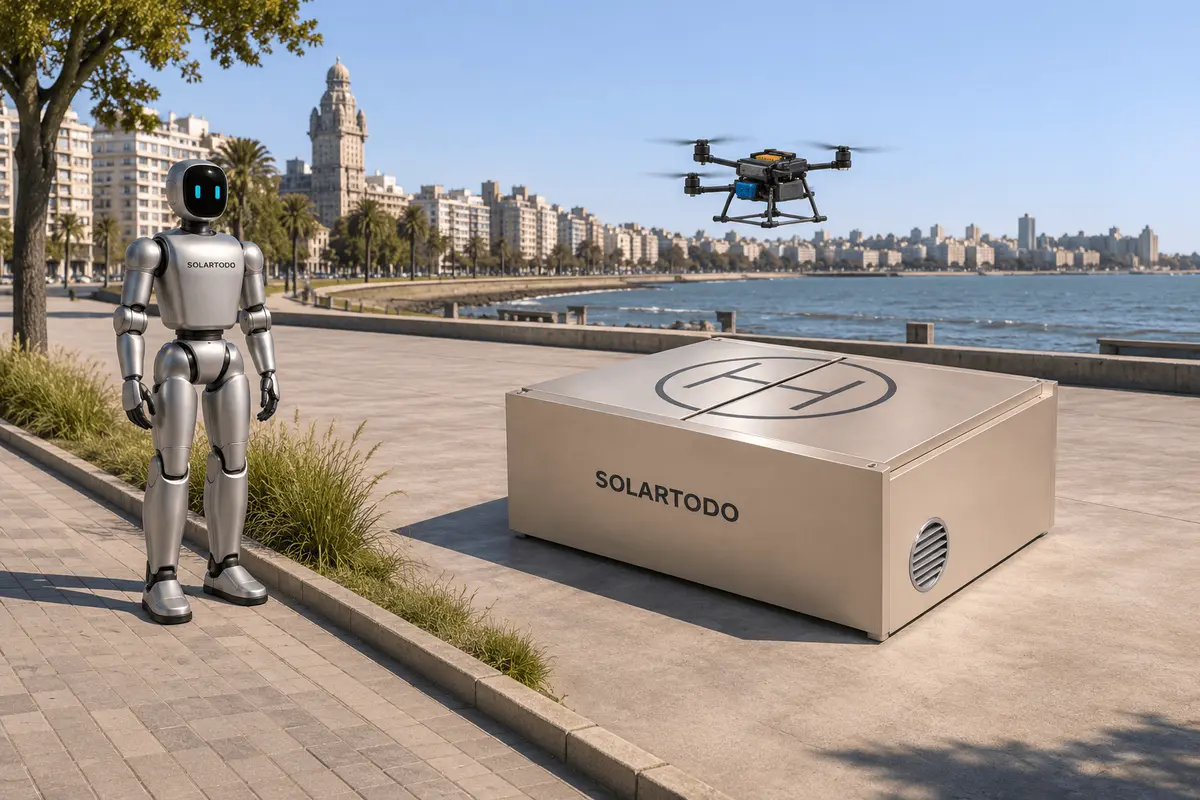
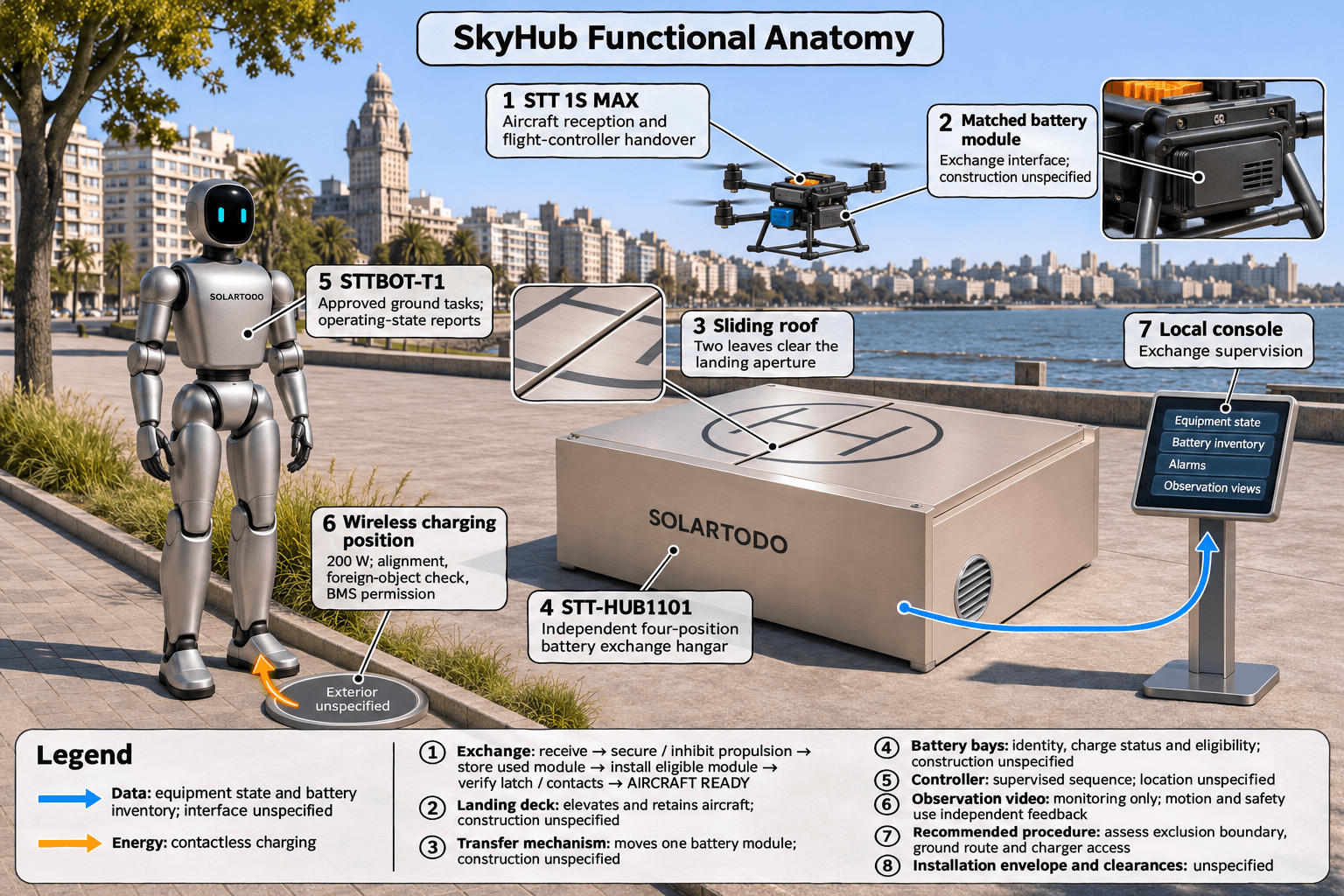
For STT-HUB1101, page 24 specifies the independent four-bay hangar configuration paired with STT 1S MAX and its matched battery module. The hangar receives the aircraft, secures it on an elevating landing deck, exchanges its removable battery module, records battery location and charge status, and hands the aircraft back to the flight controller. The local hangar controller supervises the exchange sequence. Operators can monitor status at the local console and, where enabled, through the remote dashboard. Page 22 identifies the four-position inventory, supervised battery exchange and aircraft turnaround role.
Page 25 defines the exchange clock from detected touchdown to E10 confirmation of the deck at release height, the transfer tool clear, battery inventory reconciled and AIRCRAFT READY. Capture and ground propulsion inhibit are included. The later operator Handover request, aircraft preflight checks, flight authorization and departure are outside that clock. Thus, the exchange endpoint precedes activities that are excluded from its timing; it is not a report of aircraft departure. The supplied page does not define ground-route reopening permissions.
Page 27 distinguishes the sliding roof, landing deck, transfer mechanism, battery bays and observation views. It describes video as an observation source and states that motion and safety use independent feedback. For the proposed evaluation, request the relevant physical feedback and permission evidence alongside video observations.
Page 57 states that each STTBOT robot can receive an approved ground task, report its operating state and return to its own 200 W wireless charging position. Ground inspection requires operator review of the task area and walking path. Aerial-event follow-up requires a common event ID and safe separation from the aircraft recovery volume.
The model comparison on page 58 lists STTBOT-T1 standing height as 1320 mm, mass including battery as approximately 35 kg, and standing width × depth as 450 × 200 mm. Its wireless charging specification is a 200 W contactless module. Those entries describe the robot and charging module; the supplied page contains no corridor-width or aircraft-clearance specification. Automatic return for energy involves navigating to the assigned charging position and requesting charge, with dock alignment, foreign-object check and BMS permission as coordination conditions.
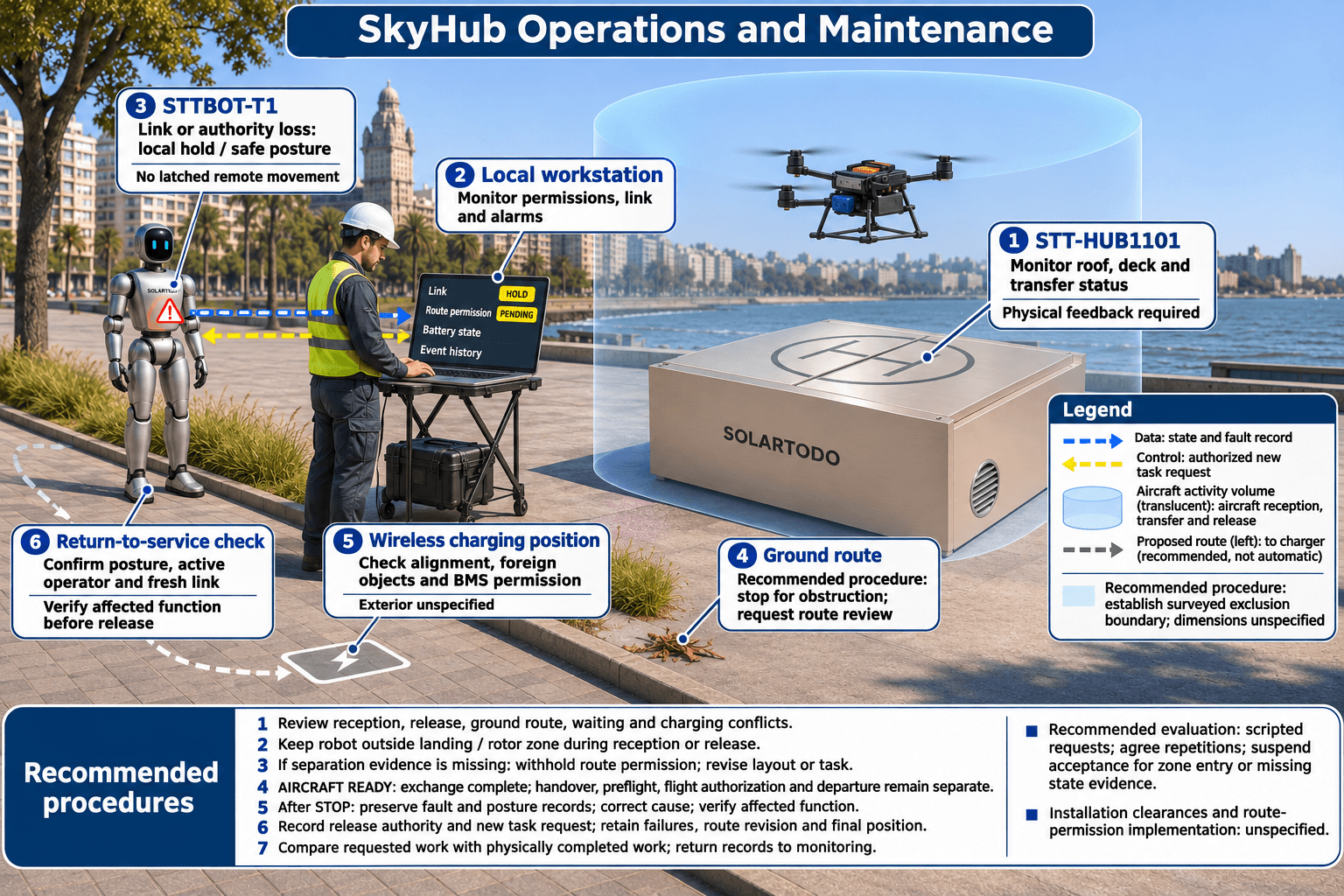
Page 58 also states that robots do not enter the aircraft landing and rotor exclusion zone while the cabinet receives or releases the UAV. A robot task involving contact with infrastructure or a person requires a separate operator decision under the site procedure.
Page 59 explains that S1 shoulder-frame spacing is not overall body width and that S1 effective arm reach and T1 arm span use different measurement definitions. It identifies the supplied-unit record as the source for the S1 outside envelope and the actual tool fitted to each robot. No such supplied-unit record is included in this article’s evidence.
Proposed design
Place the hangar around aircraft access
Document proposed reception and release paths, moving equipment interfaces, service access and surrounding circulation on a common surveyed drawing before selecting the hangar position. Obtain the missing installation envelope, foundation inputs and clearance requirements before accepting construction details. The supplied excerpts do not establish those installation requirements.
Request a site assessment and applicable manufacturer information defining the aircraft landing and rotor exclusion boundary. Record its basis, equipment configuration, responsible reviewer and associated operating states. Do not calculate that boundary from aircraft body dimensions or robot width: the aircraft geometry on page 9 does not supply a hangar clearance schedule.
Assess ground routes and charging access
For the proposed layout, prefer ground routes, waiting positions and charging access outside the aircraft exclusion zone. Assess the space needed for the intended robot configuration, fitted tool and permitted posture rather than treating standing dimensions as a complete motion envelope.
Keep any proposed shared-space route unavailable until its access conditions and aircraft separation procedure have been defined and verified. The manual’s reception-and-release prohibition does not establish unrestricted access at other times. Where separation cannot be substantiated, revise the hangar position, route or ground-task scope before accepting the layout.
Make permissions explicit
Prepare a proposed permission matrix linking aircraft reception, exchange, handover and release to ground-route availability. Identify the authorizing roles, required physical feedback and handling of conflicting requests. Request evidence of how the aircraft-zone restriction is implemented in the intended configuration; the supplied excerpts do not establish an automatic ground-route interlock.
Record route revisions and task identifiers. Do not use exchange completion alone as the proposed basis for reopening a nearby ground route. Following a STOP condition, apply the controlled recovery and release process on page 76, including a new task request rather than silent resumption.
Hypothetical measurable evaluation assumptions
The following assumptions describe a proposed evaluation protocol, not completed trials or demonstrated product performance.
Hypothetical evaluation assumption: Each candidate layout would be evaluated using the same documented boundaries, starting positions and scripted permission requests.
Hypothetical evaluation assumption: The buyer and evaluation team would agree the repetition count before testing and record its rationale without treating an initial screening sample as proof of statistical reliability.
Hypothetical evaluation assumption: Any robot entry into the defined aircraft landing and rotor exclusion zone during reception or release would prevent acceptance of the affected scenario.
Hypothetical evaluation assumption: Each trial record would include the requested route, authorized route, equipment state, physical robot position, intervention and final disposition.
Hypothetical evaluation assumption: An unexplained route release or missing state evidence would suspend acceptance of the affected scenario pending investigation and repeat evaluation.
Hypothetical evaluation assumption: A charging-return conflict would be evaluated with the robot energy state and permitted waiting response documented before the trial.
Repeatable conflict scenarios
Agree controlled test procedures before exercises involving equipment movement. Begin with a documented scenario review to identify unsupported functions before requesting a physical demonstration.
Reception request during a ground task
Hypothetical evaluation assumption: A tabletop scenario would place a proposed ground task near the restricted approach when an aircraft reception request is introduced.
Identify which permissions must be withheld and where the robot could remain outside the exclusion boundary. Request implementation evidence before translating the scenario into an equipment exercise.
Release request during charging return
Hypothetical evaluation assumption: A scripted robot return-to-charger request would coincide with an aircraft release request.
Examine whether the proposed charger route is independent of the restricted area or creates an unresolved conflict. Record any deferred requests, interventions and responsible owners.
Exchange completion before departure
Hypothetical evaluation assumption: A tabletop exercise would present the documented AIRCRAFT READY endpoint while a proposed ground-route request remains pending.
Check whether the proposed access decision distinguishes exchange completion from subsequent handover and flight activity. Record the permission and physical state required to decide ground access.
Teleoperation interruption and recovery
Hypothetical evaluation assumption: An agreed controlled procedure would exercise loss of the teleoperation link or active-operator authority.
Page 76 specifies local hold/safe posture with no latched remote movement for ROB-TEL-12. Before hand-back or re-entry, the supervisor confirms robot posture, active operator and link freshness. Compare any demonstrated response with those requirements and preserve the fault and posture records.
Blocked ground route
Hypothetical evaluation assumption: A controlled obstruction would be introduced on an authorized ground route outside the aircraft exclusion zone.
Examine the response and any subsequent authorization decision. Keep people outside conflict areas and do not presume an autonomous rerouting capability that the supplied evidence has not established.
The NIST ground robot methods describe repeatable apparatus, procedures, quantitative metrics and recorded fault conditions. The NIST aerial testing FAQ distinguishes measurement methods from acceptance thresholds selected by the organizations using them and states that NIST does not train or certify anybody. These references provide methodological context; they do not establish Uruguay operating requirements, SkyHub certification or successful SkyHub testing. The scenarios above are not represented as NIST standard tests.
Survey and acceptance checklist
Use this proposed checklist to organize the buyer’s evidence request:
- Request the intended equipment configuration and its identification records before evaluating model-specific limits.
- Prepare a surveyed drawing of proposed aircraft paths, exclusion boundaries, ground routes, waiting positions, charger access and service interfaces.
- Obtain missing installation envelopes and clearance requirements rather than estimating them from illustrations.
- Document the proposed relationship between reception, exchange, handover, release and ground-route permissions.
- Request evidence showing how the aircraft-zone restriction is implemented, observed and maintained.
- Retain failed trials, interventions and configuration changes alongside successful trials.
- Record recovery authority and affected-function checks before returning equipment to service.
- Resolve applicable local permissions separately from technical evaluation.
Page 77 lists asset identity, route revision, operator approvals, actual motion times, final location and fault/intervention information among the customer records. The stated review purpose of the mission record is to distinguish requested work from physically completed ground work. Request those records as part of the evaluation evidence; the supplied excerpts do not establish a particular export format or delivery mechanism.
Limitations
The supplied evidence is insufficient to accept a specific Montevideo parcel or prescribe separation dimensions. It does not establish installation clearances, a delivered integration, local permissions or observed conflict-control performance.
Aircraft maxima do not resolve those gaps. Page 8 warns that maximum flight time is not guaranteed route duration and maximum radio distance is not an approved operating radius. On page 10, the 54-minute maximum forward-flight value applies at 12 m/s, windless, in photo mode, with obstacle action off and discharge from 100% to 0% SOC. That value establishes neither site clearance nor mission permission.
Procurement questions
Ask the supplier for the hangar installation envelope, moving-part clearances, service access requirements and basis for defining the aircraft exclusion zone. Request configuration records for the intended ground robot and a description of the proposed permission arrangements, including any operator procedure or additional integration needed to maintain separation.
Request a witnessed evaluation plan with retained failures, recovery records and named acceptance authority. Keep commercial acceptance distinct from local authorization. Consult the SkyHub product page for product navigation and use contact for configuration and evaluation questions.
FAQ
Is Montevideo an established SkyHub deployment?
Montevideo is solely a proposed site in this article; the supplied evidence establishes no deployment or measured local result.
What layout and charging access should the buyer evaluate?
As a proposed procurement step, request a surveyed drawing showing aircraft exclusion boundaries, ground-task routes, waiting positions and charger access, together with evidence explaining how separation would be maintained.
Can a fixed clearance distance be specified here?
No. The supplied evidence does not establish site separation dimensions; obtain installation requirements and a site assessment before fixing them.
May ground robots enter the landing and rotor exclusion zone during UAV reception or release?
No. Manual page 58 states that robots do not enter that zone while the cabinet receives or releases the UAV.
Does completed battery exchange authorize ground access?
The supplied manual does not define ground-route permission through exchange completion. Page 25 excludes later operator handover, preflight, flight authorization and departure from the exchange clock; request a separate documented basis for ground access.
What information is needed if STTBOT-S1 replaces STTBOT-T1?
Pages 58–59 identify different model dimensions and measurement definitions. Request the S1 supplied-unit outside envelope and fitted-tool record, then reassess the proposed route for that configuration.
Do NIST references certify SkyHub or authorize local operation?
No. They provide evaluation-method context; they establish neither SkyHub certification or test success nor permission to operate in Montevideo.
What should happen after a robot STOP condition?
Use controlled recovery, preserve fault evidence, verify the affected function and record release authority and a new task request; page 76 states that the original task is not silently resumed after a STOP condition.
References
The manual links above identify the supplied excerpts used for product identity, configuration, operating restrictions, recovery and records. The linked NIST ground robot methods and aerial testing FAQ provide evaluation-method context only. None of the supplied sources establishes local authorization or a completed Montevideo deployment.
Proposed Equipment
- STT 1S MAX multirotor aircraft
- STT-HUB1101 independent four-bay battery exchange hangar
- Matched STT 1S MAX removable battery modules
- STTBOT-T1 bipedal ground robot
- STTBOT-T1 assigned 200 W contactless charging position