Summary
For a proposed Montevideo application, match the supplier’s source-aging evidence to the luminaires offered on each arm and use repeat field measurements before and after cleaning to decide when to clean, service, or replace. Close the visit as a cleaning intervention when a reproducible gain restores the project’s adopted lighting requirement. Diagnose a confirmed shortfall after cleaning. Consider replacement when the affected assembly cannot be serviced or approved corrective work fails to restore the requirement. The supplied material includes no product PDF, so its URL, page references, and model-specific operating conditions remain unverified.
Key Takeaways
- Tie the bid, photometric report, and aging evidence to the exact luminaire offered on each arm.
- Ask the supplier to connect light-source test conditions to the conditions inside each assembled luminaire.
- Establish a clean commissioning baseline at fixed field points under documented operating settings.
- Repeat low readings and measure the same points immediately before and after approved cleaning under comparable conditions.
- Judge recovery against both the baseline and the project’s adopted lighting requirement, including any location-specific criteria.
- Assign responsibility for cleaning, diagnosis, repair, replacement, and field verification after each intervention.
Proposed problem
The proposed project needs a decision rule for declining lighting at the surfaces it is intended to serve. When a low reading is reported, document the measurement point and procedure, repeat the survey under comparable conditions, and use a paired cleaning test before deciding whether corrective service is needed.
Define the project’s lighting requirement before commissioning. Record the surfaces it applies to, the required metric and measurement method, the operating mode in which it applies, and how individual points and the overall pattern will be judged. If the adopted requirement includes a minimum at specific locations or a uniformity criterion, retain the point-level data and evaluate each applicable criterion. Use the clean commissioning survey as the reference for trends and the adopted requirement as the test for acceptance.
Source-backed product boundary
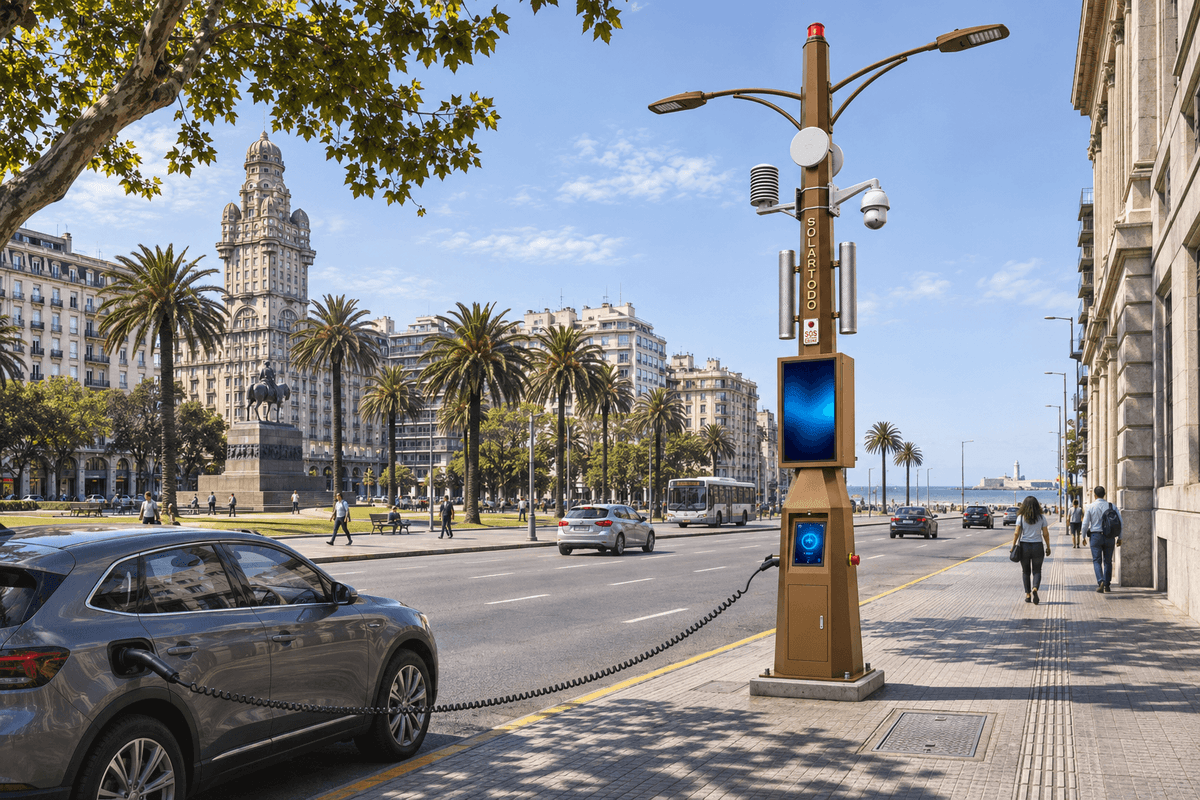
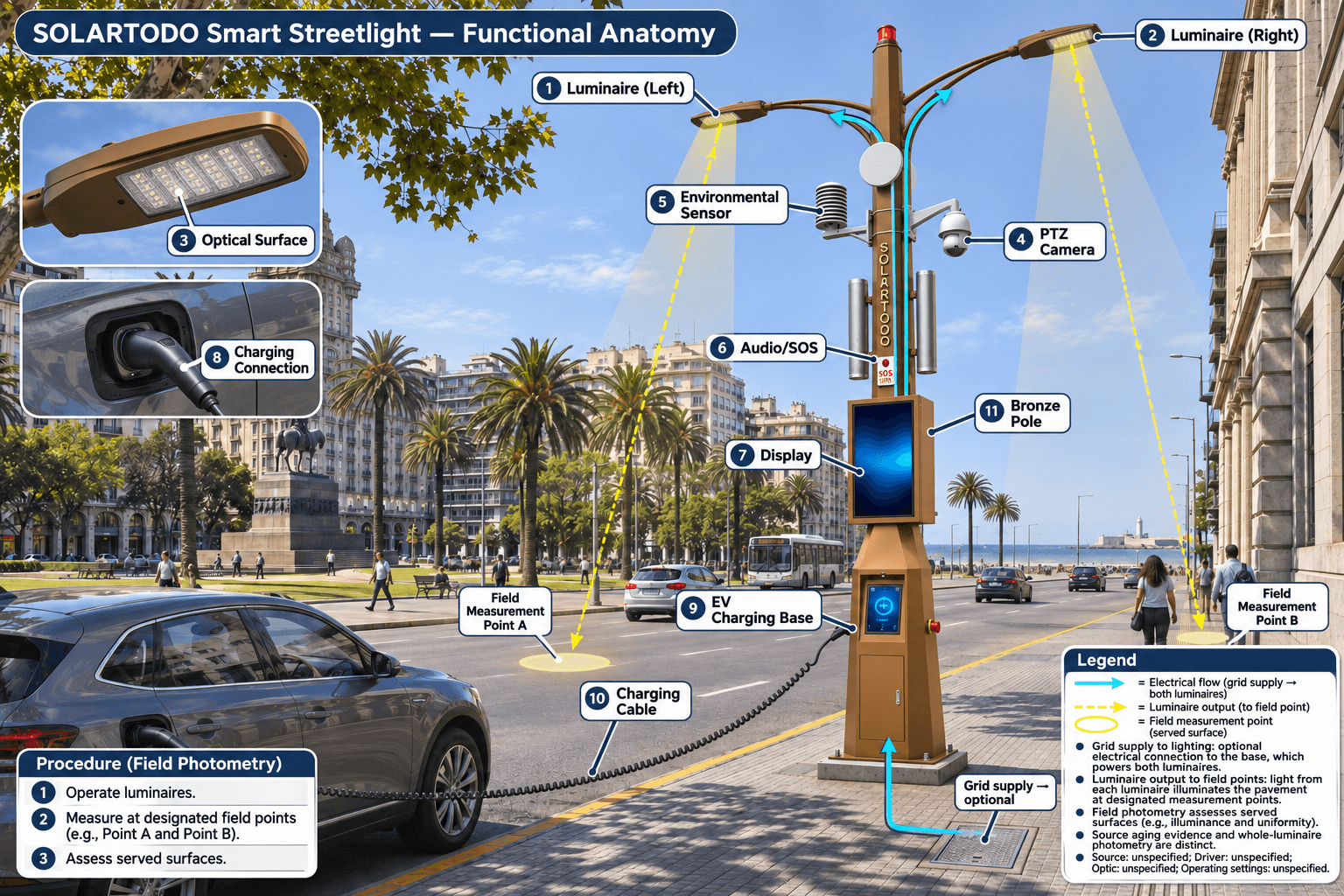
The proposed evaluation uses smart-classic-twin-bronze as its reference identifier. The catalog extraction identified as city-catalog-2026-11-01-v1 describes the SOLARTODO classic twin-arm bronze smart streetlight. The catalog appearance shows a bronze polygonal pole with two curved luminaire arms, a PTZ camera, an environmental sensor, a display, audio/SOS, and an integrated EV charging base. The catalog lists grid-fed lighting and modular communications and control as options. Ask the supplier to confirm the quoted model identifier and configuration against the catalog appearance. SOLARTODO smart streetlight product family
The offered light source, driver settings, optics, and operating conditions need supplier confirmation for each arm. Request the product PDF and record its revision and the pages covering the offered model, operating conditions, photometry, and service provisions. Resolve those evidence gaps before relying on a model-specific lumen-maintenance claim in the purchase decision.
Proposed design
Connect source aging to the offered assembly
Ask the supplier to identify the proposed light source in each arm and provide the matching aging report. If the offered source is LED, request the applicable source-level lumen-maintenance evidence and any projection the supplier relies on. The U.S. Federal Energy Management Program purchasing page cites IES LM-80-08 for LED light-source lumen maintenance, IES LM-79-08 for electrical and photometric measurements of solid-state lighting products, and IES LM-50-13 for photometric measurements of roadway and street lighting installations. Use these citations as technical context from U.S. federal purchasing when checking what each supplier document covers. U.S. DOE FEMP exterior-lighting purchasing guidance
Request the report’s tested source identifier, drive current, temperature measurement point, test duration, and measured lumen-maintenance data. If the supplier offers a projection, ask for the calculation method, supporting data, operating assumptions, and stated limits. Request the corresponding drive settings and source temperature measurements for each offered luminaire under stated ambient and operating conditions. Compare those conditions with the conditions supporting the aging claim. Require a documented explanation for any differences and ask how component substitutions would affect the evidence.
Request photometry for the complete luminaire with the optic offered on each arm. Ask whether the supplier has aging evidence for the full assembly, what configuration was tested, and whether the evidence covers changes in total output or light distribution over time. Record any gap in whole-luminaire evidence when judging the supplier’s claim and agreeing on service obligations. Verify installed lighting with the project’s field survey.
Establish the baseline and repeat the field survey
After installation, aiming, and commissioning, record a clean baseline on a map of repeatable measurement points. Include the locations that matter to acceptance and, where the test procedure allows, points for assessing each arm separately. Record the measurement plane and position, instrument identification and calibration status, selected settings and observed operating state, relevant electrical readings where available, and background lighting. Keep raw point readings alongside the calculated acceptance metrics. Photograph the setup and luminaire aiming for the next survey crew.
For a reported decline, repeat the affected points using the same procedure and confirm the operating state before intervening. If the lighting from the arms overlaps, use arm-specific checks where the supplier’s documented procedure permits them. Record changes in nearby lighting, obstructions, aim, or measurement conditions. If the bid includes controls, ask the supplier how survey staff should set and verify the required operating mode. Use field photometry to verify lighting at the evaluation points. The U.S. DOE reference describes research on monitoring and fault detection and a test bed focused on electrical performance. U.S. DOE connected lighting systems research
Use the cleaning response to decide what happens next
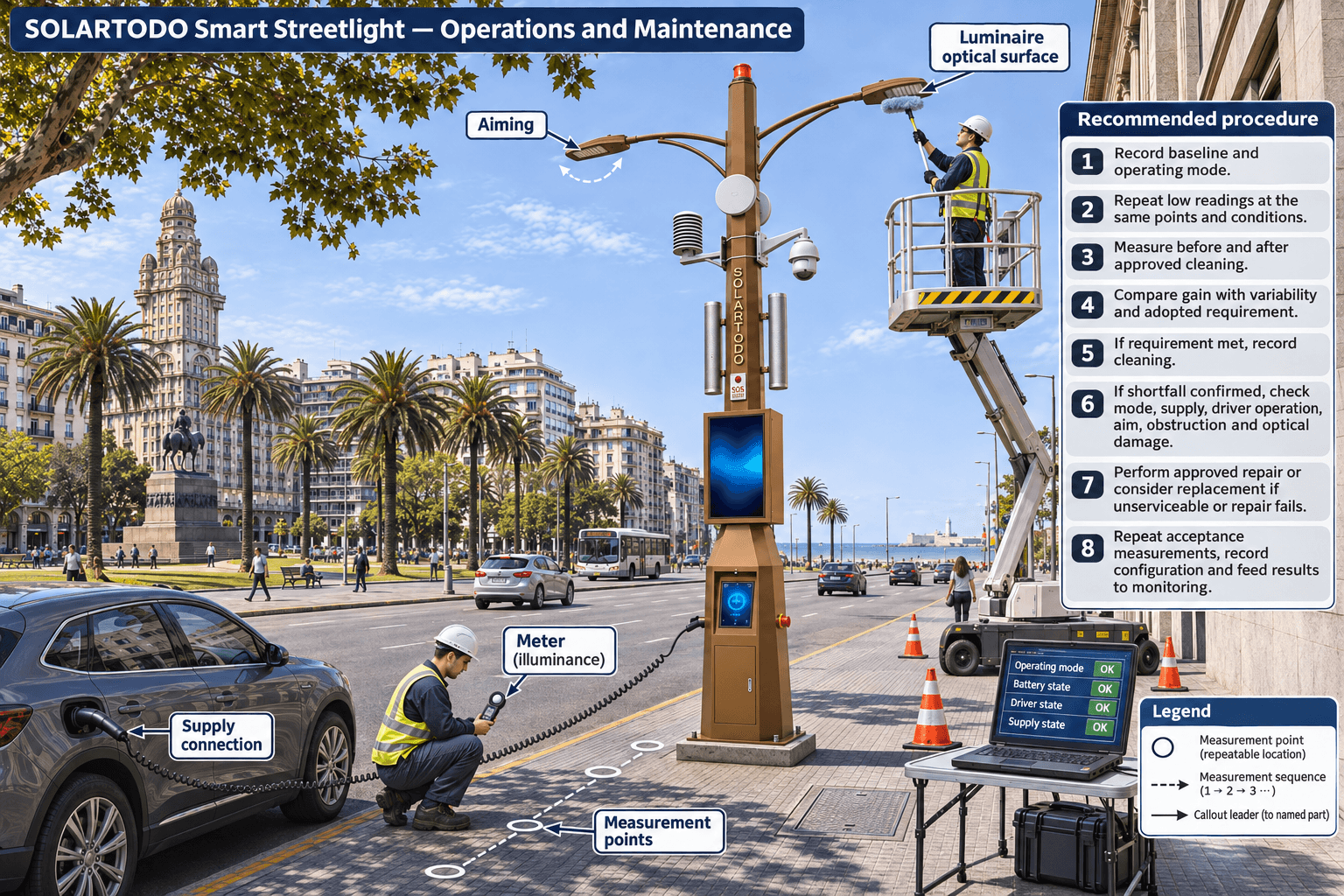
Take an as-found set of readings before changing hardware, aim, or operating settings. Document the optical surface condition and clean using the supplier’s approved method. Repeat the same points with the same measurement geometry and operating mode under comparable background conditions. Compare the paired readings point by point. Treat a gain that exceeds survey variability as evidence that cleaning recovered some of the loss. Close the visit as a cleaning intervention if the cleaned readings also meet the adopted requirement, and use the record to review the inspection interval. If readings improve but remain below the requirement, record both the recovery and the remaining shortfall.
When the shortfall is confirmed, check actual operation and any applicable dimming settings, supply and driver operation, alignment, obstructions, and visible optical damage. Review the pattern across the two arms and nearby points to guide diagnosis. Recheck the lighting after any approved adjustment or repair. Consider replacement when the affected assembly cannot be serviced or when approved corrective work fails to restore the adopted requirement. Repeat acceptance measurements after replacement and link the replacement configuration and readings to the maintenance record.
Explicitly hypothetical measurable evaluation assumptions
Set actual alert criteria using the adopted lighting requirement and the repeatability established during commissioning.
Hypothetical evaluation assumption: Schedule a routine repeat survey six months after the clean commissioning baseline.
Hypothetical evaluation assumption: Flag a critical point for a repeat survey when its illuminance falls at least 10% below its own clean baseline under the specified test mode.
Hypothetical evaluation assumption: Classify a cleaning response as measurable when the post-cleaning gain at an affected point exceeds 5% of its pre-cleaning reading and also exceeds the protocol’s estimated reading variability.
Hypothetical evaluation assumption: Require two comparable post-cleaning measurement sets to confirm a remaining shortfall before escalating the diagnosis.
Use the project’s trend alert to schedule repeat measurements. Act on a confirmed breach of the adopted lighting requirement regardless of whether the trend alert was triggered. If survey variability makes a reading too close to the decision boundary to resolve, repeat the measurement under comparable conditions and document the uncertainty before drawing a conclusion.
Survey and acceptance checklist
- Before award. Match each quoted luminaire to its source identification, whole-luminaire photometry, drive settings, and thermal evidence. Identify missing reports or document revisions.
- At commissioning. Record the measurement grid, critical points, instrument setup, background lighting, operating mode, and clean optical condition. Check the adopted lighting criteria and archive the point-level readings.
- At a decline alert. Reproduce the documented conditions, confirm the anomaly, and inspect optics, aim, obstructions, and applicable controls before changing the installation. Record which arm or area appears affected.
- At cleaning. Record paired readings before and after approved cleaning. Compare the gain with survey variability and judge the cleaned readings against the adopted requirement.
- At service or replacement. Document the diagnosis and work performed, then repeat field checks under the specified operating conditions. Record changes in component identity, aiming, or configuration.
Limitations
Use field readings to assess lighting at the surveyed points. Seek separate evidence for any claim about total luminaire lumens or the cause of a decline in output. Treat a repeatable post-cleaning shortfall as a trigger for diagnosis and require separate evidence before attributing it to LED aging.
The supplied material contains no site survey, adopted lighting thresholds, commissioning baseline, or product-specific aging or photometric report. Set the actual cleaning interval and any replacement decision from project evidence as it becomes available. Obtain the product PDF and verify the offered model, page references, and operating conditions during document review.
Procurement questions
- Which light-source, driver, and optic identifiers apply to each luminaire arm, and which document revisions control the offer?
- Under what current, temperature, and operating conditions was source aging tested, and how do those conditions compare with operation in the offered luminaire?
- Which aging and photometric reports apply to the assembled luminaire, and what evidence covers output or distribution changes over time?
- Which operating settings can the evaluation team hold steady and verify during commissioning and repeat measurements?
- What cleaning methods and materials does the supplier approve, which assemblies are serviceable, and what parts will be available?
- Who pays for diagnosis, repeat measurements, corrective work, and replacement when cleaned luminaires still fall short of the agreed acceptance criteria?
FAQ
Is Montevideo an installed reference for this model?
Montevideo, Uruguay, is solely a proposed evaluation site. The supplied evidence establishes no installation there.
What should the supplier identify for each arm?
Request the exact light source, driver settings, and optic for each offered arm, with matching photometric and aging documentation.
Does LED source aging evidence establish whole-luminaire lumen maintenance?
The FEMP purchasing guidance identifies LED light-source lumen maintenance and solid-state product photometry as distinct measurement scopes. Ask for the thermal and electrical link to the offered assembly and for complete-luminaire aging evidence covering its optics and output.
What belongs in the clean commissioning baseline?
Keep the point map, raw readings, measurement geometry, instrument details, operating settings, and relevant background conditions. Record the acceptance metrics for the same survey.
What finding supports cleaning as the maintenance response?
Check for a repeatable gain beyond survey variability by comparing readings at the same points before and after approved cleaning under comparable conditions. Close the visit as cleaning when the cleaned readings also meet the adopted lighting requirement.
What if cleaning improves the readings but the project still falls short?
Record the improvement and confirm the remaining shortfall, then check operating settings, electrical operation, aim, obstructions, and optical condition before deciding on corrective work.
When should replacement enter the decision?
Consider replacement after confirming the shortfall when the affected assembly cannot be serviced or approved corrective work fails to restore the adopted requirement. Repeat the acceptance measurements after replacement.
Can connected controls replace field photometry?
Use field photometry to verify lighting at the evaluation points. If the bid includes controls, ask the supplier how to verify the operating mode during each survey.
References
- Classic twin-arm bronze appearance and catalog options in the supplied extraction identified as
city-catalog-2026-11-01-v1. SOLARTODO smart streetlight catalog - U.S. research context for networked lighting, operation monitoring, and fault detection. U.S. DOE connected lighting systems
- U.S. federal purchasing context for LED source lumen maintenance, solid-state product photometry, and roadway installation measurements. U.S. DOE FEMP exterior-lighting purchasing guidance
- Request supplier documentation that links the quoted luminaire on each arm to the proposed reference identifier
smart-classic-twin-bronze. The supplied material includes no product PDF or PDF URL. Product page references and documented operating conditions are pending supplier documentation.
Proposed Equipment
- SOLARTODO classic twin-arm bronze smart streetlight
- Bronze polygonal pole with two curved luminaire arms
- PTZ camera
- Environmental sensor
- Display
- Audio/SOS
- Integrated EV charging base