Municipal Smart Lighting TCO Analysis 2026: Europe City…

Cinn Song
Founder & Chief Solutions Architect
Watch the video
TL;DR
European cities should treat smart lighting as a 10-year TCO project, not a lamp purchase. With EU non-household electricity at €0.1837/kWh in H2 2025, documented LED savings of 65%-84%, and smart-lighting market growth of 8.6% to 2030, the strongest projects combine efficient luminaires, verified controls, maintenance planning, and EPC financing.
Municipal smart lighting TCO in Europe is now driven by €0.1837/kWh power, 65%-84% retrofit savings, and 8.6% smart-lighting market growth to 2030, making controls-led LED upgrades a financeable city asset.
Summary
Municipal smart lighting TCO in Europe is now driven by €0.1837/kWh power, 65%-84% retrofit savings, and 8.6% smart-lighting market growth to 2030, making controls-led LED upgrades a financeable city asset.
Key Takeaways
European cities can cut smart-lighting TCO by 45%-70% when LED conversion, adaptive dimming, IP66 hardware, and 10-12 year maintenance planning are procured together.
- Benchmark existing assets with 500 MWh-2,000 MWh tariff bands because Eurostat reported EU non-household electricity at €18.37 per 100 kWh in H2 2025.
- Prioritize LED retrofits where legacy lamps exceed 120 W because Spain documented a shift from 164 W to 58 W per light point, implying 65% annual energy savings.
- Specify connected controls with DALI-2, D4i, or validated 0-10V behavior because dimming accuracy affects both lux compliance and 10%-30% extra savings.
- Compare EPC bids over 10 years because Portugal's OesteLED project replaced 68,487 luminaires, invested €12.5 million, and generated €3.4 million annual savings.
- Select IP66 luminaires, 170 lm/W optics, and 100,000-hour L70 LEDs to reduce relamping visits over a typical 25-year pole design life.
- Use 50+, 100+, and 250+ pole volume thresholds to negotiate 5%, 10%, and 15% supply discounts on SOLARTODO smart streetlight projects.
- Model smart-pole add-ons separately because AI cameras, WiFi, environmental sensors, and emergency modules can move capex from €400-€900 per LED point to €1,600-€16,000 per integrated pole.
- Protect public budgets with ESCO or financing structures when projects exceed $1,000K and annual savings can service a 7-12 year contract.
European Municipal Lighting TCO Context in 2026
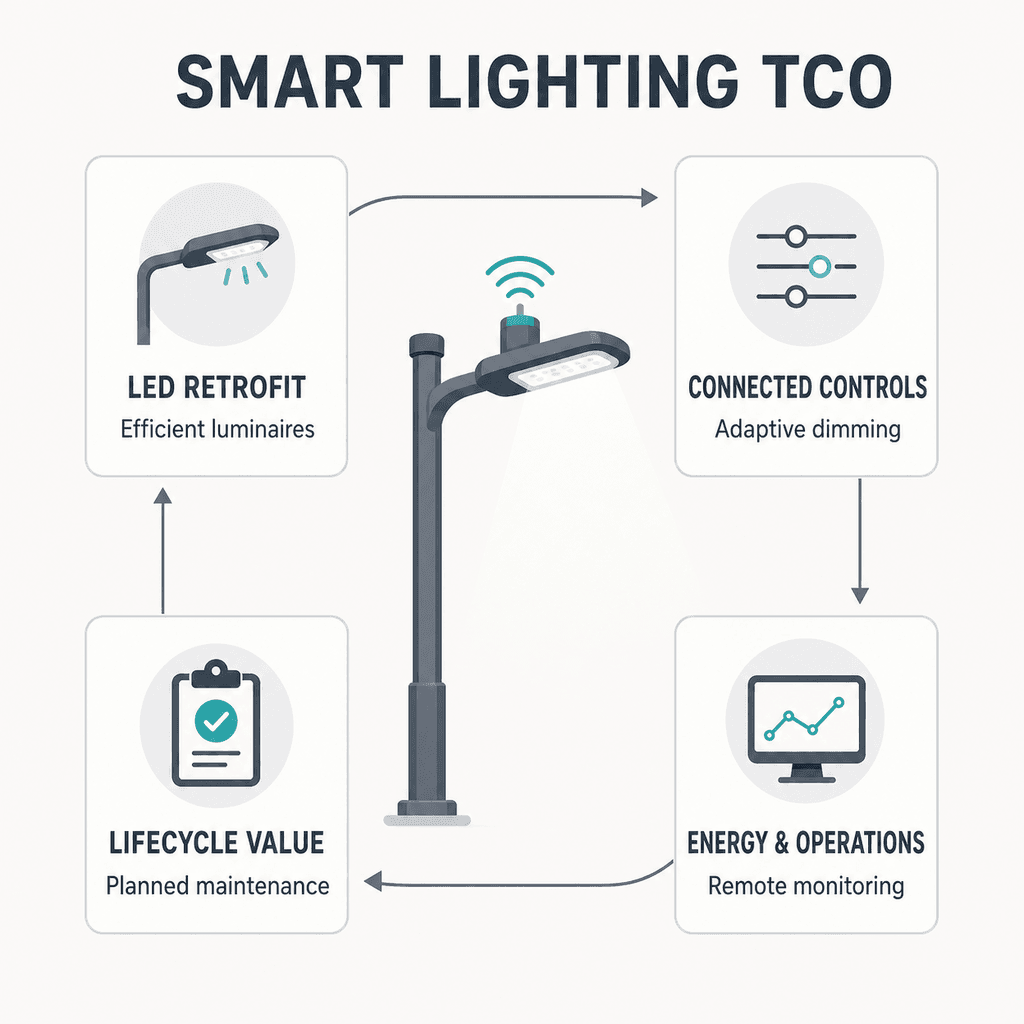
Municipal smart lighting in Europe is a TCO decision because 35 TWh of road-lighting demand, €4 billion annual public cost, and volatile tariffs dominate lifecycle economics.
The baseline is no longer a simple lamp replacement calculation. According to the EU Publications Office (2017), road lighting in EU28 countries covered more than 1.6 million km of roads, consumed about 35 TWh of electricity, and cost public authorities almost €4,000 million each year. In 2026 procurement, that legacy load is being repriced against high but easing electricity tariffs, stricter energy-performance rules, and a larger smart-city software stack.
According to Eurostat (2026), the EU average non-household electricity price for 500 MWh-2,000 MWh consumers was €18.37 per 100 kWh in the second half of 2025, down 3.5% from the first half of 2025. The same Eurostat series shows the recent peak at €21.51 per 100 kWh in the first half of 2023, so cities should stress-test payback at both normalized and crisis-price scenarios.
Smart lighting adoption is also becoming a market signal. MarketsandMarkets (2026) estimates the European smart lighting market at $2.02 billion in 2025 and $3.06 billion by 2030, equal to an 8.6% CAGR. That growth is not only decorative building lighting; outdoor networks, connected luminaires, sensors, and maintenance software are part of the same procurement ecosystem.
The International Energy Agency states, 'Policy action to improve efficiency is the single best approach' for sustained cost reduction. For municipalities, this means the cheapest kilowatt-hour is often the one removed through luminaire efficacy, adaptive schedules, and lower truck-roll frequency rather than bought through a new power contract.
| Metric | 2023-2024 Baseline | 2025-2026 Status | 2030 Procurement Implication |
|---|---|---|---|
| EU road-lighting demand | 35 TWh/year | Still a major municipal load | Retrofit portfolios remain material |
| EU public lighting cost | About €4.0 billion/year | Higher tariff sensitivity after crisis | TCO must include tariff stress cases |
| EU non-household electricity | €21.51/100 kWh in H1 2023 | €18.37/100 kWh in H2 2025 | Savings remain bankable |
| Europe smart lighting market | $2.13 billion in 2024 | $2.02 billion in 2025 estimate | $3.06 billion by 2030 |
| Market CAGR | Not applicable | 2025 starting point | 8.6% from 2025-2030 |
Technical Cost Drivers: LED, Controls, Sensors, and Smart Poles
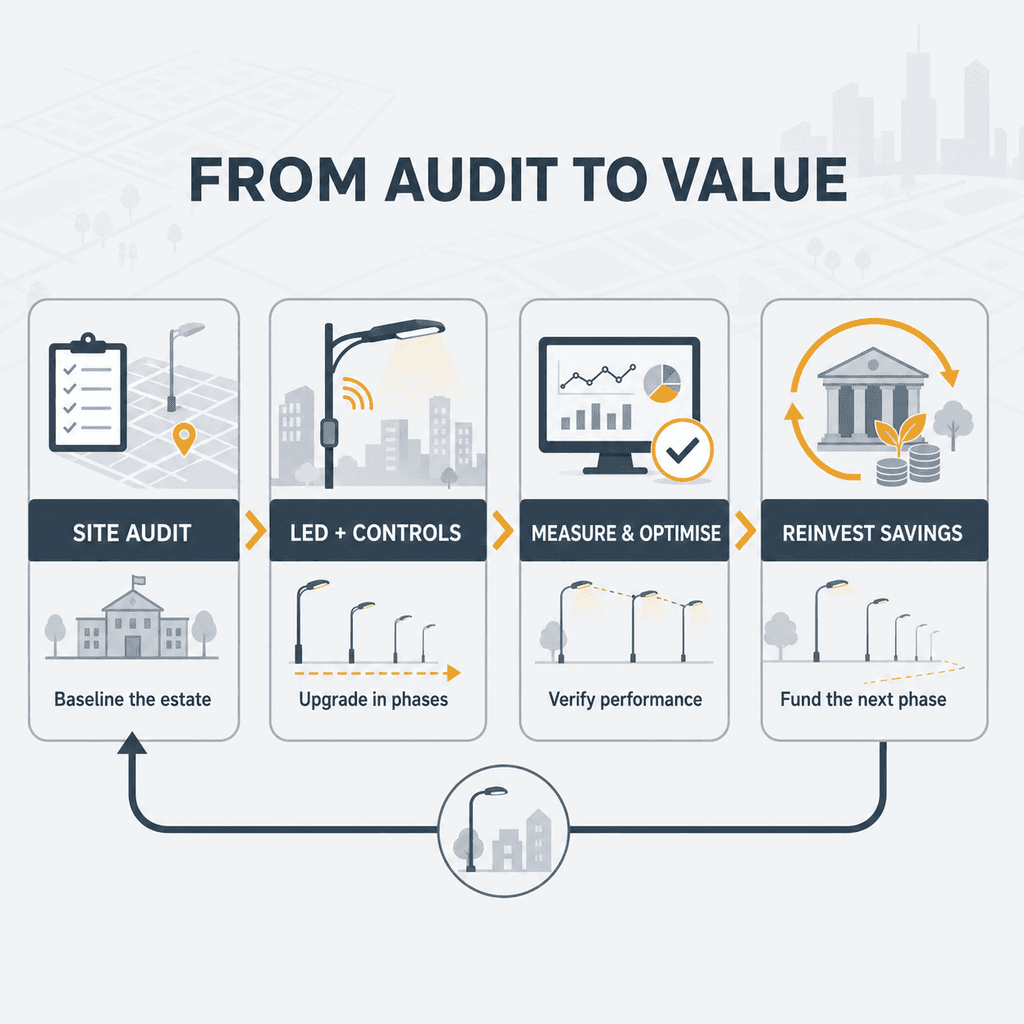
A European LED streetlight TCO model should quantify wattage, dimming accuracy, enclosure rating, maintenance interval, and sensor payload before comparing capex.
The biggest technical driver is wattage reduction. IDAE (2017) reported Spanish municipal streetlighting proposals that reduced average power from 164 W to 58 W per light point, a 65% reduction before fully counting flow-regulation effects. ManagEnergy (2023) reported Portugal's OesteLED ESCO project replaced 68,487 high-pressure sodium luminaires and achieved an estimated 84% reduction in streetlight electricity consumption.
Controls are the second cost driver. PNNL (2024) studied 23 LED streetlights claiming 0-10V dimmability and found inconsistent relationships between control voltage, luminous flux, and input power. That matters because a city expecting 30% overnight dimming savings may receive less if drivers do not produce predictable output. For new European tenders, DALI-2, D4i, Zhaga Book 18 readiness, or verified 0-10V curves should be required in the technical schedule.
Hardware durability determines whether the savings survive year 7. A municipal luminaire should normally specify IP66 ingress protection, IK08 or higher impact resistance, surge protection matched to the grid, and field-replaceable drivers. SOLARTODO smart streetlight variants use 170 lm/W LED platforms, IP66 enclosures, -40°C to +55°C operating design, and 25-year pole design life for export infrastructure projects.
Smart-pole scope changes TCO. A conventional LED point may be procured mainly for illumination, while a 10m smart pole can include a 120 W or 150 W LED luminaire, AI camera, WiFi access point, environmental sensor, and emergency communication module. SOLARTODO's 10m community entrance model typically budgets $1,600-$2,000 per pole, while larger 5-in-1 city poles can reach $12,000-$16,000 supply-and-install depending on sensors, telecom, civil works, and software.
| Configuration | Typical Scope | Indicative Capex | Energy Impact | Best Fit |
|---|---|---|---|---|
| Basic LED retrofit | Luminaire, driver, bracket | €250-€600 per point | 50%-65% reduction | Residential roads |
| Connected LED retrofit | LED, node, CMS, dimming | €400-€900 per point | 60%-75% reduction | Urban corridors |
| Security smart pole | 120 W LED, camera, WiFi, call module | $1,600-$2,000 per pole | Replaces 3-4 devices | Gates, parks, campuses |
| 5-in-1 city smart pole | 150 W LED, 4K PTZ, sensors, WiFi 6, PA | $12,000-$16,000 per unit | Multi-service TCO | CBDs, boulevards |
| Solar hybrid pole | LED, PV, battery, controller | Project-specific | Grid-energy reduction | Remote roads |
Europe City Benchmarks and Regional Market Signals to 2030
Europe city benchmarks show 4-8 year payback for simple LED retrofits, while sensor-rich smart poles need corridor-level value stacking to justify 7-12 years.
Portugal provides a useful benchmark because the OesteLED project combined scale, ESCO financing, and measured energy economics. ManagEnergy (2023) reported €12.5 million of investment over a 12-year contract, €3.4 million in annual energy savings, and 58.85% of savings retained by beneficiary municipalities. That implies gross simple payback below 4 years before contract sharing, a benchmark that smaller cities can approach only with aggregated procurement.
Spain provides a technical benchmark. IDAE reported 264,045 proposed light-point reforms from 726,647 audited points, with more than 97% including LED replacement and annual consumption savings of 65%. For a city with 20,000 light points moving from 164 W to 58 W at 4,100 operating hours, annual energy falls from about 13.45 GWh to 4.76 GWh, saving 8.69 GWh before adaptive dimming.
Germany highlights the scale of deferred modernization. A Journal of Cleaner Production case study reported 9.5 million public streetlights in Germany consuming about 4 TWh/year and costing roughly €750 million annually. At the 2025 German non-household price reported by Eurostat of €22.64 per 100 kWh, every 1 GWh avoided is worth about €226,400 before network-specific charges and maintenance savings.
Regional context matters for SOLARTODO because European benchmarks influence buyer expectations in Latin America, Middle East/Africa, and Southeast Asia. According to BloombergNEF (2026), global energy-transition investment reached $2.3 trillion in 2025, with the EU growing 18% to $455 billion and Asia-Pacific accounting for 47% of global investment. According to IRENA (2025), renewables added 585 GW in 2024, with solar and wind providing 96.6% of net renewable additions.
| Region | 2025-2026 Market Signal | Lighting TCO Relevance | Procurement Note |
|---|---|---|---|
| Asia-Pacific | 47% of global energy-transition investment in 2025 | Strong supply chain scale lowers hardware cost | Watch quality and certification |
| Europe | EU investment grew 18% to $455 billion in 2025 | Highest policy pressure and mature ESCO models | Prioritize TCO documentation |
| North America | US investment reached $378 billion in 2025 | Controls and grid-services pilots expanding | Require ANSI/UL alignment |
| Middle East/Africa | Efficiency investment growth cited by IEA at 40%-60% in 2024 for MEA/Africa | Heat, dust, and grid reliability shape specs | Use IP66 and high-temperature drivers |
| Latin America | IEA cited about 20% efficiency-investment growth in Central and South America in 2024 | Municipal budgets favor financed retrofits | Bundle lighting with public safety |
EPC Investment Analysis and Pricing Structure
EPC smart-lighting procurement should compare FOB, CIF, and turnkey offers because logistics, foundations, CMS integration, and maintenance can shift TCO by 20%-40%.
For municipal buyers, EPC means engineering, procurement, and construction delivered as one accountable work package. In smart lighting, that normally includes lighting design, pole structural review, luminaire supply, control nodes, cabinet or gateway equipment, cabling, installation, commissioning, CMS setup, operator training, and handover documentation. For smart-pole corridors, EPC also includes camera alignment, WiFi backhaul, emergency-call testing, and privacy-by-design configuration.
SOLARTODO should be evaluated as a B2B manufacturer and exporter, not an online marketplace. The commercial flow is inquiry, offline quotation, technical confirmation, optional financing review, production, delivery, and project support. Standard payment terms are 30% T/T deposit plus 70% against bill of lading, or 100% L/C at sight for approved transactions. Financing is available for large projects above $1,000K, subject to credit review and country risk.
Pricing should be compared in three tiers. FOB Supply covers factory supply at origin port and is best when the municipality or EPC contractor controls freight and installation. CIF Delivered adds international freight and insurance to the destination port. EPC Turnkey includes supply, delivery, installation, commissioning, and warranty support, which is the correct basis for lifecycle budgeting.
Volume pricing can materially change TCO. For SOLARTODO smart streetlight projects, buyers should use 50+ poles for an indicative 5% discount, 100+ poles for 10%, and 250+ poles for 15%, subject to configuration, steel price, electronics payload, and delivery schedule. For a $2,000 security smart pole, that shifts supply cost to about $1,900, $1,800, or $1,700 per unit before freight and civil works.
| Commercial Tier | Included Scope | Buyer Risk | Indicative Use Case |
|---|---|---|---|
| FOB Supply | Product, export packing, origin-port handover | Freight, duties, installation | Experienced EPC importer |
| CIF Delivered | FOB plus freight and marine insurance | Duties, inland transport, installation | City buyer with local contractor |
| EPC Turnkey | Engineering, delivery, installation, commissioning | Lowest delivery interface risk | Municipal corridor or campus |
| Application | Annual Savings Driver | Typical Payback | TCO Recommendation |
|---|---|---|---|
| Simple LED retrofit | 50%-65% energy reduction | 4-7 years | Use where poles and cabling are sound |
| Connected LED controls | 60%-75% total energy reduction | 5-8 years | Add CMS when tariffs exceed €0.15/kWh |
| ESCO portfolio | Shared savings over 10-12 years | 0 upfront possible | Aggregate 10,000+ points |
| Smart security pole | Avoids 3-4 separate devices | 6-10 years | Count avoided civil works and O&M |
| Full smart-city pole | Multi-service revenue or avoided capex | 7-12 years | Use only where sensors have owners |
For quotations, send project drawings, pole height, wind-speed requirement, luminaire wattage, control protocol, target lux class, quantity, destination port, and warranty expectation to [email protected]. Large city portfolios should also include annual operating hours, current energy tariff, maintenance cost per truck roll, and whether an ESCO or municipal capex budget will fund the project.
2026-2040 Trend Outlook for Municipal Smart Lighting
From 2026 to 2040, smart lighting will evolve from LED energy retrofits into sensor-ready infrastructure with AI maintenance, grid flexibility, and privacy controls.
The historical trend is clear. From 2021 to 2023, Europe's public-sector lighting economics were reshaped by electricity-price volatility, with EU non-household prices rising sharply in 2022 and 2023. From 2024 to 2026, prices eased but remained high enough for LED savings to retain strong payback; ACER's Eurostat-based series showed EU industrial electricity prices at €0.17/kWh in 2024, still 71% above its 2008 index baseline.
The near-term 2027-2030 trend is controls-led. The EU Energy Performance of Buildings Directive 2024/1275 requires automatic lighting controls for certain non-residential buildings above 290 kW by December 31, 2027 and above 70 kW by December 31, 2029. While road lighting is governed separately, the procurement culture will increasingly expect occupancy detection, zoning, external-signal response, and measured performance.
The long-term 2030-2040 outlook is a split market. Commodity LED replacement will become a maintenance category, with 170 lm/W-class luminaires and 100,000-hour life treated as baseline. Smart-pole systems will become a data-infrastructure category, where AI cameras, environmental sensors, public WiFi, EV or telecom interfaces, and edge computing are justified only when each module has a budget owner and a maintenance plan.
BloombergNEF's Albert Cheung said, 'the global energy transition is resilient and provides a number of opportunities for investors.' For cities, the practical translation is disciplined TCO: buy efficiency first, add intelligence where it reduces measurable operating cost, and finance large portfolios with transparent savings allocation.
FAQ
Municipal smart lighting FAQs should answer cost, installation, standards, controls, maintenance, financing, privacy, and ROI in 40-80 words each.
Q: What is municipal smart lighting TCO? A: Municipal smart lighting TCO is the full lifecycle cost of luminaires, poles, controls, electricity, maintenance, software, financing, and replacement. In Europe, the electricity line is significant because Eurostat reported €18.37 per 100 kWh for EU non-household consumers in H2 2025. A useful TCO model covers at least 10 years.
Q: How much energy can European cities save with LED streetlighting? A: European LED retrofit savings commonly range from 50% to 75% when legacy sodium lamps are replaced with efficient LED luminaires and controls. Spain's IDAE reported a 65% proposed reduction from 164 W to 58 W per light point. Portugal's OesteLED project reported an estimated 84% consumption reduction.
Q: What payback period should procurement managers expect? A: Simple LED retrofits often pay back in 4-7 years, while connected systems usually need 5-8 years because controls and software add capex. Smart poles with cameras, WiFi, and sensors may require 7-12 years unless they replace separate devices or create telecom, safety, or maintenance value.
Q: What should an EPC turnkey smart-lighting contract include? A: EPC turnkey delivery should include lighting design, product supply, pole and foundation checks, installation, control-node setup, CMS commissioning, testing, documentation, and warranty support. For smart poles, it should also include camera alignment, network integration, emergency-call testing, and operator training. Buyers should compare FOB, CIF, and EPC scopes separately.
Q: How does SOLARTODO price municipal smart lighting projects? A: SOLARTODO prices projects after technical confirmation, not through an online cart. FOB Supply, CIF Delivered, and EPC Turnkey quotations are available depending on buyer responsibility. Indicative volume discounts are 5% for 50+ poles, 10% for 100+ poles, and 15% for 250+ poles, subject to configuration and delivery schedule.
Q: Which technical standards matter most for smart streetlights? A: Core references include IEC 60598 for luminaire safety, IEC 62722 for LED luminaire performance, EN 13201 for road-lighting performance, EN 40 for lighting columns, and IEC 62676 for video surveillance systems. For controls, DALI-2, D4i, Zhaga interfaces, or validated 0-10V dimming curves should be specified.
Q: Are smart poles always better than basic LED retrofits? A: Smart poles are not always better; they are justified when multiple services share one location. A $1,600-$2,000 SOLARTODO security smart pole can replace lighting, camera, WiFi, and emergency-call infrastructure at entrances. For ordinary residential roads, a connected LED retrofit may deliver lower TCO with less operational complexity.
Q: What maintenance assumptions should cities use? A: Cities should model LED life at up to 100,000 hours L70 only when thermal design, surge protection, and driver quality are credible. Maintenance assumptions should include cleaning, driver replacement, node replacement, CMS support, and truck rolls. A 10-12 year plan is more realistic than relying only on headline LED chip life.
Q: How should privacy be handled when smart lighting includes cameras? A: Camera-equipped smart lighting should be procured with privacy settings defined before installation. Cities should specify lawful purpose, retention periods, role-based access, signage, cybersecurity controls, and whether face recognition is enabled, disabled, or limited to 1:1 verification. Privacy cost belongs in TCO because compliance requires administration and audits.
Q: When is project financing available for SOLARTODO smart lighting? A: Financing can be reviewed for large SOLARTODO projects above $1,000K, especially where energy savings, municipal budgets, or ESCO contracts support repayment. Standard payment terms are 30% T/T plus 70% against bill of lading, or 100% L/C at sight. Contact [email protected] with quantity, scope, and destination.
Conclusion
Municipal smart lighting in Europe is financeable when cities combine 65%-84% energy savings, verified controls, and 10-year TCO models instead of buying luminaires only.
The bottom line: for European city benchmarks to 2030, SOLARTODO recommends separating basic LED retrofits, connected LED corridors, and multi-function smart poles into different TCO cases. Projects above 100 poles should request volume pricing, and portfolios above $1,000K should evaluate EPC turnkey delivery and financing.
References
- IEA (2024): Energy Efficiency 2024, including global efficiency progress, $660 billion efficiency investment, and policy context: https://www.iea.org/reports/energy-efficiency-2024/executive-summary — https://www.iea.org/reports/world-energy-outlook-2024
- IRENA (2025): Renewable Capacity Statistics 2025, including 585 GW renewable additions and 4,448 GW global renewable capacity: https://www.irena.org/News/pressreleases/2025/Mar/Record-Breaking-Annual-Growth-in-Renewable-Power-Capacity — https://www.irena.org/Data/View-data-by-topic/Capacity-and-Generation
- BloombergNEF (2026): Energy Transition Investment Trends, including $2.3 trillion global investment and $455 billion EU investment in 2025: https://about.bnef.com/insights/clean-energy/bloombergnef-finds-global-energy-transition-investment-reached-record-2-3-trillion-in-2025-up-8-from-2024/ — https://about.bnef.com/ The references below combine 2024-2026 market, efficiency, standards, and European tariff sources used for municipal smart-lighting TCO assumptions.
- Eurostat (2026): EU non-household electricity prices for H2 2025, including €18.37 per 100 kWh average and country-level benchmarks.
- EU Publications Office (2017): Green public procurement background for street lighting, including 35 TWh/year EU road-lighting demand and €4 billion public cost.
- ManagEnergy / European Commission (2023): OesteLED Portugal ESCO case with 68,487 luminaires, €12.5 million investment, and €3.4 million annual savings.
- IDAE Spain (2017): Spanish municipal lighting audit data showing 264,045 reform requests and 65% expected annual energy savings.
- IEA (2024): Energy Efficiency 2024, including global efficiency progress, $660 billion efficiency investment, and policy context.
- IRENA (2025): Renewable Capacity Statistics 2025, including 585 GW renewable additions and 4,448 GW global renewable capacity.
- BloombergNEF (2026): Energy Transition Investment Trends, including $2.3 trillion global investment and $455 billion EU investment in 2025.
- PNNL / U.S. DOE (2024): Streetlight dimming-control study covering 23 LED streetlights and 0-10V performance variation.
- IEC 60598 and IEC 62722 (current standards): International luminaire safety and LED luminaire performance standards used for outdoor lighting procurement.
- EUR-Lex Directive 2024/1275 (2024): EU building energy performance directive requiring automatic lighting controls for defined non-residential systems by 2027 and 2029.
About SOLARTODO
SOLARTODO is a global integrated solution provider specializing in solar power generation systems, energy-storage products, smart street-lighting and solar street-lighting, intelligent security & IoT linkage systems, power transmission towers, telecom communication towers, and smart-agriculture solutions for worldwide B2B customers.
About the Author

Cinn Song
Founder & Chief Solutions Architect
Cinn Song founded SOLARTODO LIMITED and leads its smart-city infrastructure engineering — from solar, storage and integrated smart poles to the company's push into physical-AI city edge nodes: pole-mounted edge computing, vertical LLMs for smart cities, drone-based O&M with autonomous battery swapping, robotic maintenance, and high-speed counter-UAS interception. Since 2010, he has directed turnkey EPC + BOT delivery across 50+ countries, including telecom monopole supply for national grid operators, off-grid solar street-lighting for African municipalities, and integrated smart-pole programs for Gulf smart cities.
Cite This Article
Cinn Song. (2026). Municipal Smart Lighting TCO Analysis 2026: Europe City…. SOLARTODO. Retrieved from https://solartodo.com/knowledge/municipal-smart-lighting-tco-analysis-2026-europe-city-benchmarks-to-2030-2
@article{solartodo_municipal_smart_lighting_tco_analysis_2026_europe_city_benchmarks_to_2030_2,
  title = {Municipal Smart Lighting TCO Analysis 2026: Europe City…},
  author = {Cinn Song},
  journal = {SOLARTODO Knowledge Base},
  year = {2026},
  url = {https://solartodo.com/knowledge/municipal-smart-lighting-tco-analysis-2026-europe-city-benchmarks-to-2030-2},
  note = {Accessed: 2026-10-13}
}
Published: August 16, 2026 | Available at: https://solartodo.com/knowledge/municipal-smart-lighting-tco-analysis-2026-europe-city-benchmarks-to-2030-2
Subscribe to Our Newsletter
Get the latest solar energy news and insights delivered to your inbox.
View All Articles