power line Design for Extreme Weather Conditions | SOLARTODO

Cinn Song
Founder & Chief Solutions Architect
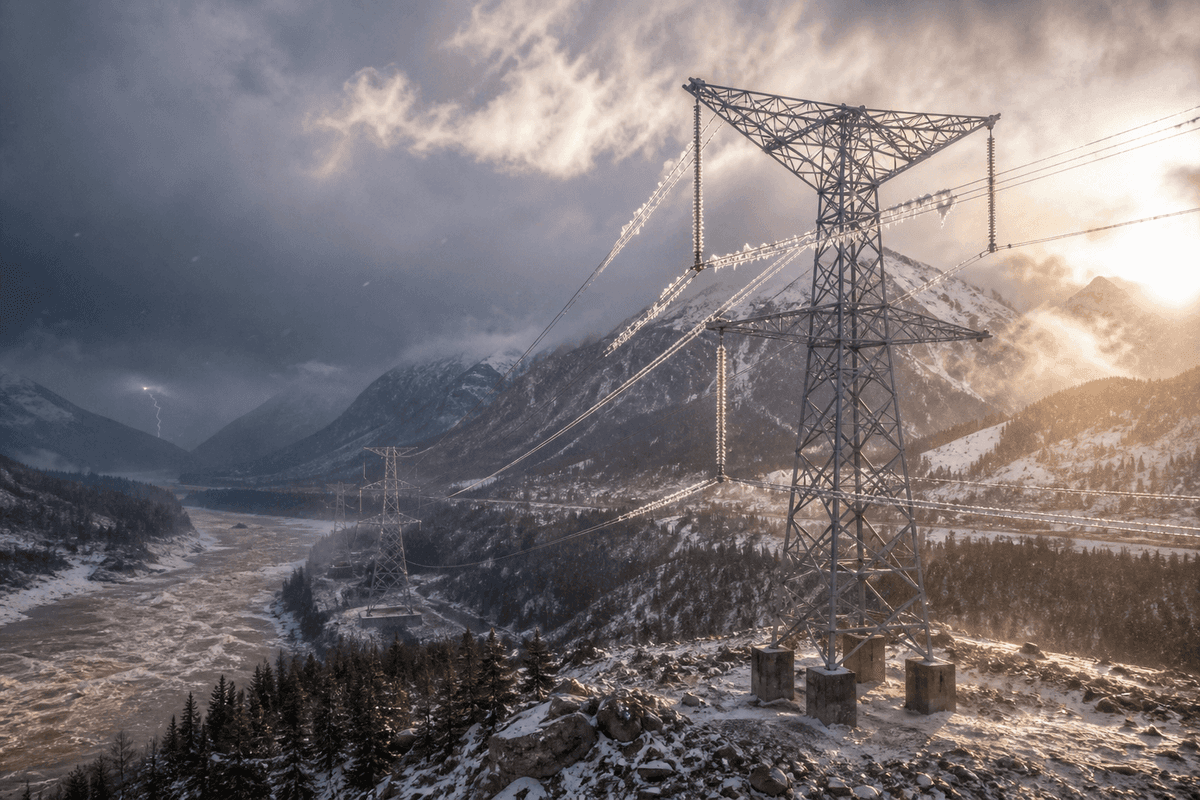
Watch the video
TL;DR
Extreme-weather power line design is the process of engineering 45kV-1000kV corridors for wind, 15mm ice, heat sag, lightning, floods, and broken-wire events. Buyers should require IEC 60826 load cases, IEEE 738 conductor checks, 50-year design life, sub-10-ohm grounding, and EPC pricing that separates FOB supply, CIF delivery, and turnkey construction.
Extreme-weather power line design combines IEC 60826 load cases, 15mm ice checks, 50-year structural life, and 10-ohm grounding targets to protect transmission corridors from wind, icing, lightning, flooding, and heat-driven sag.
Summary
Extreme-weather power line design combines IEC 60826 load cases, 15mm ice checks, 50-year structural life, and 10-ohm grounding targets to protect transmission corridors from wind, icing, lightning, flooding, and heat-driven sag.
Key Takeaways
- Model 6-10 governing load cases, including maximum wind, 15mm ice, broken-wire, installation, and flood-access scenarios before final tower selection.
- Select 30m-120m steel monopoles or lattice towers according to span, voltage class, terrain, ROW width, and 50-year design life requirements.
- Verify conductor sag and ampacity with IEEE 738-2023 when ambient temperature, solar heating, wind speed, and emergency ratings affect clearance.
- Specify grounding below 10 ohms for standard corridors and below 4 ohms in high-lightning regions to reduce outage and equipment-damage risk.
- Compare monopoles for 30-50% lower corridor clutter against lattice towers for higher loading strength on 500kV-1000kV backbone routes.
- Budget EPC costs in 3 tiers: FOB supply, CIF delivered, and turnkey EPC, with 5%, 10%, and 15% volume discounts at 50, 100, and 250 structures.
- Reduce lifecycle risk by requiring hot-dip galvanizing, mill certificates, trial assembly, and inspection test plans for every critical steel package.
- Plan maintenance every 12-24 months after storms, floods, or icing events to keep clearances, bolts, foundations, and grounding within utility limits.
Extreme-Weather Power Line Design for Resilient Transmission
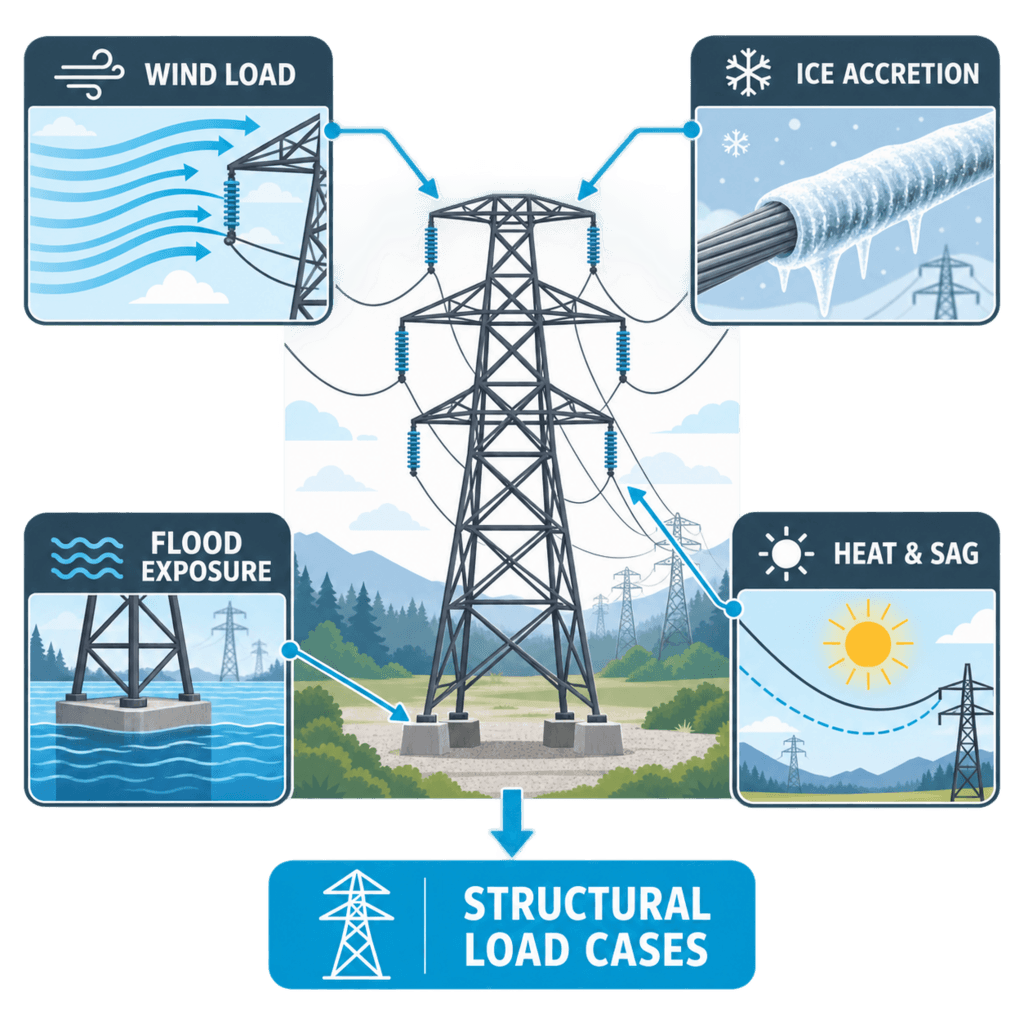
Extreme-weather power line design protects 45kV-1000kV corridors by combining wind, ice, flood, heat, lightning, and broken-wire checks into one 50-year reliability model.
For utilities, EPC contractors, and industrial developers, the problem is no longer only peak demand growth. Transmission assets must survive typhoons, cyclones, desert heat, flash flooding, wildfire smoke, salt fog, and abnormal icing while still maintaining electrical clearance and emergency transfer capacity. According to IEA (2023), the world must add or refurbish over 80 million km of grids by 2040, which makes resilient design a procurement issue as much as an engineering issue.
IEC 60826:2017 provides the core framework for overhead transmission line loading and strength requirements using reliability-based principles for lines 45kV and above. That matters because a pole or tower cannot be selected only by voltage and height. The correct design basis must define return periods, wind pressure, terrain category, ice thickness, conductor tension, foundation uplift, and allowable serviceability limits.
For SOLARTODO power tower projects, the design conversation usually starts with route climate data, voltage class, span, conductor family, soil profile, and maintenance access. A 30m 110kV tapered monopole may be suitable for city-edge corridors with 250m spans and 15mm ice assumptions, while a 120m 1000kV UHVDC lattice tangent tower may be required for 600m spans and 8-bundle ACSR_900 conductors. The right answer depends on verified loading, not catalogue appearance.
The International Energy Agency states, 'bigger, stronger and smarter grids' are needed for clean energy transitions. In practice, stronger means higher reserve against wind and longitudinal loads; smarter means better sensors, digital inspections, and weather-adjusted ratings; bigger means enough corridor and structure capacity to connect renewable generation without creating new weak points.
Technical Design Basis and Extreme Weather Load Cases
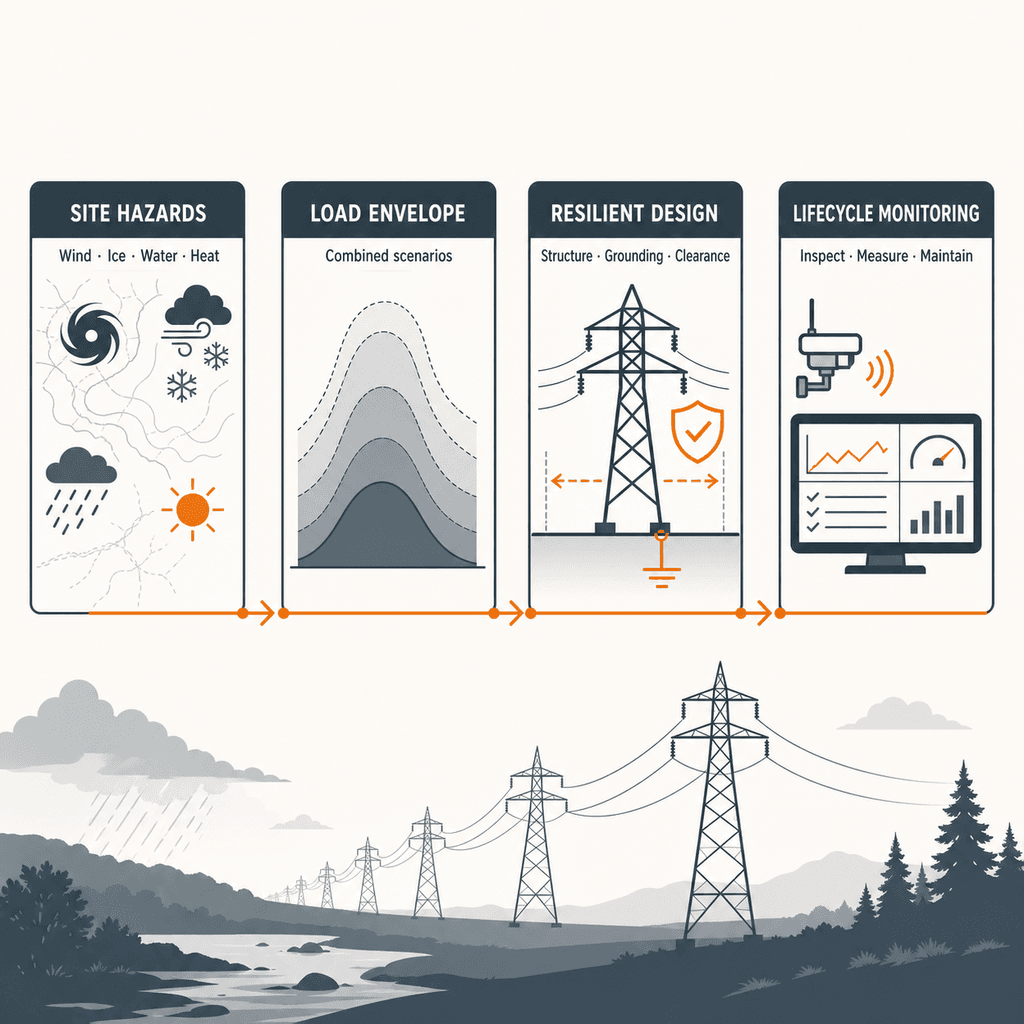
A bankable design basis should include at least 6-10 load combinations covering wind, 15mm ice, heat sag, lightning, flooding, seismic exposure, and broken conductors.
Extreme-weather design begins with climate classification. Engineers should define basic wind speed, gust response, topographic amplification, radial ice thickness, minimum and maximum conductor temperature, pollution severity, corrosion category, flood level, and lightning ground flash density where data are available. IEC 60826 notes that national standards must establish local climatic data for application, so using a generic catalogue load without route validation is a common procurement error.
Wind loading is usually the dominant transverse case for both monopoles and lattice towers. In coastal or cyclone-prone regions, the governing design may be maximum wind on the structure plus wind on conductors and insulators. For a 110kV monopole, that can drive shaft diameter, wall thickness, base plate design, anchor bolts, and foundation overturning moment. For 500kV-1000kV lattice structures, wind on wide conductor bundles and crossarms can dominate member utilization.
Ice loading creates a different failure pattern. A 15mm radial ice assumption increases vertical conductor weight and can increase transverse wind area when combined with wind-on-ice cases. Uneven shedding can create unbalanced longitudinal loads, especially near angle towers, dead-end structures, river crossings, and exposed ridgelines. For procurement, buyers should request a loading tree that clearly separates everyday tension, maximum wind, ice-only, wind-plus-ice, installation, and broken-wire cases.
Heat is also an extreme-weather design case. According to IEEE 738-2023, conductor current-temperature calculation relates bare overhead conductor temperature to electrical current and weather conditions. When ambient temperature rises and wind speed falls, conductors sag more, reducing road, rail, vegetation, and ground clearances. For renewable interconnection lines, dynamic or ambient-adjusted ratings can improve utilization, but only if sag, annealing limits, and clearance compliance remain within the utility design envelope.
Lightning and grounding must be designed as a system rather than an accessory. A common target is below 10 ohms footing resistance for standard transmission structures and below 4 ohms in high-lightning regions, supported by counterpoise conductors, ground rods, and soil-resistivity testing. OPGW can provide shielding and fiber communication in one asset, but shield angle, tower geometry, and earthing quality determine actual outage performance.
Structures, Conductors, Foundations, and Materials
Transmission resilience depends on matching 30m-120m structures, ACSR-240 to ACSR_900 conductors, galvanized steel, and foundations to verified weather and soil loads.
Structure selection is a trade-off between mechanical duty, right-of-way, transport, installation speed, and lifecycle inspection. Tubular steel monopoles reduce footprint and visual clutter, often by 30-50% versus comparable lattice structures in constrained urban corridors. Lattice towers remain more economical for very high loads, long spans, major angle points, and UHV routes where steel tonnage is justified by conductor bundle size and clearance geometry.
For 110kV city-edge lines, a 30m tapered steel monopole with a 250m design span, 1 circuit, ACSR-240 conductors, and optional OPGW is often practical. For 1000kV UHVDC corridors, a 120m tangent lattice tower with 1 circuit, 8 subconductors per phase, ACSR_900 conductors, and 600m spans is a different engineering class. Both can be resilient, but they solve different problems.
| Design Factor | 110kV Tapered Monopole | 1000kV UHVDC Lattice Tower | Extreme-Weather Implication |
|---|---|---|---|
| Typical height | 30m | 120m | Higher structures need stronger wind and deflection control |
| Design span | 250m | 600m | Longer spans increase conductor swing, sag, and longitudinal load |
| Conductor basis | ACSR-240 | 8 x ACSR_900 bundle | Larger bundles require spacer dampers and corona control |
| Structure type | Steel tubular monopole | Heavy steel lattice | Monopoles reduce ROW; lattice handles heavy UHV loads |
| Baseline ice case | 15mm radial ice | 15mm radial ice | Ice affects vertical load and unbalanced shedding risk |
| Grounding target | Less than 10 ohms, or 4 ohms in high-lightning zones | Less than 10 ohms, or 4 ohms in high-lightning zones | Lower resistance improves lightning performance |
| Design life | 50 years | 50 years | Coating, fatigue, and maintenance planning must match asset life |
| Typical role | City-edge reinforcement | Bulk power backbone | Procurement specs should match route criticality |
Conductors require both mechanical and thermal verification. ACSR-240 may be sufficient for many 110kV feeders, while ACSR_900 and 8-bundle configurations support UHVDC transfer. Hardware should include vibration dampers, spacer dampers, arcing horns, corona rings, and insulator strings selected for voltage, pollution class, wind swing, and creepage distance. Composite insulators can reduce handling weight by roughly 30-70% compared with porcelain, but buyers should still evaluate aging, tracking resistance, and local utility acceptance.
Foundation design is often where extreme-weather budgets fail. Floodplains may need deeper piles, scour protection, and raised access platforms. Soft soils increase settlement risk and may require pile groups or improved pads. Rocky terrain may reduce excavation but increase anchor complexity. For each structure family, SOLARTODO recommends geotechnical reports, soil resistivity tests, flood-level data, and foundation drawings before final EPC pricing.
Materials should be specified with inspection evidence. Hot-dip galvanizing supports long corrosion protection, but coating thickness should match atmospheric severity, salt exposure, industrial pollution, and maintenance interval. A defensible QA package includes steel mill certificates, galvanizing certificates, bolt grade documentation, welding procedure qualifications where applicable, dimensional inspection, trial assembly records, and packing lists for export control.
EPC Investment Analysis and Pricing Structure
EPC pricing should separate FOB supply, CIF delivery, and turnkey construction, with volume discounts of 5% at 50 units, 10% at 100, and 15% at 250.
Turnkey EPC delivery includes route-specific engineering, tower or pole design, procurement, manufacturing, galvanizing, factory inspection, export packing, shipping coordination, civil works, foundation construction, erection, stringing support, grounding, testing, and handover documentation. For extreme-weather projects, EPC scope should also include climate data validation, geotechnical review, constructability planning, spare parts, and post-storm inspection procedures.
The three-tier pricing structure helps procurement teams compare offers without confusing factory supply with installed cost. FOB supply covers steel structures, bolts, basic accessories, drawings, inspection documents, and export packing at the manufacturing side. CIF delivered adds international freight and insurance to the destination port. EPC turnkey includes local civil works, erection, stringing, testing, commissioning support, and project management, so it is the only tier that reflects actual installed corridor cost.
For a 30m 110kV tapered monopole, a practical installed EPC range is often USD 20,000-30,000 per pole position, depending on foundation depth, access roads, grounding, insulator choice, and conductor hardware. For large UHV lattice towers, steel mass can reach roughly 180-260 tons per tower depending on wind zone, span, and bundle geometry. At a galvanized Q420 angle steel benchmark near USD 1,400 per ton, the steel superstructure alone can represent USD 252,000-364,000 before hardware and civil works.
| Pricing Tier | Includes | Best For | Procurement Watchpoint |
|---|---|---|---|
| FOB Supply | Structures, bolts, drawings, packing, factory QA | Buyers with their own logistics and installer | Excludes ocean freight, duties, and site works |
| CIF Delivered | FOB scope plus freight and insurance to port | Importers and EPCs managing local erection | Confirm port, Incoterms, and unloading responsibility |
| EPC Turnkey | Engineering, supply, delivery, civil works, erection, testing | Utilities and developers needing single-point delivery | Requires route, soil, permits, and local labor assumptions |
Volume pricing should be negotiated early because tower families repeat along a route. SOLARTODO can guide indicative discounts of 5% for 50+ structures, 10% for 100+ structures, and 15% for 250+ structures when designs, steel grades, and hardware are standardized. Payment terms are typically 30% T/T deposit plus 70% against bill of lading, or 100% L/C at sight for qualified buyers.
ROI is measured in avoided outage cost, lower repair frequency, faster permitting, reduced land impact, and improved corridor availability. A monopole that reduces foundation footprint by 30-50% may lower urban acquisition and reinstatement costs. A stronger lattice design may avoid expensive failure cascades during cyclones or icing events. For large projects above USD 1,000K, SOLARTODO can support project financing discussions through inquiry-based offline quotation. Contact [email protected] for EPC pricing, technical schedules, and financing review.
Applications, Selection Guide, and Procurement Checklist
Use extreme-weather line design for 66kV-1000kV renewable interconnections, city-edge feeders, industrial parks, coastal grids, floodplains, deserts, and UHV backbone corridors.
The most common use cases are renewable evacuation lines, substation take-off spans, industrial park feeders, mining power supply, coastal transmission reinforcement, and long-distance bulk transfer corridors. According to IRENA (2024), infrastructure is one of three priority pillars for realigning the energy transition with climate objectives. That makes line resilience essential for solar and wind integration, not just a grid-maintenance concern.
SOLARTODO typically recommends monopoles where right-of-way is constrained, visual impact matters, access roads are narrow, or municipal approval is sensitive. Lattice towers are recommended where the project has long spans, heavy conductor bundles, high angle loads, river crossings, UHV voltage, or severe wind and ice loading. Hybrid routes are common: monopoles near substations and city edges, lattice towers across open terrain, and heavier dead-end structures at critical angle points.
Selection should follow a disciplined checklist:
- Confirm voltage class, route length, target span, circuit count, and conductor type.
- Collect 30-year or longer climate records where available for wind, ice, temperature, flood, and lightning exposure.
- Define the reliability level, design life, return period, and maintenance access assumptions.
- Run sag-tension and clearance checks at maximum operating temperature and emergency current.
- Match foundation type to bearing capacity, uplift, overturning, flood scour, and soil resistivity.
- Require QA documents for steel grade, galvanizing, bolts, insulators, OPGW, and conductor accessories.
- Compare lifecycle cost, not only FOB steel price, because outage risk and foundation scope can dominate TCO.
The International Renewable Energy Agency states, 'Technologies, not fuels, are the centerpiece of the new energy system.' For transmission buyers, that means towers, conductors, sensors, foundations, and digital ratings must be treated as strategic infrastructure. Extreme-weather design is the engineering layer that keeps renewable generation connected when climate stress increases.
FAQ
Power line design for extreme weather usually requires 8-12 procurement answers covering load cases, structures, conductors, cost, EPC scope, maintenance, and standards.
Q: What is extreme-weather power line design? A: Extreme-weather power line design is the engineering process used to keep overhead lines reliable during wind, ice, heat, flooding, lightning, and abnormal conductor events. It defines load cases, structure strength, conductor sag, grounding, foundations, and maintenance assumptions for a target life, commonly 50 years for transmission assets.
Q: Which standards should be used for overhead transmission line weather loading? A: IEC 60826:2017 is the primary international reference for overhead transmission line loading and strength criteria using reliability-based design. Engineers may also apply ASCE 10-15 for steel lattice structures, IEEE 738-2023 for conductor temperature and ampacity, and local grid codes for statutory wind, ice, clearance, and safety requirements.
Q: How much ice loading should be considered in line design? A: Ice loading is route-specific, but 15mm radial ice is a common baseline for many temperate and subtropical transmission specifications. Severe alpine, freezing-rain, or high-altitude corridors may require heavier assumptions. Procurement teams should request separate ice-only, wind-plus-ice, and unbalanced ice-shedding cases before approving tower families.
Q: When should a utility choose monopoles instead of lattice towers? A: Choose steel monopoles when right-of-way is narrow, visual impact matters, or a 110kV-220kV city-edge route needs compact foundations and faster erection. Choose lattice towers for heavier loads, long spans, major line angles, and 500kV-1000kV corridors. Monopoles can reduce corridor clutter by about 30-50%.
Q: How does extreme heat affect overhead conductors? A: Extreme heat increases conductor temperature and sag, which can reduce ground, road, railway, and vegetation clearances. IEEE 738-2023 provides the accepted method for calculating conductor current-temperature behavior under weather conditions. Engineers must verify normal and emergency ratings against maximum conductor temperature and allowable sag limits.
Q: What grounding resistance should be specified for storm-prone lines? A: A practical grounding target is below 10 ohms for standard transmission structures and below 4 ohms in high-lightning regions. The final value should reflect soil resistivity, lightning density, voltage class, shield wire design, and utility practice. Counterpoise conductors and deeper rods may be required in rocky or dry soil.
Q: What does EPC turnkey delivery include for power line projects? A: EPC turnkey delivery includes engineering, procurement, manufacturing, logistics, foundations, erection, stringing support, grounding, testing, and handover documents. For extreme-weather lines, it should also include climate data review, geotechnical validation, storm-access planning, QA inspection, and post-event maintenance guidance. SOLARTODO provides inquiry-based offline quotations, not marketplace checkout.
Q: How should buyers compare FOB, CIF, and EPC prices? A: FOB pricing covers factory supply, export packing, and documents; CIF adds ocean freight and insurance to destination port; EPC turnkey adds civil works, erection, testing, and project management. Buyers should not compare FOB steel price against installed EPC cost. SOLARTODO can quote all 3 levels after route and load data are available.
Q: What payment and financing terms are typical? A: Standard payment terms are usually 30% T/T deposit plus 70% against bill of lading, or 100% L/C at sight for qualified buyers. For large projects above USD 1,000K, financing may be available after technical scope, buyer qualification, project location, and delivery schedule are reviewed. Contact [email protected] for evaluation.
Q: How often should extreme-weather transmission assets be inspected? A: Routine inspection is commonly scheduled every 12-24 months, with additional inspections after cyclones, severe icing, floods, wildfires, or lightning clusters. Crews should check bolt tightness, corrosion, insulators, dampers, conductor damage, tower plumb, foundation cracking, erosion, and grounding continuity. Critical crossings may justify sensors or drone inspection.
Q: What documents should be requested before procurement approval? A: Buyers should request the design basis report, loading tree, sag-tension calculations, structure drawings, foundation assumptions, material certificates, galvanizing certificates, bolt specifications, insulator datasheets, OPGW details, QA plan, packing list, and installation manual. For severe weather corridors, also request route climate evidence and geotechnical inputs.
Q: Can existing lines be upgraded for extreme weather instead of rebuilt? A: Existing lines can sometimes be uprated or reinforced, but only after structural assessment, foundation review, conductor clearance checks, and corrosion inspection. IEC 60826 states that many concepts can address refurbishment, upgrading, and uprating of existing lines. If old towers lack reserve strength, selective replacement may be safer than conductor-only upgrades.
References
- IEC 60826 (2017): Design criteria of overhead transmission lines; specifies reliability-based loading and strength requirements for overhead lines 45kV and above. https://webstore.iec.ch/en/publication/33148 — https://webstore.iec.ch/
- IEEE 738 (2023): Standard for calculating the current-temperature relationship of bare overhead conductors under electrical current and weather conditions. https://standards.ieee.org/ieee/738/10207/ — https://standards.ieee.org/ieee/1547/7382/
- IEA (2023): Electricity Grids and Secure Energy Transitions; reports over 80 million km of grids must be added or refurbished by 2040. https://www.iea.org/reports/electricity-grids-and-secure-energy-transitions — https://www.iea.org/reports/world-energy-outlook-2024
- IEA (2025): Building the Future Transmission Grid; highlights global electricity demand growth near 4% annually through 2027. https://www.iea.org/reports/building-the-future-transmission-grid/executive-summary — https://www.iea.org/reports/world-energy-outlook-2024
- IRENA (2024): World Energy Transitions Outlook 2024; identifies infrastructure, policy, and institutional capacity as priority pillars for the 1.5 C pathway. https://www.irena.org/publications/2024/Nov/World-Energy-Transitions-Outlook-2024 — https://www.irena.org/Data/View-data-by-topic/Capacity-and-Generation The key references for extreme-weather line design include IEC 60826:2017, IEEE 738-2023, ASCE 10-15, IEA 2023 grid analysis, and IRENA 2024 infrastructure guidance.
- IEC 60826 (2017): Design criteria of overhead transmission lines; specifies loading and strength requirements for overhead lines 45kV and above. https://webstore.iec.ch/en/publication/33148
- IEEE 738 (2023): Standard for calculating the current-temperature relationship of bare overhead conductors under electrical current and weather conditions. https://standards.ieee.org/ieee/738/10207/
- ASCE 10-15 (2015): Design of Latticed Steel Transmission Structures; widely used for structural reliability and member design in steel lattice towers.
- IEA (2023): Electricity Grids and Secure Energy Transitions; reports over 80 million km of grids must be added or refurbished by 2040. https://www.iea.org/reports/electricity-grids-and-secure-energy-transitions
- IEA (2025): Building the Future Transmission Grid; highlights global electricity demand growth near 4% annually through 2027. https://www.iea.org/reports/building-the-future-transmission-grid/executive-summary
- IRENA (2024): World Energy Transitions Outlook 2024; identifies infrastructure as a core pillar for the 1.5 C transition pathway. https://www.irena.org/publications/2024/Nov/World-Energy-Transitions-Outlook-2024
- CIGRE Technical Brochure 178 (2001): Probabilistic design of overhead transmission lines; referenced by IEC 60826 for reliability concepts and climatic loading methods.
Conclusion
Extreme-weather power line design should combine 50-year structural life, 6-10 load cases, IEEE 738 sag checks, and sub-10-ohm grounding before procurement approval.
The bottom line: for 66kV-1000kV corridors, SOLARTODO recommends selecting tower type, conductor package, foundation, and EPC tier only after route-specific wind, ice, heat, flood, and lightning data are verified. This approach reduces outage exposure, improves lifecycle cost control, and gives B2B buyers a defensible basis for technical and commercial comparison.
About SOLARTODO
SOLARTODO is a global integrated solution provider specializing in solar power generation systems, energy-storage products, smart street-lighting and solar street-lighting, intelligent security & IoT linkage systems, power transmission towers, telecom communication towers, and smart-agriculture solutions for worldwide B2B customers.
Procurement paths
About the Author

Cinn Song
Founder & Chief Solutions Architect
Cinn Song founded SOLARTODO LIMITED and leads its smart-city infrastructure engineering — from solar, storage and integrated smart poles to the company's push into physical-AI city edge nodes: pole-mounted edge computing, vertical LLMs for smart cities, drone-based O&M with autonomous battery swapping, robotic maintenance, and high-speed counter-UAS interception. Since 2010, he has directed turnkey EPC + BOT delivery across 50+ countries, including telecom monopole supply for national grid operators, off-grid solar street-lighting for African municipalities, and integrated smart-pole programs for Gulf smart cities.
Cite This Article
Cinn Song. (2026). power line Design for Extreme Weather Conditions | SOLARTODO. SOLARTODO. Retrieved from https://solartodo.com/knowledge/power-line-design-for-extreme-weather-conditions
@article{solartodo_power_line_design_for_extreme_weather_conditions,
  title = {power line Design for Extreme Weather Conditions | SOLARTODO},
  author = {Cinn Song},
  journal = {SOLARTODO Knowledge Base},
  year = {2026},
  url = {https://solartodo.com/knowledge/power-line-design-for-extreme-weather-conditions},
  note = {Accessed: 2026-10-13}
}
Published: August 17, 2026 | Available at: https://solartodo.com/knowledge/power-line-design-for-extreme-weather-conditions
Subscribe to Our Newsletter
Get the latest solar energy news and insights delivered to your inbox.
View All Articles