Regulamentações ANEEL para EV charging em Cabo Verde

Cinn Song
Founder & Chief Solutions Architect
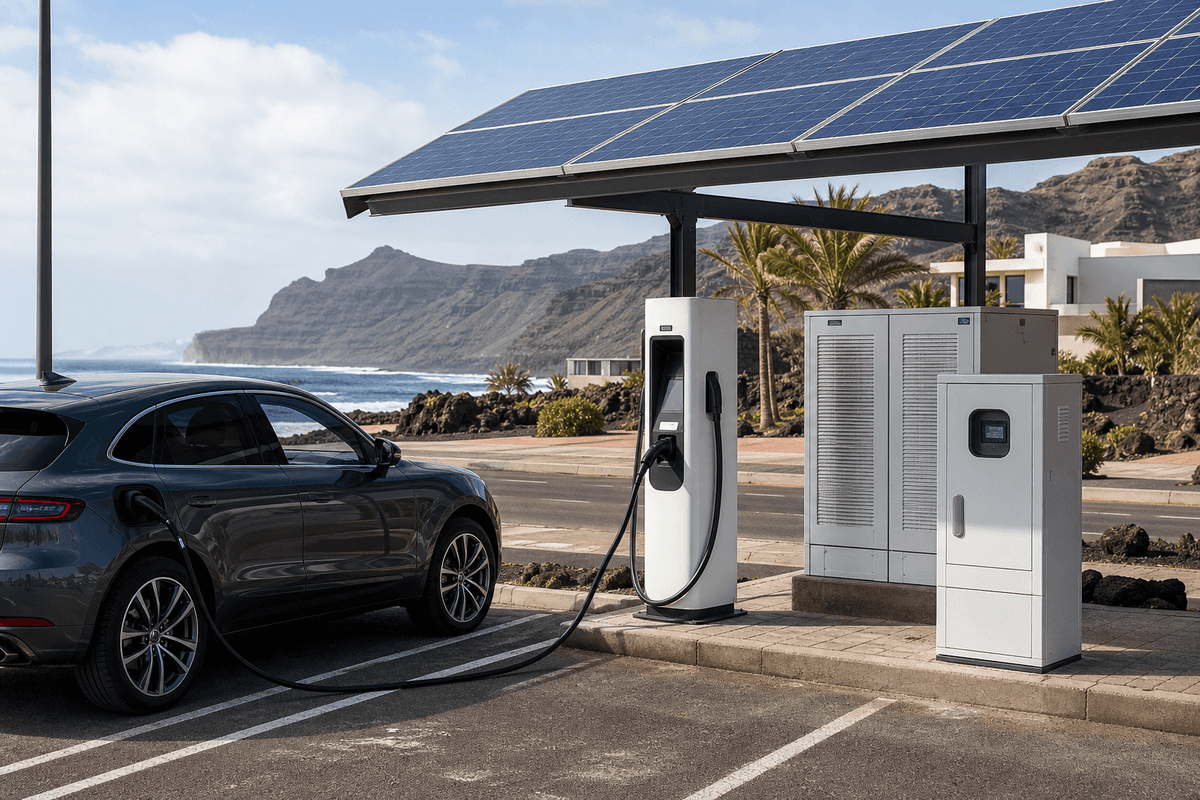
Watch the video
TL;DR
Cabo Verde EV charging projects should not be planned under Brazil’s ANEEL rules. Use ARME tariff validation, IEC 61851/62196 chargers, and Cabo Verde’s 2026 incentives for charging equipment, meters, PV, and storage. For B2B sites, SOLARTODO recommends 150 kWp solar carports for 10 chargers and 1.5 MWh storage where grid capacity is constrained.
Cabo Verde does not apply Brazil’s ANEEL rules; EV charging projects follow ARME electricity regulation, 2026 tariff updates, and tax incentives that exempt new chargers, meters, storage, and PV equipment for public charging.
Summary
Cabo Verde does not apply Brazil’s ANEEL rules; EV charging projects follow ARME electricity regulation, 2026 tariff updates, and tax incentives that exempt new chargers, meters, storage, and PV equipment for public charging.
Key Takeaways
- Verify 1 local regulator: ANEEL does not regulate Cabo Verde, so EV charging permits should be checked against ARME, transport, customs, and municipal rules.
- Design 10 to 20 charger sites with smart load control to avoid transformer upgrades where available grid capacity is below 500 kW to 1,000 kW.
- Use IEC 61851 and IEC 62196 compliant AC/DC charging equipment to simplify acceptance for public, fleet, and smart streetlight charging projects.
- Combine 150 kWp solar carports with 10 EV chargers to generate about 225 MWh/year in strong solar-resource sites.
- Add 1.5 MWh / 750 kW LFP storage where fast charging peaks could increase demand charges or delay interconnection by 6 to 18 months.
- Budget 3 commercial scopes: FOB supply, CIF delivered, and EPC turnkey, with volume discounts of 5%, 10%, and 15% at defined order thresholds.
- Plan payment terms around 30% T/T plus 70% against B/L, or 100% L/C at sight for bankable procurement control.
- Request financing for projects above $1,000K when charger, PV canopy, storage, civil works, and grid-connection costs are bundled.
Regulatory Reality: ANEEL Does Not Govern Cabo Verde
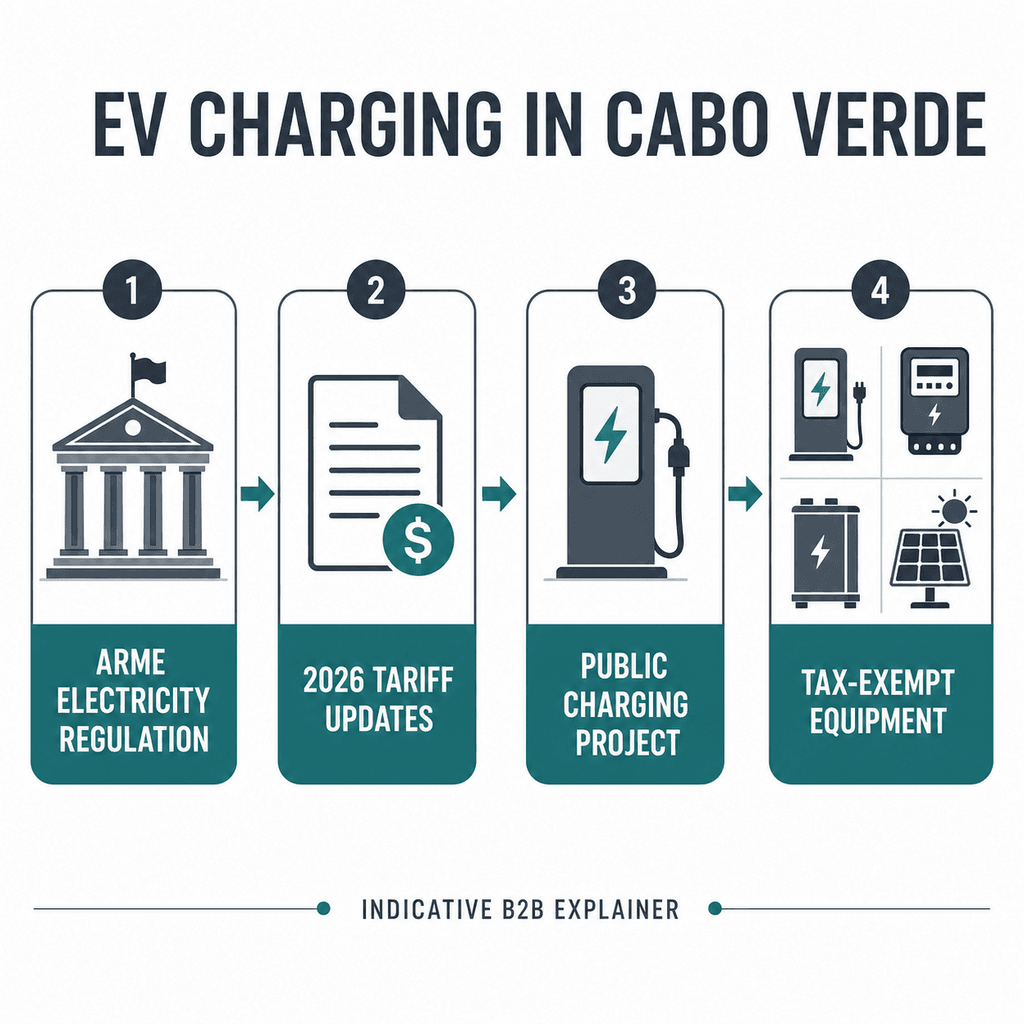
Cabo Verde EV charging projects need ARME-aligned electricity approval, not ANEEL approval, even when Brazilian procurement teams use ANEEL as a familiar benchmark.
ANEEL is Brazil’s national electricity regulator, so its distributed generation, tariff, and charging interpretations do not have direct legal force in Cabo Verde. For Cabo Verde, the relevant regulator is ARME, the multisector economic regulator that oversees electricity tariffs and sector rules. The practical takeaway for investors is simple: use ANEEL only as a comparison model, then validate the actual permitting route through Cabo Verde authorities.
For public EV charging, the regulatory stack normally touches electricity supply, grid interconnection, metering, public access, equipment safety, customs incentives, and municipal site permissions. According to Cabo Verde’s 2026 State Budget Law, Article 54 exempts imports of new EV charging equipment, including connectors, protections, cables, meters, and associated autoproduction and storage equipment for public charging. That incentive is commercially important because it can reduce landed cost for charger-plus-solar-plus-storage packages.
According to ARME Deliberação n.º 29/CA/2026, electricity tariffs for EDEC and AEB were updated for a 6-month period beginning 1 July 2026. For an EV charging business case, this matters because retail charging price, demand exposure, and solar self-consumption value all depend on the applicable tariff class. A mall, hotel, fleet depot, or municipality should model charging economics against the current ARME tariff table rather than importing a Brazilian tariff assumption.
The International Energy Agency states, “Large-scale adoption of EVs hinges” on accessible charging. For Cabo Verde, that access issue is shaped by island grids, imported fuel exposure, tourism mobility, and the need to avoid oversized distribution upgrades. A SOLARTODO smart streetlight or solar carport charging node can therefore be positioned as grid-supporting infrastructure, not only as an EV amenity.
Technical Compliance Path for EV Charging and Smart Streetlight Sites
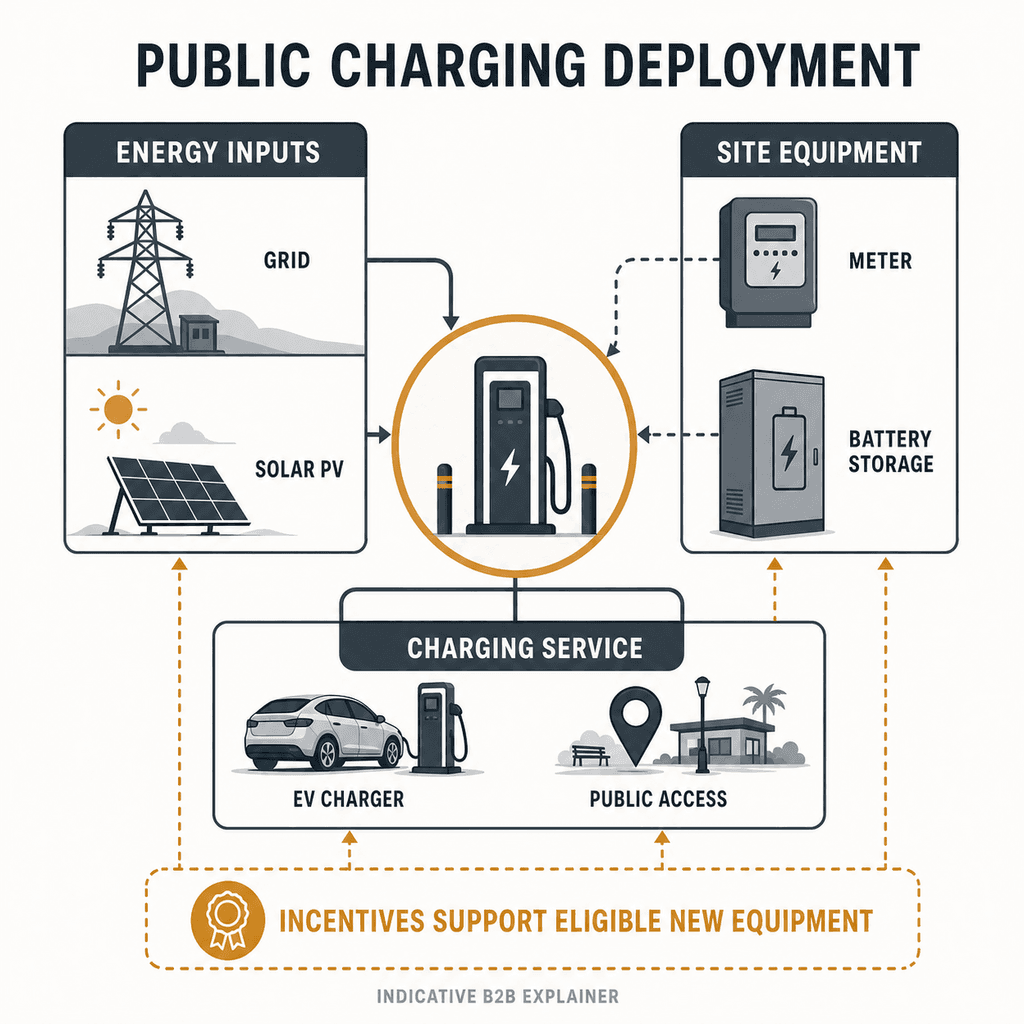
A compliant Cabo Verde charging site should combine IEC-grade chargers, ARME tariff review, certified protection gear, and load management above 22 kW.
The minimum technical baseline should be international charger safety plus local electrical acceptance. IEC 61851 covers conductive EV charging systems, while IEC 62196 defines plugs, socket-outlets, connectors, and vehicle inlets. For grid-connected distributed energy resources, IEEE 1547-2018 is a useful interconnection reference, even where a local utility applies its own detailed grid code.
For smart streetlight charging, the design must separate streetlighting continuity from vehicle charging peaks. A typical municipal pole may carry LED lighting, CCTV, communications, environmental sensors, and one AC charging point. Where charging reaches 7 kW, 11 kW, or 22 kW per bay, the feeder, earthing, protection, residual current devices, metering, and communications gateway must be engineered as a utility-facing electrical asset.
A SOLARTODO configuration for Cabo Verde can use 22% efficient bifacial PV modules on carports, AC chargers for destination parking, and LFP battery buffering for sites with constrained grid connections. At the smaller end, 2 to 6 smart streetlight charging poles can support municipal parking, beaches, resorts, public offices, or ferry terminals. At the larger end, a 150 kWp solar carport with 10 charging stations can generate approximately 225 MWh/year in a good solar-resource location.
According to IRENA (2025), the global weighted-average LCOE for utility-scale solar PV reached USD 0.043/kWh in 2024, while battery storage costs fell 93% from 2010 to 2024. IRENA states, “renewables remained the most cost-competitive option” for new power generation. For Cabo Verde, where imported fuel can influence tariffs, PV-backed charging deserves a full lifecycle comparison rather than a simple charger hardware quote.
Engineering Checklist
A bankable charging submission should include at least 6 documents: single-line diagram, load study, protection design, civil layout, equipment certificates, and O&M plan.
- Confirm site load: existing contracted capacity, peak demand, and transformer spare capacity.
- Define charger mix: 7 kW, 11 kW, 22 kW AC or selected DC fast charging.
- Specify standards: IEC 61851, IEC 62196, IEC 60364, UL 9540 for storage where applicable.
- Add metering: dedicated EV charging meters where tariff, billing, or public reporting requires separation.
- Model solar yield: use NREL PVWatts-style assumptions with local irradiance, shading, soiling, and temperature losses.
- Include cybersecurity: require authenticated OCPP communications and remote firmware management.
EPC Investment Analysis and Pricing Structure
EPC turnkey delivery for Cabo Verde charging projects should price supply, shipping, installation, commissioning, and O&M separately across 3 commercial tiers.
SOLARTODO is a B2B manufacturer and exporter, not an online marketplace, so the commercial process is inquiry, engineering review, offline quotation, and optional project financing. EPC scope usually includes engineering, procurement, construction, grid-interface coordination, installation supervision, testing, commissioning, operator training, and warranty handover. For Cabo Verde, procurement teams should request both equipment-only and installed-cost scenarios because island freight, cranes, trenching, and utility works can materially change total cost.
| Pricing tier | What it includes | Best use case | Buyer responsibility |
|---|---|---|---|
| FOB Supply | Chargers, smart poles, PV modules, inverters, BESS, factory documentation | Importers and EPCs with local installers | Ocean freight, customs, installation, permits |
| CIF Delivered | Equipment plus international freight and insurance to agreed port | Municipal or commercial buyers needing landed-cost clarity | Local clearance, civil works, grid connection |
| EPC Turnkey | Design, supply, construction support, commissioning, training, and O&M plan | Resorts, malls, fleet depots, and public charging corridors | Site access, permits, utility approvals, payment milestones |
Volume pricing should be structured clearly. For 50+ units or equivalent project packages, buyers can target a 5% discount. For 100+ units, a 10% discount is a practical planning assumption. For 250+ units or multi-island framework procurement, a 15% discount may be negotiated subject to technical standardization, shipping schedule, and payment security.
Payment terms are normally 30% T/T deposit plus 70% against B/L, or 100% L/C at sight for qualified institutional buyers. Financing is available for large projects above $1,000K, especially when solar carports, LFP storage, chargers, and smart infrastructure are packaged under a bankable EPC scope. Contact [email protected] for project review and quotation.
ROI should be calculated against two alternatives: grid-only charging and diesel-supported charging. A 150 kWp SOLARTODO solar carport producing about 225,000 kWh/year can offset daytime electricity purchases and supply 10 destination chargers. A 1.5 MWh / 750 kW LFP battery can reduce charging peaks and may avoid 6 to 18 months of grid-upgrade delay where transformer capacity is constrained.
Selection Guide for Cabo Verde EV Charging Infrastructure
Select AC charging for dwell times above 45 minutes, DC charging for fast turnover, and storage where coincident peak exceeds grid limits.
Cabo Verde use cases vary sharply by site. Hotels and resorts often need visible sustainability, guest convenience, and moderate charging speed. Municipal smart streetlight charging needs low visual impact, controlled billing, and reliable lighting continuity. Fleet depots need predictable overnight or shift-based charging, while ferry terminals and airport parking may require higher charger availability during specific traffic windows.
| Option | Typical rating | Grid impact | Best Cabo Verde application | SOLARTODO fit |
|---|---|---|---|---|
| Smart streetlight AC charging | 7 kW to 22 kW | Low to medium | Municipal parking, resorts, public offices | Smart poles with metering and OCPP |
| Solar carport charging | 50 kWp to 150 kWp PV plus 10 chargers | Medium | Malls, hotels, airports, universities | Bifacial fixed-tilt carport package |
| DC fast charging hub | 60 kW to 180 kW per charger | High | Fleet depots, highways, taxi hubs | Charger plus EMS and optional BESS |
| Storage-buffered charging | 750 kW / 1.5 MWh | Grid peak reduction | Constrained feeders and multi-charger sites | Container LFP BESS with PCS |
According to IEA (2024), public charging could increase sixfold by 2035 under its outlook for EV charging infrastructure. That global trajectory supports early planning in tourism and island markets, but Cabo Verde projects still need conservative load assumptions. A charger that looks modest on paper can become a grid problem if several vehicles charge simultaneously during evening peaks.
For smart streetlight projects, SOLARTODO recommends a phased deployment: start with 5 to 20 poles, monitor utilization for 90 to 180 days, then expand by district or island. This reduces stranded equipment risk and creates real demand data for ARME tariff review, municipal budgeting, and utility reinforcement planning.
FAQ
EV charging in Cabo Verde should be planned around ARME rules, 2026 import incentives, and IEC-compliant equipment, not Brazilian ANEEL procedures.
Q: Does ANEEL regulate EV charging in Cabo Verde? A: No, ANEEL regulates Brazil’s electricity sector and does not govern Cabo Verde. Cabo Verde EV charging projects should be checked against ARME electricity regulation, national transport policy, customs incentives, and municipal permissions. Brazilian EPC teams may use ANEEL concepts as internal benchmarks, but legal compliance must follow Cabo Verde requirements.
Q: Which Cabo Verde authority matters most for charging tariffs? A: ARME is the key electricity regulator for tariff-related review in Cabo Verde. ARME Deliberação n.º 29/CA/2026 updated electricity tariffs for EDEC and AEB for a 6-month period from 1 July 2026. Charging operators should model pricing, demand exposure, and self-consumption value against the current applicable tariff class.
Q: Are EV charging imports tax-exempt in Cabo Verde? A: Cabo Verde’s 2026 State Budget Law includes incentives for electric mobility. Article 54 exempts new equipment for EV charging, including connectors, protections, cables, meters, and associated autoproduction and energy storage equipment for public charging. Buyers should still confirm HS codes, documentation, and eligibility before shipment.
Q: What standards should EV chargers meet? A: Public and commercial chargers should generally comply with IEC 61851 for conductive charging systems and IEC 62196 for plugs and connectors. Storage-backed charging sites should also reference UL 9540, UL 9540A, IEC 62619, and NFPA 855 where batteries are included. Local acceptance may require additional utility documentation.
Q: When should a site use solar carports instead of only grid power? A: Solar carports are attractive when daytime charging, shaded parking, and visible decarbonization are all valuable. A 150 kWp carport can generate about 225 MWh/year in a strong solar-resource site and support roughly 10 destination chargers. Malls, resorts, airports, and universities are strong candidates.
Q: When is battery storage needed for EV charging? A: Battery storage is useful when charger peaks exceed the available transformer or contracted capacity. A 1.5 MWh / 750 kW LFP BESS can buffer fast-charging demand, reduce peak import, and help avoid grid upgrades. It is most relevant for 8 to 20 charger hubs or constrained island feeders.
Q: What does EPC turnkey delivery include? A: EPC turnkey delivery includes engineering, procurement, construction support, installation supervision, testing, commissioning, training, and warranty handover. For Cabo Verde, it should also include grid-interface documentation, civil layout, metering strategy, and O&M planning. SOLARTODO can quote FOB Supply, CIF Delivered, or EPC Turnkey depending on buyer capability.
Q: What payment and financing terms are available? A: Standard payment terms are 30% T/T deposit plus 70% against B/L, or 100% L/C at sight for qualified buyers. Financing is available for large projects above $1,000K, especially when chargers, solar carports, batteries, and smart infrastructure are bundled. Contact [email protected] for project-specific quotation.
Q: How should municipalities deploy smart streetlight charging? A: Municipalities should start with 5 to 20 smart streetlight charging poles and monitor real utilization for 90 to 180 days. Each pole should separate lighting loads from EV charging loads and include certified protection, metering, and communications. This phased approach reduces oversizing and supports budget approval.
Q: How often should charging infrastructure be maintained? A: Commercial EV charging sites should receive quarterly visual checks and at least 1 professional electrical inspection per year. Maintenance should verify connectors, insulation resistance, protective devices, software updates, metering accuracy, and communication uptime. Battery-backed sites also need thermal-management, BMS, and fire-safety inspections.
Conclusion
Cabo Verde EV charging investment should follow ARME-led local compliance, IEC safety standards, and 3-tier EPC pricing rather than ANEEL assumptions.
Bottom line: for Cabo Verde sites above 10 chargers or 150 kWp solar carports, SOLARTODO recommends ARME tariff validation, IEC-compliant equipment, and optional 1.5 MWh storage when grid capacity is constrained. This approach gives procurement teams a defensible path from inquiry to offline quotation, financing review, and EPC delivery.
References
- IEA Global EV Outlook 2024 (2024): States that mass EV adoption depends on accessible charging and projects major growth in public charging infrastructure. — https://www.iea.org/reports/world-energy-outlook-2024
- IRENA Renewable Power Generation Costs in 2024 (2025): Reports solar PV LCOE of USD 0.043/kWh and a 93% reduction in battery storage costs from 2010 to 2024. — https://www.irena.org/Data/View-data-by-topic/Capacity-and-Generation
- IEC 61851 (2023): Defines conductive EV charging system requirements for AC and DC charging equipment. — https://webstore.iec.ch/
- IEC 62196 (2022): Defines plugs, socket-outlets, vehicle connectors, and vehicle inlets for EV conductive charging. — https://webstore.iec.ch/
- IEEE 1547-2018 (2018): Provides interconnection and interoperability requirements for distributed energy resources connected to electric power systems. — https://standards.ieee.org/ieee/1547/7382/ These 8 references define the regulatory, technical, and cost basis for Cabo Verde EV charging, solar carports, storage, and grid interconnection planning.
- ARME Deliberação n.º 29/CA/2026 (2026): Updates electricity tariffs for EDEC and AEB for a 6-month period from 1 July 2026.
- Cabo Verde Lei n.º 69/X/2025, Article 54 (2025): Provides 2026 incentives exempting EVs and new EV charging equipment, meters, storage, and associated autoproduction equipment.
- Cabo Verde Resolução n.º 63/2026 (2026): Promotes electric mobility, charging infrastructure, decentralized renewable generation, and simplified renewable-energy procedures.
- IEA Global EV Outlook 2024 (2024): States that mass EV adoption depends on accessible charging and projects major growth in public charging infrastructure.
- IRENA Renewable Power Generation Costs in 2024 (2025): Reports solar PV LCOE of USD 0.043/kWh and a 93% reduction in battery storage costs from 2010 to 2024.
- IEC 61851 (2023): Defines conductive EV charging system requirements for AC and DC charging equipment.
- IEC 62196 (2022): Defines plugs, socket-outlets, vehicle connectors, and vehicle inlets for EV conductive charging.
- IEEE 1547-2018 (2018): Provides interconnection and interoperability requirements for distributed energy resources connected to electric power systems.
About SOLARTODO
SOLARTODO is a global integrated solution provider specializing in solar power generation systems, energy-storage products, smart street-lighting and solar street-lighting, intelligent security & IoT linkage systems, power transmission towers, telecom communication towers, and smart-agriculture solutions for worldwide B2B customers.
About the Author

Cinn Song
Founder & Chief Solutions Architect
Cinn Song founded SOLARTODO LIMITED and leads its smart-city infrastructure engineering — from solar, storage and integrated smart poles to the company's push into physical-AI city edge nodes: pole-mounted edge computing, vertical LLMs for smart cities, drone-based O&M with autonomous battery swapping, robotic maintenance, and high-speed counter-UAS interception. Since 2010, he has directed turnkey EPC + BOT delivery across 50+ countries, including telecom monopole supply for national grid operators, off-grid solar street-lighting for African municipalities, and integrated smart-pole programs for Gulf smart cities.
Cite This Article
Cinn Song. (2026). Regulamentações ANEEL para EV charging em Cabo Verde. SOLARTODO. Retrieved from https://solartodo.com/knowledge/regulamentaes-aneel-para-ev-charging-em-cabo-verde
@article{solartodo_regulamentaes_aneel_para_ev_charging_em_cabo_verde,
  title = {Regulamentações ANEEL para EV charging em Cabo Verde},
  author = {Cinn Song},
  journal = {SOLARTODO Knowledge Base},
  year = {2026},
  url = {https://solartodo.com/knowledge/regulamentaes-aneel-para-ev-charging-em-cabo-verde},
  note = {Accessed: 2026-10-16}
}
Published: August 31, 2026 | Available at: https://solartodo.com/knowledge/regulamentaes-aneel-para-ev-charging-em-cabo-verde
Subscribe to Our Newsletter
Get the latest solar energy news and insights delivered to your inbox.
View All Articles