Regulatory Compliance for Pole-Based Urban Drone…

Cinn Song
Founder & Chief Solutions Architect
Watch the video
TL;DR
Pole-based urban drone operations are compliant when the project connects aircraft authorization, Remote ID, local data processing, cybersecurity, energy autonomy, and human-approved response procedures. SOLARTODO Sentinel / Sky Hub uses 2.8-3.2 kWp on-pole PV, 5-20 kWh storage, local edge AI, and de-identified metadata reporting to support auditable B2B deployments.
Pole-based urban drone operations need aviation authorization, Remote ID, local data processing, IEC-style cybersecurity, and duty-cycle energy planning around 2.8-3.2 kWp PV, 5-20 kWh batteries, and human-approved response rules.
Summary
Pole-based urban drone operations need aviation authorization, Remote ID, local data processing, IEC-style cybersecurity, and duty-cycle energy planning around 2.8-3.2 kWp PV, 5-20 kWh batteries, and human-approved response rules.
Key Takeaways
Treat pole-based drone compliance as a 6-domain engineering package covering aviation rules, privacy, cybersecurity, energy, safety cases, and maintenance evidence.
- Map each deployment to at least 1 aviation operating category before procurement, because BVLOS, night, and dense-area flights may need waivers or specific authorization.
- Specify Remote ID and flight logs for 100% of managed aircraft so operators can support registration, traceability, and post-event audit requests.
- Keep raw video and sensor feeds on the pole, transmitting only de-identified metadata from 4-9 event classes such as intrusion, crowd density, and vehicle count.
- Size off-grid energy with 2.8-3.2 kWp on-pole PV, 1.0-1.3 kW clear-sky DC peak, 7-10 kWh/day yield, and 5-20 kWh battery storage.
- Build C-UAS procedures around 2 controls: human authorization and non-lethal response using detection, tracking, coordination, and soft aerial recovery methods.
- Require IEC 62443-style network segmentation, role-based access, encrypted telemetry, and at least 12 months of mission and maintenance records.
- Budget EPC delivery with 3 tiers, 50+ unit volume planning, and 3-6 year ROI analysis against trenching, manual patrol, and separate equipment cabinets.
Regulatory Compliance Framework for Pole-Based Urban Drone Operations
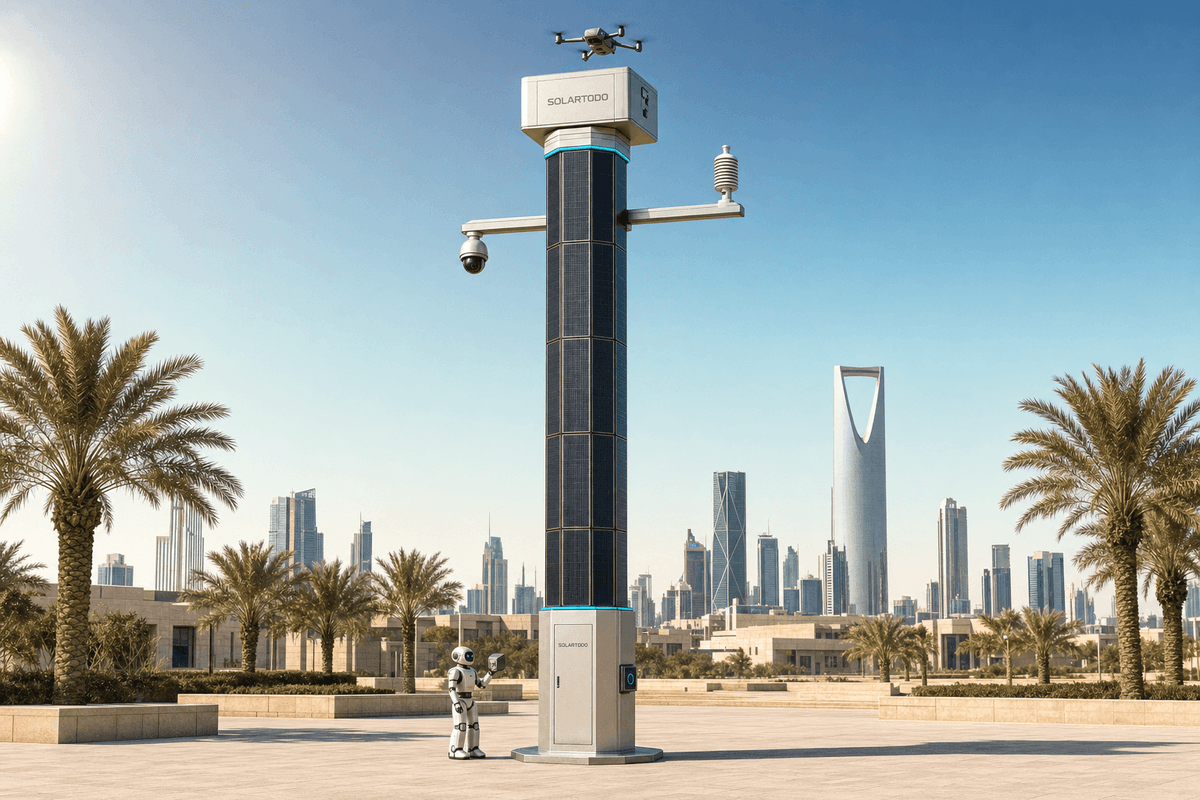
Pole-based urban drone operations are compliant only when aviation, privacy, cybersecurity, energy, and maintenance controls are engineered together across 5 operational domains.
For SOLARTODO Sentinel / Sky Hub, regulatory compliance starts with a clear product definition: it is a pure smart pole for edge sensing, autonomous drone service, robot coordination, battery-backed off-grid operation, and local AI processing. It is not a public lighting asset, and it should not be evaluated as a modified lighting pole. Procurement teams should classify it as a pole-based physical-AI edge node with aviation interfaces, safety responsibilities, and operational records.
The core compliance challenge is that the pole is fixed infrastructure, while the drone is a regulated aircraft. That means the project must satisfy site construction rules, radio planning, civil aviation requirements, data-protection expectations, cybersecurity controls, and maintenance obligations. A successful specification does not treat these as separate checklists; it links every mission to a responsible operator, authorization path, energy budget, sensor trigger, and evidence trail.
According to the FAA (2024), Remote ID became a required identification layer for most registered drones in U.S. airspace, with enforcement discretion ending on March 16, 2024. The FAA states, "Remote ID is the ability of a drone in flight to provide identification and location information." That rule illustrates the broader procurement lesson: city drone systems need identity, accountability, and retrievable operational data from the first design review.
Urban deployments also need local legal review because low-altitude airspace, sensitive sites, population density, and emergency-response procedures differ by country. In the European Union, Commission Implementing Regulation (EU) 2021/664 created U-space service requirements for designated UAS airspace, including network identification and traffic information services. In the United States, Part 107 rules, waivers, and airspace authorization shape routine commercial operations. In Gulf, Latin American, African, and Southeast Asian markets, the same engineering package should be mapped to the national civil aviation authority before purchase orders are finalized.
System Architecture and Operational Controls
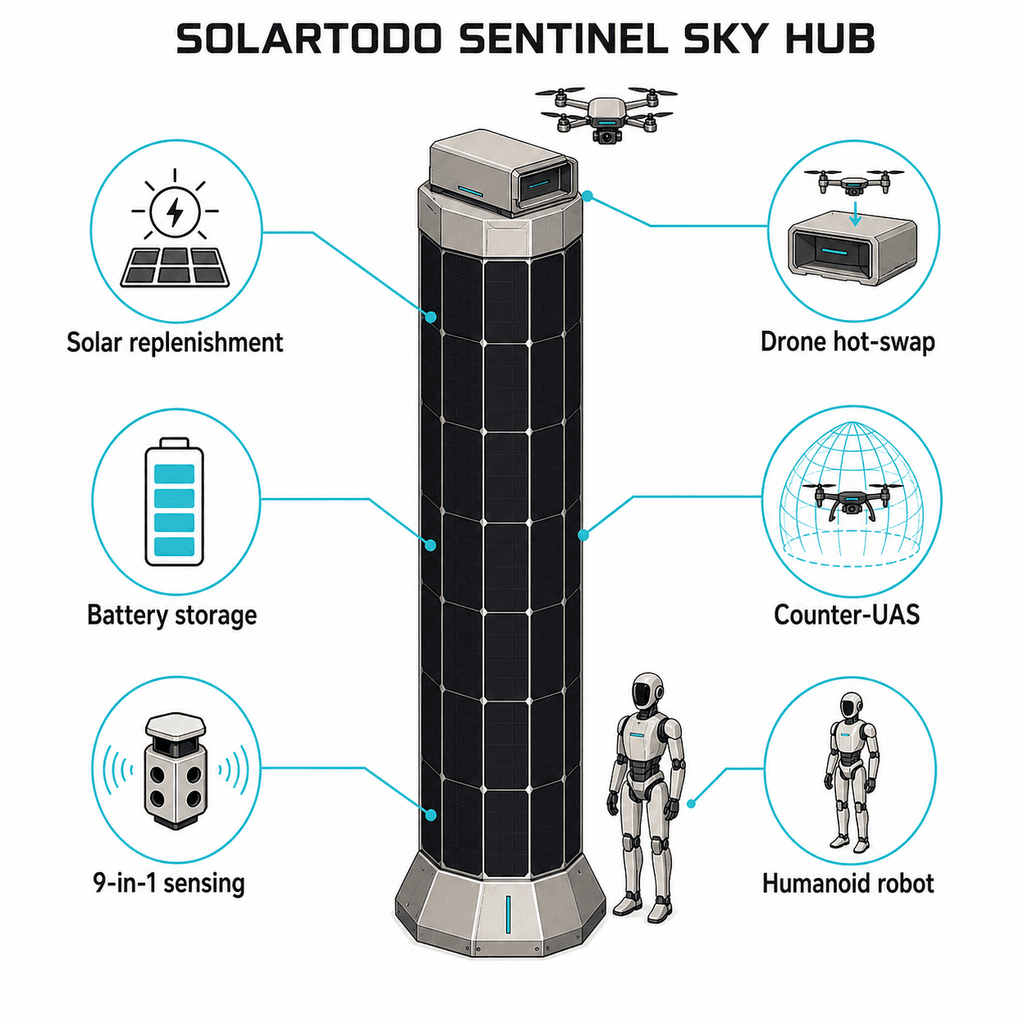
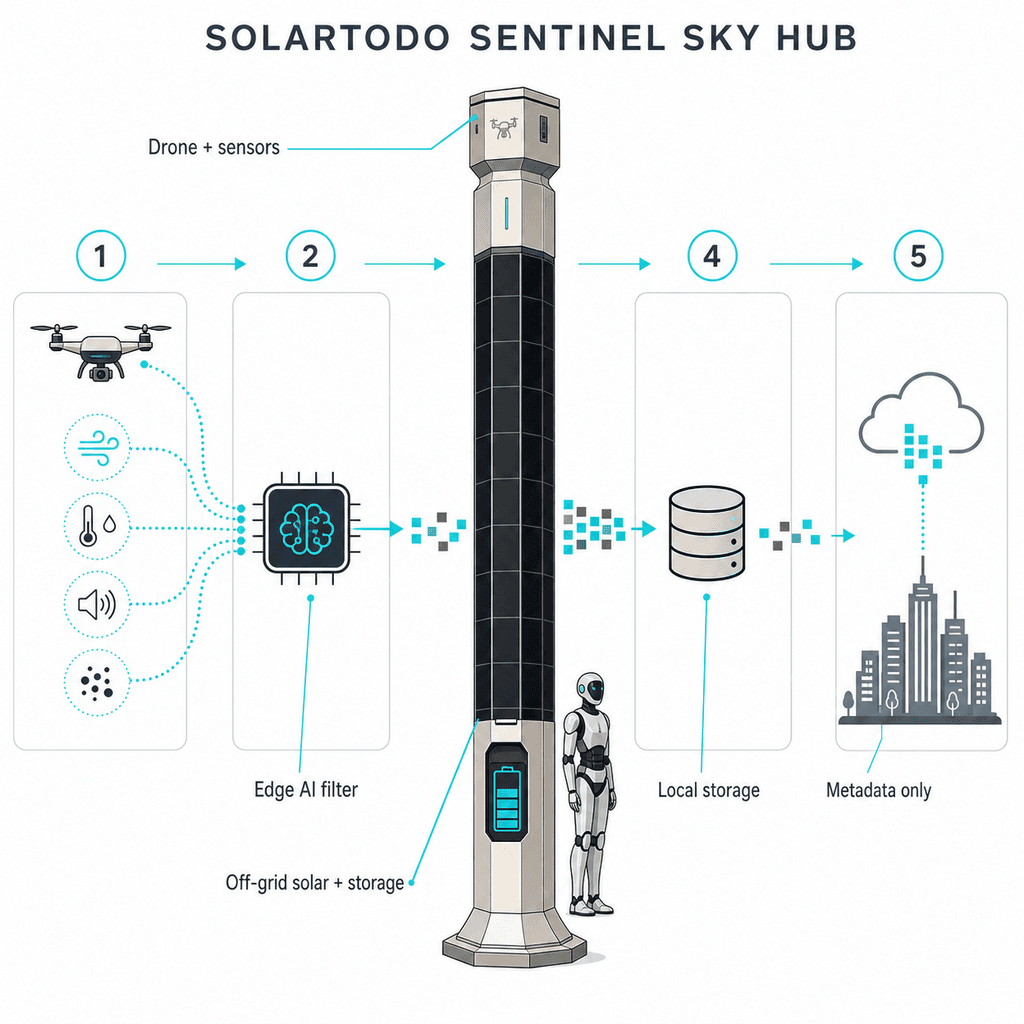
SOLARTODO Sentinel / Sky Hub organizes drone service, local inference, robot support, and command reporting into 4 operating loops with human authorization.
The system architecture should be documented as an auditable workflow rather than a list of modules. A typical operating loop begins with local sensing, moves to authorized assessment and response, schedules edge-compute and vehicle tasks, and ends with maintenance or incident closure. This gives the owner a common operating picture without exporting raw site data from the pole.
Sky Hub supports drone launch, patrol, inspection, return, battery exchange, and redeployment from the pole. Its battery magazine enables repeated sorties by exchanging a depleted aircraft pack for a charged pack after landing. Mission management covers route planning, charge-state logic, swap-state control, task queueing, fleet health, and mission logs. These records are essential for regulators, insurers, and asset owners because they connect a flight to the operator, aircraft condition, battery state, route, and response decision.
The edge AI layer runs local inference on Jetson-class compute. Raw video and sensor streams remain on the pole for local processing. Only de-identified event metadata, equipment status, alarms, environmental summaries, and mission records should leave the site. This design supports PDPL/LGPD-oriented data minimization because the system can report that an event occurred without transmitting high-volume identifiable footage to a remote cloud by default.
The sensing package can include PTZ video analytics, anonymous vehicle count, crowd-density estimation, intrusion detection, perimeter awareness, and a 9-parameter environmental station measuring wind speed, wind direction, temperature, humidity, atmospheric pressure, noise, PM10, PM2.5, and illuminance. These inputs are operationally useful because drone launch decisions depend on wind, temperature, battery state, and site rules. The system should not be specified with active face recognition or licence-plate recognition unless a separate, jurisdiction-specific legal basis and technical design are approved.
Counter-UAS coordination must remain non-lethal and human-authorized. The pole may detect and track an unauthorized aircraft through local sensors or optional partner inputs, then coordinate a friendly drone for soft aerial net-capture or close-approach deterrence after operator approval. Radar should be treated only as an optional external input, not as standard pole hardware. The compliance file should define who may authorize escalation, what evidence is required, and how the event is logged.
Aviation, Privacy, Cybersecurity, and Energy Requirements
A compliant Sky Hub deployment needs at least 8 documented controls: aircraft authorization, Remote ID, route rules, data minimization, cyber segmentation, energy modeling, maintenance logs, and incident review.
Aviation compliance begins with the operating concept. Buyers should define whether flights are within visual line of sight, beyond visual line of sight, night operations, over controlled sites, near airports, or inside designated UAS zones. According to EASA (2023), the SORA methodology uses a structured risk process for specific-category drone operations, including ground risk, air risk, containment, and operational safety objectives. That framework is useful even outside Europe because it forces the project team to document risk assumptions.
Privacy compliance is equally important in urban and industrial zones. SOLARTODO should be specified around local processing, event-level reporting, and retention limits. Raw feeds stay on the pole; exported data should be limited to de-identified event and status metadata. That approach reduces bandwidth and lowers privacy exposure, but it does not remove the need for signage, access controls, retention policies, incident disclosure rules, and local counsel review.
Cybersecurity should be designed as operational technology, not generic office IT. IEC 62443 provides a recognized family of standards for industrial automation and control-system security, including segmentation, access control, secure remote access, and system lifecycle practices. For a pole network, that means separating drone control, maintenance access, command-center dashboards, and external integrations. Every API, firmware update, operator role, and log-export path should be documented.
The energy model is a compliance topic because autonomy claims affect reliability, safety, and service obligations. The pole is fully off-grid for normal operation through on-pole solar replenishment and battery storage; it is not dependent on grid, city, or site power. The on-pole PV surface should be treated as a replenishment layer, typically 2.8-3.2 kWp nameplate, with realistic high-irradiance clear-sky output around 1.0-1.3 kW DC peak and 7-10 kWh/day. Drone and robot workloads are buffered by 5-20 kWh-class storage and scheduled by duty cycle.
According to NREL (2025), PVWatts estimates PV output from solar resource data, system losses, tilt, orientation, and temperature assumptions. NREL states, "PVWatts estimates the energy production of grid-connected photovoltaic energy systems." For Sky Hub, the engineering point is similar even though the pole is off-grid: energy yield must be modeled for the site, season, mission frequency, battery autonomy, cleaning losses, and thermal conditions.
According to IRENA (2025), utility-scale solar PV remained one of the lowest-cost new power sources in many markets, while battery storage costs continued to fall sharply over the past decade. According to the IEA (2025), electricity systems are adding more distributed renewables and digital controls, increasing the need for planning around flexibility and grid-edge operation. These trends support pole-based edge infrastructure, but they do not justify exaggerated solar-autonomy claims.
EPC Investment Analysis and Pricing Structure
EPC planning for pole-based drone operations should compare 3 procurement tiers, 3 volume bands, and a 3-6 year payback model.
EPC delivery includes engineering, procurement, construction, commissioning, and warranty support. Engineering should cover foundation assumptions, wind loading, communications, aviation interfaces, cybersecurity segmentation, energy modeling, sensor coverage, flight routes, and authority workflows. Procurement should include the pole, PV replenishment layer, battery system, drone service equipment, edge compute, sensors, communications, robot charging interface, and control software. Construction and commissioning should verify foundations, grounding, power electronics, battery behavior, wireless links, mission workflows, safety interlocks, and operator handover.
| Pricing tier | Scope | Indicative unit range |
|---|---|---|
| FOB Supply | Equipment supplied ex-works China | $4,030-$8,840 |
| CIF Delivered | Equipment plus ocean freight and insurance | $4,527-$9,931 |
| EPC Turnkey | Installed, commissioned, and covered by 1-year warranty | $6,500-$13,000 |
| Volume band | Indicative discount | Procurement use case |
|---|---|---|
| 50+ units | 5% | Campus, industrial park, or small perimeter program |
| 100+ units | 10% | Port district, logistics zone, or multi-site security network |
| 250+ units | 15% | Large framework order across multiple urban or industrial zones |
ROI depends on avoided trenching, fewer separate field cabinets, reduced manual inspection, lower technician dispatch frequency, and fewer standalone drone service assets. A reasonable early model compares one Sky Hub node with the conventional bundle of a sensor pole, power connection, cabinet, environmental station, patrol labor, and separate drone charging point. Where trenching is expensive and patrol labor is recurring, EPC payback can target 3-6 years, subject to local labor rates, duty cycle, customs costs, and civil works.
Payment terms are typically 30% T/T advance plus 70% against bill of lading, or 100% irrevocable L/C at sight for qualified trade customers. Project financing can be discussed for programs above $1,000K. Buyers should contact [email protected] with site coordinates, quantity, storage autonomy target, mission frequency, expected robot duty cycle, and civil-work assumptions.
Selection Guide for Procurement and Compliance Teams
Procurement teams should require 10 deliverables before award, including aviation mapping, energy simulation, cybersecurity design, and acceptance-test scripts.
A pole-based drone system should be purchased as engineered infrastructure, not a catalog device. The request for quotation should define legal jurisdiction, site boundaries, population exposure, expected flight profiles, environmental envelope, battery autonomy, communications coverage, data-retention policy, and escalation authority. Without these inputs, suppliers may overstate capability or underprice the integration work.
| Compliance area | Buyer requirement | Evidence to request |
|---|---|---|
| Aviation authorization | Define flight category, airspace, route limits, and operator responsibility | Operating concept, waiver or approval matrix, flight-log format |
| Remote identification | Support drone identity and traceability requirements | Remote ID capability statement and registration workflow |
| Data handling | Keep raw feeds local and export only de-identified metadata | Data-flow diagram, retention policy, role permissions |
| Cybersecurity | Segment command, maintenance, and reporting networks | IEC 62443-oriented architecture and access-control matrix |
| Energy autonomy | Model duty cycle against PV yield and 5-20 kWh storage | PV yield calculation, battery sizing, mission scheduling policy |
| Environmental limits | Use weather rules for flight safety and maintenance | 9-parameter station data mapping and launch thresholds |
| C-UAS coordination | Keep response non-lethal and human-authorized | Escalation SOP, operator approval log, event closeout form |
| Acceptance testing | Verify field operation before handover | FAT/SAT scripts, commissioning report, training record |
The most useful supplier response is not a single brochure claim; it is a traceable compliance pack. SOLARTODO can support project-specific configuration, but the final bill of materials, certifications, warranty language, foundation drawings, aviation workflows, and commissioning scripts should be confirmed before production release.
FAQ
Pole-based drone compliance usually fails from 6 gaps: unclear authority, weak logs, poor energy modeling, privacy drift, cyber exposure, and missing maintenance evidence.
Q: What is regulatory compliance for pole-based urban drone operations? A: It is the combined control system for aircraft authorization, operator responsibility, site safety, privacy, cybersecurity, energy reliability, and maintenance records. For a Sky Hub project, compliance should cover at least 5 domains before procurement: aviation rules, local data handling, communications security, off-grid power modeling, and human-approved response procedures.
Q: Does SOLARTODO Sentinel / Sky Hub require grid or site power for normal operation? A: No. Sky Hub is designed as a fully off-grid pole using on-pole solar replenishment and battery storage, not city, grid, or site power. The PV layer is typically 2.8-3.2 kWp nameplate, while 5-20 kWh-class storage buffers drone, robot, sensing, and compute workloads by duty cycle.
Q: How should buyers handle aviation authorization for automated drone sorties? A: Buyers should define the operating category, airspace, route limits, operator role, and approval pathway before ordering hardware. In many jurisdictions, flights beyond visual line of sight, dense-area operations, night missions, or controlled airspace require specific authorization, waiver review, or a risk assessment comparable to SORA-style documentation.
Q: What data can leave the pole under a privacy-oriented design? A: Only de-identified event and status metadata should leave the pole, such as alarms, mission logs, battery state, equipment health, and environmental summaries. Raw video and sensor streams stay on the pole for local processing. This supports PDPL/LGPD-oriented data minimization but still requires local retention and access-control policies.
Q: Can the system perform face recognition or licence-plate recognition? A: Active face recognition and licence-plate recognition should not be specified as deployed Sky Hub capabilities. The recommended compliance scope is anonymous vehicle count, crowd-density estimation, intrusion detection, and perimeter awareness. Any more intrusive analytics would require separate legal review, documented lawful basis, and jurisdiction-specific controls.
Q: How does counter-UAS coordination stay within safe operating rules? A: Counter-UAS coordination must be human-authorized and non-lethal. The pole can support detection, tracking, command coordination, soft aerial net-capture, or close-approach deterrence using an approved friendly drone workflow. Optional partner sensors may feed the system, but the pole itself should be specified around controlled response and auditable operator approval.
Q: What cybersecurity standards should procurement teams reference? A: IEC 62443 is the most relevant reference family for industrial automation and control-system cybersecurity. A Sky Hub project should document network segmentation, encrypted telemetry, role-based access, firmware update procedures, audit logs, and remote-maintenance controls. These controls are especially important when multiple poles share a command view.
Q: How is the off-grid energy model calculated? A: The model should combine PV nameplate capacity, realistic vertical-surface yield, storage size, local irradiance, temperature, cleaning losses, and mission duty cycle. In high-irradiance regions, the on-pole PV layer may produce about 1.0-1.3 kW DC peak and 7-10 kWh/day, while batteries handle high-power flight and robot tasks.
Q: What does EPC turnkey delivery include for this product? A: EPC turnkey delivery includes engineering, procurement, construction, commissioning, and 1-year warranty support. For Sky Hub, that should cover foundations, PV and battery integration, edge compute, drone service equipment, sensors, communications, acceptance tests, operator training, and compliance documentation. Indicative EPC pricing is $6,500-$13,000 per unit before final engineering.
Q: What payback period is realistic compared with conventional infrastructure? A: A 3-6 year payback can be realistic where trenching, utility service points, manual patrol, and separate drone-support assets are expensive. The model should compare total installed cost, avoided cabinets, reduced technician visits, mission frequency, and maintenance savings. Final ROI depends on local labor, customs, civil works, and operating rules.
Q: What maintenance records should operators keep? A: Operators should keep aircraft logs, battery swap records, firmware history, sensor calibration, environmental readings, mission outcomes, incident reviews, and authorization records. A practical minimum is 12 months of searchable logs, with longer retention for regulated sites. These records support audits, warranty claims, insurance review, and continuous safety improvement.
Q: When should a buyer request partner-sensor integration? A: Partner-sensor integration is appropriate when the site already operates perimeter, airspace, or security sensors that can provide verified event inputs. The pole should still process and coordinate locally, while external feeds are treated as optional inputs. Interface specifications should define latency, data format, ownership, retention, and operator authority.
References
Regulatory and engineering references should combine 7 authority sources covering aviation identity, drone risk assessment, PV yield, cybersecurity, ingress protection, and renewables planning.
- FAA (2024): Remote Identification of Drones rule and operational guidance for identification and location broadcasting by unmanned aircraft.
- FAA Part 107 (2026): U.S. small unmanned aircraft operating rules covering registration, remote pilot responsibilities, waivers, and airspace authorization.
- EASA Regulation (EU) 2021/664 (2021): U-space regulatory framework defining services such as network identification, traffic information, and UAS flight authorization.
- EASA SORA 2.5 (2023): Specific Operations Risk Assessment methodology for structured ground-risk, air-risk, containment, and operational safety analysis.
- NREL PVWatts Calculator v8.5.2 (2025): Solar resource and PV performance methodology for estimating energy production under location and system-loss assumptions.
- IEC 62443 (2024): Industrial automation and control-system cybersecurity standards for segmentation, access control, secure maintenance, and lifecycle risk management.
- IEC 60529 (2013): Degrees of protection provided by enclosures, including IP-code definitions for dust and water ingress testing.
- ASTM F3411 (2022): Standard specification for Remote ID and tracking message formats used in unmanned aircraft system identification architectures.
Conclusion
Regulatory-ready pole-based drone operations require 5 aligned systems: aviation approval, local data processing, IEC-style cybersecurity, off-grid energy modeling, and auditable human authorization.
The bottom line: SOLARTODO Sentinel / Sky Hub is best procured as engineered off-grid smart-pole infrastructure, with 2.8-3.2 kWp PV replenishment, 5-20 kWh battery buffering, local edge AI, and a compliance file built before deployment. For B2B projects above 50 units, the strongest specification links ROI, duty cycle, airspace rules, data minimization, and acceptance testing in one EPC package.
About SOLARTODO
SOLARTODO is a global integrated solution provider specializing in solar power generation systems, energy-storage products, smart street-lighting and solar street-lighting, intelligent security & IoT linkage systems, power transmission towers, telecom communication towers, and smart-agriculture solutions for worldwide B2B customers.
About the Author

Cinn Song
Founder & Chief Solutions Architect
Cinn Song founded SOLARTODO LIMITED and leads its smart-city infrastructure engineering — from solar, storage and integrated smart poles to the company's push into physical-AI city edge nodes: pole-mounted edge computing, vertical LLMs for smart cities, drone-based O&M with autonomous battery swapping, robotic maintenance, and high-speed counter-UAS interception. Since 2010, he has directed turnkey EPC + BOT delivery across 50+ countries, including telecom monopole supply for national grid operators, off-grid solar street-lighting for African municipalities, and integrated smart-pole programs for Gulf smart cities.
Cite This Article
Cinn Song. (2026). Regulatory Compliance for Pole-Based Urban Drone…. SOLARTODO. Retrieved from https://solartodo.com/knowledge/regulatory-compliance-for-pole-based-urban-drone-operations
@article{solartodo_regulatory_compliance_for_pole_based_urban_drone_operations,
  title = {Regulatory Compliance for Pole-Based Urban Drone…},
  author = {Cinn Song},
  journal = {SOLARTODO Knowledge Base},
  year = {2026},
  url = {https://solartodo.com/knowledge/regulatory-compliance-for-pole-based-urban-drone-operations},
  note = {Accessed: 2026-09-09}
}
Published: July 26, 2026 | Available at: https://solartodo.com/knowledge/regulatory-compliance-for-pole-based-urban-drone-operations
Subscribe to Our Newsletter
Get the latest solar energy news and insights delivered to your inbox.
View All Articles