Summary
For the proposed Santiago solar-plus-storage application, define the output-smoothing duty before selecting equipment. Ask bidders to document response timing, charging and discharging limits, electrical interfaces and acceptance evidence against that agreed duty. The supplied SOLARTODO catalog establishes LFP storage and solar-coupling scope, but provides no named model, product PDF or verified response specification. Proceed with requirements definition and documentation requests; keep model selection conditional on supporting evidence.
Santiago is a proposed site only. The supplied material establishes no installation, site conditions or Chilean connection requirements.
Key Takeaways
- Define the electrical measurement boundary and desired output behavior before requesting sizing.
- Request documented timing from disturbance detection through measured output response, with settling assessed separately.
- Ask bidders to substantiate charging and discharging operation for the proposed duty.
- Request separate power ratings and energy-capacity information, including their stated operating conditions.
- Agree on test methods and synchronized records before making acceptance commitments.
- Obtain the exact configuration, authoritative technical documentation and applicable project approvals before ordering.
Proposed problem
The buyer's question concerns smoothing brief PV-output fluctuations at a proposed Santiago site. This article does not evaluate backup duration, overnight supply or project savings.
The supplied DOE solar-and-storage overview describes short-term storage as a way to moderate rapid changes in solar generation. It also distinguishes energy capacity from power capacity. These statements support the general application concept; they do not establish the performance of a SOLARTODO configuration.
For the procurement brief, request available PV measurements and identify the intended output-measurement boundary. Ask the owner to specify which recorded or proposed disturbances should be evaluated and what output behavior would be acceptable. The evidence pack supplies neither those site measurements nor an agreed performance target.
Source-backed product boundary
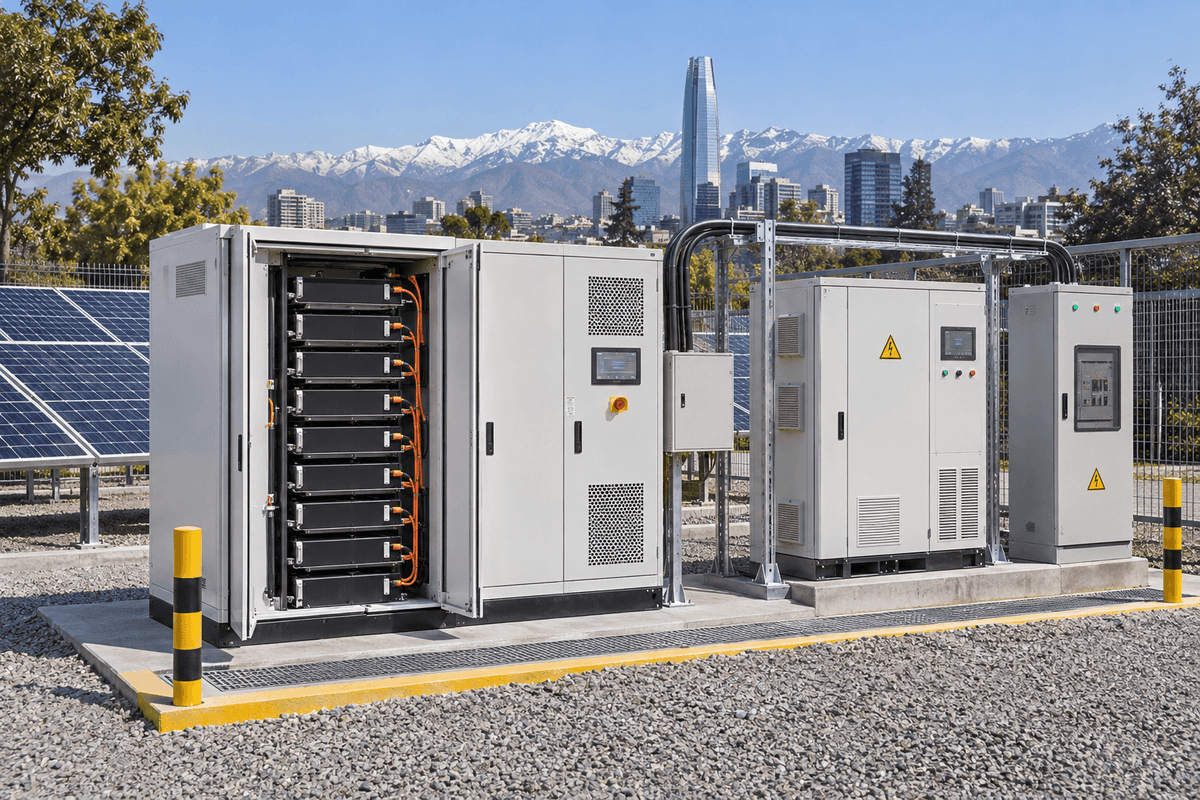
The supplied SOLARTODO energy-storage catalog, catalog identity city-catalog-2026-11-01-v1, includes LFP chemistry and configurations for solar coupling, peak shaving and backup power. Its versioned extraction establishes catalog scope only.
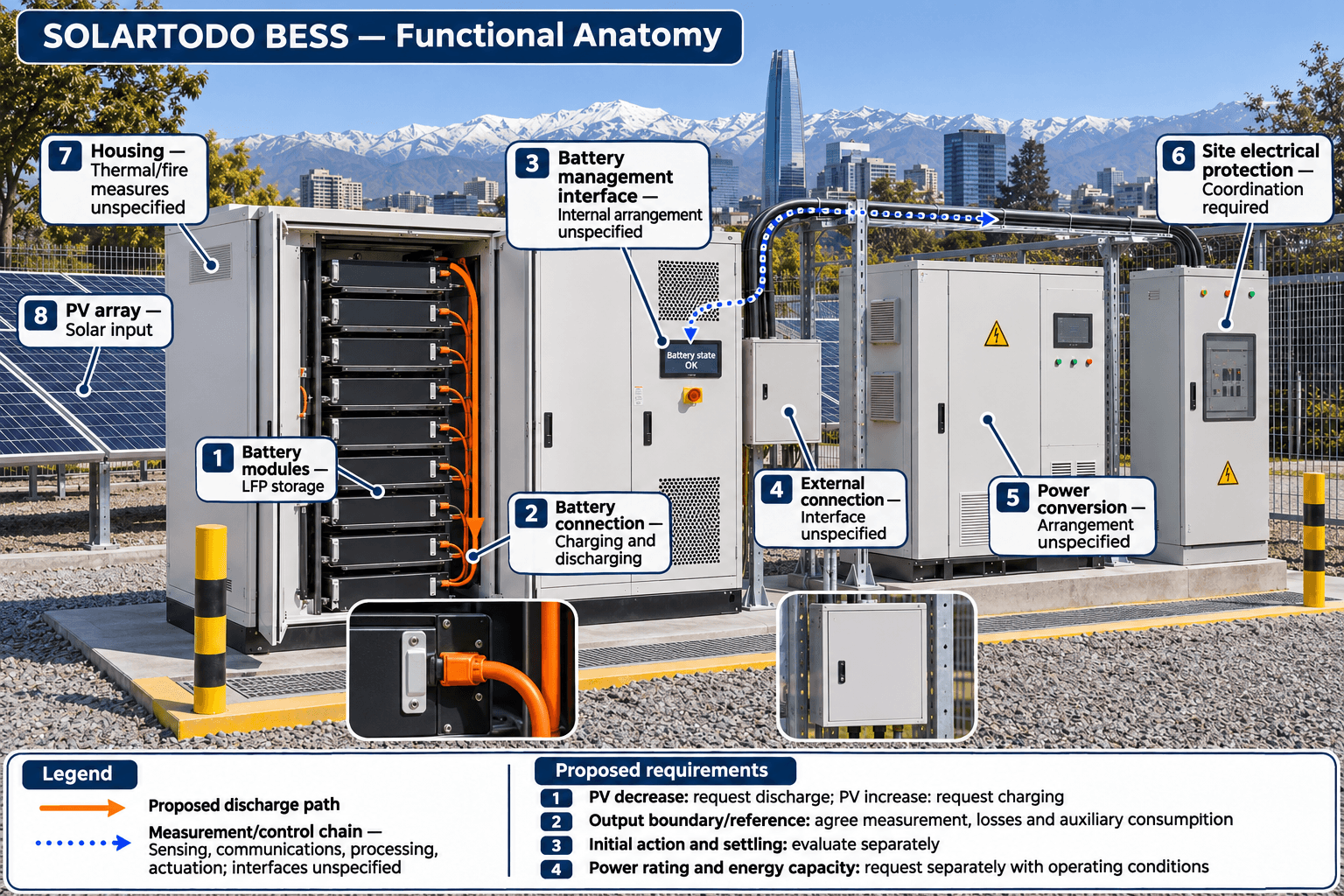
According to that extraction, a selected system needs battery modules and management, power conversion and site electrical protection. Housing and thermal/fire measures are configuration-specific. The extraction does not identify a storage model, converter arrangement, enclosure, capacity, response specification, certification or warranty.
The catalog distinguishes energy capacity and power rating. Request both in a bid, with the applicable model and operating conditions identified. Do not infer a firming capability from either rating alone without documentation addressing the proposed duty.
No product PDF, PDF URL, model designation or PDF page is supplied. The internal energy-storage page remains the relevant product navigation destination, but the supplied catalog scope is insufficient for model selection.
Proposed response and conversion requirements
The following items are proposed buyer requirements for an agreed evaluation. They are not existing SOLARTODO specifications, demonstrated capabilities or Santiago regulatory requirements.
Define the output boundary and reference
Specify where combined PV-and-storage output would be measured. Ask the bidder to identify the treatment of intervening loads, auxiliary consumption and losses in the proposed measurement arrangement.
Document the desired output reference, the permitted deviation and the calculation method. If measurements are proposed at another location, require an agreed explanation of how those records would be used in acceptance.
Request response evidence
Ask bidders to describe the proposed measurement and control chain, including sensing, communications, control processing and converter actuation. Require each timing claim to state its starting event, endpoint, measurement resolution and operating conditions.
For the proposed acceptance protocol, evaluate the interval to initial compensating action separately from the interval to an agreed settled output band. Request records suitable for checking tracking error, overshoot and oscillation against buyer-approved criteria. No response-time or settling threshold is established by the supplied sources.
Substantiate the conversion arrangement
For discussion with bidders, the proposed control objective is to request discharge during a PV-output decrease and charging during an increase. This is a proposed operating objective, not evidence that a catalog configuration supports it.
Request separate charging and discharging ratings, electrical interfaces, permissible voltage conditions and any documented operating restrictions or derating. Ask the bidder to identify the battery, management and conversion equipment supporting its proposal and provide a configuration-specific electrical diagram.
The supplied DOE photovoltaic design overview explains that PV inverters convert DC electricity to AC electricity. It does not establish a SOLARTODO storage-converter topology or electrical compatibility. Require the bidder to identify and document the proposed coupling arrangement.
Specify operating conditions and recovery tests
Request documented state-of-charge boundaries, charge/discharge permissions and applicable protection limits. Ask bidders to state the conditions attached to every performance claim.
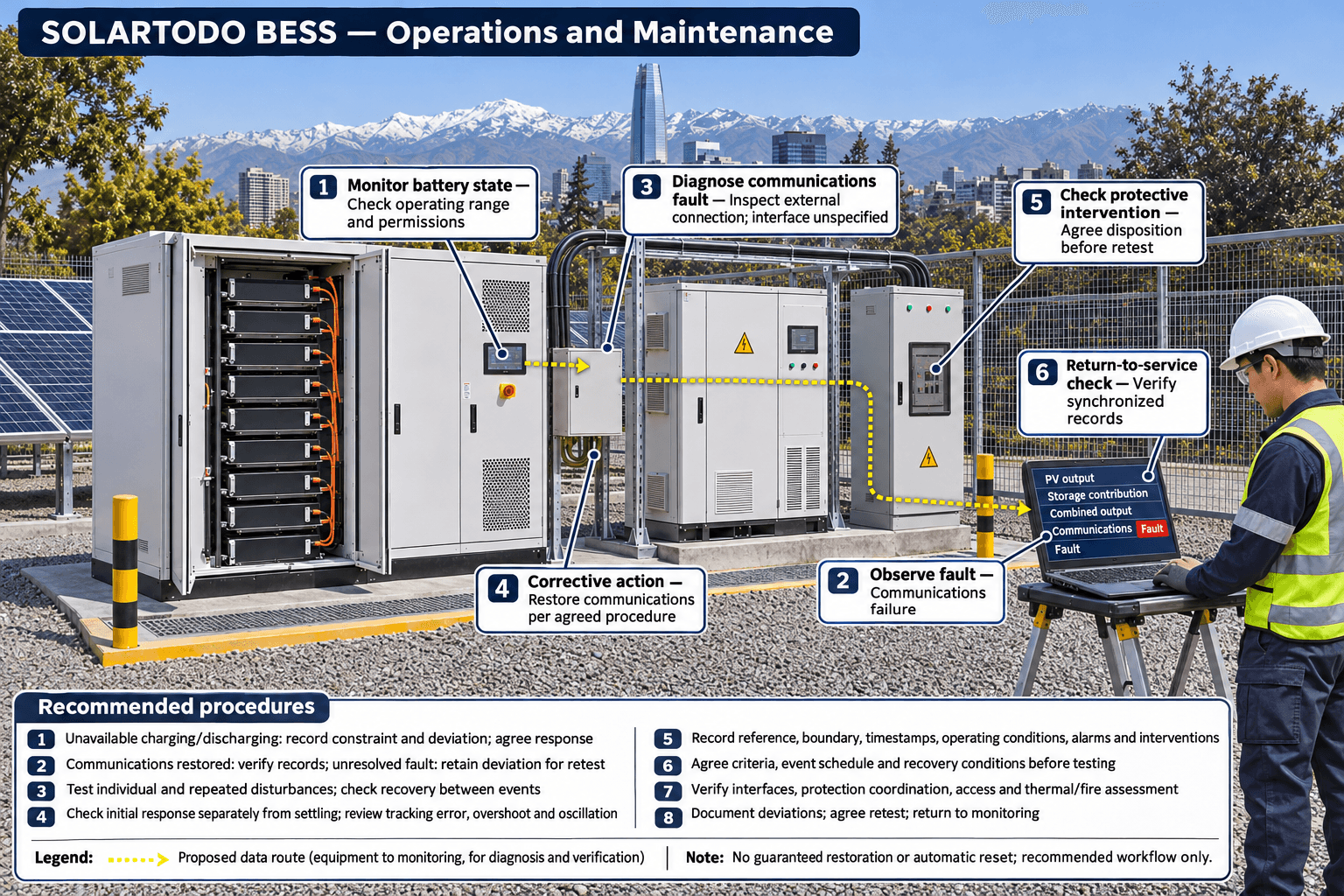
As proposed test coverage, include individual disturbances, repeated disturbances and recovery between events. Request records of available operating range and any reported constraints throughout each test. This coverage is a buyer proposal; the supplied sources do not establish comparative performance across those cases.
Agree on the response to unavailable charging or discharging capability, communications failure and protective intervention. Request that acceptance records identify these events and any resulting deviation from the agreed output reference.
Set measurable targets without inventing specifications
The evidence pack provides no basis for assigning a disturbance magnitude, response time, settling tolerance, event duration or repetition count. Leave these values open until the owner defines the duty and the bidder supplies supporting documentation.
A proposed test schedule should record:
- The reference power, disturbance trace and direction convention.
- The measurement boundary and output-reference calculation.
- The proposed initial-response and settling criteria.
- The event duration, repetition schedule and recovery conditions.
- The applicable operating range and treatment of constrained operation.
Ask bidders to submit power and energy calculations for the agreed traces, stating their assumptions and the treatment of losses and auxiliary consumption. Keep calculations identified as estimates until supported by the agreed evidence. Do not present proposed targets as product specifications or measured results.
Survey and acceptance checklist
Before comparing equipment, request the proposed connection arrangement, available PV records, measurement-quality information and an agreed smoothing objective. Assign responsibility for verifying site interfaces, protection coordination, access constraints and applicable local approvals. Request a configuration-specific assessment of housing and thermal/fire measures.
For the proposed acceptance package, require:
- Exact equipment identification and an electrical diagram.
- Authoritative technical documentation, with the applicable model, pages and operating conditions identified.
- Charging and discharging ratings, energy-capacity information and documented limits.
- The agreed control reference, measurement method and timestamp method.
- Synchronized records of PV output, storage contribution and combined output.
- Results for the agreed disturbance directions, repeated-event tests and recovery tests.
- Records of alarms, protective interventions, communications failures and deviations.
- An agreed disposition for deviations and any required retest.
If a proposed test cannot be performed at the site, agree on an alternative method and its evidentiary limits before using its results. Label simulations and analytical estimates explicitly.
Limitations and procurement decision
The supplied material contains no Santiago survey, PV trace, connection agreement or verified local operating envelope. It supports no claim about local weather, electricity demand, fluctuation frequency or project economics.
It also contains no named storage model, converter specification or product PDF. Response speed, efficiency, electrical compatibility, lifetime, warranty, certification and procurement availability therefore remain unverified for this proposal.
The DOE sources provide general technical context. Their discussion of United States electricity systems does not establish Chilean requirements or validate a SOLARTODO configuration.
The immediate buyer decision is to commission a defined duty and request configuration-specific evidence. Use contact to request the missing documentation. Before ordering, obtain an explicit allocation of responsibility for interface verification, protection coordination, local approvals and acceptance records.
FAQ
Is Santiago an existing installation in this evaluation?
No. Santiago is solely the proposed site. The supplied evidence contains no deployment record or site survey.
What does the SOLARTODO catalog establish?
It establishes LFP storage scope, solar-coupling configurations and general system components. It does not establish model-specific firming performance.
Which response timing should the buyer request?
Request timing from a defined disturbance to measured compensating action, with settling evaluated separately under an agreed test method. The sources supply no numerical threshold.
Why request charging and discharging documentation?
The proposed duty includes requests to absorb and release energy. Ask bidders to substantiate both operating directions and their limits for the selected configuration.
What power and energy information should a bid include?
Request separate power ratings and energy-capacity information, their operating conditions and calculations addressing the agreed disturbance traces.
Are numerical acceptance targets established here?
No. Disturbance magnitude, timing, tolerance, duration and repetition count remain to be agreed; the supplied evidence establishes none of them.
Which product model and PDF pages support selection?
None are supplied. Obtain the exact configuration and authoritative technical documentation before approving a model against the proposed duty.
What evidence should support acceptance and local compliance?
For performance, request agreed tests, synchronized output records and documented limits and deviations. Separately assign project-specific verification of applicable local requirements; the DOE sources do not establish Chilean requirements.
References
- SOLARTODO energy-storage catalog: supplied catalog identity city-catalog-2026-11-01-v1; LFP family scope and general configuration components. No named model or product PDF supplied.
- DOE: Solar Integration—Solar Energy and Storage Basics: general solar-firming context and distinction between power and energy capacity.
- DOE: Solar Photovoltaic System Design Basics: general PV system and DC-to-AC inverter context.
Proposed Equipment
- LFP battery modules
- Battery management
- Power conversion equipment
- Site electrical protection