Battery Bid Review: Perfect vs Separate Generation Forecasts

Cinn Song
Founder & Chief Solutions Architect
TL;DR
Request both forecast cases where SAM supports them. Keep plant inputs and other assumptions fixed, compare achieved dispatch and the relevant commercial objective, and verify the proposed controller separately.
Evaluate supported generation-connected battery bids with both perfect foresight and separate generation-forecast inputs. Hold simulated generation, battery constraints and other forecasts constant, then compare achieved dispatch and the relevant revenue, demand or bill objective. Results show scenario sensitivity, not guaranteed field performance.
Summary
Evaluate supported generation-connected battery bids with both perfect foresight and separate generation-forecast inputs. Hold simulated generation, battery constraints and other forecasts constant, then compare achieved dispatch and the relevant revenue, demand or bill objective. Results show scenario sensitivity, not guaranteed field performance.
Key Takeaways
- Request paired forecast cases as a procurement recommendation when the chosen SAM dispatch mode supports them.
- Use a separate weather file for supported PV configurations and a separate generation profile for FOM Custom Generation Profile–Battery.
- Keep simulated generation, battery constraints, price inputs and BTM load-forecast assumptions unchanged to isolate generation forecast sensitivity.
- Compare actual battery operation and state of charge alongside dispatch targets and the selected commercial objective.
- Review PV smoothing separately, including its time-step, ramp-rate and forecast-file requirements.
- Require reproducible model files and controller documentation; a forecast sensitivity study does not verify field performance.
Evaluate Generation-Connected Battery Bids with Both Perfect and Separate Forecast Inputs
Yes—as a procurement recommendation, request a perfect-foresight case and a separate generation-forecast case when the selected SAM configuration supports them. Keep the generation used to simulate plant output unchanged, while changing the information available to dispatch. This comparison can help buyers examine sensitivity to generation forecast errors rather than treating perfect prediction as an operating expectation.
For PV-connected batteries, SAM supports a separate forecast weather file in specified dispatch modes. For front-of-meter Custom Generation Profile–Battery systems, the corresponding input is a separate generation profile. The appropriate comparison therefore depends on the generation model and dispatch objective. SAM Battery Dispatch—FOM
1. Select the Dispatch Objective Before Comparing Forecasts
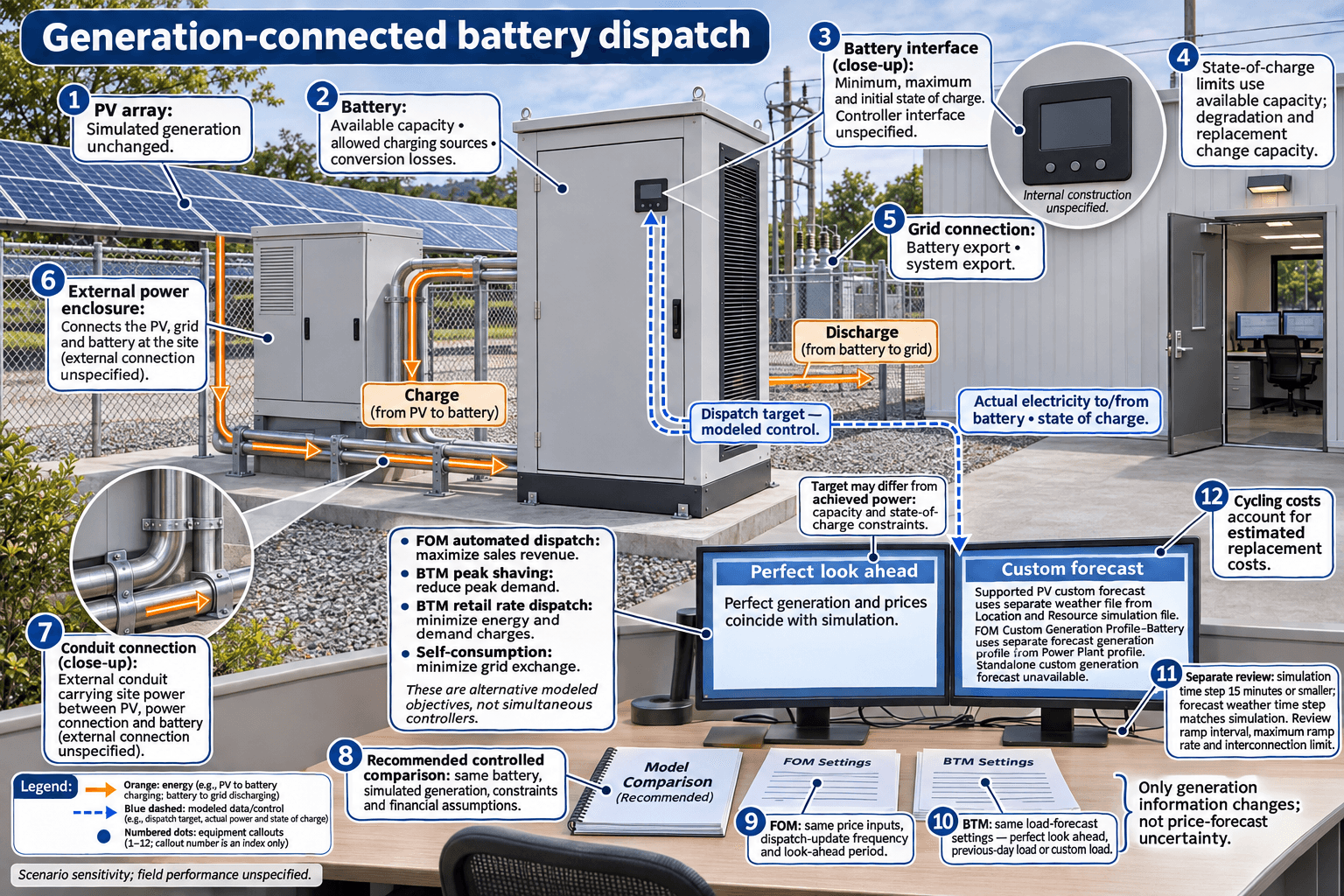
In SAM's front-of-meter automated dispatch, the algorithm attempts to maximize revenue from electricity sales. It responds to power prices and, for generation-connected configurations, available system power. Battery capacity, state of charge, conversion losses and cycling costs constrain its decisions. Perfect look ahead uses generation and prices that coincide with those used in the simulation. Custom forecast allows different generation-forecast inputs. SAM Battery Dispatch—FOM
Behind-the-meter objectives differ. Peak shaving attempts to reduce peak demand, while retail rate dispatch attempts to minimize the energy and demand charge portions of the electricity bill. Both have generation and load forecast settings. Self-consumption instead minimizes power exchanged with the grid. Buyers should request the mode that represents the proposed operating objective before comparing forecast cases. SAM Battery Dispatch—BTM
A recommended tender requirement is to identify the configuration, dispatch mode and commercial objective explicitly. A revenue-oriented FOM simulation and a bill-oriented BTM simulation should be assessed against their respective objectives.
2. Specify a Controlled Forecast Comparison
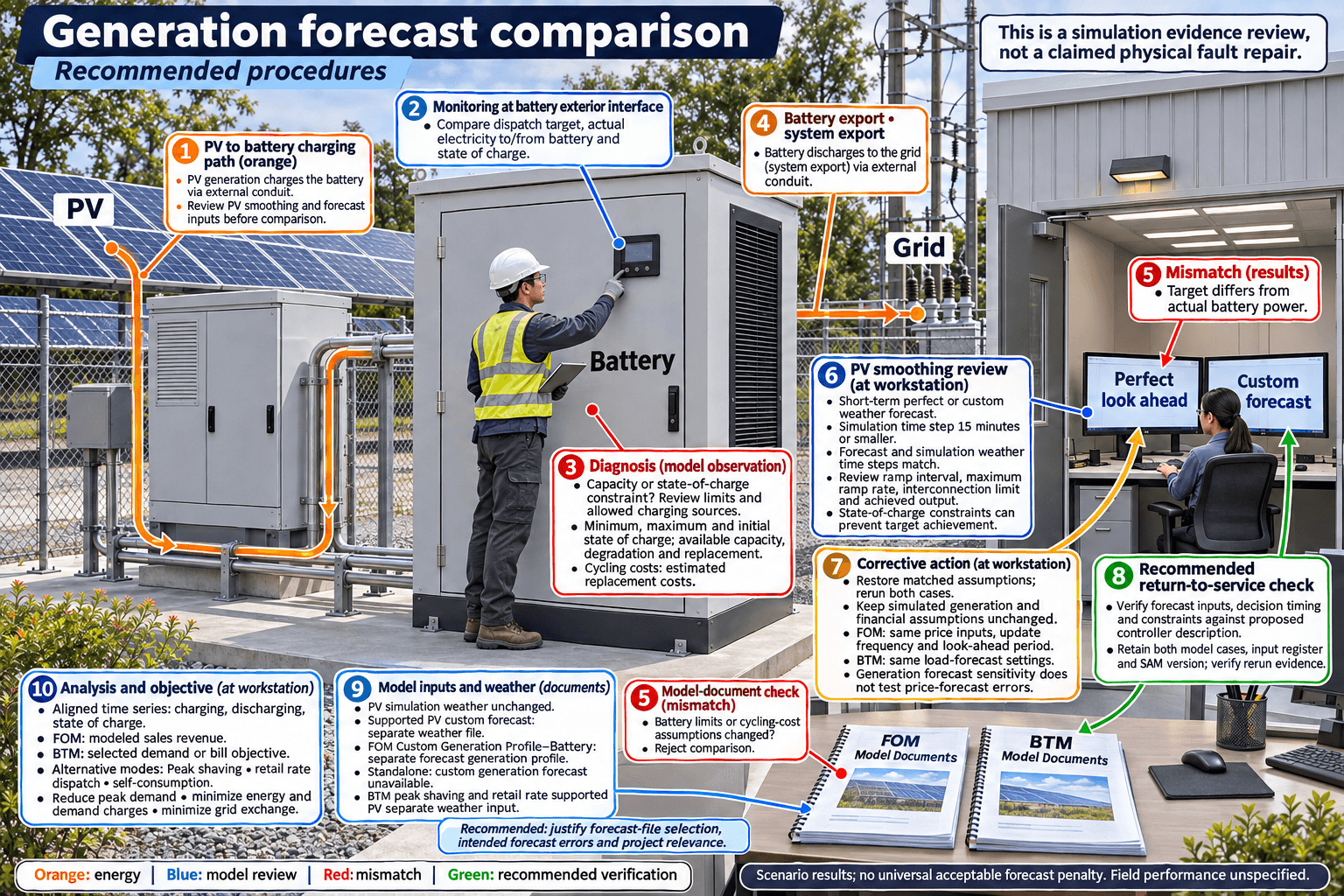
Ask bidders to submit reproducible model files and an input register for both cases. The recommended comparison should retain the same battery, simulated generation, operating constraints and financial assumptions, changing only the generation information used by dispatch.
For FOM PV Battery automated dispatch, SAM's custom forecast uses a different weather file from the one on the Location and Resource page. For Custom Generation Profile–Battery, it uses a forecast generation profile different from the Power Plant profile. Custom generation forecast is unavailable for standalone batteries because they do not dispatch in response to a generating system's profile. SAM Battery Dispatch—FOM
For BTM peak shaving, custom forecast combines look-ahead dispatch with a different weather file from the PV simulation. Retail rate dispatch similarly offers a separate forecast weather file for PV Battery. BTM load forecasts are configured separately, including perfect look ahead, previous-day load and custom load options. SAM Battery Dispatch—BTM
To isolate generation forecast sensitivity, buyers should require unchanged load-forecast settings in the BTM comparison. For FOM evaluation, request unchanged price inputs, dispatch-update frequency and look-ahead period. Label each scenario precisely: a generation-forecast comparison does not establish price-forecast uncertainty.
A different weather file should not automatically be described as a validated operational forecast. As a procurement recommendation, require the bidder to explain its selection, intended forecast-error characteristics and relevance to the project.
3. Compare Achieved Dispatch and Its Constraints
SAM's FOM documentation distinguishes the automated battery power target from actual electricity to or from the battery. Constraints can prevent the target from being achieved. Relevant outputs also include battery state of charge, battery electricity exported to the grid, system electricity exported to the grid and the market sell rate used in dispatch. SAM Battery Dispatch—FOM
Request aligned time-series comparisons, supported by a concise explanation of changed charging, discharging and state-of-charge trajectories. For FOM bids, ask how those changes affect modeled sales revenue. For BTM bids, ask how they affect the selected demand or bill objective. Treat differences as scenario results; neither document specifies a universal acceptable forecast penalty.
The input review should include minimum, maximum and initial state of charge; allowed charging sources; available capacity; and degradation assumptions. SAM defines minimum and maximum state of charge against available capacity, which changes with degradation and replacement. Its cycling penalties account for estimated replacement costs in applicable dispatch decisions. SAM Battery Dispatch—FOM, SAM Battery Dispatch—BTM
Buyers should therefore reject comparisons that silently change battery limits or cycling-cost assumptions alongside the forecast: those changes would prevent a clean interpretation of generation-forecast sensitivity.
4. Apply the Correct Boundary to Bid Acceptance
PV smoothing requires a distinct review. SAM supports short-term perfect forecasts and forecasts based on a custom weather file. Its smoothing algorithm requires simulation time steps of 15 minutes or smaller, and the forecast weather file should have the same time step as the simulation weather file. State-of-charge constraints can still prevent the smoothing target from being met. SAM Battery Dispatch—FOM
For a smoothing bid, request the ramp interval, maximum ramp rate, interconnection limit and forecast settings rather than relying only on a revenue comparison.
The SAM Battery Dispatch—FOM and Battery Dispatch—BTM help documents describe simulation controls; they do not establish a particular battery controller's forecast accuracy or field performance. As a recommended acceptance action, obtain the proposed controller's operating description and verify that its forecast inputs, decision timing and constraints correspond to the modeled configuration. Record the SAM version used and retain both model cases for review.
FAQ
Should both perfect foresight and a separate forecast case be requested?
Yes, as a procurement recommendation where the selected SAM mode supports them. The paired cases help examine how different generation information changes modeled dispatch.
Which weather file should remain unchanged?
Keep the weather file used to simulate PV production unchanged. In supported custom-forecast modes, use a different file specifically for dispatch forecasting.
What if generation is modeled with a custom profile?
FOM Custom Generation Profile–Battery supports a separate forecast generation profile rather than a forecast weather file.
Does this comparison test electricity-price forecast errors?
Not when price inputs remain unchanged. Label it as generation-forecast sensitivity and request a separately defined price comparison if needed.
How should BTM load forecasts be handled?
Keep their settings unchanged when isolating generation forecast effects. SAM configures load forecasts separately for relevant BTM dispatch modes.
Is a custom weather file automatically a realistic forecast?
Its relevance needs justification. Ask the bidder to explain why the file represents an appropriate forecast scenario for the project.
Can actual battery power differ from its dispatch target?
Yes. SAM identifies capacity, state of charge and other constraints that can prevent the battery from achieving its target.
What additional checks apply to PV smoothing?
SAM requires a simulation time step of 15 minutes or smaller; the forecast weather file should match that time step. Review ramp settings and achieved output as well.
Procurement paths
About the Author

Cinn Song
Founder & Chief Solutions Architect
Cinn Song founded SOLARTODO LIMITED and leads its smart-city infrastructure engineering — from solar, storage and integrated smart poles to the company's push into physical-AI city edge nodes: pole-mounted edge computing, vertical LLMs for smart cities, drone-based O&M with autonomous battery swapping, robotic maintenance, and high-speed counter-UAS interception. Since 2010, he has directed turnkey EPC + BOT delivery across 50+ countries, including telecom monopole supply for national grid operators, off-grid solar street-lighting for African municipalities, and integrated smart-pole programs for Gulf smart cities.
Cite This Article
Cinn Song. (2026). Battery Bid Review: Perfect vs Separate Generation Forecasts. SOLARTODO. Retrieved from https://solartodo.com/knowledge/should-a-generation-connected-battery-bid-be-evaluated-with-a-separate-forecast-weather-file-as-well-as-perfect
@article{solartodo_should_a_generation_connected_battery_bid_be_evaluated_with_a_separate_forecast_weather_file_as_well_as_perfect,
  title = {Battery Bid Review: Perfect vs Separate Generation Forecasts},
  author = {Cinn Song},
  journal = {SOLARTODO Knowledge Base},
  year = {2026},
  url = {https://solartodo.com/knowledge/should-a-generation-connected-battery-bid-be-evaluated-with-a-separate-forecast-weather-file-as-well-as-perfect},
  note = {Accessed: 2026-11-14}
}
Published: November 14, 2026 | Available at: https://solartodo.com/knowledge/should-a-generation-connected-battery-bid-be-evaluated-with-a-separate-forecast-weather-file-as-well-as-perfect
Subscribe to Our Newsletter
Get the latest solar energy news and insights delivered to your inbox.
View All Articles