Solar Storage: Verify Clipping and Curtailment Charging…

Cinn Song
Founder & Chief Solutions Architect
TL;DR
Yes—separate the two requirements. SAM describes clipped-DC charging for DC-connected batteries. Verify export-curtailment charging in the proposed AC or DC configuration using charging permissions, export settings, battery limits and time-series results; neither path guarantees full recovery.
Separate inverter-clipped DC recovery from export-limit curtailment recovery. SAM explicitly associates clipped-PV charging with DC-connected batteries; grid-limited charging requires configuration-specific verification. Compare topology, charging permissions, generation, load, export settings and battery constraints using achieved time-series operation.
Summary
Separate inverter-clipped DC recovery from export-limit curtailment recovery. SAM explicitly associates clipped-PV charging with DC-connected batteries; grid-limited charging requires configuration-specific verification. Compare topology, charging permissions, generation, load, export settings and battery constraints using achieved time-series operation.
Key Takeaways
- Specify clipped-DC recovery and export-constrained generation recovery as separate requirements.
- SAM explicitly describes clipped-PV charging for a DC-connected battery.
- Verify grid-limited charging in the proposed AC or DC configuration; topology alone is not proof.
- Document system-charging and grid-charging permissions separately.
- Assess recovery with available capacity, SOC limits, dispatch objectives and forecast assumptions.
- Request electrical diagrams and achieved time-series results before accepting a recovery estimate.
Solar-plus-storage charging: distinguish inverter clipping from export-limit curtailment
Yes. Specify inverter-clipped DC recovery separately from recovery of generation restricted by grid export limits. In SAM, charging from clipped PV power is explicitly associated with a DC-connected battery. Charging from grid-limited system power is a separate option whose availability depends on the connection and dispatch configuration. Neither option guarantees that all restricted energy reaches storage. SAM Battery Dispatch—FOM
1. Identify the constraint before selecting the topology
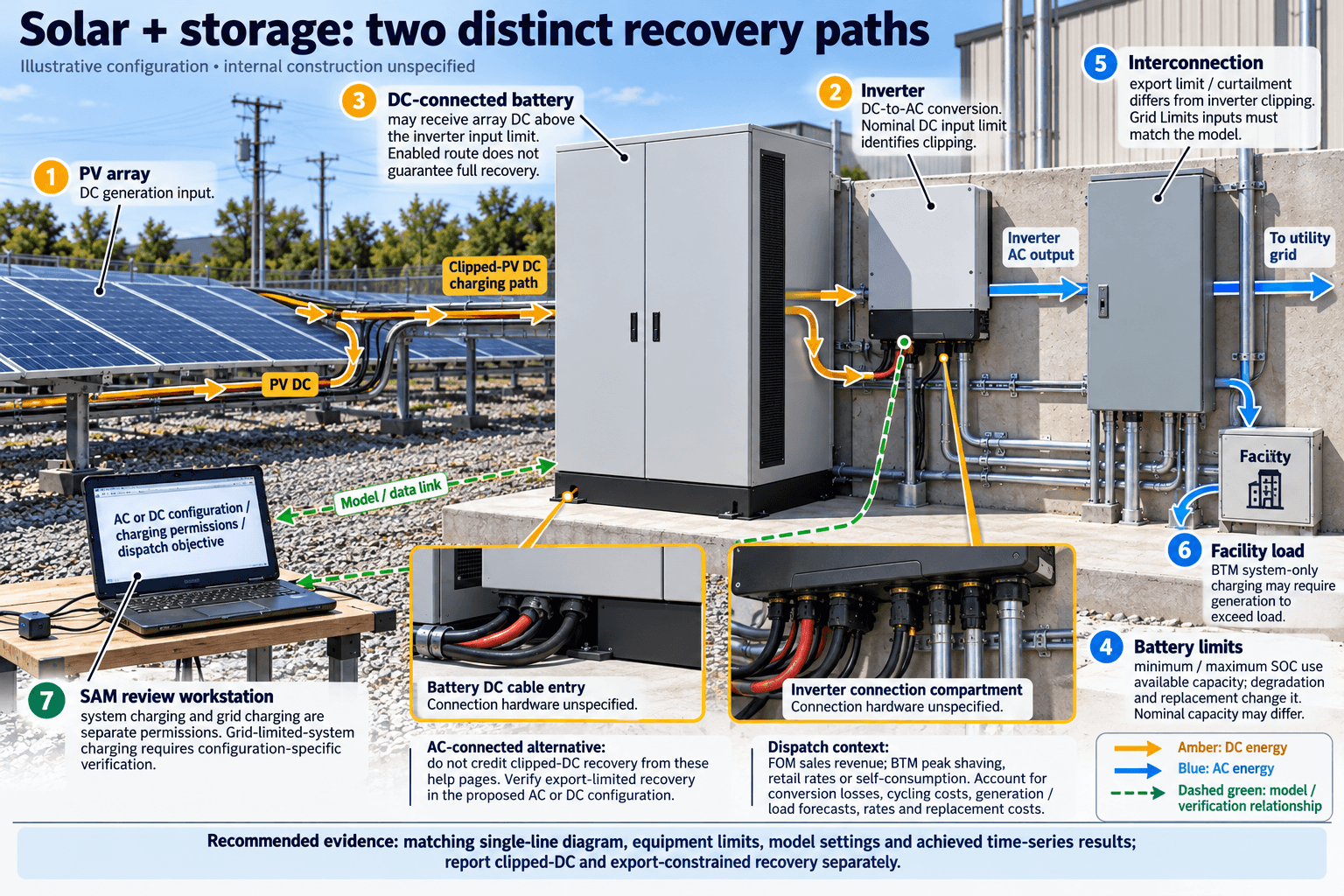
SAM defines clipped-system charging as allowing a DC-connected battery to charge from PV array power exceeding the inverter’s nominal DC input power. The relevant design question is therefore whether the battery has a charging path to that DC power. An AC-connected battery should not be credited with this specific clipped-DC recovery capability on the basis of SAM’s dispatch guidance. SAM Battery Dispatch—BTM
Grid-limited charging addresses a different restriction. SAM describes it as charging from system power exceeding the interconnection limit, or from curtailed power, when an interconnection limit is enabled and/or curtailment is specified on the Grid Limits page. This is a separate charging permission from clipped-system charging. SAM Battery Dispatch—FOM
For procurement, request separate descriptions of the two energy paths rather than accepting a general promise to “capture excess solar.” Ask the designer to identify the limiting device or control setting, the battery connection point, and the charging permission used in the model.
2. Match each recovery path to a demonstrable connection
| Recovery objective | Connection and modeling boundary | Recommended buyer verification |
|---|---|---|
| Recover inverter-clipped PV DC power | SAM explicitly describes this option for PV with a DC-connected battery. | Request a single-line diagram showing the PV-to-battery DC charging path and the applicable inverter input limit. |
| Recover generation restricted by export limits or curtailment | SAM treats this as grid-limited-system charging, separate from clipping. It enables or disables charging options according to dispatch and AC/DC connection. | Request the exact AC- or DC-connected model configuration, its enabled charging options, and the export-limit or curtailment inputs. |
A DC connection is thus the explicit condition for the clipped-DC path described in these help pages. For export-constrained generation, evaluate either proposed AC or DC architecture against the actual model configuration and electrical path. The help pages do not provide a blanket promise that every AC- or DC-connected arrangement supports this function. Verify availability in the selected configuration before crediting recovery. SAM Battery Dispatch—FOM
Also distinguish charging from the generating system from charging from the grid. SAM lists these as separate permissions. For a behind-the-meter design, it additionally offers restrictions such as charging from the system only when generation exceeds load. Recommend documenting these settings so that modeled battery charging has an identifiable source. SAM Battery Dispatch—BTM
3. Model charging opportunity and battery constraints together
An enabled charging route does not establish the quantity of energy that will be stored. SAM constrains dispatch through minimum and maximum state of charge, and those limits refer to available battery capacity. Available capacity changes as batteries degrade and are replaced; it is not necessarily the nominal capacity displayed on the Battery Cell and System page. SAM Battery Dispatch—BTM
Dispatch objectives also matter. Front-of-meter automated dispatch attempts to maximize power-sales revenue while accounting for capacity, state of charge, conversion losses and cycling costs. Behind-the-meter options include peak shaving, retail-rate dispatch and self-consumption. Retail-rate dispatch considers generation and load forecasts, energy and demand rates, available capacity, degradation and future replacement costs. SAM Battery Dispatch—FOM, SAM Battery Dispatch—BTM
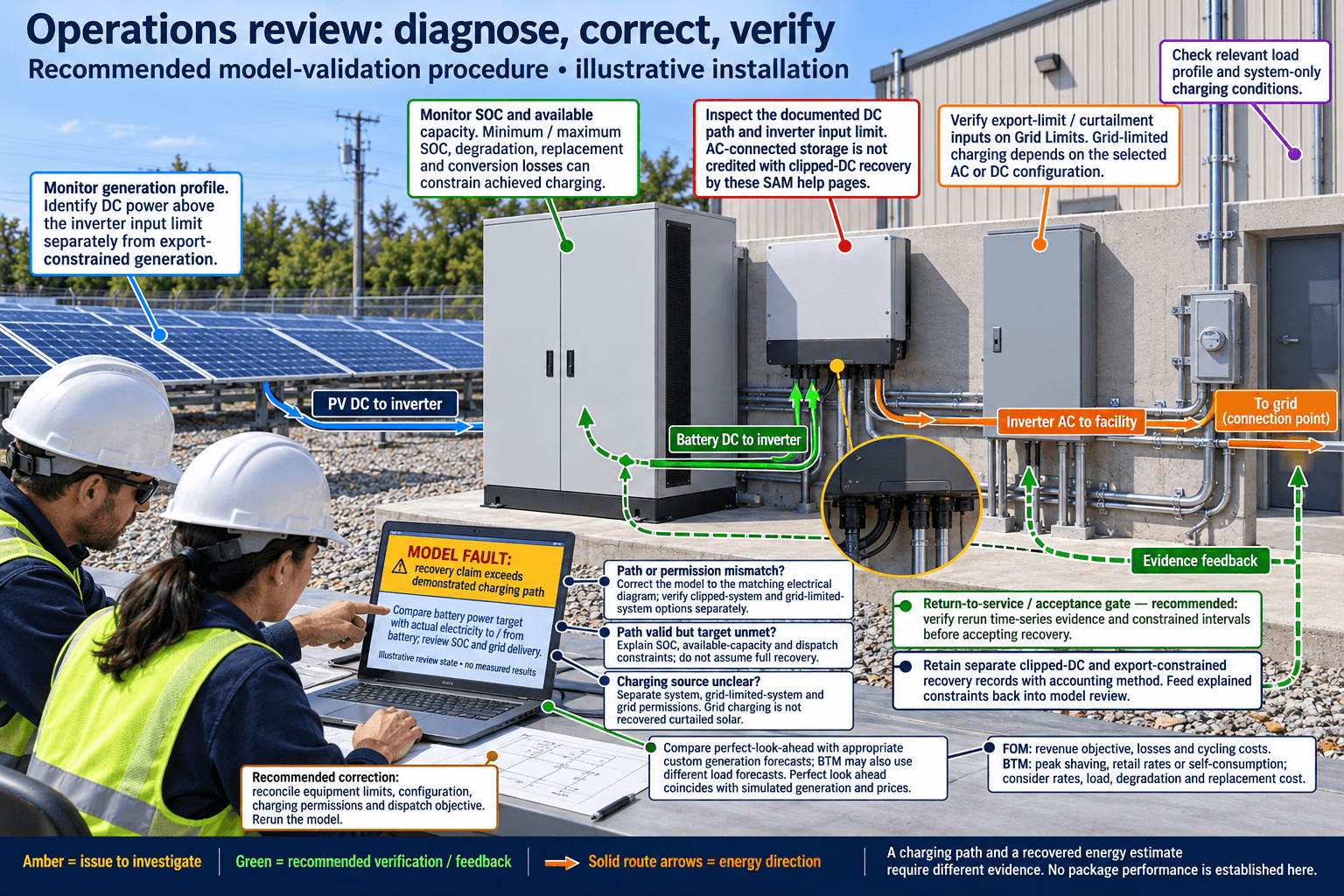
Recommend requesting the generation profile, relevant load profile, inverter parameters, export-limit and curtailment settings, battery performance inputs, SOC limits, charging permissions and dispatch objective before comparing alternatives. Require separate reporting of the two recovery objectives, with the accounting method explained, rather than treating every battery-charging interval as recovered lost generation.
4. Compare achieved operation before accepting a recovery estimate
SAM’s front-of-meter guidance recommends comparing the automated battery power target with actual electricity to or from the battery. Constraints can prevent the battery from meeting its target. For a procurement review, request these time-series results alongside SOC and grid-delivery outputs, and ask the designer to explain constrained intervals. SAM Battery Dispatch—FOM
Forecast assumptions deserve a separate check. SAM’s perfect-look-ahead option uses generation and prices that coincide with the simulated operating conditions. Its custom-forecast options introduce different generation forecasts; behind-the-meter modeling also permits different load forecasts. Recommend comparing appropriate forecast cases before relying on a recovery estimate for a commercial decision. SAM Battery Dispatch—FOM, SAM Battery Dispatch—BTM
The SAM Battery Dispatch—FOM and Battery Dispatch—BTM help pages explain simulation controls, not a particular equipment package’s recovery performance. Before placing an order, request a matching single-line diagram, equipment operating limits, model settings and time-series results. Acceptance should distinguish whether a charging path exists from how much energy the proposed system is calculated to recover.
FAQ
Should clipping and export curtailment be separate procurement requirements?
Yes. SAM defines separate charging options for inverter-clipped PV DC power and grid-limited or curtailed system power.
Which topology supports clipped-DC charging in SAM?
The help pages explicitly describe clipped-system charging for PV systems with a DC-connected battery.
Can an AC-connected battery be credited with clipped-DC recovery?
These SAM help pages do not support that claim. Request evidence of the proposed charging path before assigning recovery.
Does export-curtailment recovery require DC connection?
The pages do not state a universal DC-only requirement. Verify the grid-limited charging option in the proposed AC or DC configuration.
Does enabling a charging option guarantee full recovery?
No. SAM dispatch remains constrained by available capacity, SOC and other operating constraints.
Is grid charging the same as recovering curtailed solar?
No. SAM lists grid charging and grid-limited-system charging as separate permissions. Request an explanation of the modeled charging source.
Why review perfect-look-ahead assumptions?
SAM’s perfect forecast coincides with simulated conditions. Recommend comparing an appropriate alternative forecast before relying on the result.
What should a buyer request before accepting the design?
Request the single-line diagram, equipment limits, model configuration, charging permissions and time-series results explaining each recovery path.
Procurement paths
About the Author

Cinn Song
Founder & Chief Solutions Architect
Cinn Song founded SOLARTODO LIMITED and leads its smart-city infrastructure engineering — from solar, storage and integrated smart poles to the company's push into physical-AI city edge nodes: pole-mounted edge computing, vertical LLMs for smart cities, drone-based O&M with autonomous battery swapping, robotic maintenance, and high-speed counter-UAS interception. Since 2010, he has directed turnkey EPC + BOT delivery across 50+ countries, including telecom monopole supply for national grid operators, off-grid solar street-lighting for African municipalities, and integrated smart-pole programs for Gulf smart cities.
Cite This Article
Cinn Song. (2026). Solar Storage: Verify Clipping and Curtailment Charging…. SOLARTODO. Retrieved from https://solartodo.com/knowledge/should-a-solar-plus-storage-charging-design-distinguish-recovery-of-inverter-clipped-dc-power-from-recovery-of-power
@article{solartodo_should_a_solar_plus_storage_charging_design_distinguish_recovery_of_inverter_clipped_dc_power_from_recovery_of_power,
  title = {Solar Storage: Verify Clipping and Curtailment Charging…},
  author = {Cinn Song},
  journal = {SOLARTODO Knowledge Base},
  year = {2026},
  url = {https://solartodo.com/knowledge/should-a-solar-plus-storage-charging-design-distinguish-recovery-of-inverter-clipped-dc-power-from-recovery-of-power},
  note = {Accessed: 2026-11-02}
}
Published: November 2, 2026 | Available at: https://solartodo.com/knowledge/should-a-solar-plus-storage-charging-design-distinguish-recovery-of-inverter-clipped-dc-power-from-recovery-of-power
Subscribe to Our Newsletter
Get the latest solar energy news and insights delivered to your inbox.
View All Articles