Mixed-Driver Streetlights: Verify 0–10V Output Response

Cinn Song
Founder & Chief Solutions Architect
TL;DR
Yes—recommend matched responses where shared settings must deliver comparable dimming. Define targets and tolerances, verify the proposed combinations, and check installed illumination separately. No universal matching tolerance is established by the DOE overview.
Require comparable dimming responses where mixed-driver luminaires must follow shared 0–10V settings. Define the comparison basis, operating settings and acceptance tolerance; verify proposed combinations and installed scenes. DOE identifies driver performance variation but does not establish a universal tolerance or project-specific savings.
Key Takeaways
- Recommend response matching where the lighting design requires comparable dimming behavior.
- Request measured response data rather than relying solely on a 0–10V dimmability description.
- Define whether matching means relative output or an absolute output target.
- Agree project-specific settings, measurement conditions and acceptance tolerances.
- Verify installed illumination separately from driver–luminaire response matching.
- Calculate energy economics with project inputs; keep FEMP purchasing mandates within their U.S. federal scope.
Mixed-Driver Streetlight Fleets: Specify and Verify 0–10V Light-Output Response
Summary
Yes—as a procurement recommendation, require comparable light-output responses at shared 0–10V settings where the lighting design calls for comparable dimming behavior. Request model-specific response data, define the intended operating settings and an agreed acceptance tolerance, then verify representative driver–luminaire combinations. Matching should support the project’s lighting objectives; it should not automatically mean identical lumen output from every fixture. The DOE research supports checking response consistency, but its January 2024 overview does not establish a universal matching tolerance or guarantee roadway uniformity. DOE, January 2024
1. Why a shared interface needs performance evidence
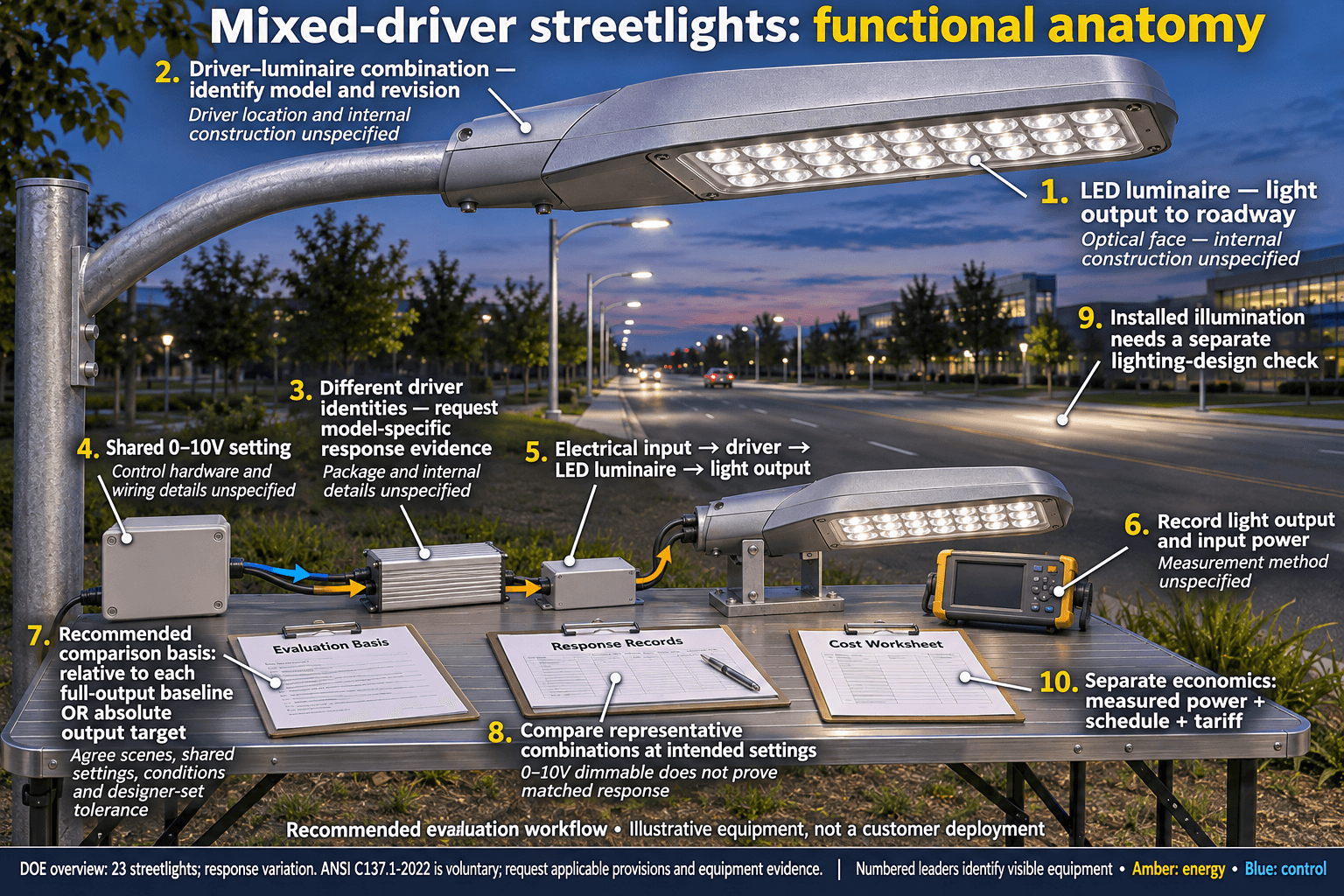
The U.S. Department of Energy’s The Energy and Operational Impacts of Using 0-10V Control for LED Streetlights, published January 10, 2024, describes a study of 23 LED streetlights claiming dimmability through a 0–10V interface. The study characterizes performance variation among commercially available LED drivers and explores the potential impact of the voluntary ANSI C137.1-2022 standard. DOE, January 2024
For procurement, this supports a practical recommendation: treat “0–10V dimmable” as the starting point for evaluation, and request evidence of the actual output response before accepting mixed-driver operation. The DOE overview identifies more accurate and consistent dimming across luminaires as an objective. It does not establish that every product carrying the interface description already meets that objective.
Buyers should therefore ask suppliers to demonstrate how their proposed combinations respond at the settings the fleet will use. Avoid assuming a particular voltage represents a particular percentage of light output unless the product’s measured response supports that interpretation.
2. Define what needs to match
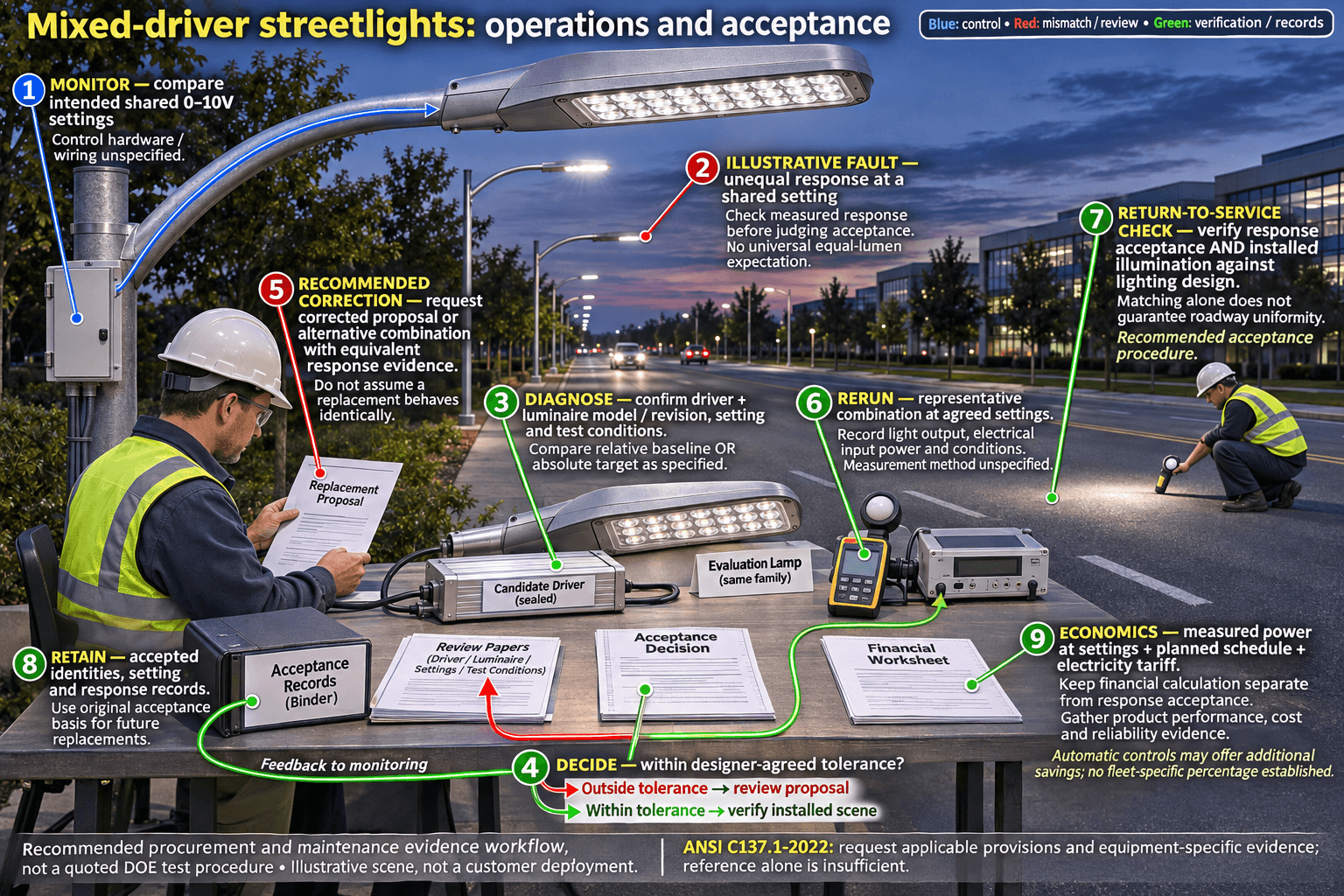
As a recommended specification method, first identify which luminaires are intended to follow the same dimming behavior. Then state whether the comparison concerns relative output against each luminaire’s full-output baseline or an absolute light-output target. Define those terms in the procurement documents so suppliers price and demonstrate the same requirement.
Recommended inputs include:
- The proposed driver and luminaire identities, including relevant revisions.
- The shared control settings and intended lighting scenes.
- The target response at those settings and the comparison basis.
- The measurement conditions, acceptance tolerance and required records.
Set the tolerance with the project’s lighting designer rather than copying an unsupported universal value. The January 2024 DOE overview identifies performance variation and references ANSI C137.1-2022, but it does not provide the standard’s detailed requirements. Ask the supplier to identify the applicable standard provisions and submit evidence for the proposed equipment; a reference to the standard alone should not replace that review.
3. Verify the proposed combinations and installed scenes
A recommended acceptance process is to compare representative driver–luminaire combinations at the agreed shared settings. Request recorded light output and electrical input power under documented conditions. Review the results against the specified response before approving the combinations for fleet use.
Keep the acceptance questions separate: does each combination follow the agreed dimming response, and does the installed lighting satisfy the project’s illumination requirements? Do not make response matching the sole acceptance criterion for illumination across the site. Recommend an installed-scene check against the lighting design as an additional verification step.
For future replacements, retain the accepted equipment identities, response records and operating settings. Recommend requiring equivalent evidence when a replacement driver or luminaire is proposed. This makes the original acceptance basis available for maintenance decisions without assuming that an alternative component will behave identically.
The DOE study overview supports the need for consistency evaluation; the testing sequence above is a recommended procurement method, not a test procedure quoted from that overview. DOE, January 2024
4. Assess energy economics separately from response matching
FEMP’s Purchasing Energy-Efficient Exterior Lighting, updated June 2023, recommends gathering accurate, relevant product performance, cost and reliability data. It also identifies automatic lighting controls as an opportunity for additional energy savings. Neither point establishes a savings percentage for a particular mixed-driver fleet. FEMP, June 2023
For a project-specific comparison, recommend using measured input power at the intended operating settings, the planned schedule and the applicable electricity tariff. Keep the lighting-response acceptance decision distinct from the financial calculation.
FEMP’s published lifetime-cost example concerns wall-mounted luminaires under stated operating, tariff, lifetime and discount assumptions. Its dollar savings should not be transferred to a streetlight fleet. Likewise, its mandatory purchasing requirements concern covered U.S. federal acquisitions; buyers elsewhere should establish the requirements applicable to their own project. FEMP, June 2023
FAQ
Should different drivers be prohibited?
The DOE overview does not establish that requirement. Recommend accepting proposed combinations against an agreed response specification.
Does 0–10V dimmability prove matched output?
It should not be accepted as proof. DOE’s January 2024 overview describes performance variation among commercially available drivers.
Should all luminaires produce identical lumens?
Recommend defining the target from the lighting design, including whether comparisons use relative or absolute output.
What matching tolerance should a tender specify?
Agree a project-specific tolerance with the lighting designer. The DOE overview does not establish a universal value.
Does ANSI C137.1-2022 guarantee compatibility?
The overview explores the voluntary standard’s potential impact. Request applicable provisions and equipment-specific evidence before accepting a compatibility claim.
What should suppliers submit?
Recommend equipment identities, response measurements, electrical input power and test conditions at the intended shared settings.
Does response matching guarantee uniform illumination?
That guarantee is not established by the DOE overview. Recommend checking installed scenes against the project’s lighting requirements.
Can FEMP’s savings example justify this purchase?
Its example concerns wall-mounted luminaires with specific assumptions. Recommend a separate calculation using the streetlight fleet’s operating data.
Procurement paths
About the Author

Cinn Song
Founder & Chief Solutions Architect
Cinn Song founded SOLARTODO LIMITED and leads its smart-city infrastructure engineering — from solar, storage and integrated smart poles to the company's push into physical-AI city edge nodes: pole-mounted edge computing, vertical LLMs for smart cities, drone-based O&M with autonomous battery swapping, robotic maintenance, and high-speed counter-UAS interception. Since 2010, he has directed turnkey EPC + BOT delivery across 50+ countries, including telecom monopole supply for national grid operators, off-grid solar street-lighting for African municipalities, and integrated smart-pole programs for Gulf smart cities.
Cite This Article
Cinn Song. (2026). Mixed-Driver Streetlights: Verify 0–10V Output Response. SOLARTODO. Retrieved from https://solartodo.com/knowledge/should-a-streetlight-fleet-using-different-led-drivers-require-matched-light-output-responses-at-shared-010v-control
@article{solartodo_should_a_streetlight_fleet_using_different_led_drivers_require_matched_light_output_responses_at_shared_010v_control,
  title = {Mixed-Driver Streetlights: Verify 0–10V Output Response},
  author = {Cinn Song},
  journal = {SOLARTODO Knowledge Base},
  year = {2026},
  url = {https://solartodo.com/knowledge/should-a-streetlight-fleet-using-different-led-drivers-require-matched-light-output-responses-at-shared-010v-control},
  note = {Accessed: 2026-11-24}
}
Published: November 24, 2026 | Available at: https://solartodo.com/knowledge/should-a-streetlight-fleet-using-different-led-drivers-require-matched-light-output-responses-at-shared-010v-control
Subscribe to Our Newsletter
Get the latest solar energy news and insights delivered to your inbox.
View All Articles