Battery Bid Comparison: Align Initial SOC and Dispatch…

Cinn Song
Founder & Chief Solutions Architect
TL;DR
Yes—recommend a common initial SOC for baseline bid simulations. Declare capacity and SOC limits, align dispatch assumptions, and inspect operating traces. Equal initial SOC alone does not establish equivalent equipment or guaranteed performance.
Use a common initial SOC for the baseline battery bid comparison, supported by declared capacity, SOC limits and dispatch inputs. Compare operating traces under aligned project conditions, and review equipment-specific limits separately. This is a recommended procurement method based on SAM’s modeling definitions, not a SAM purchasing requirement.
Summary
Use a common initial SOC for the baseline battery bid comparison, supported by declared capacity, SOC limits and dispatch inputs. Compare operating traces under aligned project conditions, and review equipment-specific limits separately. This is a recommended procurement method based on SAM’s modeling definitions, not a SAM purchasing requirement.
Key Takeaways
- Specify a common initial SOC for the baseline and label departures as separate scenarios.
- Record capacity and operating SOC limits alongside the initial percentage.
- Select starting conditions and SOC windows appropriate to the offered battery.
- Align dispatch objectives, project data, forecast assumptions and charging permissions.
- Check time steps because some dispatch settings operate per simulation interval.
- Review SOC and power traces, then reconcile model inputs with offered-equipment documentation.
Battery Bid Comparisons: Use a Common Initial State of Charge
Yes. Buyers should require the same initial state of charge (SOC) for a baseline comparison of battery simulations, while recording each bid’s capacity and operating limits. Treat this as a recommended comparison rule: SAM defines initial SOC as the battery’s charge at the beginning of the simulation, but its Battery Dispatch help pages do not establish a procurement requirement to standardize bids. SAM Battery Dispatch—BTM
1. Specify the Starting Condition Before Comparing Results

SAM defines an initial SOC of 100% as fully charged and 0% as fully discharged. Its dispatch calculations operate within battery capacity and SOC constraints. Consequently, the procurement reason for aligning initial SOC is straightforward: buyers should compare bids under an agreed starting condition rather than leave that condition to each bidder. SAM Battery Dispatch—FOM
Recommended tender wording is: “Use the buyer’s specified initial SOC for the baseline simulation. Declare initial SOC, minimum SOC, maximum SOC, available capacity and nominal capacity. Identify any departure from the baseline and submit it as a separate scenario.”
Choose that baseline with the project engineer rather than automatically specifying fully charged or fully depleted. SAM advises selecting SOC limits appropriate to the battery type being modeled. Ask bidders to confirm that the proposed initial condition and operating window are appropriate for their offered battery. SAM Battery Dispatch—BTM
2. Check Capacity and SOC Limits Alongside the Starting Percentage
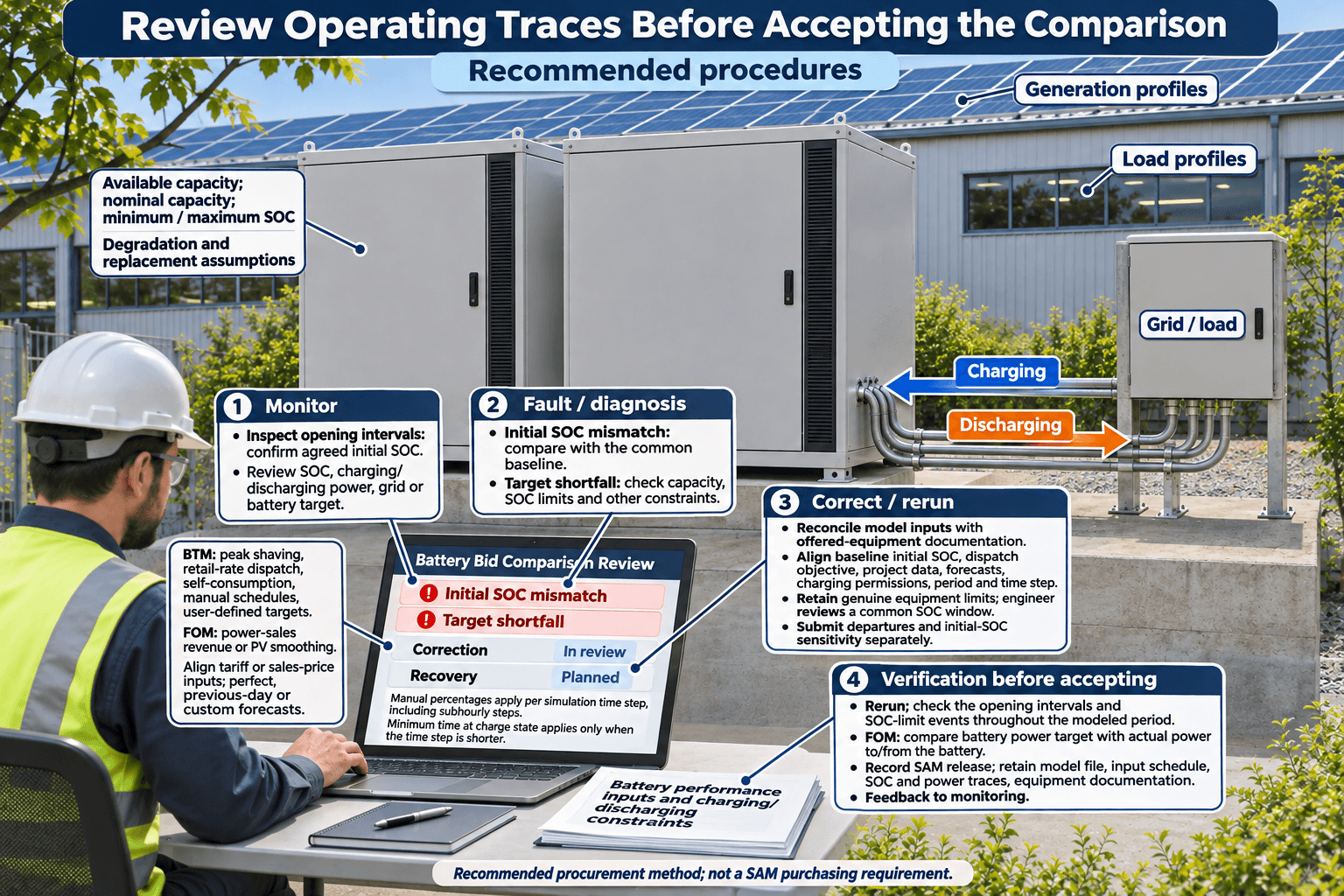
Matching initial SOC is one comparison control, not a complete definition of equivalent batteries. SAM states that minimum and maximum SOC are percentages of available battery capacity. That available capacity changes as batteries degrade and are replaced, and may be lower than nominal capacity. The limits affect both energy available for dispatch and charge-discharge cycle depth in battery-life calculations. SAM Battery Dispatch—FOM
For bid review, request a compact input schedule showing:
- Initial, minimum and maximum SOC.
- Nominal capacity and the available-capacity basis used in the simulation.
- Battery-life and replacement assumptions.
- Battery performance inputs and charging/discharging constraints.
Recommend retaining genuine equipment differences in the comparison and explaining them explicitly. Where operating limits differ, ask the engineer to determine whether a common modeling window is appropriate. Do not silently overwrite a bidder’s declared limits simply to make the input sheets look identical.
SAM’s dispatch pages direct users to the Battery Cell and System page for performance characteristics. Buyers should therefore request those model inputs as well as the dispatch settings; an initial-SOC entry alone does not describe battery performance. SAM Battery Dispatch—BTM
3. Align the Dispatch Objective, Data and Time Step
For behind-the-meter comparisons, SAM offers distinct objectives: peak shaving, retail-rate dispatch, self-consumption, manual schedules and user-defined targets. Retail-rate dispatch seeks to minimize energy and demand charges, while self-consumption seeks to minimize power exchanged with the grid. Ask bidders to use the same agreed service objective in the baseline. SAM Battery Dispatch—BTM
For front-of-meter projects, SAM’s automated dispatch attempts to maximize power-sales revenue, whereas PV smoothing addresses power ramp rates at the interconnection point. These are different modeled services. Specify which service the bid must demonstrate before comparing its results. SAM Battery Dispatch—FOM
Recommend a common baseline for load and generation profiles, applicable tariff or sales-price inputs, forecast assumptions, charging permissions, simulation period and time step. SAM distinguishes perfect forecasts from previous-day or custom forecasts, and allows charging permissions to vary with configuration and dispatch choice. SAM Battery Dispatch—BTM
Check time-dependent settings carefully. SAM’s minimum time at charge state applies only when the simulation time step is shorter than that setting. Its manual charge/discharge percentages apply per simulation time step, including subhourly steps. Require bidders to explain those settings rather than assume identical percentages create identical operation at different resolutions. SAM Battery Dispatch—BTM
4. Review Operating Traces Before Accepting the Comparison
Request input exports and time-series results, including SOC, charging/discharging power and the relevant grid or battery target. SAM explains that targets may not be met when capacity, SOC or other constraints intervene. For front-of-meter automated dispatch, it specifically recommends comparing the battery power target with actual power to/from the battery. SAM Battery Dispatch—FOM
As a review method, inspect the opening intervals to confirm the agreed starting condition, then examine target shortfalls and SOC-limit events throughout the modeled period. Consider a separate initial-SOC sensitivity comparison if the starting condition remains a procurement uncertainty; label it separately from the common baseline.
The SAM Battery Dispatch—BTM and Battery Dispatch—FOM help pages describe simulation controls, not offered-equipment guarantees. Before accepting a bid, request its model file, record the SAM release used, and have the bidder reconcile modeled capacity, operating limits and performance inputs with the offered equipment documentation.
FAQ
Should every bidder use the same initial SOC?
Recommended for the baseline comparison. Require bidders to disclose exceptions and present alternative starting conditions separately.
Does SAM require buyers to standardize initial SOC?
Its Battery Dispatch help pages define the input and dispatch constraints. Standardizing bids is a procurement recommendation.
Should the baseline always start fully charged?
No universal starting value is recommended here. Agree a project baseline and ask bidders to confirm its suitability.
What does initial SOC mean in SAM?
It is the battery’s state of charge at the beginning of the simulation; 100% means fully charged and 0% fully discharged.
Is matching initial SOC enough?
Also review capacity, operating limits, performance inputs, dispatch objectives, forecast assumptions and charging permissions.
Why request available capacity?
SAM expresses minimum and maximum SOC against available capacity, which changes with degradation and replacement.
Can the battery always meet its dispatch target?
No. SAM identifies capacity, SOC and other constraints as reasons actual operation may fall short of targets.
What should bidders submit for verification?
Request the model file, software release, input schedule, SOC and power traces, and equipment documentation supporting the modeled parameters.
Procurement paths
About the Author

Cinn Song
Founder & Chief Solutions Architect
Cinn Song founded SOLARTODO LIMITED and leads its smart-city infrastructure engineering — from solar, storage and integrated smart poles to the company's push into physical-AI city edge nodes: pole-mounted edge computing, vertical LLMs for smart cities, drone-based O&M with autonomous battery swapping, robotic maintenance, and high-speed counter-UAS interception. Since 2010, he has directed turnkey EPC + BOT delivery across 50+ countries, including telecom monopole supply for national grid operators, off-grid solar street-lighting for African municipalities, and integrated smart-pole programs for Gulf smart cities.
Cite This Article
Cinn Song. (2026). Battery Bid Comparison: Align Initial SOC and Dispatch…. SOLARTODO. Retrieved from https://solartodo.com/knowledge/should-battery-bid-comparisons-use-the-same-initial-state-of-charge-so-that-one-simulation-does-not-begin-fully-charged
@article{solartodo_should_battery_bid_comparisons_use_the_same_initial_state_of_charge_so_that_one_simulation_does_not_begin_fully_charged,
  title = {Battery Bid Comparison: Align Initial SOC and Dispatch…},
  author = {Cinn Song},
  journal = {SOLARTODO Knowledge Base},
  year = {2026},
  url = {https://solartodo.com/knowledge/should-battery-bid-comparisons-use-the-same-initial-state-of-charge-so-that-one-simulation-does-not-begin-fully-charged},
  note = {Accessed: 2026-11-16}
}
Published: November 16, 2026 | Available at: https://solartodo.com/knowledge/should-battery-bid-comparisons-use-the-same-initial-state-of-charge-so-that-one-simulation-does-not-begin-fully-charged
Subscribe to Our Newsletter
Get the latest solar energy news and insights delivered to your inbox.
View All Articles