Streetlight Motion Dimming: Require Outdoor Test Evidence

Cinn Song
Founder & Chief Solutions Architect
TL;DR
Require outdoor application evidence before accepting motion-triggered streetlight dimming. Specify site conditions, equipment and control settings; agree measurable criteria; and demonstrate the complete lighting response. Indoor tests support the review, while the cited DOE guidance supplies no universal outdoor pass thresholds.
Require evidence for the intended outdoor application before accepting motion-triggered streetlight dimming. Use indoor occupancy-sensor results as supporting evidence, then agree project inputs, measurable acceptance criteria and a demonstration of the complete lighting response. DOE’s guidance does not prescribe universal outdoor test thresholds.
Summary
Require evidence for the intended outdoor application before accepting motion-triggered streetlight dimming. Use indoor occupancy-sensor results as supporting evidence, then agree project inputs, measurable acceptance criteria and a demonstration of the complete lighting response. DOE’s guidance does not prescribe universal outdoor test thresholds.
Key Takeaways
- Indoor occupancy-sensor research does not establish performance for an outdoor streetlight installation.
- Request the tested equipment, installation conditions, settings, measurement method and results.
- Define the intended outdoor detection task and agree acceptance criteria before testing.
- Demonstrate the lighting response and dimming sequence, alongside the sensor event.
- Evaluate project savings using declared operating and cost assumptions; do not transfer FEMP’s wall-mounted example.
- Treat FEMP’s federal purchasing guidance within its U.S. federal scope and verify the requirements applicable to the project.
Motion-Triggered Streetlight Dimming: Require Evidence for the Intended Outdoor Application
Do not accept motion-triggered streetlight dimming on indoor occupancy-sensor test results alone. A sound procurement approach is to require testing representative of the intended outdoor application, using the proposed equipment, installation arrangement and control settings. Treat this as a recommended acceptance condition: the DOE documents discussed here do not establish a mandatory outdoor motion-detection test protocol or universal pass thresholds.
1. Establish what the indoor evidence demonstrates
DOE’s Sensors and Fault Detection describes PNNL research on indoor occupancy sensors. It identifies A Review of Existing Test Methods for Occupancy Sensors, dated August 2020, and explains that this review informed development of a new test method. The stated research objective concerns potential building energy savings while minimizing occupant dissatisfaction. That description does not establish outdoor streetlight detection performance. DOE, Sensors and Fault Detection
Use an indoor report as supporting technical evidence within its documented conditions. Before accepting a proposal, ask the bidder to identify the tested sensor, installation arrangement, settings, target movements, measurement method and results. Compare those conditions with the proposed streetlight application.
Where the conditions differ, request a written explanation of applicability and outdoor test evidence addressing the differences. An indoor result should not automatically become an outdoor acceptance result merely because both applications use motion sensing.
2. Define the outdoor acceptance task before comparing bids
DOE cautions that the value of connected-lighting sensor use cases has been difficult to quantify and that sensor data accuracy is often unspecified or poorly specified. This supports asking for explicit, measurable evidence rather than accepting a general claim of intelligent operation. DOE, Sensors and Fault Detection
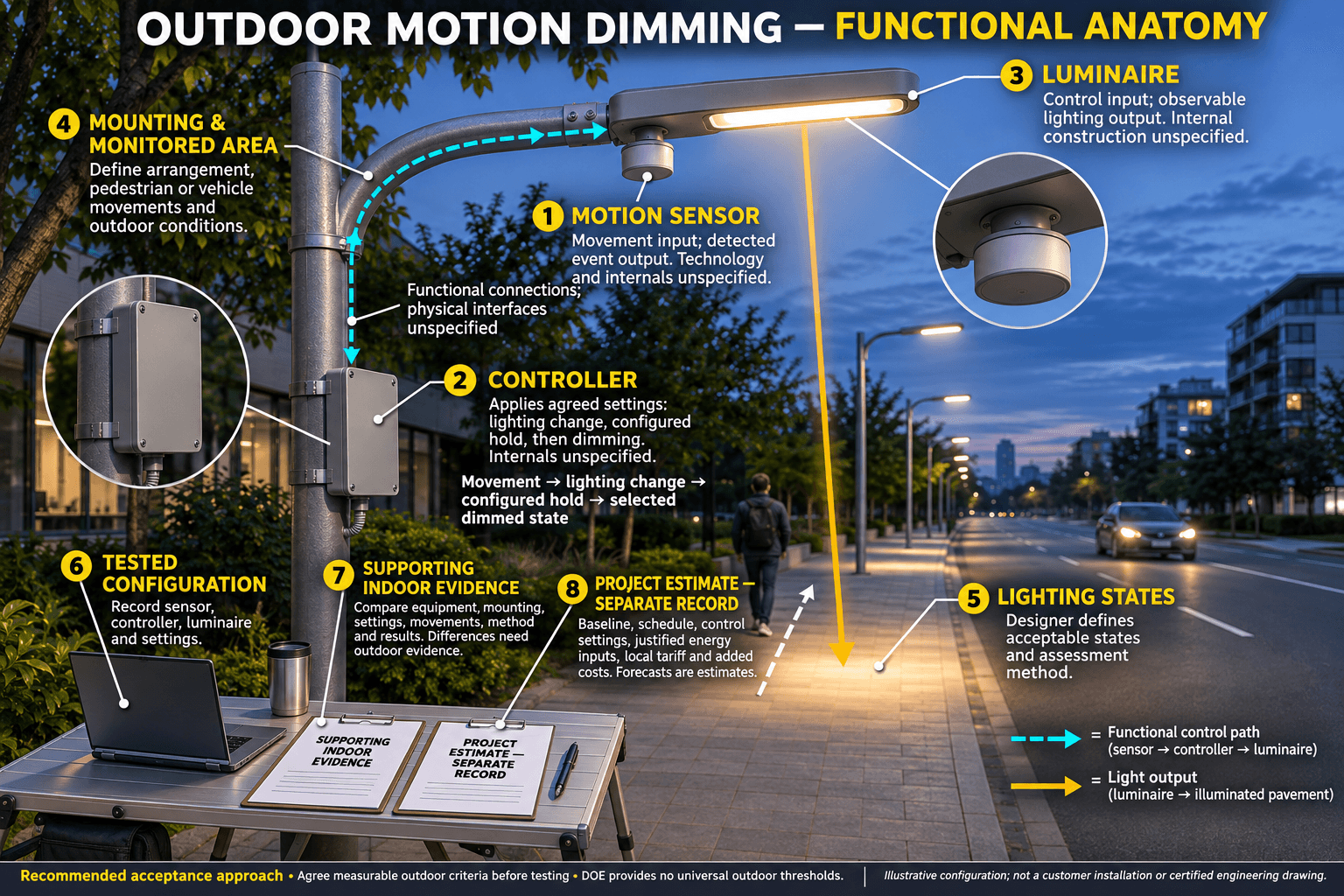
As a recommended procurement method, define the intended operating task before requesting prices. Give bidders the proposed mounting arrangement, area to be monitored, intended pedestrian or vehicle movements, operating conditions and required dimming sequence. Ask them to identify the equipment and settings they propose to test.
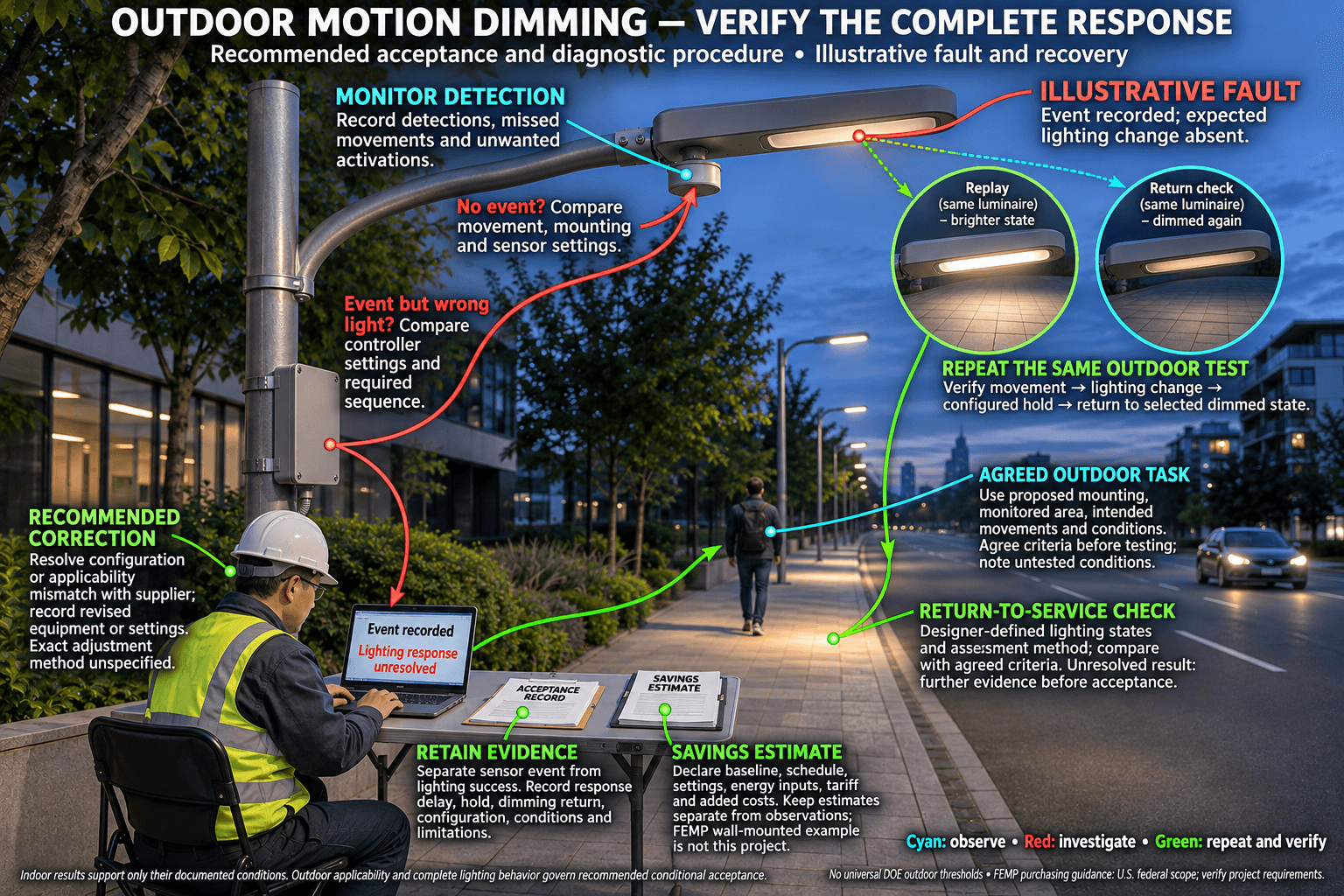
The acceptance plan should state how the buyer will observe and record detection, missed detections, unwanted activations, the delay before lighting changes, and the return to the selected dimmed state. Agree project-specific criteria before testing; do not introduce arbitrary limits after reviewing results.
Include the intended outdoor conditions in the agreed test scope. Record any conditions that the test does not cover, so the buyer can decide whether additional evidence is needed. These are recommended contract provisions, not test requirements prescribed by the DOE page.
3. Verify the lighting response as well as the sensor event
FEMP’s Purchasing Energy-Efficient Exterior Lighting, updated June 2023, describes networked controls that adapt lighting to environmental conditions and real-time activity. It also emphasizes obtaining accurate, relevant information on product performance, cost and reliability. DOE FEMP, Purchasing Energy-Efficient Exterior Lighting, June 2023
For procurement, this suggests testing the proposed lighting function through to its observable result. Recommend demonstrating a movement event, the resulting lighting change, the configured holding period and the subsequent dimming sequence. Record the sensor, controller, luminaire and settings used so the acceptance result identifies the tested configuration.
Ask the project’s lighting designer to define the acceptable lighting states and assessment method for the intended application. Neither DOE page establishes a universal minimum dimmed level, detection distance or response time for motion-triggered streetlighting. Those values should therefore come from the project requirements and supporting evidence.
Require the acceptance record to distinguish a detected event from a successful lighting response. This makes the buyer’s decision about the complete proposed function explicit.
4. Evaluate savings and purchasing obligations separately
FEMP describes additional energy-saving opportunities from automatic and networked lighting controls. It does not establish a savings percentage for a particular motion-triggered installation. Its published financial comparison concerns wall-mounted luminaires under stated operating, tariff and lifetime assumptions; it is not a streetlight motion-dimming savings calculation. DOE FEMP, Purchasing Energy-Efficient Exterior Lighting, June 2023
For a project comparison, request a declared baseline, operating schedule, control settings, measured or otherwise justified energy inputs, local tariff and additional costs. Label forecasts as estimates and keep them separate from observed acceptance results.
FEMP’s purchasing guidance addresses U.S. federal acquisitions. Do not present its federal efficiency requirements as obligations for buyers in other countries. For a U.S. federal procurement, verify the applicable requirements at solicitation; elsewhere, confirm the requirements governing the actual project.
The recommended decision is conditional acceptance based on documented outdoor applicability and demonstrated lighting behavior. Retain indoor testing as supporting evidence, agree the outdoor acceptance method before award, and make any remaining limitations visible in the acceptance record.
FAQ
Should indoor occupancy-sensor results alone justify acceptance?
No. The recommended approach is to require evidence representative of the intended outdoor installation and control function.
Are indoor test reports still useful?
Yes, within their documented conditions. Ask the bidder to explain how those conditions relate to the proposed outdoor application.
Does DOE prescribe a mandatory outdoor motion-sensor test here?
Neither cited page establishes a mandatory outdoor motion-detection protocol or universal pass thresholds. Agree a project-specific acceptance method.
What inputs should the buyer give bidders?
Provide the proposed mounting arrangement, monitored area, intended movements, operating conditions and required lighting sequence.
What should the acceptance demonstration record?
Recommended records include detections, misses, unwanted activations, lighting-response timing and return to the configured dimmed state.
Is observing a sensor event enough?
For acceptance of the dimming function, also demonstrate the resulting lighting change and configured sequence using the proposed equipment.
Can FEMP’s published savings be used for this project?
Its wall-mounted-luminaire comparison is not a motion-triggered streetlight calculation. Prepare a project estimate with explicit operating, energy and cost assumptions.
Do FEMP purchasing requirements apply worldwide?
The cited guidance addresses U.S. federal acquisitions. Buyers elsewhere should confirm the requirements applicable to their own project.
Procurement paths
About the Author

Cinn Song
Founder & Chief Solutions Architect
Cinn Song founded SOLARTODO LIMITED and leads its smart-city infrastructure engineering — from solar, storage and integrated smart poles to the company's push into physical-AI city edge nodes: pole-mounted edge computing, vertical LLMs for smart cities, drone-based O&M with autonomous battery swapping, robotic maintenance, and high-speed counter-UAS interception. Since 2010, he has directed turnkey EPC + BOT delivery across 50+ countries, including telecom monopole supply for national grid operators, off-grid solar street-lighting for African municipalities, and integrated smart-pole programs for Gulf smart cities.
Cite This Article
Cinn Song. (2026). Streetlight Motion Dimming: Require Outdoor Test Evidence. SOLARTODO. Retrieved from https://solartodo.com/knowledge/should-motion-triggered-streetlight-dimming-be-accepted-on-indoor-occupancy-sensor-test-results-alone-or-require
@article{solartodo_should_motion_triggered_streetlight_dimming_be_accepted_on_indoor_occupancy_sensor_test_results_alone_or_require,
  title = {Streetlight Motion Dimming: Require Outdoor Test Evidence},
  author = {Cinn Song},
  journal = {SOLARTODO Knowledge Base},
  year = {2026},
  url = {https://solartodo.com/knowledge/should-motion-triggered-streetlight-dimming-be-accepted-on-indoor-occupancy-sensor-test-results-alone-or-require},
  note = {Accessed: 2026-11-04}
}
Published: November 4, 2026 | Available at: https://solartodo.com/knowledge/should-motion-triggered-streetlight-dimming-be-accepted-on-indoor-occupancy-sensor-test-results-alone-or-require
Subscribe to Our Newsletter
Get the latest solar energy news and insights delivered to your inbox.
View All Articles