0–10V Streetlight Bids: Verify Power and Energy Savings

Cinn Song
Founder & Chief Solutions Architect
TL;DR
Ask bidders to substantiate 0–10V dimming savings with measured power, operating durations and a defined baseline. Verify equipment applicability and monitoring accuracy; do not accept the command percentage alone as savings evidence.
Request measured electrical power, operating durations and a defined baseline when evaluating 0–10V streetlight dimming savings. Use those inputs to review the energy estimate, and verify monitoring accuracy and equipment applicability before accepting the claim.
Key Takeaways
- As a procurement recommendation, require evidence of electrical effects instead of accepting a dimming command percentage as a savings percentage.
- Request measurements that identify the proposed luminaire, driver, controller and test conditions.
- Evaluate estimated energy using documented power measurements, operating durations and an explicit baseline.
- Ask bidders to distinguish measured results from schedule and calculation assumptions.
- Verify energy-reporting accuracy and consider whether site electrical conditions require investigation.
- Use the December 2023 PNNL report and ANSI C137.1–2022 references within their documented limits; neither establishes a particular bid’s savings.
Streetlight Dimming Bids: Request Power and Energy Evidence for 0–10V Control
Summary
Yes—as a procurement recommendation, streetlight dimming bids should quantify electrical power and energy effects rather than use the commanded dimming percentage as the claimed energy-saving percentage. Ask bidders for measurements for the proposed equipment combination, the operating schedule, the comparison baseline and the measurement conditions. Evaluate savings against that evidence. DOE identifies research into the energy and operational effects of 0–10V control, but its research overview does not establish a universal command-to-savings relationship. DOE, Interoperability
1. Make the savings claim traceable to electrical measurements
DOE describes a PNNL laboratory investigation prompted by industry feedback about issues with 0–10V control. Its stated aims included quantifying those issues and their energy impacts, and evaluating whether ANSI C137.1–2022 might reduce their occurrence or severity. DOE lists the resulting report, The Energy and Operational Impacts of Using 0-10V Control for LED Streetlights, dated December 2023. This establishes a relevant research reference; it does not establish the performance of a particular bid configuration. DOE, Interoperability
For bid evaluation, request a clear separation between the requested control setting, measured electrical input power and estimated energy use over the proposed schedule. Treat an unsupported savings percentage as unverified rather than assigning it a presumed value.
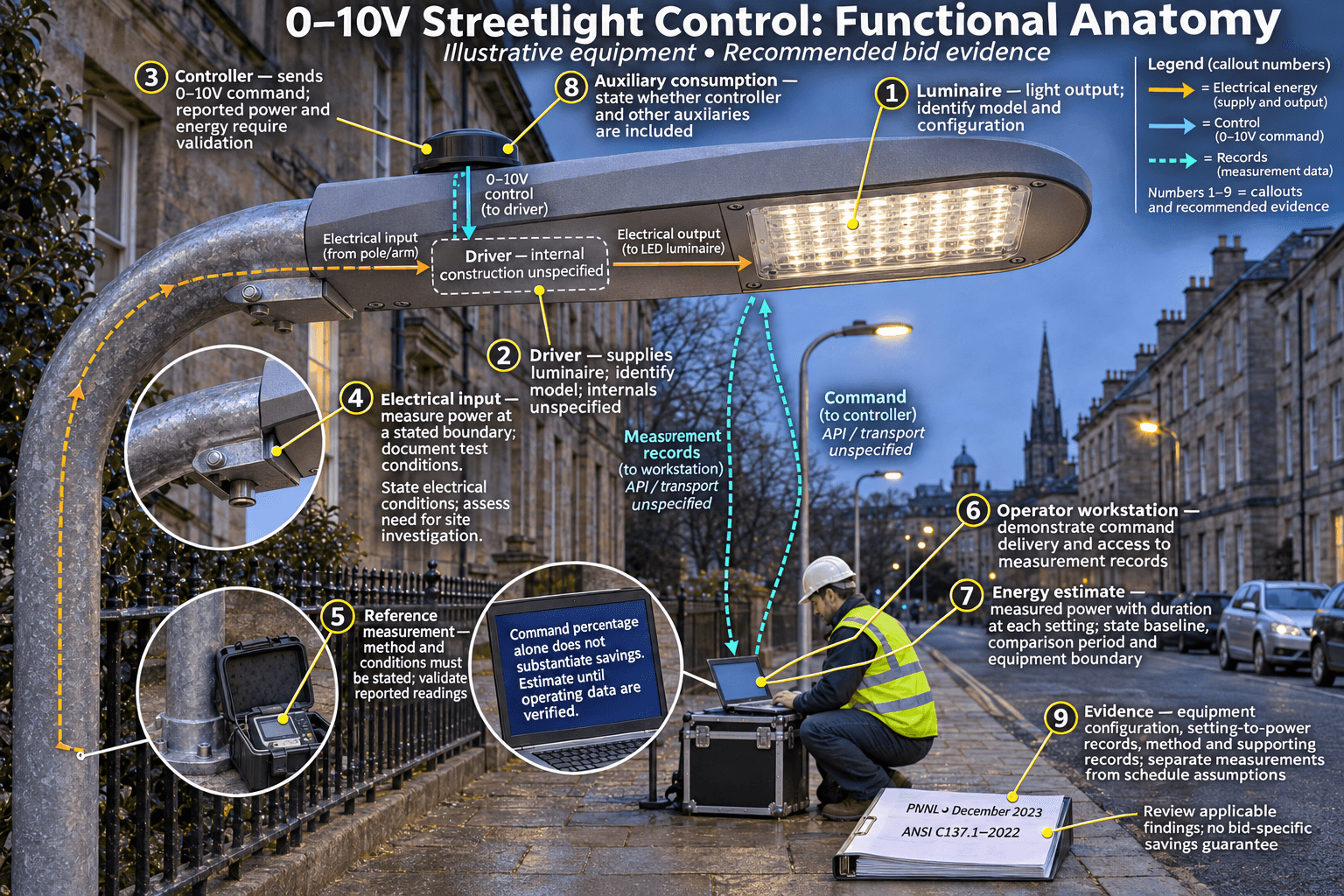
Recommend that each bidder identify the luminaire, driver and controller covered by its evidence. Request a measurement table linking each proposed operating setting to electrical input power, with the test conditions and measurement boundary stated. This gives the buyer a concrete basis for checking whether the evidence applies to the equipment being purchased.
2. Request the inputs behind the energy estimate
As a recommended evaluation method, ask bidders to calculate scheduled energy use from documented power measurements and the time assigned to each operating state. Require the baseline and proposed schedule to use an explicitly stated comparison period and equipment boundary. Label the result as an estimate until the corresponding operating data have been verified.
A useful bid evidence package should identify:
- The equipment models and configuration represented by the measurements.
- The control settings and measured electrical input power used in the estimate.
- The operating duration assigned to each setting.
- The baseline equipment or operating condition used for comparison.
- Whether controller and other auxiliary consumption are included.
- The measurement method, conditions and supporting records.
These are recommended procurement inputs, not requirements attributed to DOE. Ask bidders to expose assumptions separately from measurements so evaluators can revise the schedule or baseline without confusing an assumption with a test result. Do not accept a command percentage alone as substantiation of an energy-saving percentage.
3. Check monitoring accuracy and electrical conditions
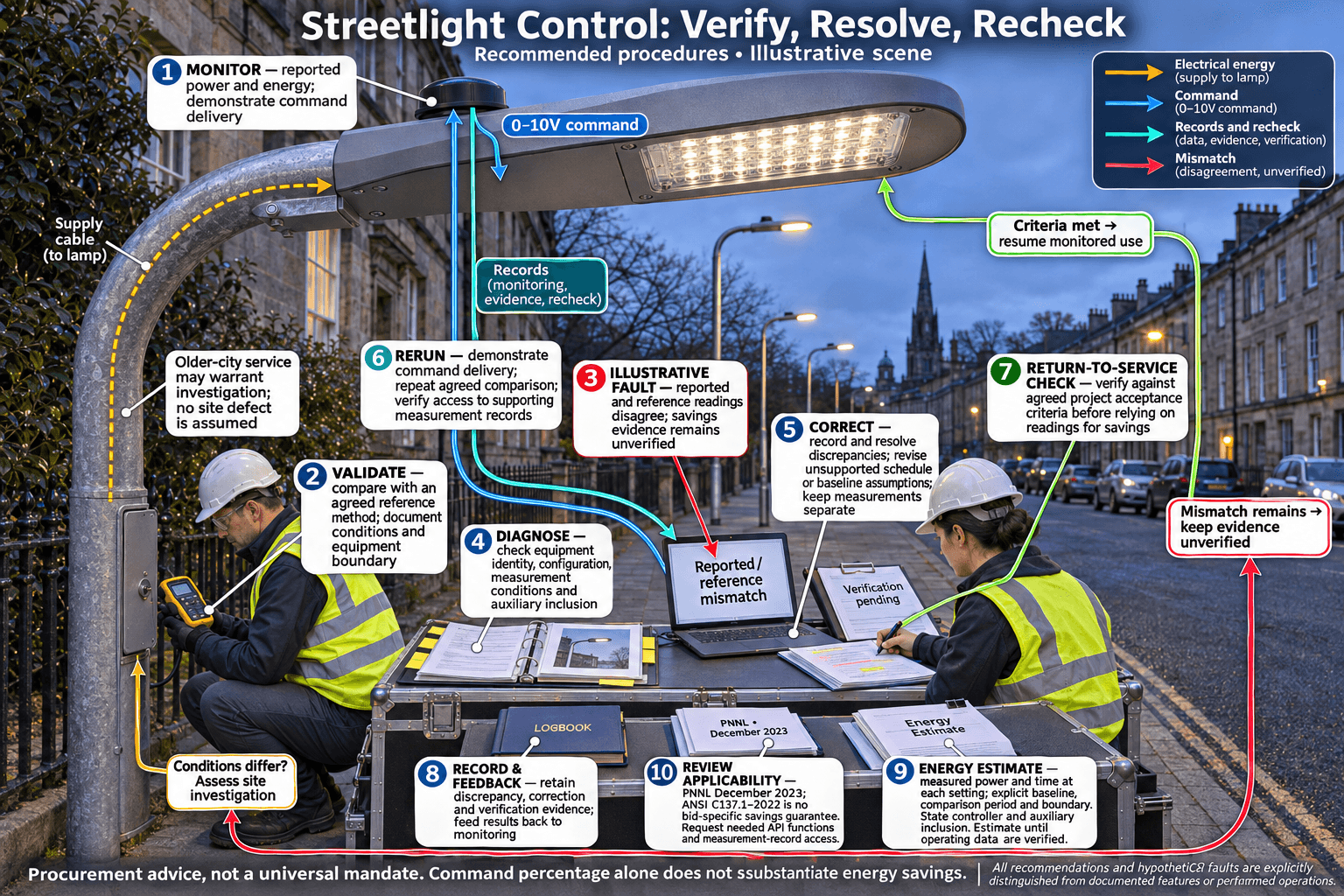
DOE says connected streetlighting offers potential value through monitoring and reporting energy use, particularly in applications where consumption is billed using estimates. It also identifies concerns about measurement accuracy, necessary functionality and maintenance as barriers to adoption. Consequently, the presence of an energy-reporting function should prompt verification of its accuracy for the intended use. DOE, Connected Streetlighting Systems
Recommend asking how the bidder will validate controller-reported power and energy, which reference measurement method will be used, and how discrepancies will be recorded and resolved. Agree on project acceptance criteria before relying on those readings to substantiate savings.
Electrical conditions also deserve attention. DOE notes that inconsistent electrical service in older cities can cause issues for connected lighting devices that are more sensitive to anomalies than unconnected counterparts. This is a contextual concern, not a finding that every installation has deficient power quality. Ask bidders to state the electrical conditions represented by their evidence and recommend checking whether the project requires additional site investigation. DOE, Connected Streetlighting Systems
4. Use standards and integration evidence within their limits
Do not treat a reference to ANSI C137.1–2022 as proof of a particular savings outcome. DOE describes investigating whether that standard might reduce the occurrence or severity of 0–10V control issues; its overview does not provide a bid-specific guarantee. Obtain and review the December 2023 PNNL report, then ask the bidder to identify the relevant findings and explain their applicability to its proposed equipment. DOE, Interoperability
Integration evidence should also be specific. DOE reports that manufacturers began offering APIs to support connected-lighting integration and that PNNL investigated their challenges, limitations and tradeoffs. An API reference should therefore lead to a request for a demonstration of the functions needed for the project. Recommend checking command delivery and access to the measurement records used in the savings assessment. DOE, Interoperability
The resulting procurement decision should rest on applicable measurements, a transparent operating estimate and an agreed verification method. This is a recommended bid-review approach, not a universal purchasing mandate or a product-performance claim.
FAQ
Should a bid equate its dimming command with energy savings?
Recommend requiring electrical measurements and a documented energy estimate. DOE’s overview does not establish a universal relationship between command percentage and savings.
What equipment should the measurement evidence identify?
Request the luminaire, driver and controller models and configuration so evaluators can check applicability to the proposed purchase.
What inputs should support the energy estimate?
Request measured input power, operating duration at each setting, the comparison period, baseline and equipment boundary.
Should auxiliary consumption be included?
Recommend requiring bidders to state whether controller and other auxiliary consumption are included, then use a consistent boundary for comparison.
Are controller-reported energy readings sufficient evidence?
Recommend validating their accuracy before relying on them. DOE identifies measurement accuracy as a concern for connected streetlighting.
Why review site electrical conditions?
DOE identifies inconsistent electrical service in older cities as a potential issue for connected devices. Recommend checking whether that concern applies to the project.
Does ANSI C137.1–2022 establish the bid’s savings?
DOE’s overview does not establish that outcome. Request applicable test evidence and review the findings of the December 2023 PNNL report.
Is this a mandatory international purchasing rule?
No mandate is established here. The proposed measurement and verification approach is procurement advice informed by DOE’s research descriptions.
Procurement paths
About the Author

Cinn Song
Founder & Chief Solutions Architect
Cinn Song founded SOLARTODO LIMITED and leads its smart-city infrastructure engineering — from solar, storage and integrated smart poles to the company's push into physical-AI city edge nodes: pole-mounted edge computing, vertical LLMs for smart cities, drone-based O&M with autonomous battery swapping, robotic maintenance, and high-speed counter-UAS interception. Since 2010, he has directed turnkey EPC + BOT delivery across 50+ countries, including telecom monopole supply for national grid operators, off-grid solar street-lighting for African municipalities, and integrated smart-pole programs for Gulf smart cities.
Cite This Article
Cinn Song. (2026). 0–10V Streetlight Bids: Verify Power and Energy Savings. SOLARTODO. Retrieved from https://solartodo.com/knowledge/should-streetlight-dimming-bids-quantify-the-actual-power-and-energy-effects-of-010v-control-rather-than-treating-the
@article{solartodo_should_streetlight_dimming_bids_quantify_the_actual_power_and_energy_effects_of_010v_control_rather_than_treating_the,
  title = {0–10V Streetlight Bids: Verify Power and Energy Savings},
  author = {Cinn Song},
  journal = {SOLARTODO Knowledge Base},
  year = {2026},
  url = {https://solartodo.com/knowledge/should-streetlight-dimming-bids-quantify-the-actual-power-and-energy-effects-of-010v-control-rather-than-treating-the},
  note = {Accessed: 2026-11-13}
}
Published: November 13, 2026 | Available at: https://solartodo.com/knowledge/should-streetlight-dimming-bids-quantify-the-actual-power-and-energy-effects-of-010v-control-rather-than-treating-the
Subscribe to Our Newsletter
Get the latest solar energy news and insights delivered to your inbox.
View All Articles