Streetlight Energy Reports: Define Luminaire and Circuit…

Cinn Song
Founder & Chief Solutions Architect
TL;DR
Request separate luminaire and circuit reports. Verify equipment coverage using a measurement diagram, check accuracy evidence, and agree comparison conditions before accepting a whole-system total.
Request separate luminaire and circuit energy reports, supported by measurement diagrams, equipment lists and accuracy evidence. Include Ethernet switches and gateways in the circuit boundary where applicable, and verify coverage before accepting a whole-system total. DOE’s research pages inform this approach but do not mandate a universal reporting architecture or acceptance tolerance.
Summary
Request separate luminaire and circuit energy reports, supported by measurement diagrams, equipment lists and accuracy evidence. Include Ethernet switches and gateways in the circuit boundary where applicable, and verify coverage before accepting a whole-system total. DOE’s research pages inform this approach but do not mandate a universal reporting architecture or acceptance tolerance.
Key Takeaways
- Request distinct labels and boundaries for luminaire-reported energy and measured circuit energy.
- Use a measurement diagram and equipment schedule to establish whether switches and gateways are included.
- Verify device-reporting accuracy separately from measurement coverage.
- Request applicable standard editions and test evidence when bidders cite ANSI energy-reporting standards.
- Agree reporting periods, comparison methods and acceptance criteria before testing.
- Investigate discrepancies before attributing them to communication equipment or claiming energy savings.
Streetlight Energy Monitoring: Separate Luminaire Reports from Circuit Totals
Yes—as a procurement recommendation, request separate reporting for luminaire consumption and measured circuit consumption, with explicit boundaries for each. Where Ethernet switches and wireless gateways are within the measured circuit, ask the supplier to identify their inclusion. Accept device self-reports as a whole-system total only after verifying that their coverage matches the defined system boundary.
DOE’s Connected Lighting Systems describes network communication infrastructure alongside circuit-level power and energy metering in the PNNL connected lighting test bed. Its Energy Reporting page explains why the accuracy of device-reported data needs attention. These pages support examining measurement coverage and accuracy; they do not prescribe this reporting arrangement for every streetlighting project. DOE, Connected Lighting Systems; DOE, Energy Reporting.
1. Define the procurement decision before selecting the dashboard
Start with the question the buyer needs the monitoring system to answer. For a lighting-only assessment, request a clearly defined luminaire-consumption report. For an assessment covering lighting and its communication infrastructure, request a circuit report whose documented boundary includes those loads. Treat these as recommended reporting requirements, rather than assuming that a dashboard’s “total energy” label establishes coverage.
DOE describes connected lighting systems as combining distributed intelligence, sensors and modern network interfaces. It also identifies unresolved questions about additional energy savings and whether benefits justify investment. Monitoring capability alone therefore does not establish an investment result. DOE, Connected Lighting Systems.
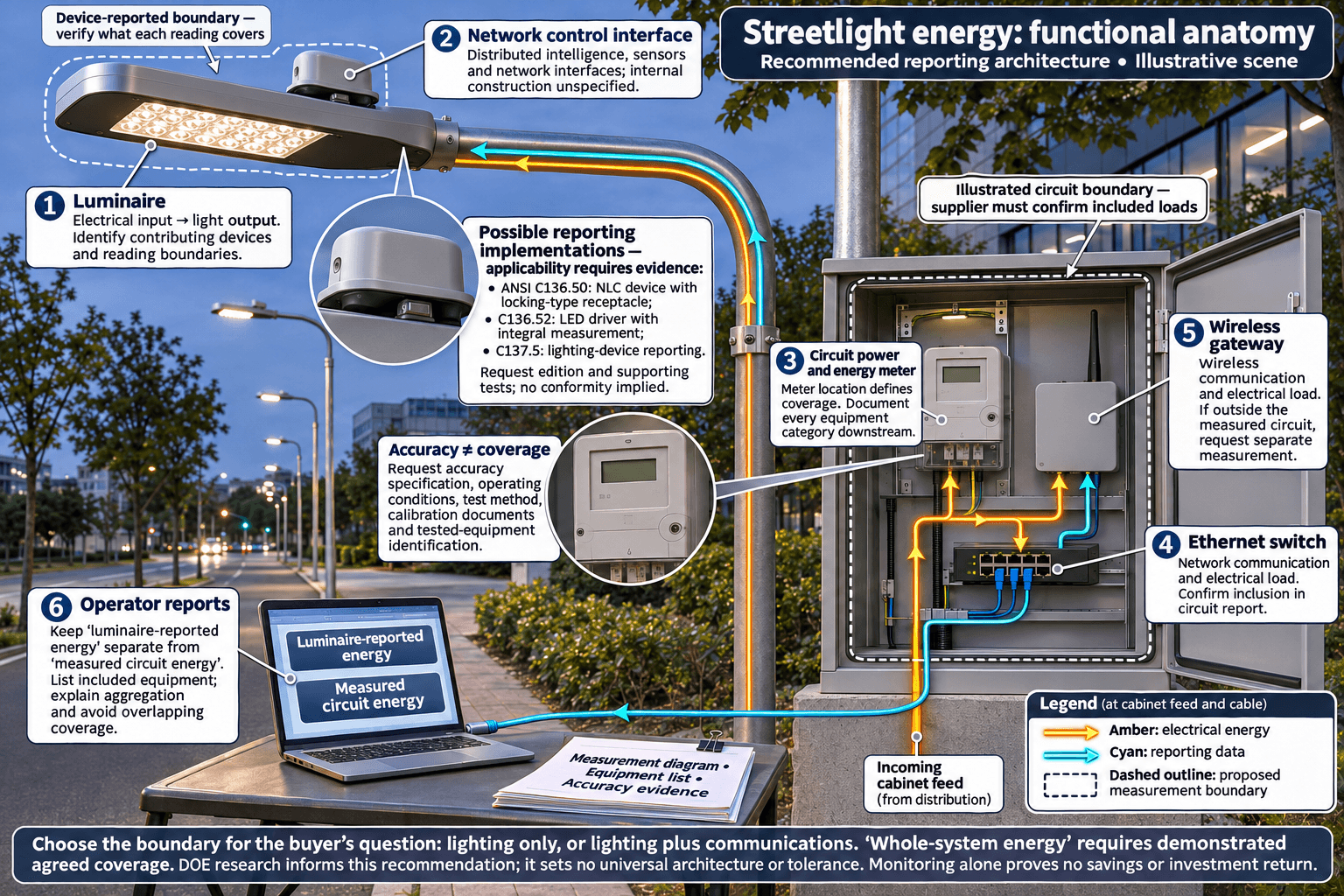
Before comparing offers, ask each bidder for a measurement diagram, a list of included equipment and an explanation of how each displayed total is produced. Recommended labels are “luminaire-reported energy” and “measured circuit energy,” supplemented by the equipment covered. Reserve “whole-system energy” for an explicitly agreed boundary that the supplier can demonstrate.
2. Specify separate measurement boundaries
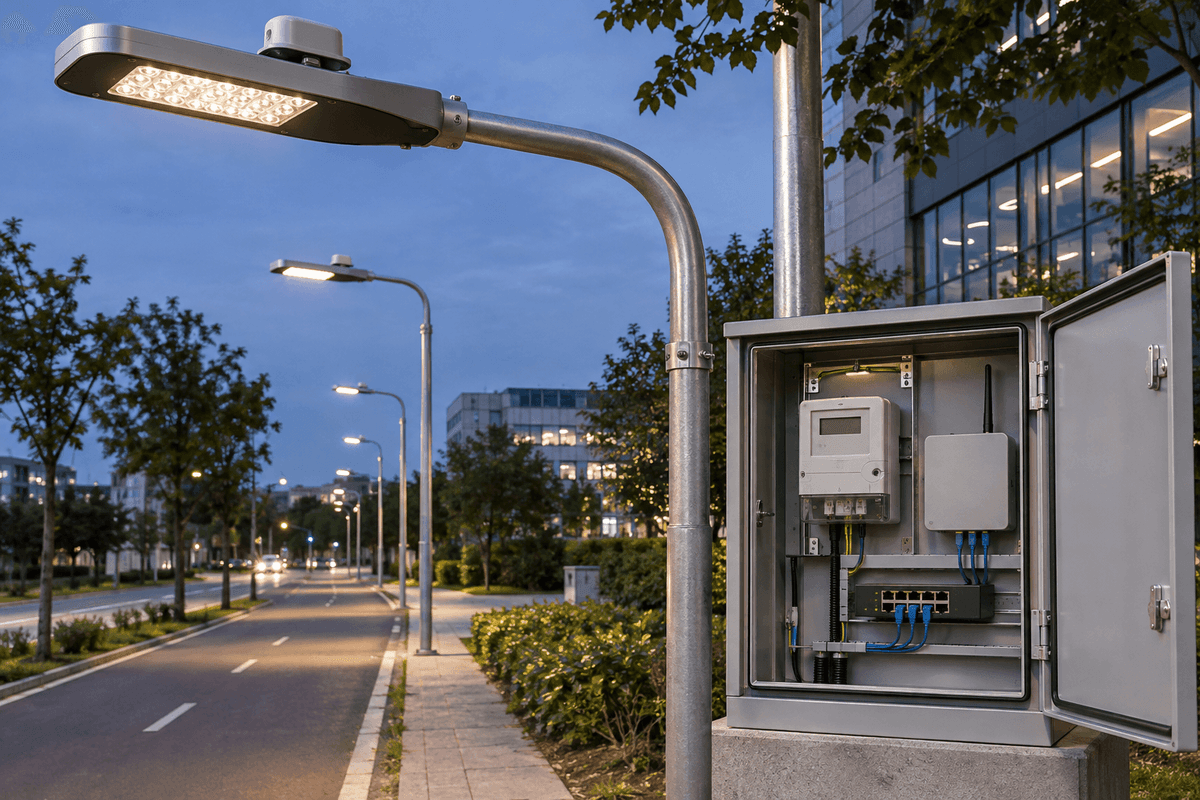
PNNL’s connected lighting test bed includes dedicated streetlighting infrastructure, Ethernet switches, wireless communication gateways, and circuit-level power and energy metering. Its stated focus is electrical performance evaluation rather than emulating real-world lighting environments. This is a useful reference for discussing measurement architecture, but it is not evidence of the consumption of a particular installation. DOE, Connected Lighting Systems.
For procurement, request the following reporting structure:
- Luminaire reporting: identify the devices contributing data and the electrical boundary represented by each reading.
- Circuit reporting: identify the meter location and every equipment category within its measurement boundary.
- Communication equipment: state whether Ethernet switches and wireless gateways fall inside that circuit boundary or require separate reporting.
- Aggregation method: explain which readings are added together and how overlapping coverage is avoided.
Do not assume that a device reporting its own energy measures everything connected elsewhere in the installation. Equally, do not assume that a circuit labelled “streetlighting” includes every communication device. Require the diagram and equipment schedule to resolve both questions.
If communication equipment is outside the measured lighting circuit, request a separate measurement proposal before accepting a combined system total. This is a recommended way to make the reporting boundary reviewable, not a DOE-mandated circuit design.
3. Verify accuracy independently of coverage
Coverage and accuracy should be separate acceptance questions. First ask what each reading represents. Then request evidence showing how accurately it reports that quantity.
DOE’s Energy Reporting states that reporting accuracy is often unspecified or insufficiently specified. It describes PNNL laboratory research characterizing the ability of networked lighting and other electrical devices to report their own energy use. A self-reporting feature should therefore prompt a request for accuracy evidence rather than an assumption of accuracy. DOE, Energy Reporting.
Recommended bidder submissions include the accuracy specification, applicable operating conditions, test method, calibration documentation and identification of the tested equipment. Ask the supplier to explain how that evidence relates to the proposed equipment and measurement boundary.
The DOE page identifies three ANSI standards addressing lighting energy reporting: C136.50 for an NLC device with a locking-type receptacle, C136.52 for LED drivers with integral energy measurement, and C137.5 for lighting-device energy reporting. Request the applicable standard edition and supporting test documentation when a bidder cites one. The DOE overview does not itself demonstrate conformity of any offered product. DOE, Energy Reporting.
4. Make the acceptance method explicit
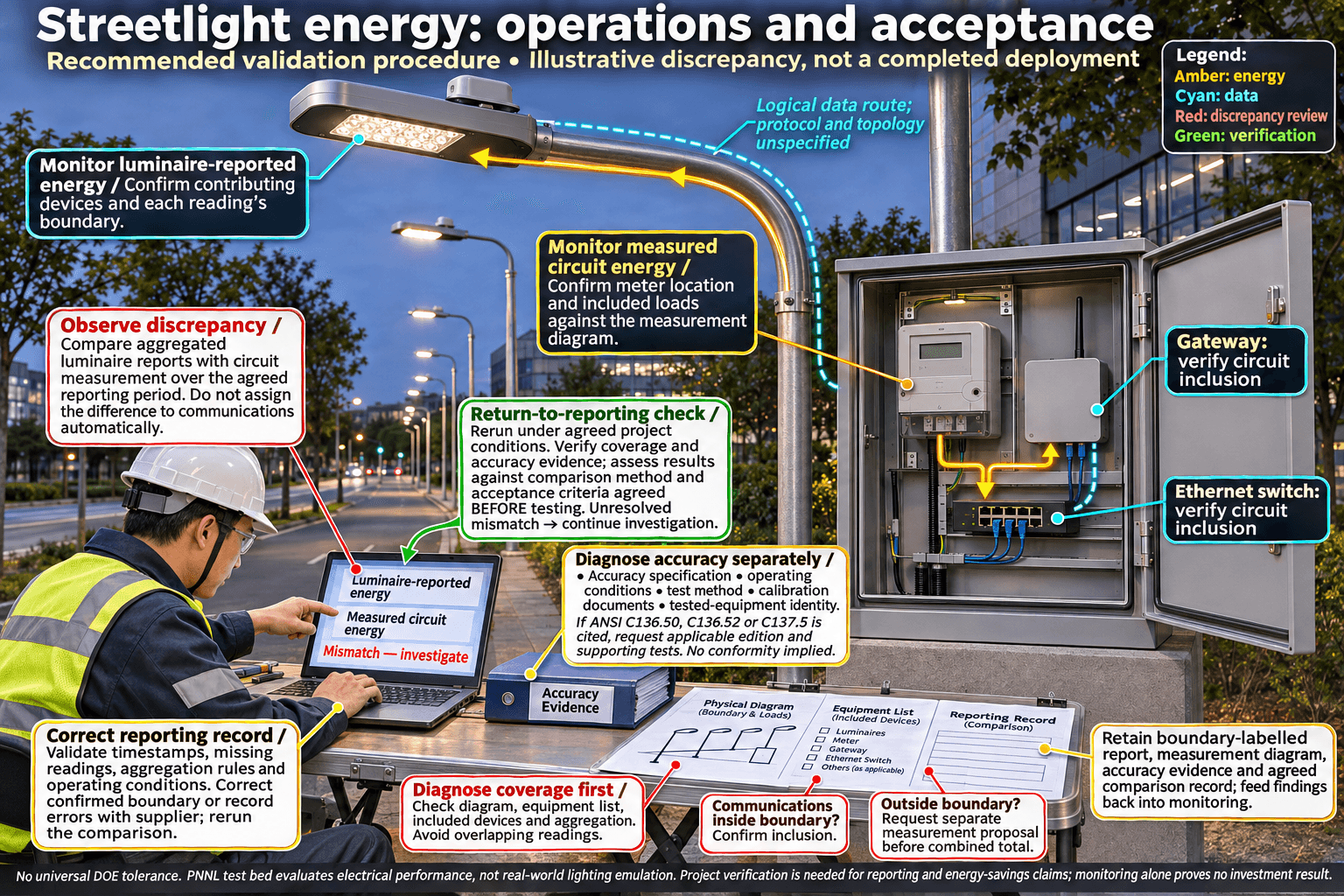
As a recommended acceptance approach, compare circuit measurements and aggregated luminaire reports over an agreed reporting period. Ask the supplier to document timestamps, included devices, missing readings, aggregation rules and equipment operating conditions. Define the comparison method and acceptance criteria before testing; do not derive a universal tolerance from the DOE overview pages.
If the results differ, request an investigation against the measurement diagram and accuracy evidence. Do not automatically classify the difference as switch-and-gateway consumption. Establishing that allocation should require measurements or other project-specific evidence supporting it.
Keep acceptance claims proportionate to the test. DOE explicitly describes the connected lighting test bed as focused on electrical performance rather than real-world lighting emulation. For a proposed streetlighting installation, request verification under the project’s agreed conditions before accepting claims about reporting performance or additional energy savings. DOE, Connected Lighting Systems.
A useful deliverable is therefore a boundary-labelled energy report accompanied by a measurement diagram, accuracy evidence and an agreed comparison record. This gives the buyer a concrete method for deciding whether luminaire data answer the lighting question and whether circuit measurements cover the intended system.
FAQ
Should luminaire consumption and circuit consumption be reported separately?
Yes, as a procurement recommendation. Request separate reports with defined boundaries so each can be assessed against its intended purpose.
Does a luminaire self-report establish whole-system consumption?
Accept it as a whole-system total only after verifying that its measurement coverage matches the agreed system boundary.
Should the circuit report include Ethernet switches and gateways?
If those devices are within the intended system boundary, request confirmation that the circuit measurement includes them, or request separate measurement.
Does DOE require this reporting arrangement?
The two DOE overview pages describe research infrastructure and energy-reporting accuracy work. They do not prescribe this arrangement for every project.
What accuracy evidence should a buyer request?
Request the accuracy specification, operating conditions, test method, calibration documentation and identification of the equipment covered.
Which energy-reporting standards does DOE identify?
DOE identifies ANSI C136.50, C136.52 and C137.5. Ask bidders to identify the applicable edition and provide evidence supporting any conformity claim.
Can the difference between circuit and luminaire readings be assigned to gateways?
Do not assign it automatically. Request an investigation of measurement boundaries, reporting records and accuracy evidence before accepting that allocation.
Do these DOE pages establish project energy savings?
No. Request project-specific verification; DOE’s Connected Lighting Systems overview explicitly discusses unresolved questions about additional savings and investment value.
Procurement paths
About the Author

Cinn Song
Founder & Chief Solutions Architect
Cinn Song founded SOLARTODO LIMITED and leads its smart-city infrastructure engineering — from solar, storage and integrated smart poles to the company's push into physical-AI city edge nodes: pole-mounted edge computing, vertical LLMs for smart cities, drone-based O&M with autonomous battery swapping, robotic maintenance, and high-speed counter-UAS interception. Since 2010, he has directed turnkey EPC + BOT delivery across 50+ countries, including telecom monopole supply for national grid operators, off-grid solar street-lighting for African municipalities, and integrated smart-pole programs for Gulf smart cities.
Cite This Article
Cinn Song. (2026). Streetlight Energy Reports: Define Luminaire and Circuit…. SOLARTODO. Retrieved from https://solartodo.com/knowledge/should-streetlight-energy-monitoring-report-luminaire-consumption-separately-from-circuit-consumption-that-includes
@article{solartodo_should_streetlight_energy_monitoring_report_luminaire_consumption_separately_from_circuit_consumption_that_includes,
  title = {Streetlight Energy Reports: Define Luminaire and Circuit…},
  author = {Cinn Song},
  journal = {SOLARTODO Knowledge Base},
  year = {2026},
  url = {https://solartodo.com/knowledge/should-streetlight-energy-monitoring-report-luminaire-consumption-separately-from-circuit-consumption-that-includes},
  note = {Accessed: 2026-11-08}
}
Published: November 8, 2026 | Available at: https://solartodo.com/knowledge/should-streetlight-energy-monitoring-report-luminaire-consumption-separately-from-circuit-consumption-that-includes
Subscribe to Our Newsletter
Get the latest solar energy news and insights delivered to your inbox.
View All Articles