Aging Battery SOC Limits: Verify the Available-Capacity…

Cinn Song
Founder & Chief Solutions Architect
TL;DR
Yes for SAM dispatch: multiply current available capacity by each SOC limit. Request both capacity inputs and SOC settings, verify the boundaries as the battery ages, and confirm the actual controller’s denominator before acceptance.
In SAM, minimum and maximum dispatch SOC limits use current available battery capacity, which changes with degradation and replacement. Buyers should request nominal and available capacity, SOC limits, and boundary calculations together. Confirm the actual controller’s definitions separately: SAM’s modeling convention does not verify equipment behavior.
Summary
In SAM, minimum and maximum dispatch SOC limits use current available battery capacity, which changes with degradation and replacement. Buyers should request nominal and available capacity, SOC limits, and boundary calculations together. Confirm the actual controller’s definitions separately: SAM’s modeling convention does not verify equipment behavior.
Key Takeaways
- SAM applies minimum and maximum dispatch SOC percentages to current available capacity.
- Unchanged SOC percentages produce a smaller absolute capacity window when available capacity declines.
- Calculate each boundary by multiplying current available capacity by the corresponding SOC fraction.
- The capacity window between SOC limits is not a guaranteed AC energy or runtime figure.
- Request equipment-specific operating limits and evidence of the controller’s SOC denominator.
- Check individual parameters: SAM’s PV smoothing resting SOC uses nameplate capacity.
1. Use current available capacity for SAM dispatch limits

Yes—in the System Advisor Model (SAM), minimum and maximum state-of-charge (SOC) limits are percentages of the battery’s current available capacity, rather than its original nameplate capacity. Both SAM Help: Battery Dispatch—Behind-the-Meter and SAM Help: Battery Dispatch—Front-of-Meter explicitly state that available capacity changes as batteries degrade and are replaced. They also distinguish this available capacity from the nominal capacity entered on the Battery Cell and System page. BTM dispatch documentation; FOM dispatch documentation.
For procurement, the recommended decision is to require an explicit capacity basis in the dispatch specification. A percentage alone does not establish how much stored capacity remains available for operation as the battery ages.
This answer describes SAM’s dispatch convention. The two help pages do not establish how a particular battery management system or energy management system defines its displayed SOC. Before accepting equipment settings, ask the supplier to document the controller’s SOC denominator and demonstrate how its dispatch limits respond to declining available capacity.
2. Calculate the operating window on a consistent basis
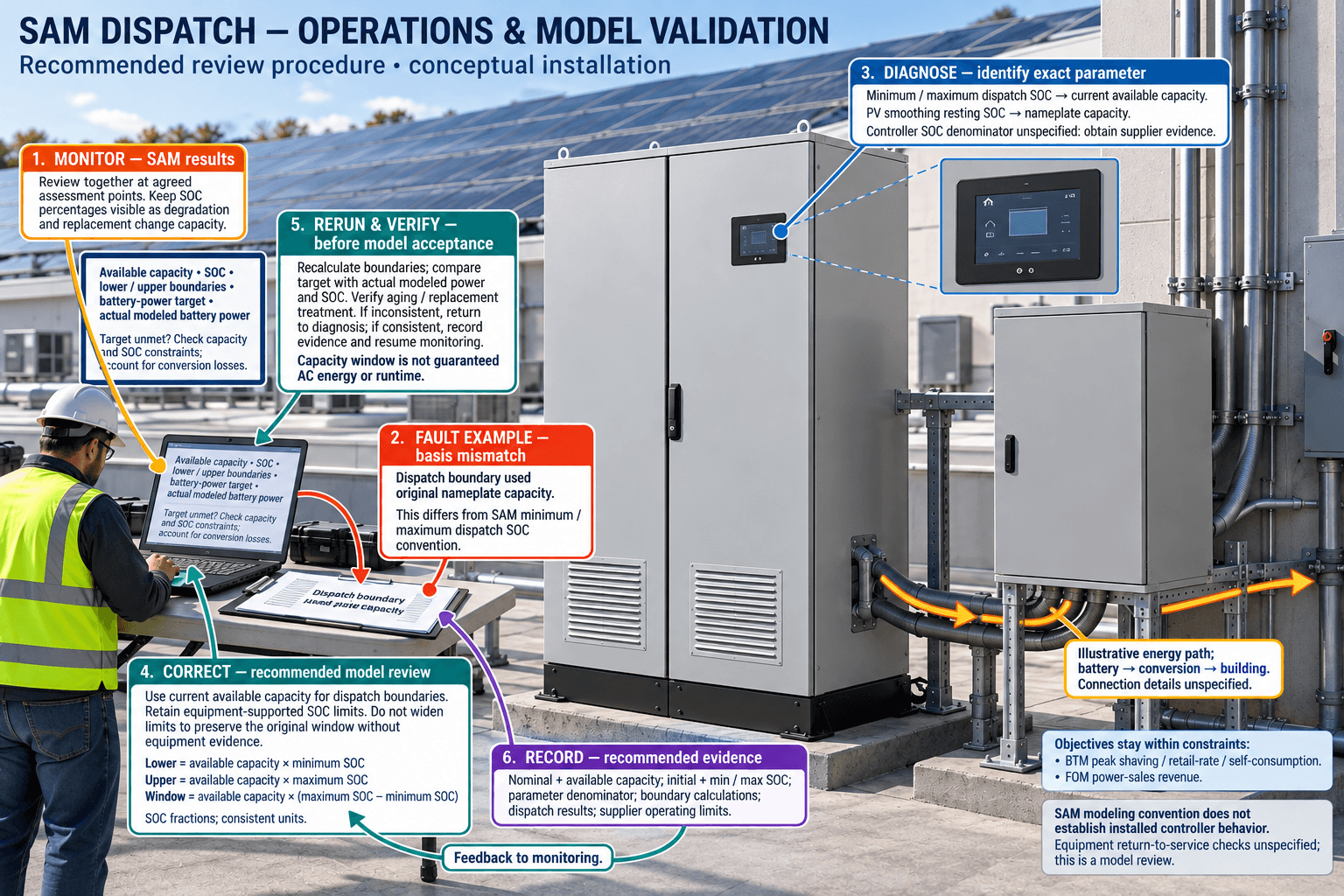
SAM defines minimum SOC as the lower limit on stored capacity and maximum SOC as the upper limit. Both limits use available battery capacity in the relevant simulation time step. Consequently, the corresponding absolute limits change when that available capacity changes. SAM Help: Battery Dispatch—Behind-the-Meter, “Charge Limits and Priority”.
The direct calculation, using consistent capacity units and expressing SOC limits as fractions, is:
- Lower capacity boundary = current available capacity × minimum SOC.
- Upper capacity boundary = current available capacity × maximum SOC.
- Capacity window between limits = current available capacity × (maximum SOC − minimum SOC).
These expressions restate the percentage definitions; they do not calculate delivered AC energy. In particular, the capacity window should not be presented as a guaranteed energy delivery or runtime figure. SAM’s front-of-meter documentation separately explains that dispatch accounts for conversion losses and can fall short of a power target because of capacity and SOC constraints. SAM Help: Battery Dispatch—Front-of-Meter, “Automated Dispatch”.
With unchanged percentage limits, a reduction in available capacity therefore reduces the absolute window between those limits. Continuing to multiply the percentages by original nameplate capacity would describe a different calculation from SAM’s documented method.
For bid comparison, request the original nominal capacity, the available capacity used at each assessment point, and the SOC limits together. Recommend requiring bidders to show their calculations rather than submitting a usable-capacity figure without its denominator.
3. Separate the capacity basis from the choice of limits
Using current available capacity answers what the percentages apply to. It does not determine which percentages are appropriate.
SAM states that minimum and maximum SOC limits affect both the energy available for dispatch and the depth of charge-discharge cycles used in battery-life calculations. Its guidance is to choose values appropriate for the battery type being modeled. The documented default range is a modeling default, not evidence of an approved operating window for a specific purchased system. SAM Help: Battery Dispatch—Behind-the-Meter, “Charge Limits and Priority”.
The recommended procurement approach is therefore to obtain model-specific operating limits separately from the capacity calculation. Ask the supplier to identify the permitted SOC window and explain how the proposed dispatch configuration uses it. Do not change those percentages merely to preserve a beginning-of-life capacity window without obtaining the applicable equipment evidence.
Also distinguish SOC constraints from dispatch objectives. SAM’s behind-the-meter options include peak shaving, retail-rate dispatch and self-consumption. Its front-of-meter automated dispatch attempts to maximize power-sales revenue within battery constraints. Selecting an objective does not remove the capacity or SOC limitations. BTM dispatch documentation; FOM dispatch documentation.
4. Specify a verification method before accepting the model
A useful purchase specification should make the capacity basis reviewable. Recommend requesting the following evidence:
- Definitions: Identify original nominal capacity, current available capacity, initial SOC, and minimum and maximum SOC as separate inputs or reported values.
- Aging treatment: Show how the model updates available capacity for degradation and replacement, while keeping the percentage settings visible.
- Boundary calculations: Report the absolute lower and upper capacity boundaries at the agreed assessment points.
- Dispatch results: Compare requested battery power with actual modeled battery power, alongside SOC, to identify intervals when targets are unmet.
These recommendations follow SAM’s distinction between nominal capacity, available capacity, SOC constraints and dispatch targets. The front-of-meter help specifically recommends comparing the automated battery-power target with actual power to and from the battery when reviewing dispatch results. SAM Help: Battery Dispatch—Front-of-Meter, “Automated Dispatch”.
Finally, identify the exact control parameter under review. The same front-of-meter help describes PV smoothing resting SOC as a percentage of nameplate capacity. That parameter has a different documented basis from the minimum and maximum dispatch SOC limits. Require the supplier to name the parameter and its denominator in the settings schedule; do not assume that every percentage labeled SOC uses the same reference. SAM Help: Battery Dispatch—Front-of-Meter, “PV Smoothing”.
FAQ
Should aging change the capacity basis for minimum and maximum SOC?
In SAM, these limits already use current available capacity, which changes with degradation and replacement. They are not fixed percentages of original nameplate capacity.
How is the capacity window between SOC limits calculated?
Multiply current available capacity by the difference between maximum and minimum SOC, expressed as fractions and using consistent capacity units.
Does a constant SOC window preserve the original usable capacity?
No. With unchanged percentage limits, declining available capacity reduces the absolute capacity window.
Should buyers automatically widen the SOC limits as capacity declines?
No automatic adjustment is established by the SAM help pages. Request model-specific operating limits before proposing a wider window.
Does the calculated capacity window equal delivered AC energy?
It does not establish AC delivery. SAM separately accounts for conversion losses and operating constraints when calculating dispatch.
Does SAM establish how an installed controller calculates SOC?
No. Ask the equipment supplier to document the controller’s SOC reference and demonstrate its treatment of changing available capacity.
Which simulation outputs should buyers review?
Recommend reviewing available capacity, SOC, boundary calculations, battery-power targets and actual modeled battery power together.
Do all SOC settings in SAM use available capacity?
No. The front-of-meter help defines PV smoothing resting SOC against nameplate capacity, unlike minimum and maximum dispatch SOC limits.
Procurement paths
About the Author

Cinn Song
Founder & Chief Solutions Architect
Cinn Song founded SOLARTODO LIMITED and leads its smart-city infrastructure engineering — from solar, storage and integrated smart poles to the company's push into physical-AI city edge nodes: pole-mounted edge computing, vertical LLMs for smart cities, drone-based O&M with autonomous battery swapping, robotic maintenance, and high-speed counter-UAS interception. Since 2010, he has directed turnkey EPC + BOT delivery across 50+ countries, including telecom monopole supply for national grid operators, off-grid solar street-lighting for African municipalities, and integrated smart-pole programs for Gulf smart cities.
Cite This Article
Cinn Song. (2026). Aging Battery SOC Limits: Verify the Available-Capacity…. SOLARTODO. Retrieved from https://solartodo.com/knowledge/should-the-batterys-minimum-and-maximum-state-of-charge-limits-be-calculated-from-current-available-capacity-rather
@article{solartodo_should_the_batterys_minimum_and_maximum_state_of_charge_limits_be_calculated_from_current_available_capacity_rather,
  title = {Aging Battery SOC Limits: Verify the Available-Capacity…},
  author = {Cinn Song},
  journal = {SOLARTODO Knowledge Base},
  year = {2026},
  url = {https://solartodo.com/knowledge/should-the-batterys-minimum-and-maximum-state-of-charge-limits-be-calculated-from-current-available-capacity-rather},
  note = {Accessed: 2026-10-30}
}
Published: October 30, 2026 | Available at: https://solartodo.com/knowledge/should-the-batterys-minimum-and-maximum-state-of-charge-limits-be-calculated-from-current-available-capacity-rather
Subscribe to Our Newsletter
Get the latest solar energy news and insights delivered to your inbox.
View All Articles