Smart Streetlight Predictive Maintenance: IoT Fault…

Cinn Song
Founder & Chief Solutions Architect
Watch the video
TL;DR
Smart streetlight predictive maintenance uses IoT telemetry to detect faults before outages happen. For 250+ pole networks, it can target 10-20% higher availability, 5-10% lower maintenance cost, and fewer truck rolls by monitoring LED drivers, power quality, cabinets, cameras, sensors, and communications in one asset platform.
Smart streetlight predictive maintenance uses IoT fault detection, 80W LED telemetry, IP66 sensors, and 10-20% uptime gains to reduce truck rolls, outages, and lifecycle cost across smart pole networks.
Summary
Smart streetlight predictive maintenance uses IoT fault detection, 80W LED telemetry, IP66 sensors, and 10-20% uptime gains to reduce truck rolls, outages, and lifecycle cost across campus, park, and municipal smart pole networks.
Key Takeaways
IoT fault detection can cut maintenance planning time by 20-50% and improve smart streetlight availability by 10-20% when telemetry is tied to work orders.
- Deploy pole-level metering at 1-minute to 15-minute intervals to identify LED driver faults, abnormal power draw, and communication loss before public outages occur.
- Monitor 80W LED luminaires, 4K cameras, Wi-Fi 6 access points, and Env-Sensor-Pro modules as separate assets so crews replace only failed components.
- Set alert thresholds for voltage, current, cabinet temperature, leakage, tilt, door-open events, and network latency to reduce false dispatches by 20% or more.
- Integrate fault alarms with a CMMS within 24 hours so procurement teams can stage drivers, surge protection devices, SIM cards, and sensor cartridges before site visits.
- Specify IEC 60598-1:2024, IEC 62722-2-1:2023, IP66 protection, and ASTM A123 galvanization to align maintenance data with verifiable product quality.
- Compare FOB Supply, CIF Delivered, and EPC Turnkey pricing for 50, 100, and 250+ pole projects to capture 5%, 10%, and 15% volume discounts.
- Use predictive analytics to target 5-10% maintenance cost reduction and 15% less downtime versus reactive programs, based on NIST and Deloitte benchmarks.
- Pilot 20-50 smart poles for 90 days before citywide rollout to validate fault codes, wireless coverage, spare-parts demand, and dashboard escalation rules.
Smart Streetlight Predictive Maintenance for B2B Infrastructure
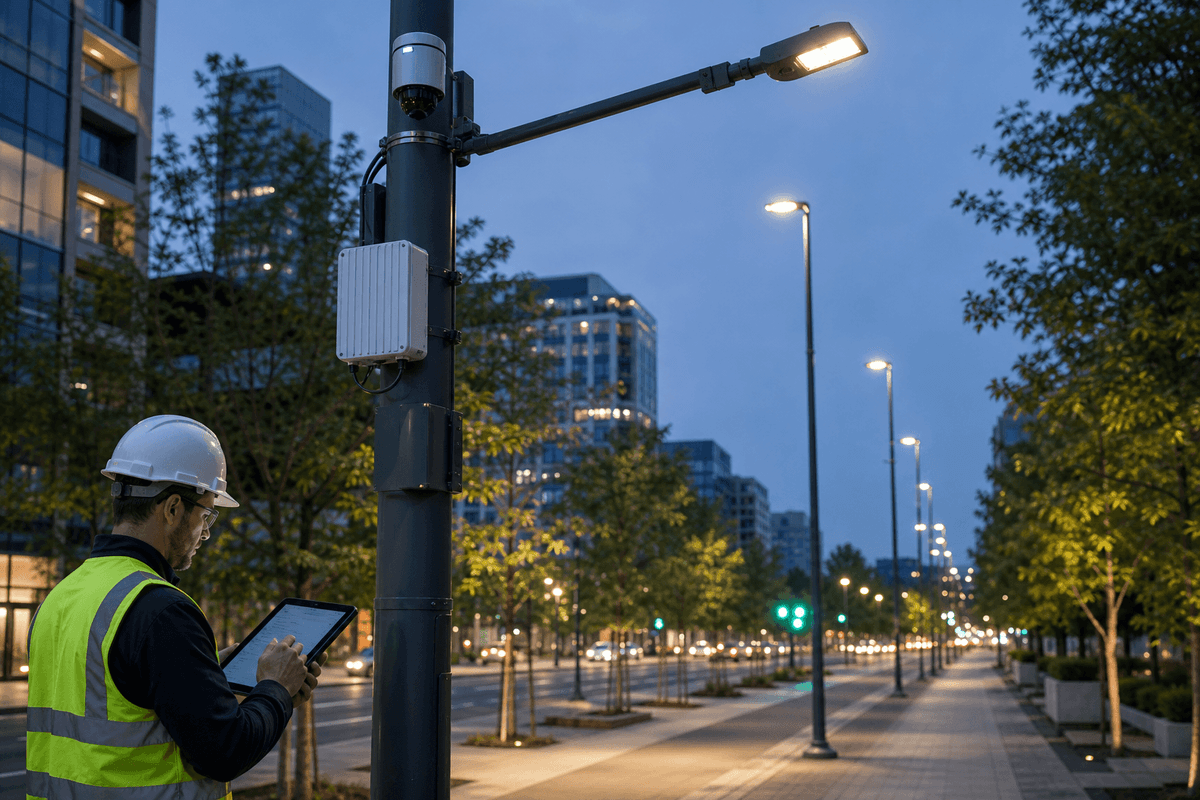
Smart streetlight predictive maintenance detects faults across 80W LED luminaires, 4K cameras, Wi-Fi 6 radios, and environmental sensors before failures become visible outages.
For procurement managers and city engineers, the maintenance problem is not simply lamp replacement. Modern smart streetlights combine lighting, surveillance, connectivity, environmental monitoring, USB charging, and edge controllers in one 8-meter asset. A single truck roll may involve electrical, network, civil, and security technicians unless the fault is identified remotely.
SOLARTODO positions predictive maintenance as an operational layer over the smart pole, not as a decorative dashboard. Each pole should report module health, energy use, cabinet temperature, signal strength, firmware status, and alarm history. The result is a service model where teams dispatch for a known failed driver, tripped breaker, camera communication fault, or sensor drift issue instead of inspecting every pole manually.
According to NIST (2020), establishments that relied mainly on predictive maintenance saw 15% less downtime and 87% lower defect rates than comparable reactive environments. Deloitte (2017) reports that predictive maintenance can reduce planning time by 20-50%, increase uptime by 10-20%, and reduce maintenance cost by 5-10%. For streetlight operators, those percentages translate into fewer nighttime inspections, fewer repeat visits, and better service-level reporting.
The International Energy Agency states, "Compared to incandescent, LED lamps offer 80-90% energy savings." The same logic applies to controls: the U.S. Department of Energy states, "Equipping exterior luminaires with advanced controls can save even more energy." Predictive maintenance extends that control layer from energy optimization into asset reliability.
Technical Deep Dive: IoT Fault Detection Architecture
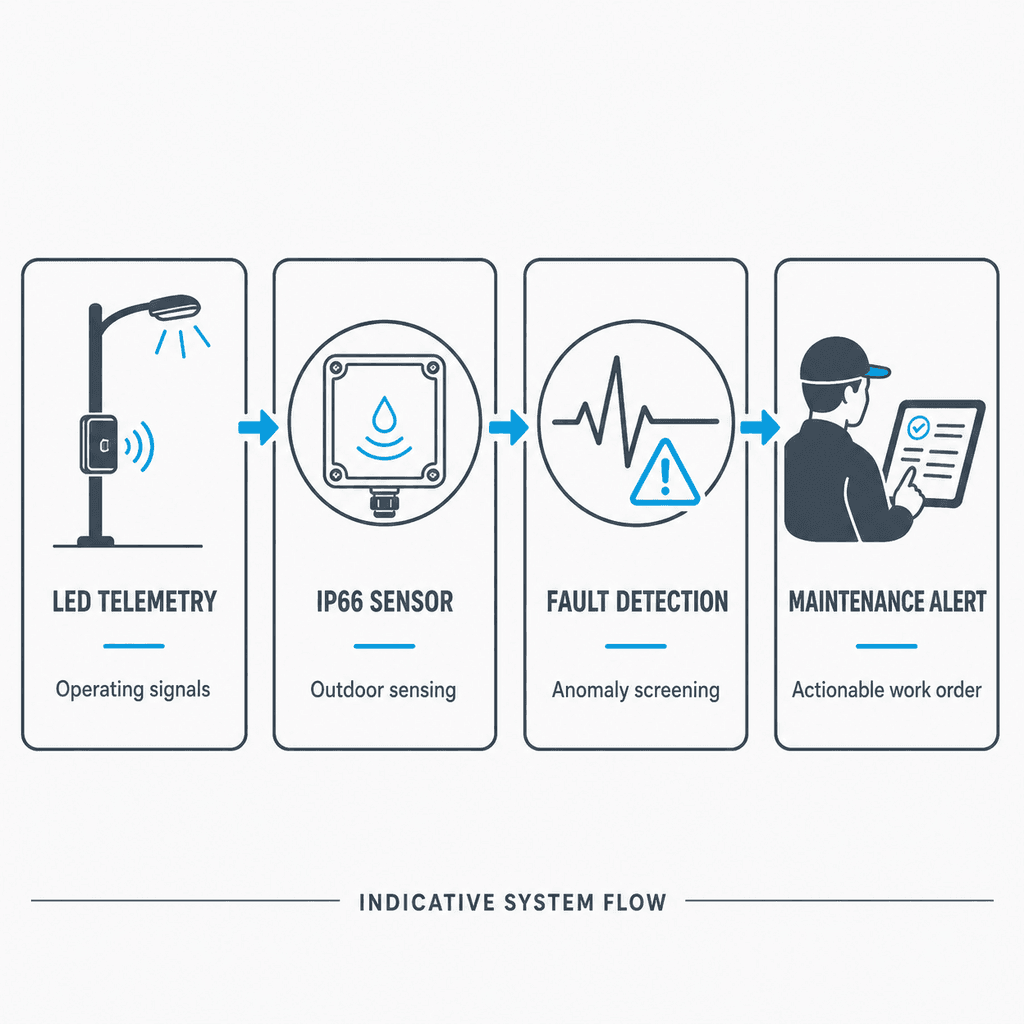
A reliable IoT fault detection system combines 7-12 sensor streams, edge rules, encrypted backhaul, and asset-level fault codes for each smart pole.
The SOLARTODO 8m Campus/Park Environmental Smart Streetlight is a useful reference architecture because it consolidates five modules: LED lighting, 4K AI surveillance, environmental sensing, public Wi-Fi, and USB charging. Predictive maintenance should treat each module as a separate maintainable unit while preserving pole-level context.
Core telemetry usually includes:
- Electrical: input voltage, current, power factor, energy consumption, leakage current, breaker state, surge protection status.
- Lighting: LED driver temperature, dimming level, lumen maintenance estimate, abnormal flicker, photocell status.
- Connectivity: 4G/5G signal, LoRaWAN link quality, Wi-Fi access point uptime, packet loss, gateway heartbeat.
- Mechanical and cabinet: pole tilt, door-open switch, vibration events, cabinet humidity, internal temperature.
- Environmental module: PM2.5, PM10, O3, NO2, noise, temperature, and humidity sensor drift or calibration status.
Edge Rules and Cloud Analytics
Edge fault rules should classify high-risk events within 1-5 seconds while cloud analytics handles 30-day trends, fleet benchmarking, and failure prediction.
A smart controller can detect hard faults locally: power loss, cabinet intrusion, overtemperature, missing camera heartbeat, or LED driver failure. This matters because network outages can mask equipment problems. Local buffering and retry logic preserve event data until 4G/5G or LoRaWAN backhaul returns.
Cloud analytics adds longer-term value. If 18 poles on one feeder show rising voltage variance, the issue may be upstream distribution quality rather than luminaire failure. If a batch of LED drivers shows higher temperature under the same dimming profile, procurement can quarantine spare parts and review supplier quality before a wider failure pattern emerges.
NIST states that IoT devices may affect cybersecurity and privacy risks differently than conventional IT devices. For B2B streetlight projects, fault detection must therefore include cybersecurity telemetry: certificate expiry, failed authentication attempts, unexpected firmware versions, open service ports, and anomalous outbound traffic.
Applications, Operations, and ROI Use Cases
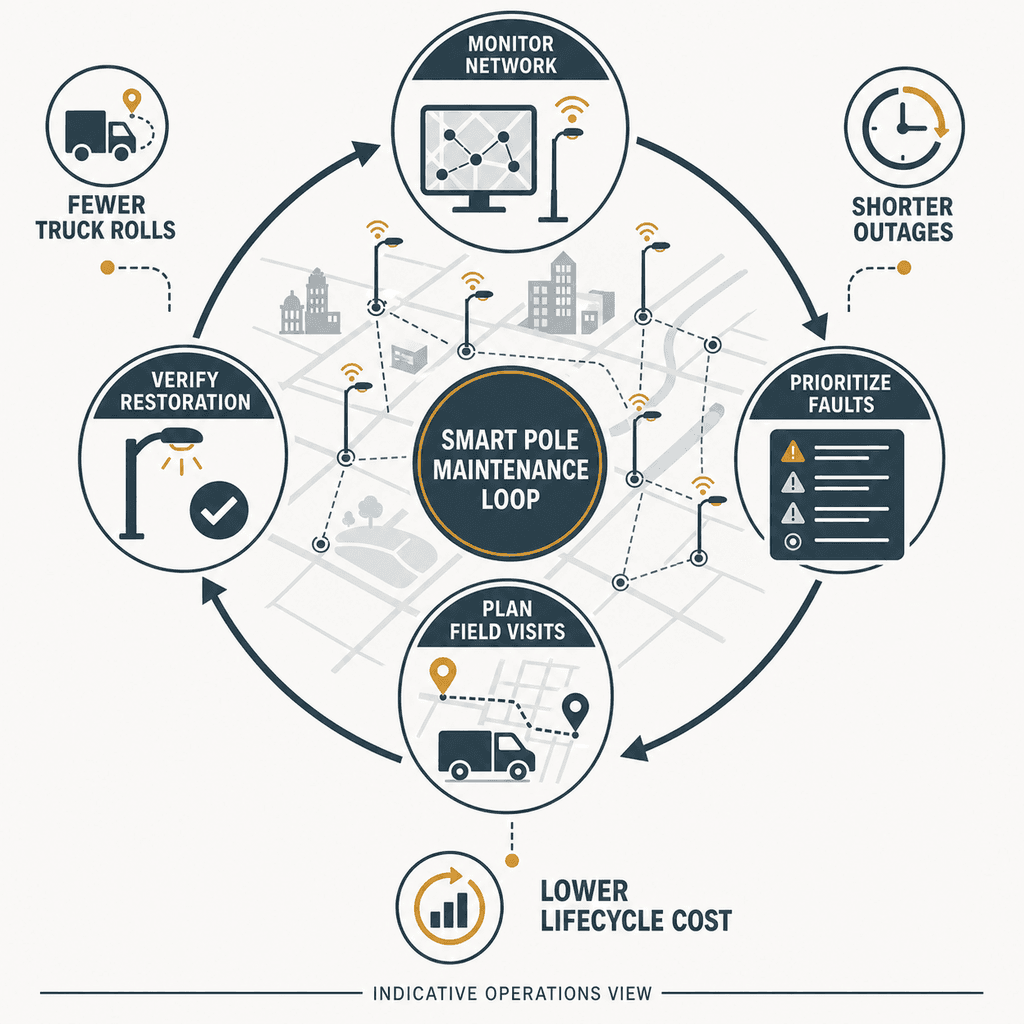
Campus and municipal operators can prioritize 90-day pilots, 500-user Wi-Fi zones, and 25-year pole assets to prove maintenance ROI before scaling.
Predictive maintenance creates the strongest value where assets are distributed, service labor is expensive, and public safety expectations are high. University campuses use it to keep pathways illuminated and cameras online. Corporate parks use it to reduce security blind spots. Municipal park departments use it to identify vandalism, water ingress, or sensor fouling without sending crews across every site.
For an EPC or municipal operator managing 250 smart poles, even one avoided repeat visit per pole per year can materially improve operations. If each manual inspection or emergency dispatch costs $80-150 in labor, vehicle, and administration, reducing 250 unnecessary visits can save $20,000-37,500 annually. When combined with LED dimming, energy metering, and remote resets, the payback case becomes clearer.
According to the U.S. Department of Energy (2024), LED roadway lighting and adaptive controls can reduce light at night by 80-90% while preserving intended function when properly designed. According to IRENA (2025), utility-scale solar PV reached a global weighted average LCOE of USD 0.043/kWh in 2024, supporting solar-powered smart poles and hybrid energy systems where grid access is weak.
SOLARTODO projects in Latin America, the Middle East, Africa, Southeast Asia, and Europe often combine technical supply with offline quotation and project financing. For these markets, predictive maintenance is especially relevant because imported spare parts, customs lead times, and remote sites make unplanned failures more expensive than planned replacements.
EPC Investment Analysis and Pricing Structure
EPC turnkey smart streetlight delivery should compare FOB, CIF, and full installation pricing for 50+ poles, 100+ poles, and 250+ poles.
EPC means Engineering, Procurement, and Construction. For a smart streetlight predictive maintenance project, EPC delivery includes site survey, lighting design, pole foundation design, load calculation, bill of materials, factory configuration, shipment, installation supervision, commissioning, training, dashboard setup, and warranty handover.
SOLARTODO is not an online marketplace. The commercial process is inquiry, technical clarification, offline quotation, and optional project financing. Large infrastructure buyers should request a pole schedule, module configuration, drawings, communication architecture, warranty terms, and spare-parts list before comparing price.
| Pricing tier | Best for | Included scope | Buyer responsibility |
|---|---|---|---|
| FOB Supply | 50+ poles | Factory supply, packing, export documents, baseline configuration | Freight, import, installation, local permits |
| CIF Delivered | 100+ poles | FOB scope plus ocean freight and insurance to destination port | Customs clearance, inland logistics, civil works |
| EPC Turnkey | 250+ poles | Engineering, procurement, installation support, commissioning, CMS setup, training | Site access, authority approvals, payment milestones |
Volume guidance is straightforward: 50+ units may qualify for a 5% discount, 100+ units for 10%, and 250+ units for 15%, subject to final configuration and freight market conditions. Payment terms are typically 30% T/T deposit plus 70% against bill of lading, or 100% L/C at sight for approved buyers. Financing is available for large projects above $1,000K after credit and project review.
ROI should be calculated against conventional lighting plus separate CCTV, Wi-Fi, environmental sensing, and manual inspection programs. A predictive maintenance-enabled smart pole can reduce duplicated civil works, improve maintenance planning by 20-50%, and reduce emergency site visits. For quotations, contact [email protected] or +6585559114 with pole quantity, country, installation environment, and required modules.
Comparison and Selection Guide
A practical selection guide compares reactive, preventive, and predictive maintenance across 5 criteria: cost, downtime, data quality, crew efficiency, and scalability.
| Maintenance model | Trigger | Typical data required | Operational impact | Best-fit scenario |
|---|---|---|---|---|
| Reactive maintenance | Public complaint or visible outage | None or manual inspection | Highest downtime and emergency labor | Small legacy networks under 50 poles |
| Preventive maintenance | Calendar schedule every 6-12 months | Asset register and inspection checklist | Predictable but may replace healthy parts | Stable networks with low module diversity |
| Condition-based maintenance | Threshold alarm from sensor data | Voltage, current, temperature, link status | Better targeting but limited prediction | 50-250 smart poles with basic CMS |
| Predictive maintenance | Trend model and fault probability | 30-180 days of telemetry and work-order history | Lower downtime, better spare planning | 250+ multi-module smart pole fleets |
Selection should start with asset criticality. A pathway light near a campus entrance, a camera pole covering a parking lot, and an environmental sensor pole near a school do not carry the same risk. Fault rules should assign severity by location, module, public safety role, and availability target.
Technical buyers should require open interfaces. ONVIF support helps video systems integrate with existing VMS platforms. REST APIs allow fault codes and work orders to synchronize with CMMS platforms. IEEE 802.15.4-based low-rate wireless networks, LoRaWAN gateways, and cellular backhaul can be selected according to pole density, available power, and public network coverage.
Standards also matter. IEC 60598-1:2024 covers general safety requirements for luminaires up to 1,000V. IEC 62722-2-1:2023 covers LED luminaire performance requirements and test conditions. ASTM A123/A123M supports hot-dip galvanized pole durability, while ISO 55000:2024 provides asset management vocabulary and principles for lifecycle governance.
FAQ
Smart streetlight predictive maintenance projects usually need 10 core answers covering fault detection, cost, installation, cybersecurity, warranties, and EPC delivery.
Q: What is smart streetlight predictive maintenance? A: Smart streetlight predictive maintenance uses IoT telemetry to detect likely failures before a pole goes dark or a module stops working. It analyzes voltage, current, temperature, communication status, door events, and operating trends. For 250+ pole networks, it helps crews plan targeted repairs instead of sending teams for broad manual inspections.
Q: How does IoT fault detection work in a smart streetlight? A: IoT fault detection works by collecting pole-level and module-level data every few seconds or minutes. Edge rules flag urgent problems such as power loss, cabinet intrusion, or overtemperature. Cloud analytics then compares 30-180 days of trends to predict LED driver degradation, sensor drift, network instability, or abnormal energy consumption.
Q: What faults can SOLARTODO smart streetlights detect remotely? A: SOLARTODO smart streetlights can be configured to detect LED driver faults, abnormal power draw, breaker trips, communication loss, cabinet door opening, high temperature, humidity risk, camera heartbeat loss, and environmental sensor drift. For integrated poles, each module is tracked separately so maintenance teams know whether to bring a driver, sensor cartridge, SIM card, or camera component.
Q: How much can predictive maintenance reduce operating cost? A: Predictive maintenance commonly targets 5-10% maintenance cost reduction and 10-20% better asset availability, based on Deloitte benchmarks for connected asset programs. Actual savings depend on labor cost, pole quantity, spare-parts lead time, and baseline failure rate. The business case is strongest for 250+ poles across multiple sites.
Q: Is predictive maintenance better than preventive maintenance? A: Predictive maintenance is better when the network has enough telemetry and failure history to guide decisions. Preventive maintenance still works for simple assets with predictable aging, but it can replace healthy parts too early. Predictive maintenance uses 30-180 days of operating data to schedule the right repair at the right time.
Q: What data should procurement teams request before buying? A: Procurement teams should request the fault code list, telemetry fields, dashboard screenshots, API documentation, cybersecurity controls, warranty terms, and spare-parts recommendations. They should also ask whether the system separates 80W LED luminaire, 4K camera, Wi-Fi 6 access point, environmental sensor, and controller alarms. This prevents vague platform claims during tender comparison.
Q: How is cybersecurity handled for IoT streetlight networks? A: Cybersecurity should include encrypted communication, unique device credentials, firmware signing, role-based access, audit logs, certificate management, and vulnerability support. NIST IoT guidance emphasizes lifecycle risk management for connected devices. For public infrastructure, buyers should also require network segmentation between lighting control, camera traffic, public Wi-Fi, and city IT systems.
Q: What does EPC turnkey delivery include for smart streetlights? A: EPC turnkey delivery includes engineering design, procurement, pole supply, logistics, foundation guidance, installation support, commissioning, CMS setup, training, documentation, and warranty handover. SOLARTODO can quote FOB Supply, CIF Delivered, or EPC Turnkey depending on buyer responsibility. Large projects above $1,000K may qualify for financing review.
Q: What warranty and maintenance terms should buyers evaluate? A: Buyers should evaluate LED luminaire warranty, pole corrosion protection, controller warranty, camera warranty, sensor calibration policy, and spare-parts availability. A 25-year galvanized pole life is useful only if replaceable electronic modules remain supportable. Ask for annual inspection requirements and a recommended 2-5% spare-parts allocation for critical modules.
Q: How long does installation and commissioning take? A: Installation timing depends on civil works, pole quantity, import clearance, and network readiness. A 20-50 pole pilot can often be commissioned faster than a citywide deployment because dashboards and fault rules are validated first. For 250+ poles, procurement teams should plan phased installation, acceptance testing, and operator training before final handover.
Q: Which standards are relevant for smart streetlight reliability? A: Relevant standards include IEC 60598-1:2024 for luminaire safety, IEC 62722-2-1:2023 for LED luminaire performance, ASTM A123/A123M for hot-dip galvanizing, IEEE 802.15.4 for low-rate wireless networks, and ISO 55000:2024 for asset management. Buyers should map tender requirements to these standards instead of relying only on catalog claims.
Q: How should a pilot project be sized? A: A practical pilot includes 20-50 poles across different site conditions such as entrances, pathways, parking zones, and remote corners. Run it for 90 days to validate communication coverage, alert thresholds, dashboard workflows, and spare-part assumptions. The pilot should produce measurable results before scaling to 250+ units.
Conclusion
Smart streetlight predictive maintenance combines 30-180 days of telemetry, standards-based hardware, and CMMS-linked alerts to reduce downtime and improve service planning.
The bottom line: for campus, park, and municipal networks above 250 poles, SOLARTODO smart streetlight predictive maintenance can target 10-20% higher availability, 5-10% lower maintenance cost, and faster EPC rollout when fault detection is specified from day one.
References
- IEC 60598-1 (2024): Luminaires - Part 1: General requirements and tests for luminaire safety up to 1,000V: https://webstore.iec.ch/en/publication/66620 — https://webstore.iec.ch/
- IEC 62722-2-1 (2023): Luminaire performance - Part 2-1: Particular requirements for LED luminaires and test conditions: https://webstore.iec.ch/en/publication/66361 — https://webstore.iec.ch/
- IEEE 802.15.4 (2015): Standard family for low-rate wireless networks used in low-power IoT and monitoring applications: https://standards.ieee.org/ieee/802.15.4/5788/ — https://standards.ieee.org/ieee/1547/7382/
- IRENA (2025): Renewable Power Generation Costs in 2024, including USD 0.043/kWh global utility-scale solar PV LCOE: https://www.irena.org/Digital-Report/Renewable-Power-Generation-Costs-in-2024 — https://www.irena.org/Data/View-data-by-topic/Capacity-and-Generation These 8 references anchor smart streetlight predictive maintenance decisions in current lighting, IoT, asset management, and renewable energy standards.
- NIST (2020): Advanced machinery maintenance research reporting 15% less downtime and 87% lower defect rates for predictive maintenance environments.
- Deloitte Insights (2017): Predictive maintenance benchmark showing 20-50% lower planning time, 10-20% higher uptime, and 5-10% lower maintenance cost.
- IEC 60598-1 (2024): Luminaires - Part 1: General requirements and tests for luminaire safety up to 1,000V.
- IEC 62722-2-1 (2023): Luminaire performance - Part 2-1: Particular requirements for LED luminaires and test conditions.
- IEEE 802.15.4 (2015): Standard family for low-rate wireless networks used in low-power IoT and monitoring applications.
- ISO 55000 (2024): Asset management vocabulary, overview, and principles for lifecycle infrastructure governance.
- U.S. Department of Energy (2024): Roadway lighting research on adaptive LED controls and energy reduction potential.
- IRENA (2025): Renewable Power Generation Costs in 2024, including USD 0.043/kWh global utility-scale solar PV LCOE.
About SOLARTODO
SOLARTODO is a global integrated solution provider specializing in solar power generation systems, energy-storage products, smart street-lighting and solar street-lighting, intelligent security & IoT linkage systems, power transmission towers, telecom communication towers, and smart-agriculture solutions for worldwide B2B customers.
About the Author

Cinn Song
Founder & Chief Solutions Architect
Cinn Song founded SOLARTODO LIMITED and leads its smart-city infrastructure engineering — from solar, storage and integrated smart poles to the company's push into physical-AI city edge nodes: pole-mounted edge computing, vertical LLMs for smart cities, drone-based O&M with autonomous battery swapping, robotic maintenance, and high-speed counter-UAS interception. Since 2010, he has directed turnkey EPC + BOT delivery across 50+ countries, including telecom monopole supply for national grid operators, off-grid solar street-lighting for African municipalities, and integrated smart-pole programs for Gulf smart cities.
Cite This Article
Cinn Song. (2026). Smart Streetlight Predictive Maintenance: IoT Fault…. SOLARTODO. Retrieved from https://solartodo.com/knowledge/smart-streetlight-predictive-maintenance-iot-fault-detection
@article{solartodo_smart_streetlight_predictive_maintenance_iot_fault_detection,
  title = {Smart Streetlight Predictive Maintenance: IoT Fault…},
  author = {Cinn Song},
  journal = {SOLARTODO Knowledge Base},
  year = {2026},
  url = {https://solartodo.com/knowledge/smart-streetlight-predictive-maintenance-iot-fault-detection},
  note = {Accessed: 2026-10-13}
}
Published: August 12, 2026 | Available at: https://solartodo.com/knowledge/smart-streetlight-predictive-maintenance-iot-fault-detection
Subscribe to Our Newsletter
Get the latest solar energy news and insights delivered to your inbox.
View All Articles