solar street light with LiFePO4 battery | SOLARTODO

Cinn Song
Founder & Chief Solutions Architect
Watch the video
TL;DR
A solar street light with LiFePO4 battery is best for B2B sites where trenching, grid extension, and maintenance raise lifecycle cost. SOLARTODO configurations use 20W-35W LEDs, 150Wh-250Wh LFP batteries, 40Wp-70Wp TOPCon panels, 4-5 rainy-day autonomy, and typical 2.5-4 year payback when EPC savings are included.
A solar street light with LiFePO4 battery combines a 35W LED, 70Wp TOPCon panel, and 250Wh LFP storage to deliver 5-day autonomy, 30-minute pole installation, and 2.5-4 year payback for B2B infrastructure projects.
Summary
A solar street light with LiFePO4 battery combines a 35W LED, 70Wp TOPCon panel, and 250Wh LFP storage to deliver 5-day autonomy, 30-minute pole installation, and 2.5-4 year payback for B2B infrastructure projects.
Key Takeaways
Solar street lights with LiFePO4 batteries reduce trenching, grid energy use, and maintenance risk when projects require 20W-35W autonomous outdoor lighting.
- Specify 150Wh-250Wh LiFePO4 batteries to support 4-5 rainy days under smart dimming profiles.
- Select 40Wp-70Wp monocrystalline TOPCon panels when 20W-35W LED loads need dependable dusk-to-dawn charging.
- Require >170 lm/W LED efficacy to achieve about 3,400 lm from 20W or 5,950 lm from 35W fixtures.
- Compare solar street lights against grid-fed lighting by including trenching, cabling, cabinets, and 12h/night energy costs.
- Plan 30-minute installation per all-in-one pole to reduce EPC labor exposure on community roads and pathways.
- Use 4G or LoRa monitoring on 50-5,000 poles to reduce fault isolation time by 30%-50%.
- Budget EPC turnkey pricing at $300-$420 per 35W unit, with 5%, 10%, and 15% discounts at 50+, 100+, and 250+ units.
- Verify IEC 61215, IEC 61730, IEC 60598, IEC 62133, and UL 8801 alignment before municipal procurement approval.
Why LiFePO4 Solar Street Lights Matter
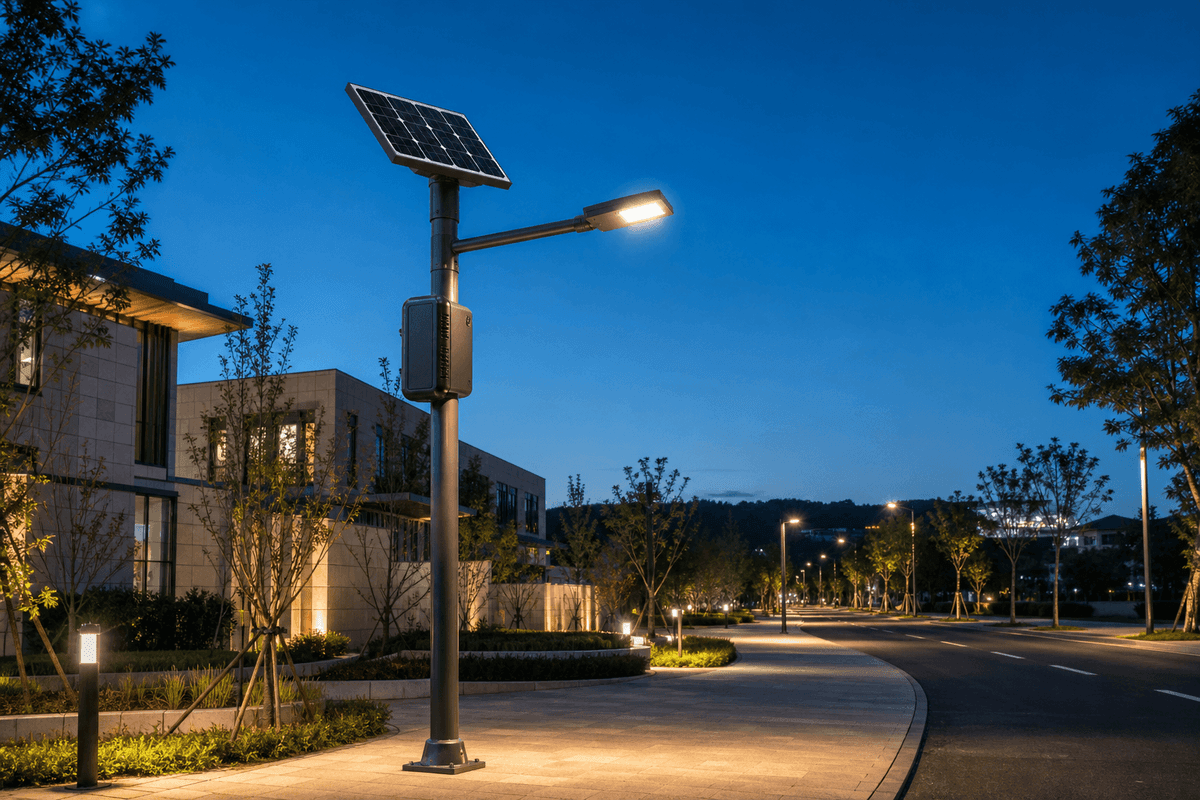
A solar street light with LiFePO4 battery replaces grid cabling with a PV-battery-LED system, typically using 20W-35W LEDs and 4-5 days autonomy.
For procurement managers, the main value is not only the lamp price. A conventional outdoor lighting circuit often requires trenching, conduit, copper cable, distribution protection, metering, reinstatement, and utility coordination. Solar street lighting moves most of that scope into a factory-integrated system, which is especially valuable for municipal roads, parks, industrial estates, residential compounds, and remote access lanes.
LiFePO4, also called lithium iron phosphate or LFP, is preferred because it has better thermal stability and cycle life than many cobalt-based lithium chemistries. In SOLARTODO project designs, typical B2B configurations use a 150Wh battery for 20W pathway lighting and a 250Wh battery for 35W community-road lighting. The battery is managed by a BMS with over-charge, over-discharge, short-circuit, and low-temperature protection.
According to IRENA (2025), the global weighted-average LCOE of utility-scale solar PV reached USD 0.043/kWh in 2024, down 90% from 2010. That cost trend supports the long-term logic of distributed solar infrastructure, even though street lights are small standalone systems rather than utility-scale plants. IEA states, "Solar PV is consistently cheaper" than new coal- or gas-fired power plants in most countries.
SOLARTODO positions these systems for B2B buyers who need project quotation, shipping, financing support, and engineering review rather than shopping-cart purchasing. The practical buying question is: what pole height, LED wattage, solar panel size, battery capacity, lighting schedule, climate reserve, and monitoring option match the site?
Technical Deep Dive
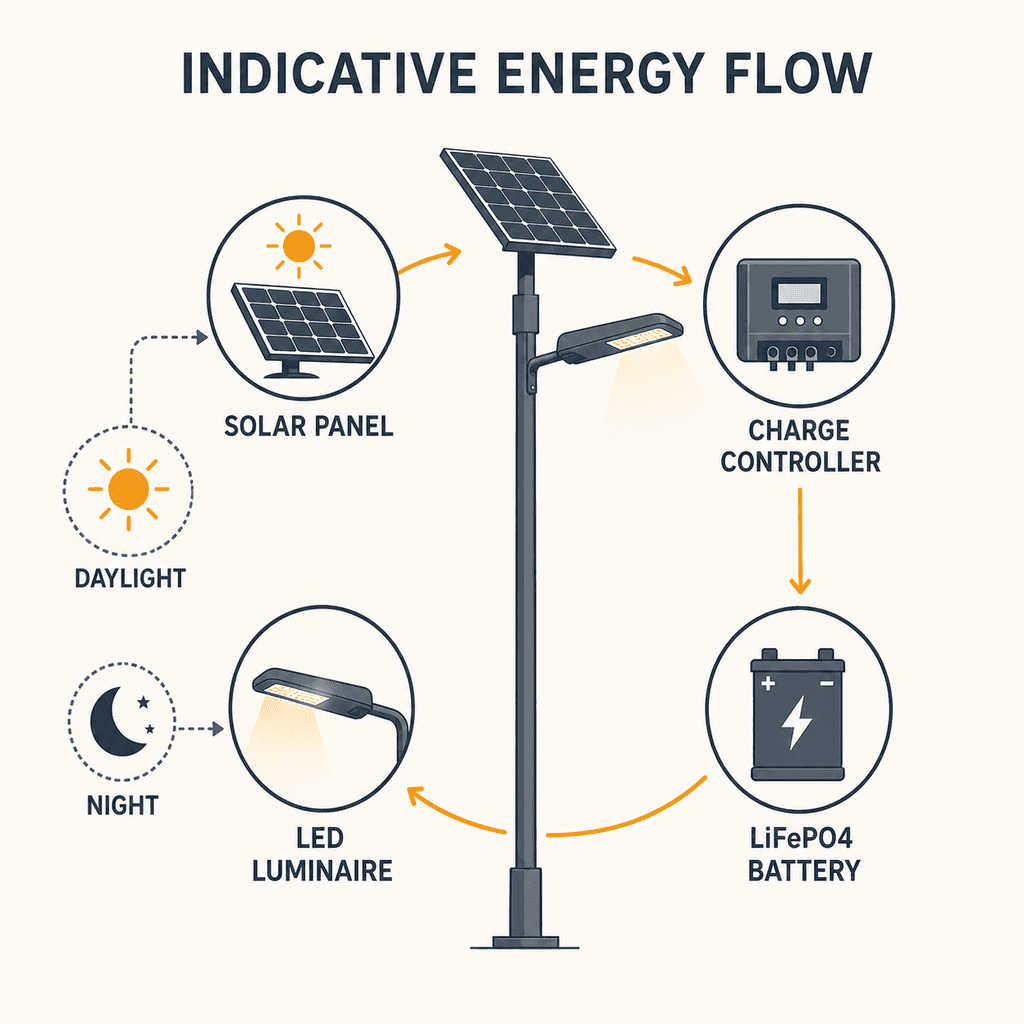
A well-sized LiFePO4 solar street light balances daily solar harvest, LED load, battery reserve, and controller losses over a 12h night schedule.
The energy chain is straightforward: a monocrystalline TOPCon solar panel charges the LiFePO4 battery through an MPPT controller, and the controller powers the LED luminaire according to dusk-to-dawn and dimming rules. For a 35W community-road model, SOLARTODO uses a 70Wp panel, 250Wh LFP battery, MPPT controller, and LED engine producing about 5,950 lm. For a 20W garden-path model, the design uses a 40Wp panel, 150Wh LFP battery, and about 3,400 lm output.
Battery and Autonomy
LiFePO4 battery sizing should be based on average nightly watt-hours, not only the LED nameplate wattage. A 35W LED running at 100% for 12 hours would need 420Wh per night before losses, which is too high for a 250Wh battery. Smart dimming solves this by using 100%, 60%, 30%, and PIR-triggered boost periods so the average load can fall by up to 60%.
For B2B projects, autonomy must be stated in rainy days and climate assumptions. A 250Wh LFP battery can support a 35W luminaire for about 5 rainy days only when dimming profiles are applied. A 150Wh battery can support a 20W pathway fixture for about 4 rainy days under similar logic. This distinction prevents unrealistic specifications and warranty disputes.
Solar Module, LED, and Controller
The solar module should be evaluated under IEC 61215 design qualification and IEC 61730 safety principles. TOPCon modules with 19%-23% efficiency are useful where fixture surface area is limited. According to NREL PVWatts (2025), its current v8.5.2 model uses 30 years of historical weather data to estimate energy-output variability, which is useful for preliminary site screening.
The LED module should be specified by luminous flux, efficacy, CCT, optics, and thermal design rather than wattage alone. A >170 lm/W LED package can deliver around 3,400 lm at 20W and 5,950 lm at 35W. For parks and campuses, 4000K neutral white usually supports comfortable wayfinding. For roads, photometric files should be checked against local spacing, mounting height, and uniformity requirements.
The MPPT controller is the operating brain of the system. In SOLARTODO designs, MPPT peak conversion efficiency can exceed 98% under stable irradiance. The controller manages charging, low-voltage disconnect, time-based dimming, PIR response, fault logging, and optional 4G or LoRa telemetry. UL states, "UL 8801" evaluates PV modules, batteries, charging circuitry, low-voltage luminaires, and controls as a PV-powered luminaire system.
Applications and Use Cases
LiFePO4 solar street lights fit sites where 3.5m-5m poles, 20W-35W LEDs, and cable-free deployment reduce civil works.
Municipal community roads are a strong use case for 35W all-in-one solar street lights on 5m poles. The integrated fixture reduces external wiring, removes separate battery boxes, and can be installed in about 30 minutes per pole after foundation readiness. For a 250-unit residential community, SOLARTODO project references indicate civil-work savings up to 45% versus grid-tied alternatives because trenching and underground cabling are largely avoided.
Parks, campuses, resorts, botanical gardens, waterfront promenades, and industrial greenbelts often fit a 3.5m, 20W design. At 10m-18m spacing, a 20W fixture with 3,400 lm supports pedestrian visibility without the glare and oversizing of a high-roadway luminaire. For a 2km pedestrian loop at 14m spacing, the project would need about 143 lights and roughly 486,200 lm of installed luminous flux.
Remote industrial and solar-farm access roads benefit from independent lighting during grid outages. A MENA-region access-lane example using 43 luminaires across 600m avoided about 600m of cable trenching and one distribution cabinet. The same logic applies to telecom tower compounds, perimeter roads, logistics yards, and rural public-service facilities.
According to IEA (2024), global annual renewable capacity additions are forecast to rise from 666GW in 2024 to almost 935GW in 2030, with solar PV and wind representing 95% of additions. For buyers in Latin America, the Middle East, Africa, Southeast Asia, and Europe, that market momentum improves supplier maturity, component availability, and financing confidence.
Comparison and Selection Guide
Buyers should compare LiFePO4 solar street lights by battery Wh, panel Wp, lumen output, pole height, autonomy, and installed cost.
| Selection item | 20W pathway model | 35W community-road model | Procurement note |
|---|---|---|---|
| Typical pole height | 3.5 m | 5 m | Match pedestrian or road lighting class |
| LED power | 20 W | 35 W | Confirm average dimmed load, not only peak watts |
| Luminous flux | About 3,400 lm | About 5,950 lm | Use photometric files for spacing decisions |
| Solar panel | 40Wp TOPCon | 70Wp TOPCon | Validate local peak-sun-hours and shading |
| Battery | 150Wh LiFePO4 | 250Wh LiFePO4 | Specify BMS and low-temperature protection |
| Autonomy | 4 rainy days | 5 rainy days | Confirm dimming assumptions in contract |
| Installation style | Separate or compact | All-in-one integrated | All-in-one reduces wiring and labor |
| Best use | Parks, campuses, resorts | Communities, access roads, pathways | Avoid overspecifying glare-prone fixtures |
Grid-connected LED lighting can still be appropriate where trenches already exist, utility power is stable, and centralized control is required. Solar street lights become more attractive where civil works are expensive, cable theft is a risk, grid extension is slow, or each pole needs independent operation.
According to IRENA (2025), battery storage costs declined 93% from 2010 to 2024, reaching USD 192/kWh. That trend matters because the battery is the cost and reliability center of a solar street light. However, procurement should still focus on cycle life, thermal protection, pack sealing, BMS quality, and replaceability rather than chasing the lowest upfront battery quote.
EPC Investment Analysis and Pricing Structure
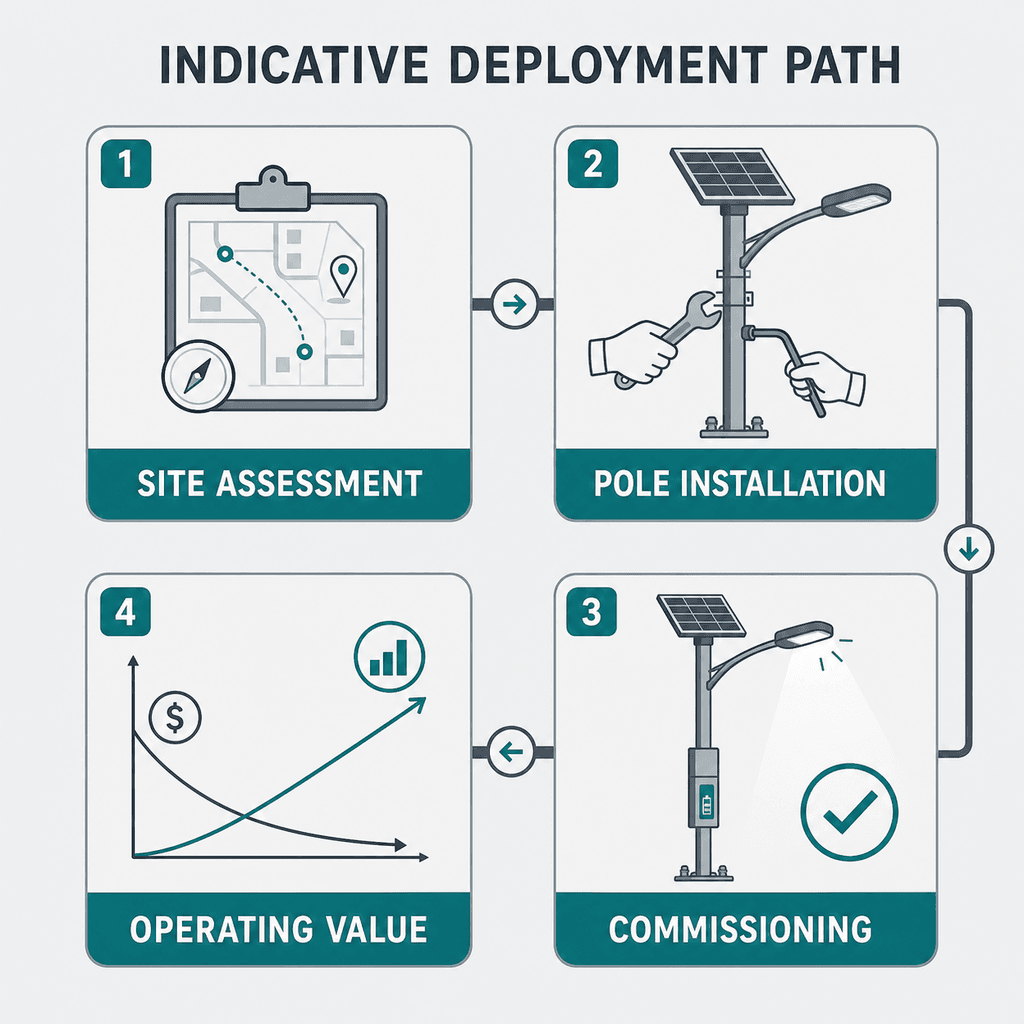
SOLARTODO EPC turnkey delivery covers engineering, procurement, construction, commissioning, warranty support, and 35W pricing from $300-$420 per installed unit.
EPC means Engineering, Procurement, and Construction. For a solar street light project, the EPC package normally includes site layout support, illumination planning inputs, bill of materials, equipment procurement, international shipping coordination, foundation and pole work, fixture installation, controller programming, testing, commissioning, and warranty administration. SOLARTODO can quote supply-only, delivered, or turnkey packages depending on the buyer's local installation capability.
| Pricing tier | Scope | 35W unit price, USD |
|---|---|---|
| FOB Supply | Equipment only, ex-works China | $195-$273 |
| CIF Delivered | Equipment plus ocean freight and insurance to destination port | $225-$315 |
| EPC Turnkey | Installed, commissioned, and project-supported | $300-$420 |
| Order volume | Discount guidance | Estimated EPC range, USD/unit |
|---|---|---|
| 1-49 units | Standard pricing | $300-$420 |
| 50-99 units | 5% discount | $285-$399 |
| 100-249 units | 10% discount | $270-$378 |
| 250+ units | 15% discount | $255-$357 |
ROI depends on local electricity tariffs, trenching cost, pole spacing, and labor rates. A 250-pole, 35W project running 12h/night would represent up to 38,325 kWh/year at full output before dimming. At USD 0.15/kWh, that equals about USD 5,749/year in avoided energy purchases, while smart dimming and reduced maintenance improve lifecycle economics. Typical payback is 2.5-4 years when avoided trenching and grid-extension costs are included.
Standard payment terms are 30% T/T advance and 70% against B/L copy, or 100% L/C at sight for larger projects. Financing is available for large projects above $1,000K, subject to project documentation, buyer profile, destination market, and banking review. For detailed quotations, contact SOLARTODO at [email protected] or WhatsApp +6585559114.
FAQ
A procurement-ready LiFePO4 solar street light FAQ should answer 10 cost, sizing, installation, maintenance, and standards questions in 40-80 words each.
Q: What is a solar street light with LiFePO4 battery? A: A solar street light with LiFePO4 battery is a standalone lighting system that combines a PV panel, LFP battery, LED luminaire, and charge controller. A typical SOLARTODO 35W model uses a 70Wp TOPCon panel, 250Wh battery, and 5m pole to deliver about 5,950 lm for community roads and pathways.
Q: Why is LiFePO4 preferred over lead-acid for solar street lights? A: LiFePO4 is preferred because it offers longer cycle life, better thermal stability, deeper usable discharge, and lower maintenance than lead-acid batteries. In public infrastructure, a 150Wh-250Wh LFP pack with BMS protection reduces replacement frequency and improves reliability during 4-5 rainy-day autonomy requirements.
Q: How many rainy days can a LiFePO4 solar street light support? A: Autonomy depends on battery capacity, LED wattage, dimming profile, and local solar resource. SOLARTODO commonly specifies 4 rainy days for a 20W, 150Wh pathway light and 5 rainy days for a 35W, 250Wh community-road light when MPPT dimming reduces average nightly consumption.
Q: How much does a 35W LiFePO4 solar street light cost? A: A 35W SOLARTODO solar street light typically ranges from $195-$273 FOB, $225-$315 CIF delivered, and $300-$420 for EPC turnkey installation. Volume guidance reduces EPC unit pricing by 5% at 50+ units, 10% at 100+ units, and 15% at 250+ units.
Q: What does EPC turnkey delivery include for solar street lighting? A: EPC turnkey delivery includes engineering, procurement, construction, commissioning, and warranty administration. For solar street lights, this usually covers site layout support, equipment procurement, shipping coordination, foundations, pole installation, controller programming, functional testing, handover documentation, and 1-year project support, depending on the destination country and contract scope.
Q: How long does installation take per pole? A: An all-in-one solar street light can be installed in about 30 minutes per pole after foundations are ready. Actual project duration depends on soil conditions, anchor cage preparation, crew size, pole height, access restrictions, and inspection requirements. Separate-component systems usually take longer because panel, battery, luminaire, and cabling work are split.
Q: What LED wattage should a buyer select? A: Choose LED wattage based on pole height, road width, spacing, illumination target, and glare limits. A 20W, 3,400 lm fixture is suitable for 3.5m park pathways, while a 35W, 5,950 lm fixture is better for 5m community roads, residential lanes, and access routes.
Q: What standards should be requested in procurement documents? A: Procurement documents should request IEC 61215 for PV module design qualification, IEC 61730 for PV module safety, IEC 60598 for luminaire safety, IEC 62133-style lithium battery safety practices, and UL 8801 alignment for PV-powered luminaire systems where relevant. Local electrical, wind-load, foundation, and lighting standards must also be checked.
Q: How does remote monitoring improve maintenance? A: Remote monitoring through 4G or LoRa can report battery voltage, charge current, LED load, fault codes, and operating hours. On fleets of 50-5,000 lights, this helps maintenance teams identify battery, controller, LED, or PV-cable faults before dispatch, reducing truck-roll time by about 30%-50%.
Q: What payback period should project managers expect? A: Typical payback is 2.5-4 years when avoided trenching, cabling, grid connection, energy purchases, and maintenance are included. A 250-pole, 35W project can avoid up to 38,325 kWh/year of full-output grid energy before dimming, with additional savings from faster installation and lower civil works.
References
These 8 references support PV cost, performance modeling, module safety, battery safety, luminaire safety, and PV-powered lighting procurement requirements.
- IRENA (2025): Renewable Power Generation Costs in 2024; reports solar PV LCOE at USD 0.043/kWh and battery storage costs down 93% since 2010.
- IEA Renewables 2024 (2024): Forecasts renewable additions rising from 666GW in 2024 to almost 935GW in 2030, led by solar PV and wind.
- NREL PVWatts (2025): PVWatts v8.5.2 methodology uses long-term weather data and updated PV modeling for project yield screening.
- IEC 61215-1:2021 (2021): Terrestrial PV module design qualification and type approval test requirements for long-term open-air operation.
- IEC 61730-1:2023 (2023): PV module construction safety requirements addressing electrical shock, fire hazards, and mechanical stress.
- IEC 60598-1:2024 (2024): General safety requirements and tests for luminaires operating from supply voltages up to 1,000V.
- IEC 62133-2:2017 (2017): Safety requirements and tests for portable sealed secondary lithium cells and batteries.
- UL 8801 (2020): Outline of Investigation for photovoltaic-powered luminaire systems including PV modules, batteries, charging circuitry, controls, and low-voltage luminaires.
Conclusion
A SOLARTODO LiFePO4 solar street light with 20W-35W LED power and 150Wh-250Wh storage is best specified by autonomy, standards, and EPC scope.
Bottom line: for B2B projects above 50 poles, SOLARTODO solar street lights with LiFePO4 batteries can reduce civil works, remove grid electricity purchases, and deliver 2.5-4 year payback when engineering, dimming profiles, and local solar data are verified before quotation.
About SOLARTODO
SOLARTODO is a global integrated solution provider specializing in solar power generation systems, energy-storage products, smart street-lighting and solar street-lighting, intelligent security & IoT linkage systems, power transmission towers, telecom communication towers, and smart-agriculture solutions for worldwide B2B customers.
About the Author

Cinn Song
Founder & Chief Solutions Architect
Cinn Song founded SOLARTODO LIMITED and leads its smart-city infrastructure engineering — from solar, storage and integrated smart poles to the company's push into physical-AI city edge nodes: pole-mounted edge computing, vertical LLMs for smart cities, drone-based O&M with autonomous battery swapping, robotic maintenance, and high-speed counter-UAS interception. Since 2010, he has directed turnkey EPC + BOT delivery across 50+ countries, including telecom monopole supply for national grid operators, off-grid solar street-lighting for African municipalities, and integrated smart-pole programs for Gulf smart cities.
Cite This Article
Cinn Song. (2026). solar street light with LiFePO4 battery | SOLARTODO. SOLARTODO. Retrieved from https://solartodo.com/knowledge/solar-street-light-with-lifepo4-battery-2
@article{solartodo_solar_street_light_with_lifepo4_battery_2,
  title = {solar street light with LiFePO4 battery | SOLARTODO},
  author = {Cinn Song},
  journal = {SOLARTODO Knowledge Base},
  year = {2026},
  url = {https://solartodo.com/knowledge/solar-street-light-with-lifepo4-battery-2},
  note = {Accessed: 2026-09-05}
}
Published: July 22, 2026 | Available at: https://solartodo.com/knowledge/solar-street-light-with-lifepo4-battery-2
Subscribe to Our Newsletter
Get the latest solar energy news and insights delivered to your inbox.
View All Articles