Acceptance Check for Custom Battery Dispatch Submissions

Cinn Song
Founder & Chief Solutions Architect

TL;DR
Check that every simulation time step has one numeric kW dispatch value; positive means discharge and negative means charge. Anything beyond that, such as schema, error handling, savings, or product performance, is unknown from the supplied sources.
The acceptance check should validate completeness and sign convention: one numeric kW value must be present for each simulation time step, with positive kW used for discharge and negative kW used for charge, based on SAM PVWatts Battery custom-dispatch guidance.
Summary
The acceptance check should validate completeness and sign convention: one numeric kW value must be present for each simulation time step, with positive kW used for discharge and negative kW used for charge, based on SAM PVWatts Battery custom-dispatch guidance.
Key Takeaways
- Verify that the dispatch series has one entry for every simulation time step.
- Confirm each entry is a numeric power value in kW.
- Interpret positive kW as battery discharge.
- Interpret negative kW as battery charge.
- Flag missing, duplicate, blank, non-numeric, or sign-conflicting entries as a recommended QA control.
- Do not use these SAM input rules as evidence of SOLARTODO product performance, savings, pricing, stock, or certifications.
Acceptance Check Objective
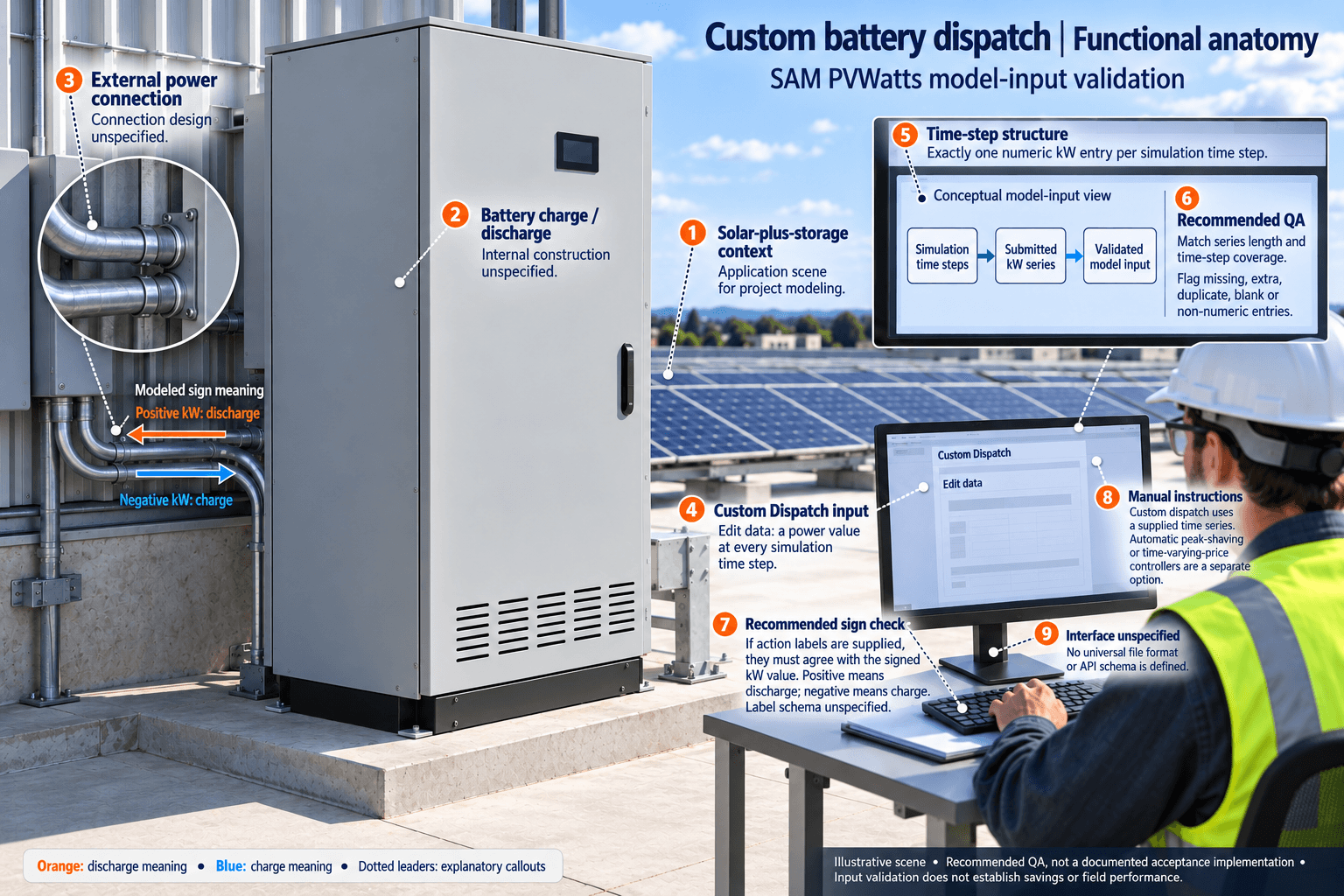
For a custom battery-dispatch submission, the acceptance check should verify two evidence-backed requirements: the submission includes one charge or discharge power value for each simulation time step, and the values follow SAM PVWatts Battery custom-dispatch sign convention: positive kW means discharge, and negative kW means charge (SAM PVWatts System Design, n.d., https://samrepo.nlr.gov/help/pvwatts_system_design.html).
This should be treated as a validation recommendation for project QA, not as a claim about any SOLARTODO product capability, deployment, savings, price, stock, certification, or performance. The supplied documents describe SAM and PVWatts battery-model behavior; they do not provide evidence for SOLARTODO battery specifications or field results.
Evidence From the Source Documents
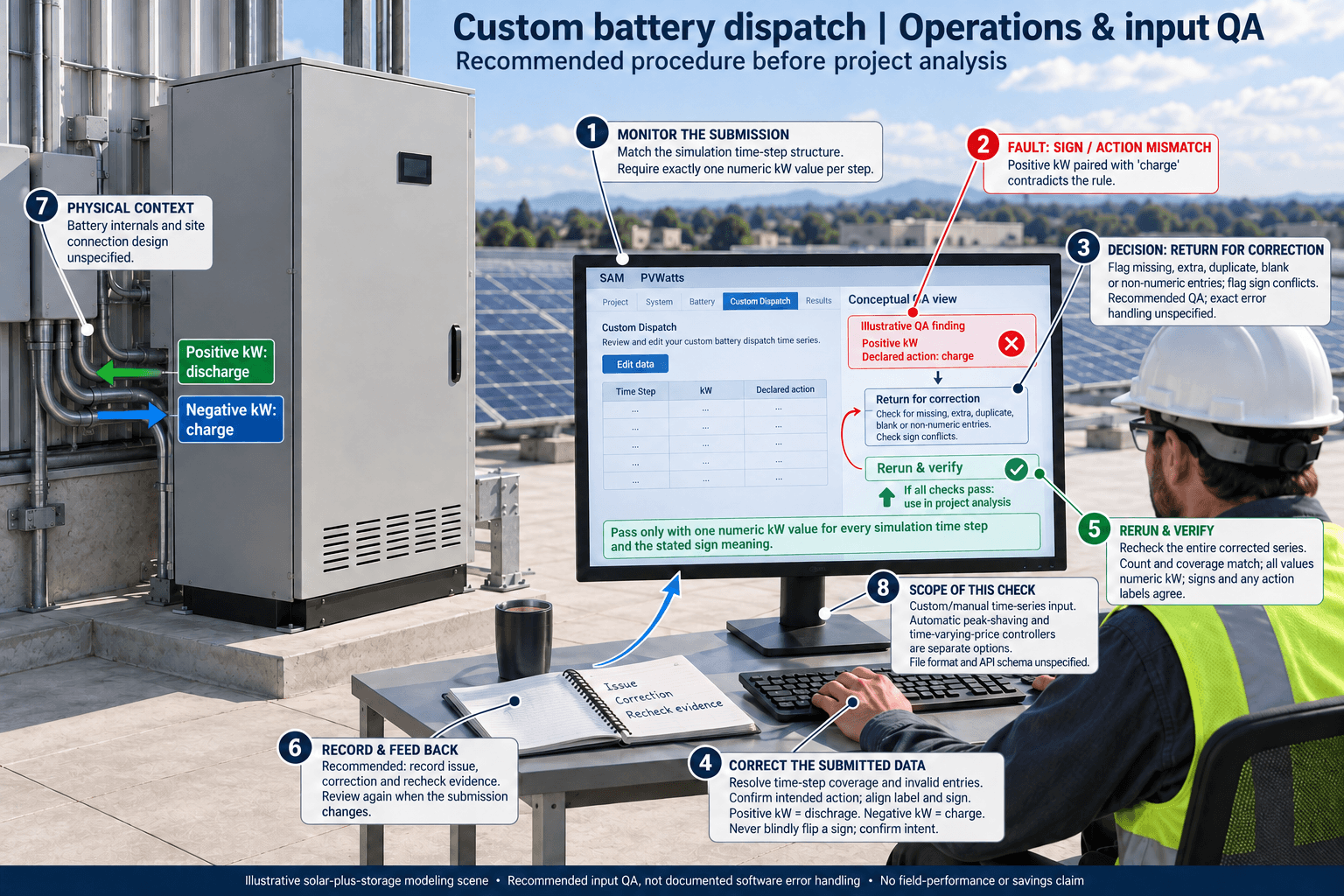
The key source statement is specific to PVWatts Battery custom dispatch. When Custom Dispatch is selected, SAM instructs the user to edit data and “specify a charge or discharge power value for each simulation time step.” The same source states the sign convention: use a positive kW value to discharge in a given time step and a negative kW value to charge in a given time step (SAM PVWatts System Design, n.d., https://samrepo.nlr.gov/help/pvwatts_system_design.html).
A second SAM battery-storage source supports the broader context that SAM includes manual dispatch options where the user provides a schedule or time-series instructions for battery charging and discharging. It also states that SAM has automatic dispatch controller options for peak shaving or time-varying power-price applications, which distinguishes custom/manual submissions from automatic dispatch behavior (SAM Battery Storage, n.d., https://samrepo.nlr.gov/help/battery_storage.html).
The sources do not state a universal file format, API schema, error message, country-specific procurement rule, or SOLARTODO-specific dispatch interface. Those details are therefore unknown from the supplied evidence.
Recommended Acceptance Criteria
The acceptance check should confirm that the submitted dispatch series length matches the simulation time-step count used by the SAM/PVWatts analysis. This is a direct requirement because the source says Custom Dispatch requires a charge or discharge power value for each simulation time step (SAM PVWatts System Design, n.d., https://samrepo.nlr.gov/help/pvwatts_system_design.html).
The check should confirm that each time-step entry contains a numeric power value expressed in kW. The source describes the custom-dispatch entry as a power value in kW for each simulation time step and defines the sign convention using kW values (SAM PVWatts System Design, n.d., https://samrepo.nlr.gov/help/pvwatts_system_design.html).
The check should verify sign meaning rather than merely allowing signed numbers. A positive kW value should be interpreted as discharge, while a negative kW value should be interpreted as charge. If the submitting system uses labels such as “charge” or “discharge,” the validation should ensure those labels do not contradict the signed kW value. The source supports the sign convention, while label-handling is a QA recommendation because the source does not define a label schema (SAM PVWatts System Design, n.d., https://samrepo.nlr.gov/help/pvwatts_system_design.html).
The check should flag missing time steps, extra time steps, blank entries, non-numeric entries, and values whose sign conflicts with the declared action. This is a recommendation derived from the source requirement that every simulation time step must have a charge or discharge power value and that signs carry operational meaning; the source does not prescribe exact software error handling (SAM PVWatts System Design, n.d., https://samrepo.nlr.gov/help/pvwatts_system_design.html).
Practical B2B QA Use
For B2B solar-plus-storage modeling workflows, this acceptance check is useful before a submitted custom dispatch profile is used in project analysis. SAM’s battery-storage documentation distinguishes automatic dispatch controllers from manual dispatch options where a schedule or time-series instruction is provided, so a custom submission should be reviewed as a time-series instruction rather than as an automatically optimized controller output (SAM Battery Storage, n.d., https://samrepo.nlr.gov/help/battery_storage.html).
The acceptance check should be documented as model-input validation. It should not be presented as evidence that a proposed battery system will save money, reduce peak demand, meet a grid requirement, or perform at a stated level. The supplied sources explain SAM model inputs and dispatch conventions, but they do not provide project economics, site results, procurement obligations, or equipment performance guarantees.
Suggested Acceptance Test Wording
“Pass only when the custom dispatch submission provides exactly one numeric kW charge/discharge power value for every simulation time step in the analysis, with positive kW interpreted as battery discharge and negative kW interpreted as battery charge. Fail or return for correction if any simulation time step is missing, duplicated, blank, non-numeric, or marked with an action that contradicts the signed kW convention.”
This wording stays within the supplied evidence: it uses SAM’s requirement for a value at each simulation time step and SAM’s positive-discharge, negative-charge convention. The fail/return behavior is a recommended QA control, because the source defines the required input behavior but does not define a universal acceptance-test implementation.
FAQ
What should the acceptance check verify first?
It should verify that the custom dispatch submission includes one charge or discharge power value for each simulation time step.
What unit should the submitted dispatch values use?
The SAM PVWatts custom-dispatch source describes the values as power values in kW.
What does a positive kW value mean?
For SAM PVWatts Battery custom dispatch, a positive kW value means the battery discharges during that time step.
What does a negative kW value mean?
For SAM PVWatts Battery custom dispatch, a negative kW value means the battery charges during that time step.
Should blank time steps pass acceptance?
No. As a QA recommendation, blank time steps should be returned for correction because the source requires a value for each simulation time step.
Should extra or duplicate time-step entries pass acceptance?
They should be flagged as a QA recommendation, because the accepted series should match the simulation time-step structure.
Does the source define an API schema for custom dispatch submissions?
No. The supplied sources define the SAM custom-dispatch input concept and sign convention, but not a universal API schema.
Can this check prove battery savings or performance?
No. The sources support input-validation rules for SAM dispatch modeling, not project savings, field performance, or product guarantees.
Procurement paths
About the Author

Cinn Song
Founder & Chief Solutions Architect
Cinn Song founded SOLARTODO LIMITED and leads its smart-city infrastructure engineering — from solar, storage and integrated smart poles to the company's push into physical-AI city edge nodes: pole-mounted edge computing, vertical LLMs for smart cities, drone-based O&M with autonomous battery swapping, robotic maintenance, and high-speed counter-UAS interception. Since 2010, he has directed turnkey EPC + BOT delivery across 50+ countries, including telecom monopole supply for national grid operators, off-grid solar street-lighting for African municipalities, and integrated smart-pole programs for Gulf smart cities.
Cite This Article
Cinn Song. (2026). Acceptance Check for Custom Battery Dispatch Submissions. SOLARTODO. Retrieved from https://solartodo.com/knowledge/what-acceptance-check-should-verify-that-custom-battery-dispatch-submissions-include-a-charge-or-discharge-power-value
@article{solartodo_what_acceptance_check_should_verify_that_custom_battery_dispatch_submissions_include_a_charge_or_discharge_power_value,
  title = {Acceptance Check for Custom Battery Dispatch Submissions},
  author = {Cinn Song},
  journal = {SOLARTODO Knowledge Base},
  year = {2026},
  url = {https://solartodo.com/knowledge/what-acceptance-check-should-verify-that-custom-battery-dispatch-submissions-include-a-charge-or-discharge-power-value},
  note = {Accessed: 2026-10-13}
}
Published: October 5, 2026 | Available at: https://solartodo.com/knowledge/what-acceptance-check-should-verify-that-custom-battery-dispatch-submissions-include-a-charge-or-discharge-power-value
Subscribe to Our Newsletter
Get the latest solar energy news and insights delivered to your inbox.
View All Articles