PV Curtailment Compensation: Rate and SAM Model Disclosure

Cinn Song
Founder & Chief Solutions Architect
TL;DR
Disclose the exact rate and its evidence. SAM names Single Owner and Merchant Plant for curtailment compensation; software treatment alone does not establish a project's right to payment.
Disclose the exact modeled curtailment compensation rate, its units and evidence, and the selected financial model. SAM explicitly documents this compensation treatment for Single Owner and Merchant Plant models; the supplied sources establish no numerical rate or project payment entitlement.
Summary
Disclose the exact modeled curtailment compensation rate, its units and evidence, and the selected financial model. SAM explicitly documents this compensation treatment for Single Owner and Merchant Plant models; the supplied sources establish no numerical rate or project payment entitlement.
Key Takeaways
- SAM explicitly describes curtailment compensation for Single Owner and Merchant Plant financial models.
- The supplied sources provide no numerical compensation rate or project-specific payment entitlement.
- Bidders should disclose the rate input, currency, energy unit, supporting evidence, and assumed payment conditions.
- Interconnection-limit losses and scheduled curtailment should be identified separately; equal compensation is not established.
- SAM assumes output-control capability and instructs users to account for associated installation or operating costs.
- PVWatts production estimates support generation analysis, not compensation eligibility.
Curtailment Compensation in PV Bids: Rate Disclosure and SAM Model Eligibility
PV bidders assigning revenue to curtailed energy should disclose the compensation rate entered in the financial model, its supporting project evidence, and the financial model used. The supplied SAM documentation explicitly describes curtailment compensation for the Single Owner and Merchant Plant financial models, using the compensation rate on the Revenue page. It supplies no numerical rate and establishes no project-specific entitlement to payment. SAM Grid Limits
1. Disclose the compensation assumption and its evidence
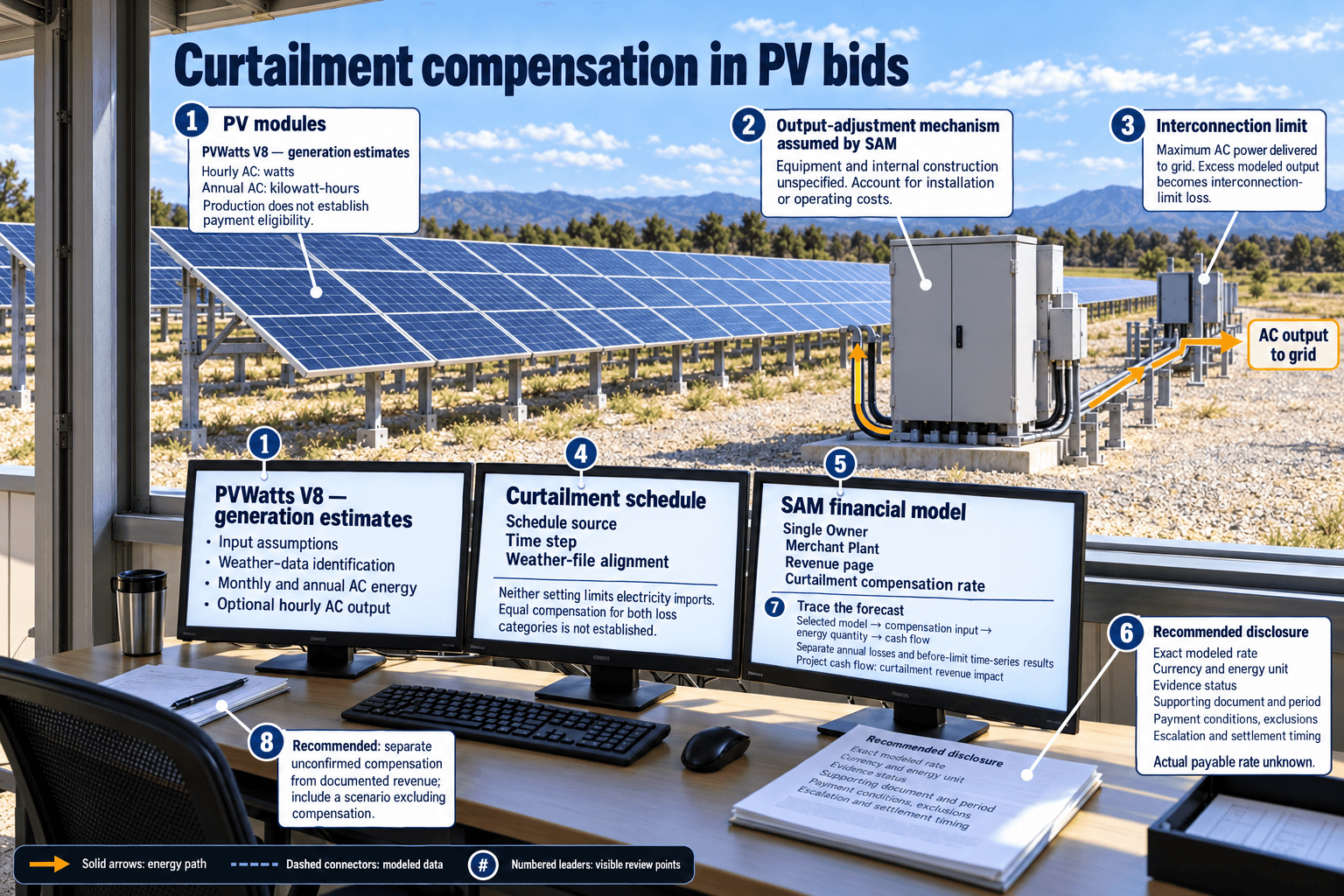
SAM states that curtailed power is compensated at the curtailment compensation rate on the Revenue page for its Single Owner and Merchant Plant financial models. That describes software treatment; it does not establish an agreed tariff, payment obligation, or eligibility under a particular project's arrangements. The supplied documents contain no project compensation agreement, so the actual payable rate remains unknown. SAM Grid Limits
For a reviewable bid, bidders should disclose:
- The exact compensation-rate input used, including its currency and energy unit.
- Whether that rate is a documented project term or an unconfirmed modeling assumption.
- The supporting document and applicable period, where available.
- Any assumed payment conditions, exclusions, escalation, or settlement timing.
- How the revenue forecast treats compensation when supporting evidence is unavailable.
These are recommended disclosure items, not payment rules established by SAM. If commercial evidence is missing, bidders should identify the rate as unconfirmed and present any assumed compensation separately from documented revenue. A scenario excluding compensation is recommended to show how much the forecast depends on that assumption.
2. Name the financial model and define eligibility carefully
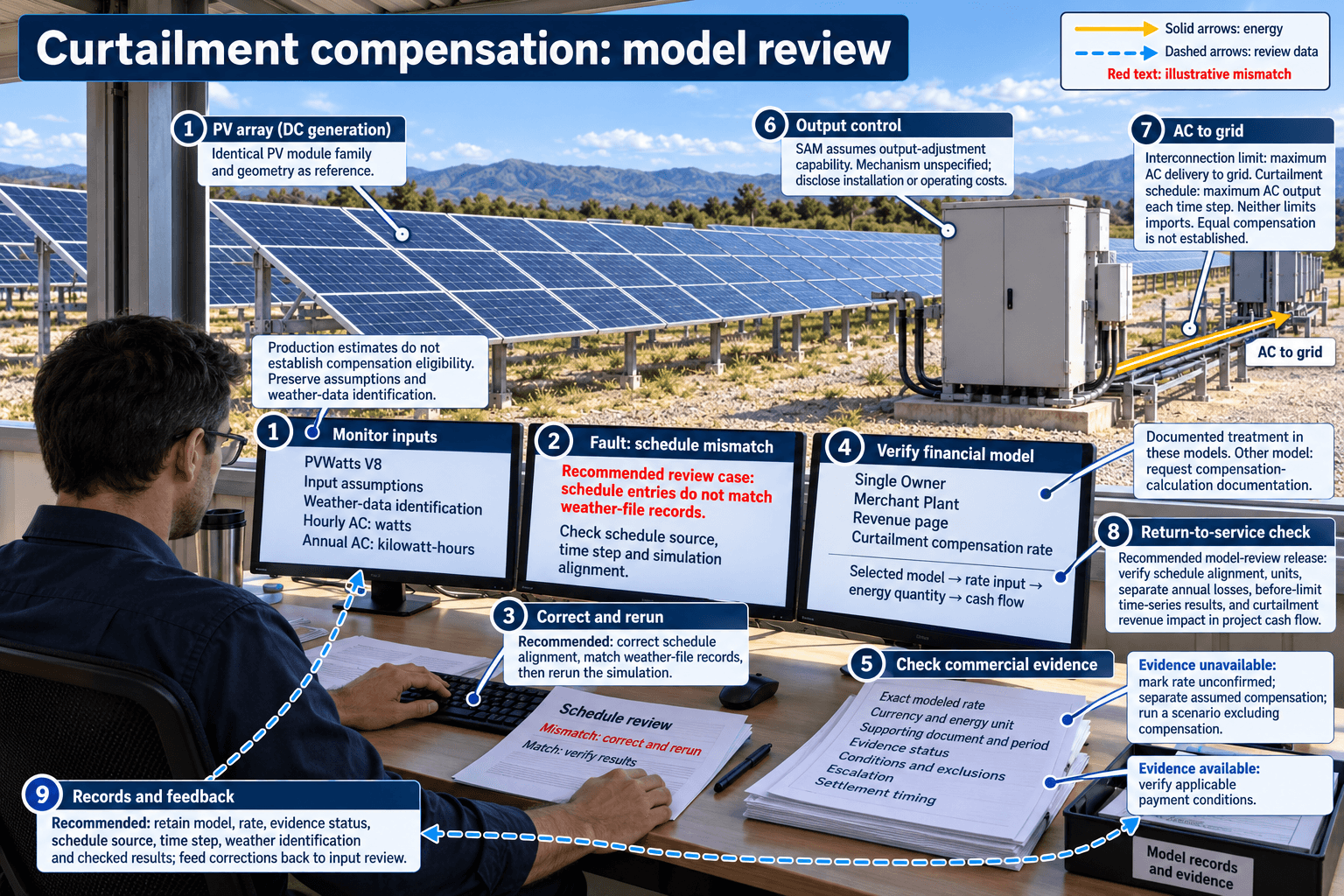
The supplied Grid Limits help page names Single Owner and Merchant Plant when describing compensation for curtailed power. Bidders relying on that documented treatment should identify which model they used and disclose the associated Revenue-page input. The excerpt does not establish equivalent treatment for other financial models. SAM Grid Limits
Two questions should therefore appear separately in the bid review. First, does the selected software model implement the compensation treatment being claimed? Second, what project evidence supports receiving that payment? Model functionality answers the first question only. The supplied sources leave the second unanswered.
For a different financial model, bidders should provide documentation supporting its compensation calculation before assigning revenue on that basis. Reviewers should request a traceable connection between the selected model, compensation input, energy quantity, and resulting cash flow. This is a recommended verification approach; the supplied excerpt does not describe settlement calculations for every model.
3. Identify which energy reduction is being valued
SAM distinguishes an interconnection limit from a curtailment schedule. The interconnection limit is the maximum AC power the system may deliver to the grid. When system AC output exceeds it, SAM reduces modeled generation to that limit and reports the associated energy loss. Grid curtailment is represented separately as a maximum system AC output for each simulation time step. Neither setting limits electricity imports. SAM Grid Limits
Bidders should therefore identify whether their revenue assumption concerns the curtailment schedule, the interconnection limit, or both. The supplied page does not establish that all losses from both mechanisms receive the same compensation. A bid should not extend the documented curtailment-compensation statement to every category of reduced generation without additional evidence.
For the curtailment schedule, SAM requires the number of entries to match the weather-file records. Bidders should disclose the schedule source, time step, and alignment with the simulation data. SAM provides separate annual-loss and before-limit time-series results for interconnection limits and curtailment, while the project cash flow shows curtailment's revenue impact. These outputs provide useful review points for tracing the forecast. SAM Grid Limits
SAM also assumes a mechanism exists to adjust output to meet grid limits and instructs users to account for associated installation or operating costs. Bidders should disclose the assumed control mechanism and its cost treatment rather than treating the software setting as evidence that equipment has been supplied. SAM Grid Limits
4. Keep generation estimates separate from compensation evidence
PVWatts V8 documents generation inputs and outputs, including monthly and annual AC energy and optional hourly AC output. Those outputs describe simulated production. The supplied PVWatts documentation does not establish a curtailment compensation rate, payment eligibility, or settlement entitlement. PVWatts V8 Documentation
Where PVWatts supports a bid's generation estimate, bidders should preserve the input assumptions and weather-data identification alongside the results. Particular care is recommended with units: the documentation identifies hourly AC output in watts and annual AC output in kilowatt-hours. An hourly power value should not simply be labeled as annual compensated energy. PVWatts V8 Documentation
A useful bid submission should let the buyer follow the calculation from production assumptions through grid restrictions to the energy quantity assigned compensation and the financial result. It should distinguish sourced facts from proposed assumptions at each stage. Neither supplied source establishes a SOLARTODO project rate, a local compensation requirement, or a guaranteed payment; those items remain unknown until supported by project evidence.
FAQ
What curtailment compensation rate should a bidder disclose?
The exact rate used in the financial model, with currency, energy unit, and evidence status. The supplied SAM page specifies no numerical rate. SAM Grid Limits
Which SAM financial models explicitly include this treatment?
The supplied documentation names Single Owner and Merchant Plant, using the curtailment compensation rate on the Revenue page. SAM Grid Limits
Does SAM model eligibility prove payment entitlement?
No project payment entitlement is established by the supplied documentation. Bidders should provide separate project evidence supporting the compensation assumption.
What should bidders do if the rate is unconfirmed?
Identify it as an assumption and disclose how the forecast treats it. A separate scenario excluding compensation is recommended.
Are interconnection losses automatically compensated?
The supplied page does not establish that interconnection-limit losses receive the same compensation as scheduled curtailment. SAM Grid Limits
How should the curtailment schedule be documented?
Disclose its source and time step, and confirm its entries match the weather-file records, as SAM requires. SAM Grid Limits
Should output-control costs be included?
SAM assumes an output-adjustment mechanism and instructs users to account for its installation or operating costs. SAM Grid Limits
Can PVWatts establish curtailment revenue?
The supplied PVWatts documentation describes production estimates, not compensation rates or payment eligibility. PVWatts V8 Documentation
About the Author

Cinn Song
Founder & Chief Solutions Architect
Cinn Song founded SOLARTODO LIMITED and leads its smart-city infrastructure engineering — from solar, storage and integrated smart poles to the company's push into physical-AI city edge nodes: pole-mounted edge computing, vertical LLMs for smart cities, drone-based O&M with autonomous battery swapping, robotic maintenance, and high-speed counter-UAS interception. Since 2010, he has directed turnkey EPC + BOT delivery across 50+ countries, including telecom monopole supply for national grid operators, off-grid solar street-lighting for African municipalities, and integrated smart-pole programs for Gulf smart cities.
Cite This Article
Cinn Song. (2026). PV Curtailment Compensation: Rate and SAM Model Disclosure. SOLARTODO. Retrieved from https://solartodo.com/knowledge/what-curtailment-compensation-rate-and-financial-model-eligibility-should-pv-bidders-disclose-when-assigning-revenue
@article{solartodo_what_curtailment_compensation_rate_and_financial_model_eligibility_should_pv_bidders_disclose_when_assigning_revenue,
  title = {PV Curtailment Compensation: Rate and SAM Model Disclosure},
  author = {Cinn Song},
  journal = {SOLARTODO Knowledge Base},
  year = {2026},
  url = {https://solartodo.com/knowledge/what-curtailment-compensation-rate-and-financial-model-eligibility-should-pv-bidders-disclose-when-assigning-revenue},
  note = {Accessed: 2026-10-25}
}
Published: October 25, 2026 | Available at: https://solartodo.com/knowledge/what-curtailment-compensation-rate-and-financial-model-eligibility-should-pv-bidders-disclose-when-assigning-revenue
Subscribe to Our Newsletter
Get the latest solar energy news and insights delivered to your inbox.
View All Articles