Streetlight Energy Measurement: Evidence for Billing…

Cinn Song
Founder & Chief Solutions Architect
TL;DR
The sources supply no numerical billing tolerance. Request applicable standards, documented test and calibration evidence, and written project-specific billing acceptance.
The supplied DOE sources identify relevant ANSI standards and measurement research but provide no numerical accuracy limits, detailed test procedures, or billing approval criteria. Buyers should request applicable clauses, configuration-specific test evidence, calibration documentation, and written billing acceptance.
Key Takeaways
- No numerical billing accuracy threshold is provided in the supplied documents.
- DOE identifies C136.50, C136.52, and C137.5 as standards addressing lighting energy-reporting accuracy.
- Standard identifiers alone do not establish the applicable edition, test conditions, or product compliance.
- Recommended evidence includes a defined measurement boundary, reference comparisons, and calibration documentation.
- DOE’s electrical-service concerns support requesting site-relevant testing, without inventing voltage limits.
- Billing eligibility and SOLARTODO controller compliance remain unknown; obtain project-specific evidence and written acceptance.
Streetlight Controller Energy Measurement: Evidence Before Billing Acceptance
Summary
The supplied DOE documents do not state numerical energy-measurement accuracy limits or detailed test procedures sufficient to approve streetlight-controller data for billing. They identify relevant ANSI standards and laboratory research, while highlighting measurement accuracy and electrical-service concerns. Buyers should use these references to request a documented acceptance specification; they cannot establish billing eligibility from the supplied summaries alone. DOE: Energy Reporting
1. What the Sources Establish—and Leave Unknown
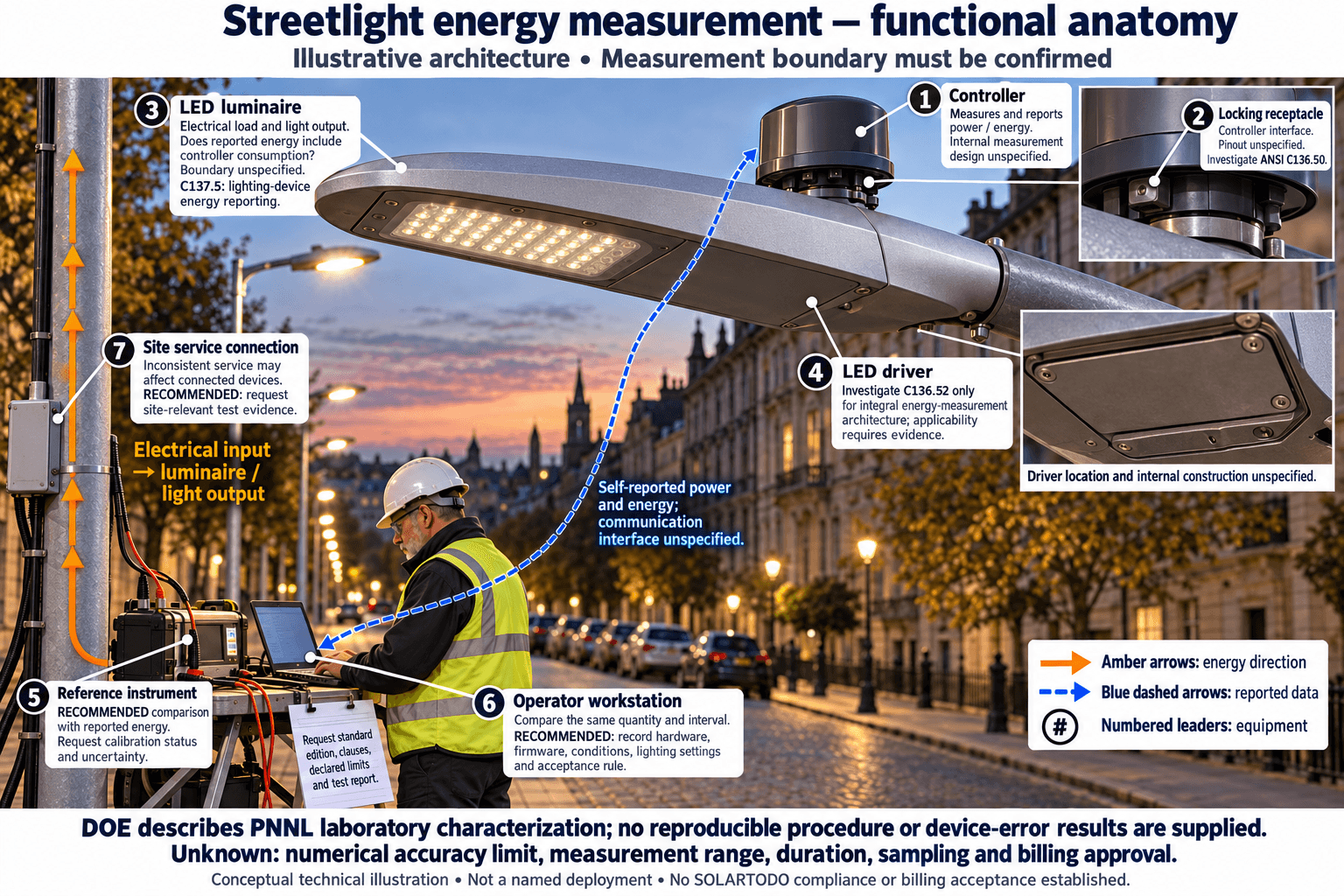
DOE describes streetlighting as an application where energy use is typically billed using estimates. Controllers capable of measuring power and energy offer potential improvements in energy accountability, performance, and maintenance. However, DOE also identifies concerns about measurement accuracy, system functionality, and maintenance as barriers to adoption. These are potential benefits, not evidence that a particular controller qualifies for billing. DOE: Connected Streetlighting Systems
The energy-reporting source explains that reported-data accuracy matters when an application depends on those data, and that accuracy is often unspecified or inadequately specified. It describes PNNL laboratory characterization of connected devices’ self-reported energy use. The supplied text does not provide the resulting device-level errors or acceptance thresholds. DOE: Energy Reporting
Consequently, the permissible percentage error, measurement range, test duration, sampling requirements, and billing approval process remain unknown from these documents. A purchasing specification should not fill those gaps with an assumed accuracy class or an unsupported numerical tolerance.
2. Which Standards Should Buyers Investigate?
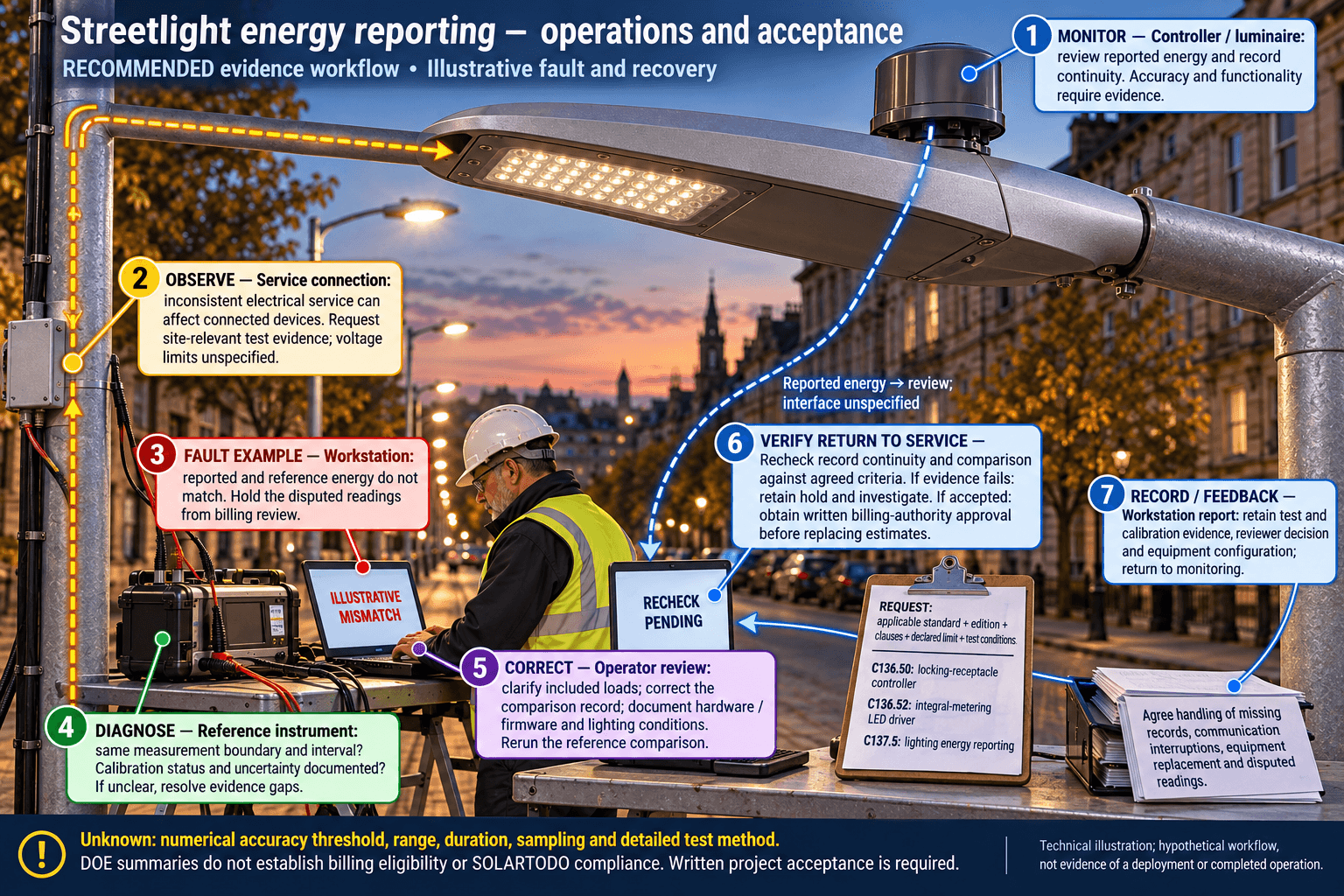
DOE identifies three published ANSI standards addressing lighting energy-reporting accuracy:
- C136.50: Energy measurement for a network lighting control device with a locking-type receptacle.
- C136.52: LED drivers with integral energy-measurement capability.
- C137.5: Energy-reporting requirements for lighting devices.
DOE states that related voluntary standards define performance requirements and test methods. However, the supplied page does not reproduce their clauses, editions, numerical limits, or test sequences. These identifiers establish relevant documents to investigate, rather than a complete acceptance specification. DOE: Energy Reporting
As a procurement recommendation, ask the supplier to identify the standard and edition applicable to the actual measurement architecture. Request the specific clauses, declared accuracy limits, test conditions, and supporting report. Avoid treating a reference to an LED-driver standard as evidence for a separate controller without documentation explaining its applicability.
The supplied U.S. DOE material does not establish a purchasing requirement for other countries or demonstrate that any utility accepts these standards for billing. Buyers should seek written confirmation from the party responsible for accepting the project’s billing measurements.
3. Recommended Measurement and Test Evidence
The following requests are recommendations for closing the evidence gaps, not test requirements quoted from the standards.
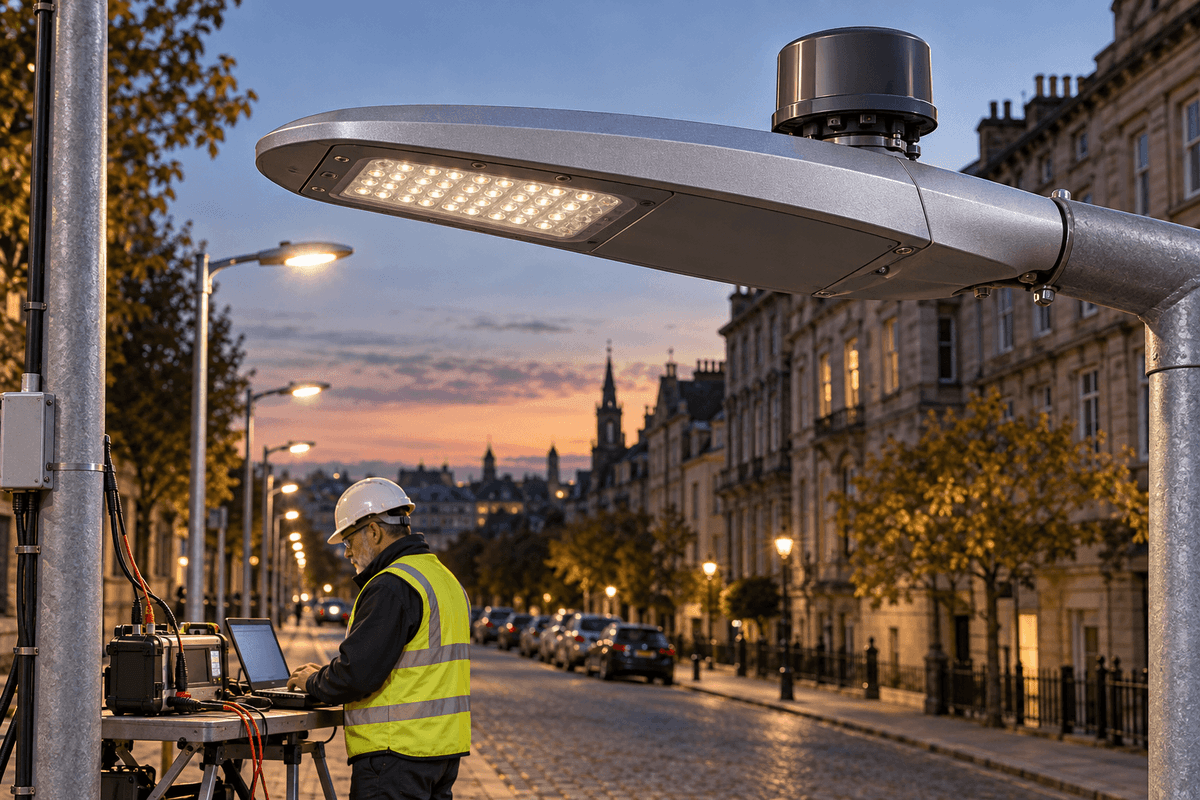
Define the measurement boundary. Ask what consumption the reported energy includes: the luminaire, controller, or other connected equipment. Require the proposed billing quantity and the tested quantity to match. The supplied documents do not define this boundary for any product.
Request a reproducible comparison. Ask for a laboratory report comparing reported energy with reference measurements, identifying the tested hardware, firmware, operating conditions, measurement intervals, and acceptance rule. Request results across the operating conditions proposed for the project, including relevant lighting settings. The sources establish that PNNL performed laboratory characterization; they do not supply a procedure that buyers can reproduce directly. DOE: Energy Reporting
Request calibration evidence. DOE lists a March 2020 report and specification template concerning calibration of energy-measuring equipment. Buyers should request documentation for the reference equipment used in testing, including calibration status and stated uncertainty. The supplied summary does not establish a required calibration interval or uncertainty limit. DOE: Energy Reporting
Address electrical-service conditions. DOE notes that older-city streetlight infrastructure can provide inconsistent electrical service and that connected lighting devices can be more sensitive to anomalies than unconnected devices. It also describes research into LED streetlight susceptibility to power-quality issues. Buyers should therefore request evidence addressing relevant site conditions, without inventing voltage limits or claiming that DOE specifies a billing test for them. DOE: Connected Streetlighting Systems
4. Recommended Decision Before Replacing Estimates
Before accepting self-reported consumption for billing, buyers should seek a written agreement linking the applicable accuracy limit, test method, equipment configuration, and billing-data acceptance process. The agreement should identify who reviews the evidence and what happens when measurements fail the agreed criteria.
As additional contractual recommendations, define how missing records, communications interruptions, equipment replacement, and disputed readings will be handled. These provisions are proposed acceptance controls; the supplied DOE summaries do not prescribe them.
The defensible answer is therefore conditional: use the relevant standards and verified test evidence to establish project-specific criteria, then obtain acceptance from the billing authority. The supplied documents alone cannot justify a numerical threshold, confirm legal billing eligibility, or establish that any SOLARTODO controller meets those conditions.
FAQ
What numerical accuracy limit should controllers meet?
The supplied documents do not state one. Obtain the applicable standard clauses and the billing authority’s acceptance criteria before specifying a limit.
Which standard addresses locking-receptacle controllers?
DOE identifies ANSI C136.50 as addressing energy measurement for network lighting control devices with locking-type receptacles. Its detailed requirements are not supplied. DOE
Which other standards does DOE identify?
DOE lists C136.52 for LED drivers with integral energy measurement and C137.5 for lighting-device energy reporting. DOE
Does naming an ANSI standard prove billing acceptance?
No billing acceptance is established by these summaries. Request applicable compliance evidence and written acceptance for the project.
Do the sources provide a complete laboratory procedure?
No. DOE describes laboratory characterization and standards containing test methods, but the supplied text does not reproduce those methods. DOE
Why consider power quality?
DOE identifies inconsistent electrical service and connected-device sensitivity to anomalies. Request testing relevant to the intended site conditions. DOE
Are these requirements mandatory outside the United States?
The supplied documents establish no such requirement. Confirm the destination project’s acceptance criteria with its responsible billing authority.
Do these sources verify SOLARTODO controller accuracy?
No. They provide no SOLARTODO-specific measurement reports, compliance evidence, or billing approvals.
Procurement paths
About the Author

Cinn Song
Founder & Chief Solutions Architect
Cinn Song founded SOLARTODO LIMITED and leads its smart-city infrastructure engineering — from solar, storage and integrated smart poles to the company's push into physical-AI city edge nodes: pole-mounted edge computing, vertical LLMs for smart cities, drone-based O&M with autonomous battery swapping, robotic maintenance, and high-speed counter-UAS interception. Since 2010, he has directed turnkey EPC + BOT delivery across 50+ countries, including telecom monopole supply for national grid operators, off-grid solar street-lighting for African municipalities, and integrated smart-pole programs for Gulf smart cities.
Cite This Article
Cinn Song. (2026). Streetlight Energy Measurement: Evidence for Billing…. SOLARTODO. Retrieved from https://solartodo.com/knowledge/what-energy-measurement-accuracy-limits-and-test-methods-should-streetlight-controllers-meet-before-their-self-reported
@article{solartodo_what_energy_measurement_accuracy_limits_and_test_methods_should_streetlight_controllers_meet_before_their_self_reported,
  title = {Streetlight Energy Measurement: Evidence for Billing…},
  author = {Cinn Song},
  journal = {SOLARTODO Knowledge Base},
  year = {2026},
  url = {https://solartodo.com/knowledge/what-energy-measurement-accuracy-limits-and-test-methods-should-streetlight-controllers-meet-before-their-self-reported},
  note = {Accessed: 2026-10-24}
}
Published: October 24, 2026 | Available at: https://solartodo.com/knowledge/what-energy-measurement-accuracy-limits-and-test-methods-should-streetlight-controllers-meet-before-their-self-reported
Subscribe to Our Newsletter
Get the latest solar energy news and insights delivered to your inbox.
View All Articles